Key Engineering Takeaways
- A guard-position indication is not, by itself, a validated safety interlock.
- Define the required protective function before selecting its sensor, logic and final switching devices.
- NPN/PNP output, normally closed operation and an IP rating do not establish a Performance Level or SIL.
- Keep ordinary process feedback separate in the specification unless the complete safety application has the necessary evidence.
Ask what happens when the indication is wrong
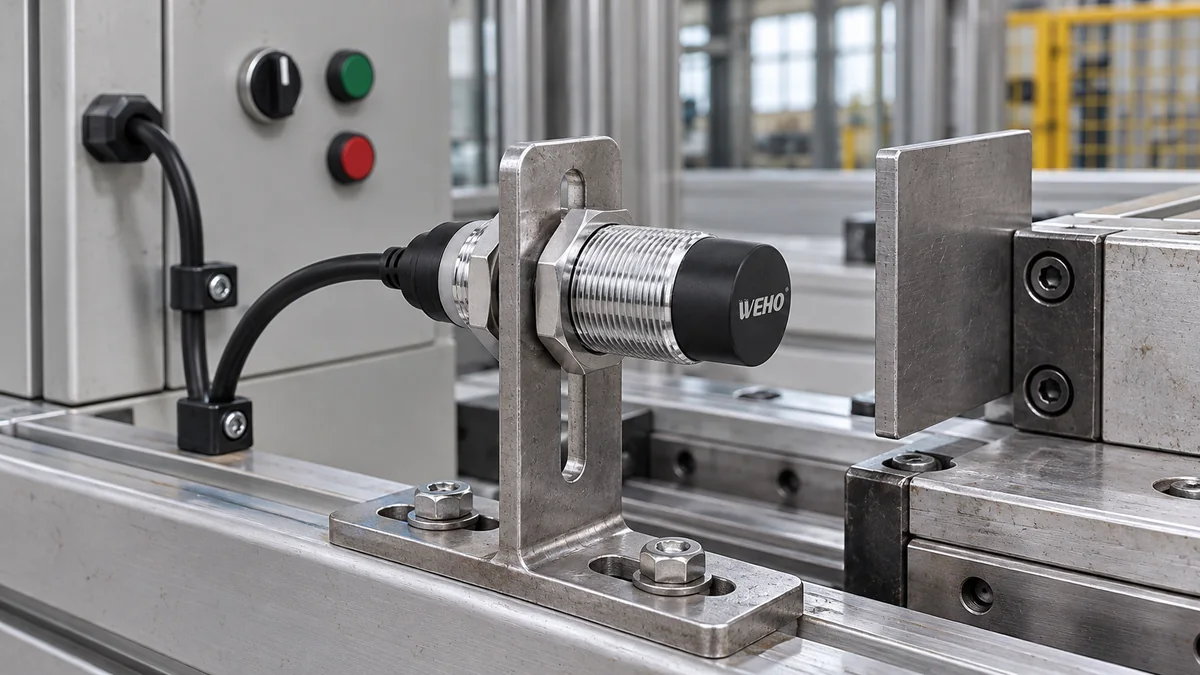
A proximity sensor can report the position of a metal flag on a cover. The engineering decision changes when that signal is relied on to prevent a person reaching hazardous movement. A missed detection may be a process interruption in one application and a dangerous failure in another. Start by documenting that consequence.
را WEHO LJA18 inductive sensor is a product reference for ordinary position detection in this discussion. The family page distinguishes output variants. This article assigns no safety certification or guard-interlock suitability to that family; any proposed safety use requires evidence for the exact device and complete function.
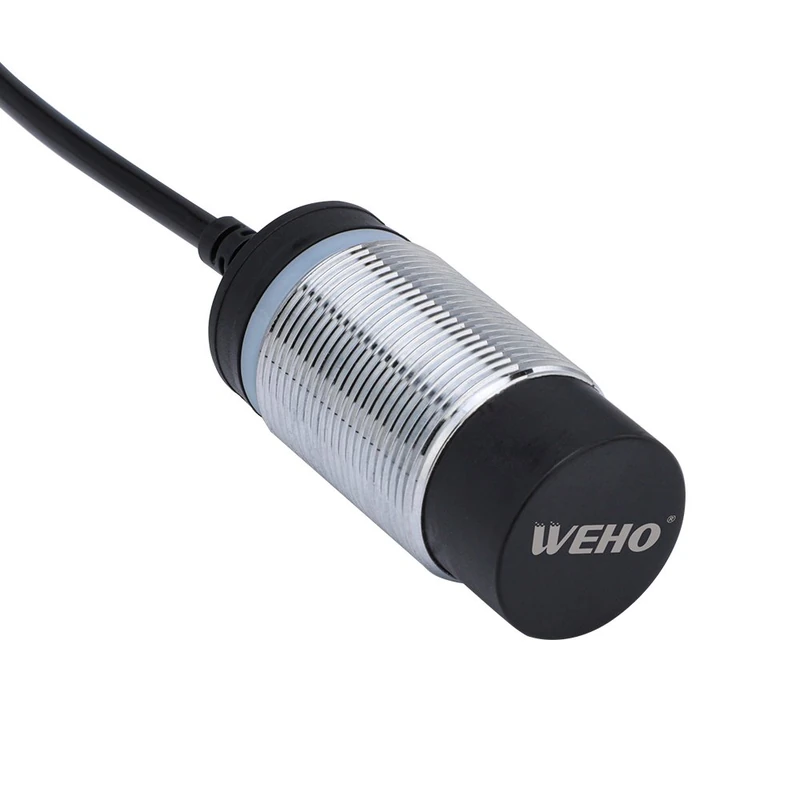
A component's familiar cylindrical housing does not answer the safety question. OMRON's ordinary proximity-sensor precautions, for example, explicitly restrict the safety uses of the products they cover. That manufacturer-specific warning illustrates why safety suitability must be established from applicable product documentation, rather than inferred from successful target detection.
Write the protective function before the component specification
A functional requirement should identify the hazard, the access route, the required safe state and the conditions for restarting. “Detect the door” leaves those questions open. “Prevent the identified hazardous movement while access is possible” describes a protective objective, but it still needs the machine designer's risk assessment, operating modes and validation criteria.
The published scope of ISO 14119:2024 addresses the design and selection of interlocking devices associated with guards, including foreseeable defeat. Its abstract distinguishes that task from processing the signal to stop machinery and prevent unexpected startup, referring to ISO 14118, ISO 13849-1 and IEC 62061. Naming one standard does not complete all those tasks.
را HSE work-equipment overview explains that routine access may require interlocked guards, sometimes with guard locking, so dangerous movement stops before someone can reach it. Use the applicable jurisdiction and machinery requirements for the actual project; a procurement article cannot determine a universal device category or required safety level.
A machine that continues moving after a stop command presents a different access question from one that reaches its safe state immediately. Determine whether the guard must remain locked until the relevant hazard has passed. A position sensor that reports “closed” cannot, by that observation alone, prove locking, stopping performance or safe access.
Separate process evidence from safety evidence
The existing inductive proximity sensor selection article addresses ordinary selection factors such as target, output and installation. For a guard-related safety function, the additional work is to establish how the sensing, logic and final control elements achieve and maintain the required protective response.
| Evidence item | Process feedback task | Safety-function task | Decision implication |
|---|---|---|---|
| Target and sensing gap | Confirm repeatable detection | Also assess relevant misalignment and failure conditions | Detection alone does not establish fault tolerance |
| Electrical output | Match the ordinary receiver | Match the documented safety architecture and diagnostics | NPN/PNP or NO/NC is insufficient |
| Component documentation | Retain exact model and operating limits | Retain applicable safety-use data and instructions | Family appearance is not safety evidence |
| Machine response | Verify the intended indication or sequence | Validate safe state, access and restart behavior | Assess the entire function |
A normally closed output can produce an inactive input after a broken wire, but that does not prove detection of every dangerous failure. A short to a supply, a stuck output or a displaced target can have different effects. Analyze the actual circuit and diagnostic coverage rather than using “normally closed” as a substitute for a safety-function specification.
Two sensors also do not automatically establish a specified safety level. Shared mounting, a common cable route, common power and downstream logic can create dependencies. The responsible assessment must address the selected architecture, component data, relevant faults and the complete validation. Do not assign a Performance Level or SIL by counting devices.
Complete a hypothetical guard-signal decision record
Consider a hypothetical packaging cell with an inspection cover. An ordinary inductive sensor reports that a metal flag is near its sensing face. The production program uses the signal to display “cover position detected.” The proposed modification would also use that same signal as the sole permission for hazardous movement.
This is a judgment example, not a WEHO installation or a tested machine. The procurement team has a sensing-distance entry and a matching PLC input, but no documented safety application, no complete protective-function analysis and no validated stopping/access relationship. The available evidence supports continuing the process-indication review; it does not release the proposed protective modification.
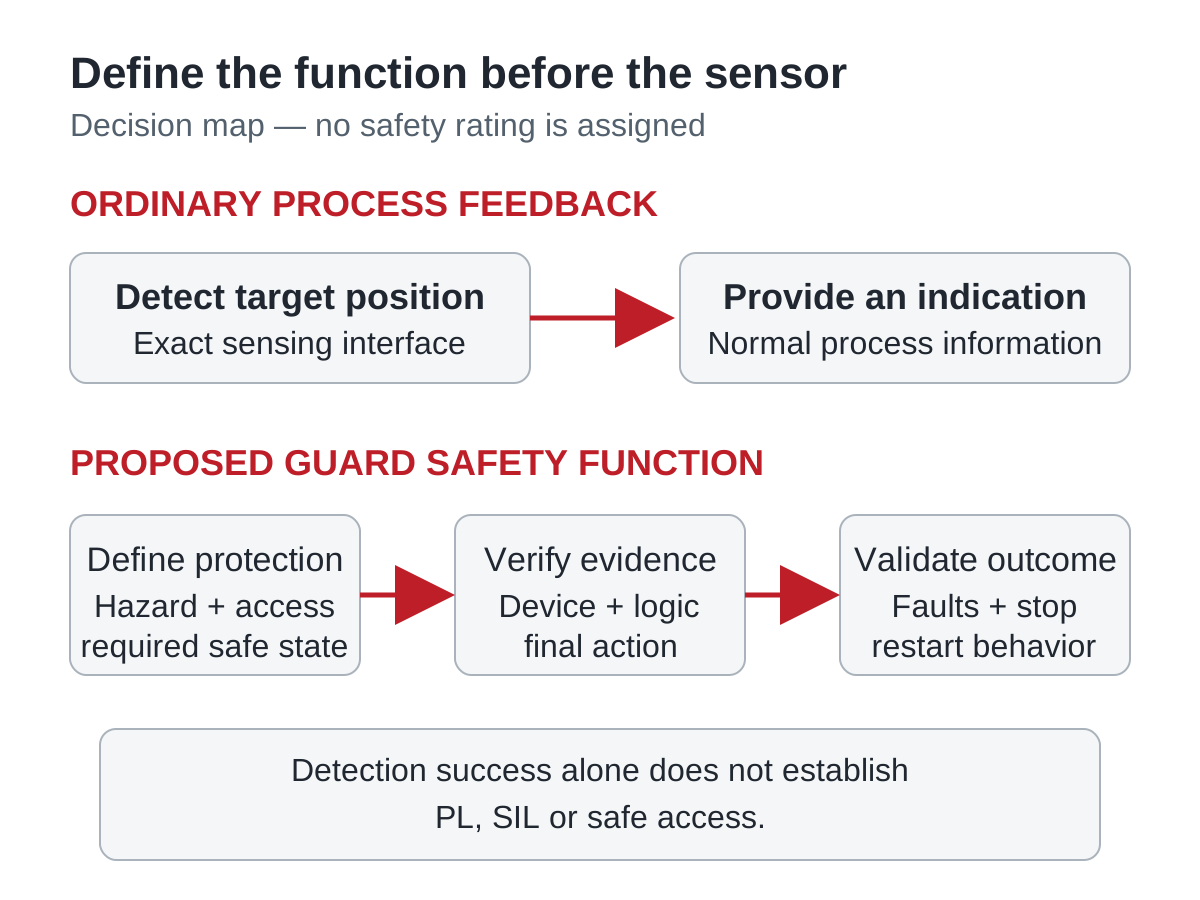
Swipe horizontally on a small screen, or open the full-size diagram.
Record the missing decisions explicitly instead of treating a successful demonstration as approval. Define what must happen if the flag remains detectable when the cover moves, if the signal is stuck in one state, or if power is restored with the cover open. The safety designer determines the applicable fault cases and controlled validation methods.
| Hypothetical condition | What the input could show | Question for the protective function | Release record |
|---|---|---|---|
| Cover closed, flag detected | Expected normal indication | Are other start and protective conditions satisfied? | Normal-state evidence only |
| Cover opens, target stays detectable | Apparently unchanged position signal | Can access occur without the required protective response? | Investigate mounting and detection concept |
| Input remains in its permissive state | Program may still see permission | Is the relevant fault detected or otherwise addressed? | Require architecture-specific evidence |
| Power returns with access possible | Input and logic restart | Is unexpected hazardous restart prevented? | Validate restoration and reset behavior |
The disposition is a hold on the safety-related modification until the required evidence exists. That is not a declaration that a product is uncertified or incompatible. It is a documented distinction between the information available for an ordinary sensing task and the additional evidence needed for a particular protective function.
Verify the whole function through a controlled plan
Validation must not depend on exposing a person to hazardous movement. Qualified personnel should establish an appropriate controlled method, including isolation or a suitable test arrangement where required. The plan should state which normal and fault conditions are exercised and which conclusions the results support.
- Define the safety task. Record hazards, access routes, operating modes, required safe state and restart conditions. Verify that the requirements come from the machine's risk assessment and applicable standards, rather than a component catalogue.
- Identify the exact devices. Record the sensor or interlock, actuator, logic device and final control elements with revisions. Verify safety-use instructions and interface compatibility for the proposed function; use the LJA18 model information only for the ordinary sensor identity it actually documents.
- Review mechanical and electrical dependencies. Record mounting, target behavior, foreseeable defeat, cable paths, supply dependencies and relevant faults. Verify the selected concept against the protective requirements before treating the schematic as released.
- Validate access and stopping behavior. Record the controlled test conditions, observations and timing where required. Verify the complete protective outcome at the actual hazard boundary, including any guard-locking requirement determined by the assessment.
- Validate reset, restoration and maintenance. Record guard closure, acknowledgement, start commands and restoration of supplies. Verify the specified restart behavior and issue inspection instructions tied to the final hardware and software revisions.
Handover should identify who owns future changes. Moving a target, changing a bracket or substituting an input device can affect a protective function even when production resumes normally. Keep safety-related modifications within the equipment's change-control and validation process, with the affected evidence updated before return to service.
Send a clearly bounded sensor enquiry
For ordinary process detection, send WEHO the target material, motion, installation envelope, environment and required output variant. If the enquiry concerns a guard-related safety function, state that purpose and request the exact applicable safety-use evidence. The machine designer must still select and validate the complete protective arrangement; a quotation for a sensor does not perform that assessment.
Engineering FAQ
Can an ordinary proximity sensor automatically replace a safety interlock?
No automatic equivalence exists between ordinary position detection and a safety interlock. Establish the required protective function, exact device suitability and complete-system validation before approving a substitution. Mechanical fit and a matching PLC signal are only part of the evidence.
Does a normally closed sensor make the circuit fail-safe?
A normally closed output alone does not establish fail-safe behavior. Different faults can produce different signal states, including a falsely permissive state. Evaluate the actual circuit, diagnostic provisions and required response rather than treating one contact convention as complete protection.
Does an IP67 rating prove suitability for a safety guard?
An IP rating does not establish functional safety performance. It addresses a separate enclosure-protection property under specified conditions. Guard-related suitability also depends on device instructions, installation, logic, final control elements and validation of the required safety function.
When might guard locking be needed instead of position detection alone?
Guard locking may be required when access must remain prevented until a hazard has passed. Determine that need from the actual hazard, access conditions and stopping behavior. A universal delay or a proximity sensor's response-frequency figure cannot establish safe access.
Can a product photo or successful production trial prove a Performance Level?
Neither a photo nor an ordinary production trial establishes a Performance Level. The conclusion requires the applicable design data, architecture analysis and validation for the complete safety-related function. This article makes no such claim for the illustrated LJA18 product family.