Compare power supply MTBF figures only after aligning the prediction method, product revision and operating assumptions. Keep useful-life evidence in a separate comparison column. A larger predicted MTBF is not a longer guaranteed lifespan, and two figures calculated under different assumptions do not establish a defensible supplier ranking.
On this page
- Build a comparison that can survive a sourcing review
- Normalize the basis before the numbers
- A hypothetical mission calculation exposes the assumption
- Ask a different question about useful life
- Define the T-60B assembly as one reliability object
- Release a comparison decision with its limits
- Request a normalized reliability response
- Technical references
Build a comparison that can survive a sourcing review
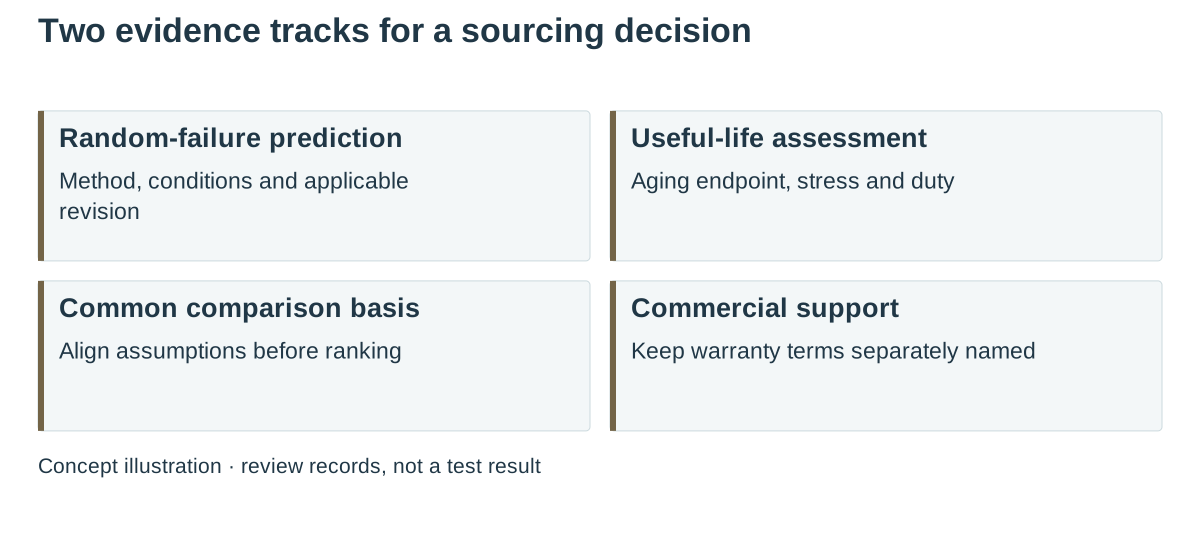
An OEM may receive one quotation with a large MTBF number, another with a life curve, and a third with only a warranty. Those answers are not measurements of the same thing. Before assigning a score, decide whether the request concerns random-failure behavior during a defined operating period, an aging endpoint, or commercial support.
This article focuses on the sourcing comparison. For installed equipment, WEHO’s separate MTBF and OEM fleet-maintenance guide addresses exposure and service records. Here the output is a normalized evidence sheet, not a replacement calendar or spare-stock forecast.
Normalize the basis before the numbers
TDK-Lambda’s MTBF glossary describes normal-operation failure behavior separately from infant mortality and end of life, and identifies temperature and component count as relevant to prediction. A calculation method is therefore part of the result. A bare number with “hours” attached is an incomplete comparison field.
For each supplier, retain the calculation or estimation method and edition, environment category, temperature definition, load/input assumptions, hardware revision and report date. If the result is based on field data or testing instead of a parts-count prediction, request its exposure, failure definition and statistical treatment. Do not quietly mix those result types in one ascending numerical list.
| Comparison field | Supplier A entry | Supplier B entry | Decision rule |
|---|---|---|---|
| Exact product/revision | Record controlled identity | Record controlled identity | Hold comparison if revision is unclear |
| Result type and method | Prediction, test estimate or field estimate | Same categories recorded separately | Compare like methods or obtain an explained reconciliation |
| Temperature and environment | Definition and stated value | Definition and stated value | Room, case and component temperatures are not interchangeable |
| Electrical conditions | Input and load basis | Input and load basis | Identify mismatch instead of selecting the favorable figure |
| Useful-life evidence | Endpoint and stress assumptions | Endpoint and stress assumptions | Review separately from MTBF |
| Evidence status | Source, date and unresolved fields | Source, date and unresolved fields | Do not replace missing values with zero |
A hypothetical mission calculation exposes the assumption
را NIST exponential model has a constant failure rate. Under that assumption, reliability over an interval is R(t) = exp(−t / MTBF). The calculation below uses invented comparison inputs solely to illustrate the arithmetic; neither input is a WEHO product rating, a measured failure rate or an appropriate life model for every operating period.
Suppose two otherwise comparable hypothetical predictions use MTBF values of 200,000 h and 400,000 h. For a 1,000 h interval, the model gives approximately 99.501% and 99.750% survival probability respectively. The first number does not promise 200,000 h from an individual unit; the second does not promise twice its wear-out life.
| Hypothetical case | Input MTBF | Interval | Modeled survival R(t) |
|---|---|---|---|
| A | 200,000 h | 1,000 h | exp(−1,000/200,000) ≈ 99.501% |
| B | 400,000 h | 1,000 h | exp(−1,000/400,000) ≈ 99.750% |
This arithmetic is useful because it makes the model visible. It is not a purchasing recommendation based on the small difference in percentages. If the two predictions use different temperatures or methods, the apparent comparison has already lost its common basis. If wear-out dominates the interval, a constant-rate model may not answer the question at all.
Ask a different question about useful life
Useful-life evidence should identify the performance endpoint, relevant component or assembly, temperature location, duty and calculation or validation basis. TDK-Lambda’s DDA specification illustrates a manufacturer documenting a reliability prediction separately from electrolytic-capacitor life assumptions. Its numbers and component choices apply to its own product, not to another manufacturer’s supply.
A supplier life statement remains conditional. Clarify whether it concerns a capacitor estimate, a fan service assumption or the complete assembly. Ask what changes in load, cooling or installation reopen that assessment. Do not convert a component-life estimate into a whole-product warranty, and do not describe a short zero-failure observation as proof of an unlimited lifetime.
Define the T-60B assembly as one reliability object
را WEHO T-60 product details and pictured T-60B label identify the triple-output assembly under review. Request reliability evidence for that full model, hardware revision and declared three-rail load combination.
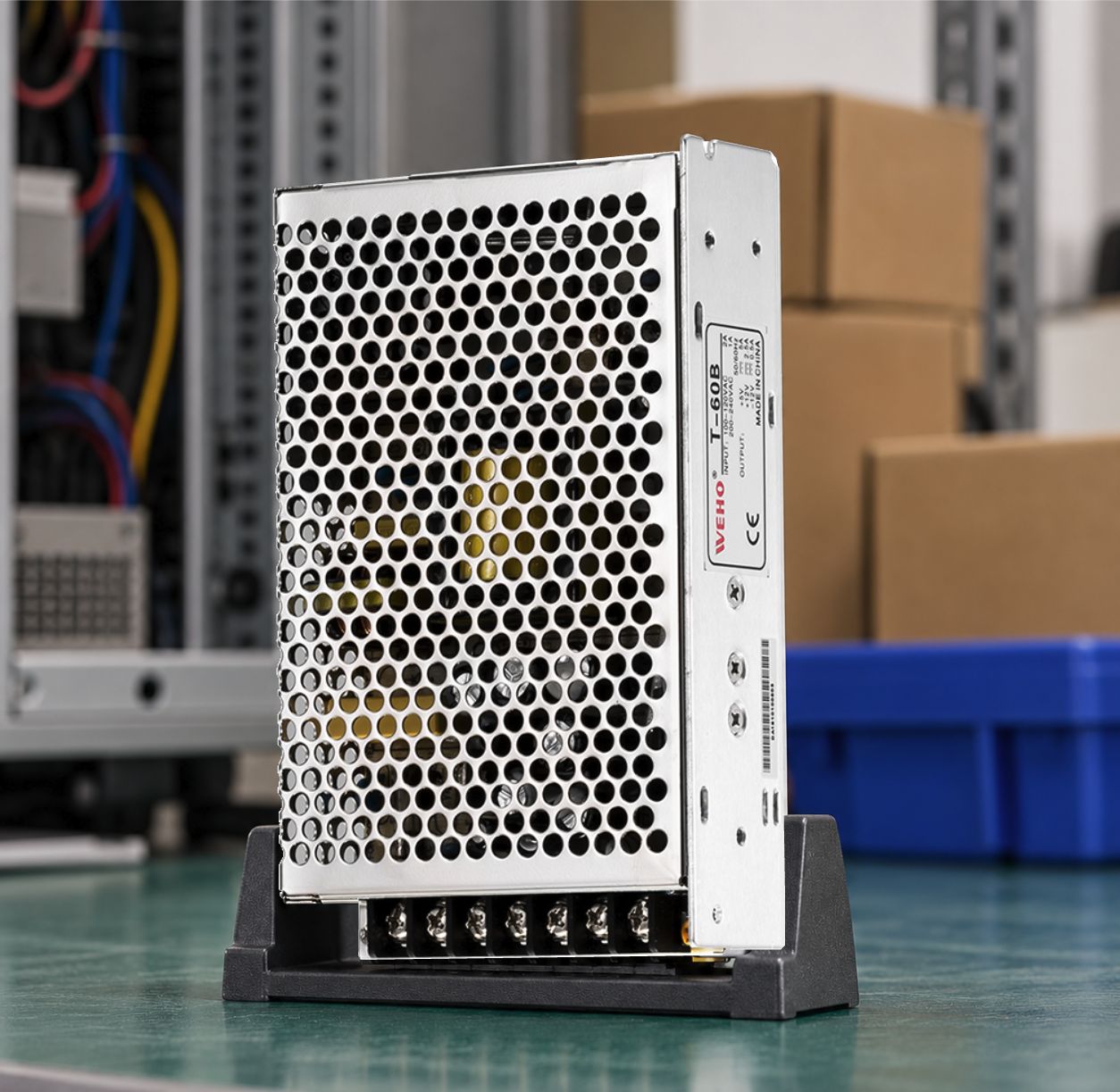
Three output rails do not make three independent product samples. Define the assembly failure criterion: for example, whether any required rail leaving its accepted limits counts as a failed unit. Keep the rail loading and monitored outputs with each observation so the exposure and failure record refer to the same complete assembly.
A report may model components or subsystems internally, but it must explain how those assumptions combine into its assembly result. Do not apply one rail’s figure to every rail, multiply the sample count by three, or transfer an MTBF from another T-series variant. No numerical MTBF or useful life is assigned to this photograph.
Request the controlled prediction and useful-life documents for the ordered T-60B revision. Keep unsupported fields open and preserve the distinction between a whole-assembly failure definition, conditional component-life evidence and commercial warranty terms.
Release a comparison decision with its limits
The comparison sheet should end with a technical disposition rather than an unexplained score. Mark each candidate as comparable on the stated basis, awaiting normalization, or lacking the evidence required for this decision. Keep the original report next to the extracted fields so a later revision can be assessed without reconstructing the sourcing history.
Commercial terms can then be assessed alongside technical evidence: support arrangements, documented substitutions and the accepted order revision. These terms are important to purchasing, but they should retain their own labels. A favorable warranty does not improve an MTBF calculation, and an impressive calculation does not create a warranty commitment.
Request a normalized reliability response
Send WEHO your reliability comparison requirements with the exact candidate, intended input/load, thermal conditions, duty and decision period. Ask which prediction and useful-life documents apply, which assumptions can be aligned with the comparison, and which fields remain unverified. That gives the sourcing team a reviewable basis for accepting or rejecting the evidence.