The power supply industry has two concepts that sound alike: Class 2 and Class II. They describe different safety characteristics. Class 2 concerns a power-limited output or circuit; Class II concerns protection against electric shock through insulation that does not rely on protective earth. A supply can meet both sets of requirements when it has been evaluated and marked accordingly. Neither designation alone proves the other.
What is a Class 2 Power Supply?
A Class 2 power supply provides an output evaluated for use with Class 2 circuits under the applicable North American requirements. The limits on voltage, current and power, together with the required evaluation, help reduce the risk of electric shock and fire. Requirements depend on the applicable standard, circuit conditions and installation rules; output wattage alone is not proof of Class 2 status. Class 2 supplies are used in applications such as lighting and control systems where the evaluated output and wiring are suitable.
What is a Class II Power Supply?
A Class II power supply provides protection against electric shock by using double insulation or reinforced insulation rather than relying on a protective earth connection for that protection. Reinforced insulation is an alternative to basic and supplementary insulation; it is not necessarily two separate physical layers. The Class II designation does not by itself establish a Class 2 output, a particular output voltage, or suitability for a medical application.
Class 2 vs Class II Power Supply: 9 Key Differences

| Aspect | Classe 2 | Classe II |
|---|---|---|
| Primary concern | Limited output energy and circuit conditions | Insulation-based protection against electric shock |
| Requirements | Check the relevant Class 2 listing, marking and installation rules | Check the product's applicable safety standard and Class II classification |
| Safety method | Limits are evaluated for the output and its intended circuit | Double or reinforced insulation provides the required shock protection |
| Typical application | Power-limited lighting, controls and other suitable circuits | Equipment requiring insulation-based shock protection, including some adapters and appliances |
| Input connections | Determined by the individual power supply; a Class 2 output does not specify its input connection | Protective earth is not relied on for shock protection; follow the individual product's input instructions |
| Identification | Look for the appropriate Class 2 marking and listing for the output | Look for the applicable Class II marking, often the square-within-a-square symbol, and documentation |
| Compatibility | Verify output rating, use conditions and wiring requirements | Verify insulation class, input and output ratings, and the end equipment's requirements |
| Grounding | Class 2 output status does not determine whether the input requires protective earth | Protective earth is not the protective measure for Class II insulation; functional earth may be present when specified |
| Relationship | A supply may also be Class II if both requirements are met | A supply may also have a Class 2 output if both requirements are met |
Standards and Certifications
Class 2 power supply: ANSI/UL 1310 is a standard for Class 2 power units; other sources and installations can be subject to different applicable requirements. Confirm the product's listing and intended output use. An IEC 62368-1 limited power source evaluation is related to a different framework and is not automatically the same as a Class 2 listing. UL Solutions discusses these distinctions.
Class II power supply: Class II describes an insulation-based protection class. The applicable product safety standard depends on the equipment and use. For example, medical electrical equipment is subject to its own relevant requirements; Class II alone does not establish medical approval. IEC 60529 describes enclosure protection using the IP code, rather than certifying Class II insulation.
Safety Protection
Class 2: The output is evaluated against limits intended to reduce shock and fire risks under applicable conditions. The installation and load still need to follow the product instructions and local requirements.
Class II: Double or reinforced insulation provides the required protection against electric shock without relying on a protective earth connection. It does not make the equipment shock-proof under all conditions, and it does not by itself establish a limited-power output.
Scénarios d'application
Class 2 outputs are used in lighting, automation and low-power control circuits where the source and installation meet the applicable requirements. Class II construction is used in some adapters, appliances and other equipment. The intended application must still be checked against the particular product's ratings, approvals and instructions.
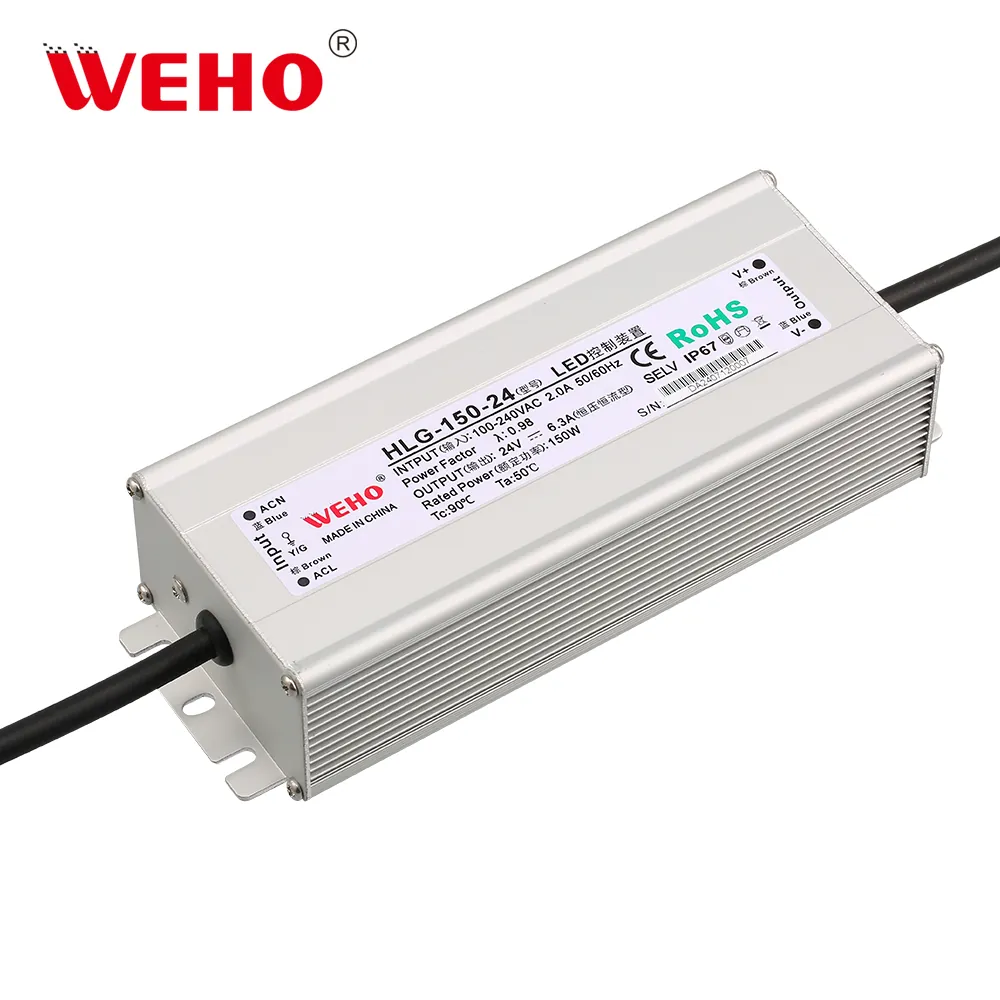
For an example of the information to review, see the WEHO HLG-150-24 LED power supply. The product example does not establish that its output is Class 2 or that the unit is Class II; verify its exact documentation against the project requirements before selection.
Input Method
A Class 2 output does not establish how the supply is connected on its input side. Some power supplies may require a protective earth input connection; follow the terminal markings and the manufacturer's instructions. Class II protection does not rely on protective earth. A separate functional earth connection, if present and specified by the manufacturer, serves a functional purpose and must not be assumed to be the protective measure.
Logo and Appearance Identification
Class II equipment is often identified by a square-within-a-square symbol, subject to the applicable marking requirements. Do not infer Class II status from a plastic case or the apparent number of wires alone: check the product markings and documentation.
Comment savoir si mon alimentation est de classe 2 ?
Check the output marking, the applicable certification or listing information, and the exact model's documentation. A Class II symbol, an IEC 62368-1 marking by itself, or a low output power rating is not sufficient to establish a Class 2 output.
Scope of Application and Compatibility
The classifications answer different questions and can apply to the same product. Confirm the required output voltage, current, load and installation conditions in addition to the Class 2 or Class II designation. A product that meets one classification must not be assumed to meet the other.
Grounding Requirements
A Class 2 output does not determine the protective earthing requirements of the complete power supply. Follow the specified input protective-earth connection where required. Class II protection does not depend on protective earth; a manufacturer may specify a separate functional earth connection for a purpose such as electromagnetic compatibility. Follow the manufacturer's instructions and the applicable installation requirements for any such connection.
What is the Voltage for Class 2?
The permitted voltage depends on the applicable requirements and the specific circuit conditions. Check the exact model's evaluated output and its instructions against the applicable rules rather than treating a single voltage value as universal. Class II alone does not set a universal output-voltage limit.
What is the Current Limit for a Class 2 Power Supply?
Current and power limits depend on the applicable evaluation and circuit conditions. Use the model's marked output rating and relevant listing for the intended application; do not infer a universal current rating from “Class 2” or “Class II” alone.
Risk of Electrical Shock and Fire
Class 2 limits are intended to reduce risks associated with the output circuit, including shock and fire. Class II insulation addresses electric-shock protection. Neither designation eliminates all electrical or fire hazards, and neither substitutes for a suitable installation, environmental protection or product-specific safety assessment.
When to Choose Class 2 or Class II Power Supply?
Start with the needs of the equipment and its installation. If the output circuit requires a Class 2 source, select a product whose specific output is appropriately listed and marked. If Class II construction is required, verify that classification in the product documentation. Some applications require both; others have different requirements. Review the complete system, destination market and applicable standards before selection.
Conclusion
Class 2 and Class II sound similar but describe different safety characteristics: the first concerns a limited-power output or circuit, while the second concerns insulation-based protection against electric shock. Check each requirement separately, along with the input, output, grounding instructions and documented approvals for the exact model.
Références
- UL Solutions: IEC 62368-1 questions and answers, including Class 2 adapter substitution
- UL Solutions: revisions to UL 2108 and Class 2 power units
- IEC: power electronic converter safety seminar, Class II protection
- IEC: IEC 60529, degrees of protection provided by enclosures
- UL Solutions: industrial battery charger testing and ANSI/UL 1310