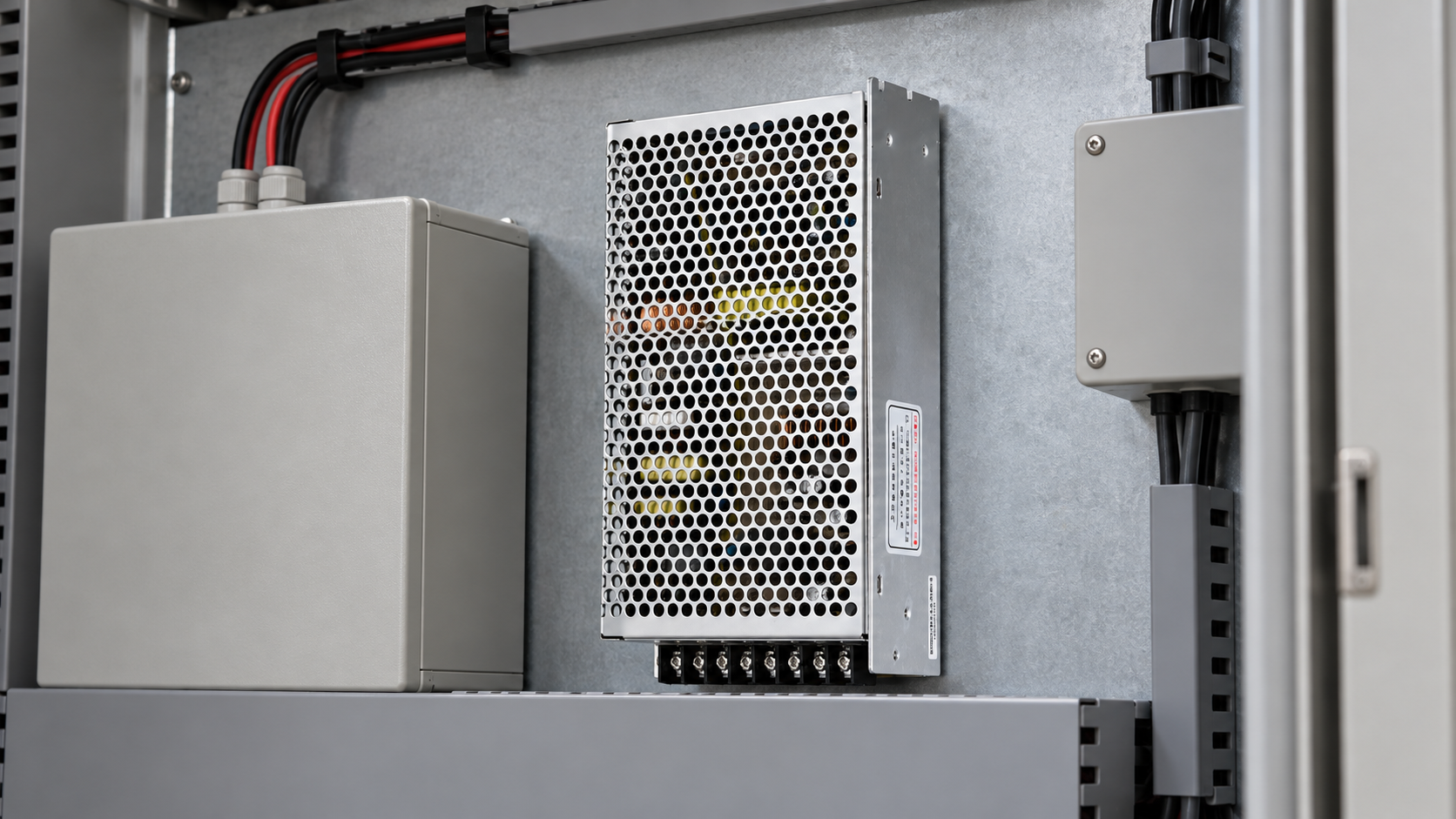
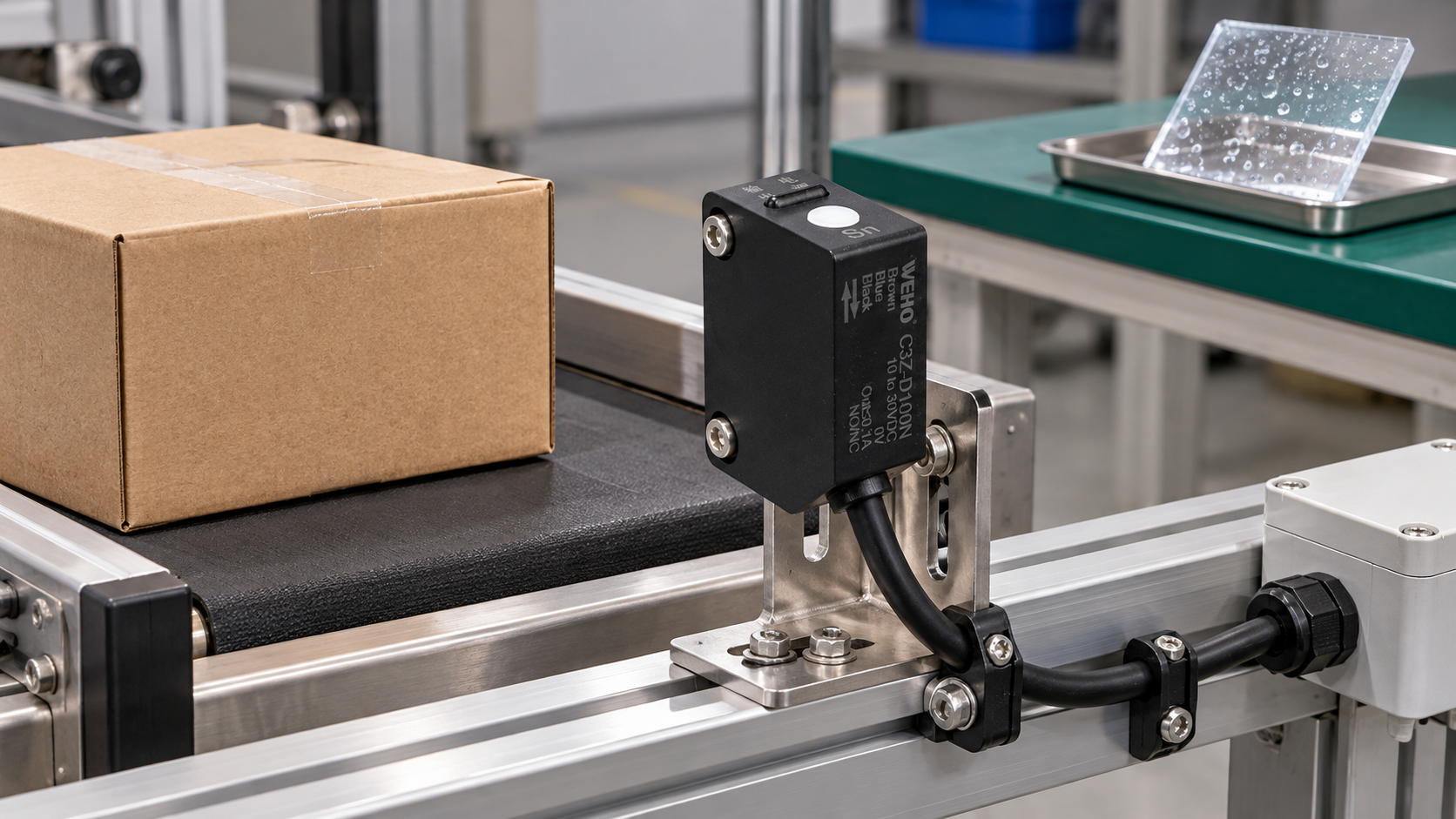
A retroreflective sensor may miss or intermittently detect a shiny or film-covered object when light reflected from the object reaches the receiver. Test the actual product, reflector and mounting geometry together before approving the arrangement.
Check the reflection from the real target
An OMRON support question describes occasional malfunction even with that manufacturer’s mirror-surface-rejection (MSR) sensors. It identifies examples such as transparent film and reflective packaging and recommends testing; this does not establish MSR capability or sample performance for any WEHO model.
A through-beam arrangement may be another option for some difficult targets, but it requires a separate emitter and receiver, suitable mounting and its own sample acceptance. Do not assume a different sensor automatically solves every object or machine constraint.
Separate the reflector path from the object reflection
In a typical retroreflective setup, the sensor sends light toward a reflector and observes its return; the intended target interrupts the path. The unwanted condition occurs when the object itself sends enough light back toward the receiver for the installed device and setting. Depending on the sensor’s output logic, the symptom can appear as a missed object or an unexpected output state.
Document the exact sensor model and mode, reflector type, positions, beam path, settings and receiver logic. A diffuse-reflective sensor has a different detection arrangement; a through-beam system uses separate optical units. Do not equate these technologies or change the installation without an approved plan.
Review the candidate and its real product documents
Le WEHO C3Z-R3 page describes a reflectional sensor and a specified reflector. Obtain the exact version’s current optical instructions and ask specifically about glossy targets, film and any documented rejection feature. The available page does not establish an MSR or polarization specification for this article.
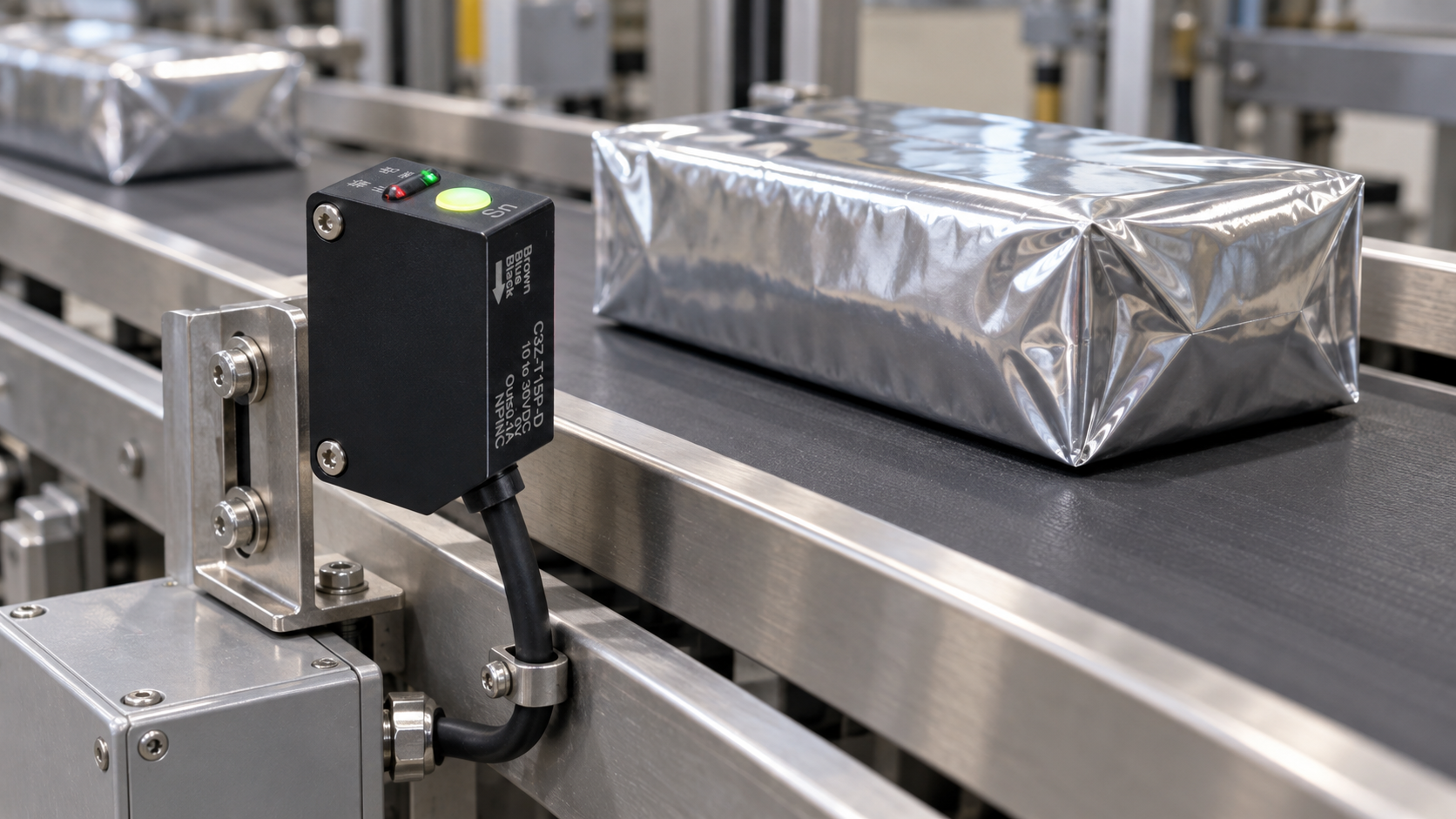
The pictured product has a visible C3Z-T15P-D marking. It is a different, directional through-beam-family device, shown only as a potential alternative to evaluate; the AI-assisted application illustration does not depict a C3Z-R3 installation. The C3Z-T15 product page describes that family and non-transparent target detection. Confirm the delivered complete suffix and emitter/receiver documentation with WEHO.
Use the difficult samples, not only a reference target
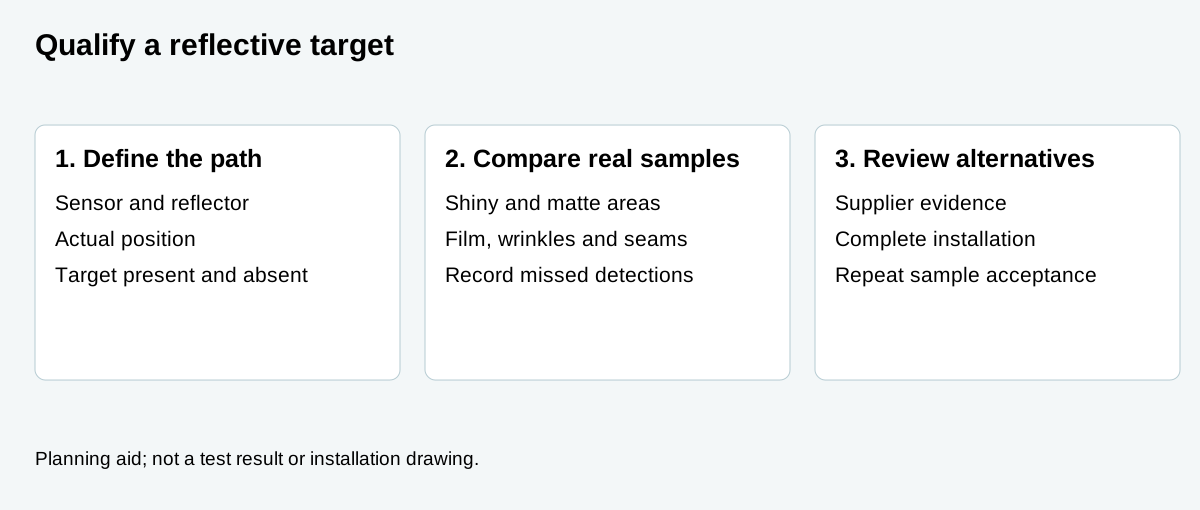
Build a sample set with the actual product finishes and expected variation: glossy labels, transparent wrapping, wrinkles, seams and the orientation seen by the machine. Include the expected target-present and target-absent conditions, the range of positions and the real background. A clean reflector and a catalog reference object do not prove acceptance for a shrink-wrapped or highly reflective package.
Record missed detections separately from false events and include motion where speed and position affect the task. Confirm what the downstream controller actually receives. Avoid diagnosing every missed count as an optical problem until supply, output interface and receiver timing have also been checked.
Compare the proposed configurations
| Case | Configuration | Acceptance evidence |
|---|---|---|
| Reference | Actual sensor, reflector and documented settings; no target. | Receiver and controller show the required absent state. |
| Target range | Glossy, matte and film-covered production samples in allowed orientations. | Required present state with counts and misses recorded. |
| Geometry | Expected position and fixture tolerances under the approved setup. | Both target states remain distinguishable. |
| Alternative method | Supplier-supported through-beam or other documented arrangement. | Same samples and states, with mechanical and electrical constraints recorded. |
| Release | Exact products, settings, sample variants and owner. | Traceable decision and open issues. |
This is a proposed comparison worksheet, not a record of a performed test or a promise that a sensor detects the listed samples.
Resolve a failure without borrowing another model’s features
If a reflective target produces an unstable return, share the symptoms and samples with the sensor supplier. Ask whether the exact device supports a particular optical feature or accessory, and whether alternative sensor positioning, shielding or sensing mode is allowed. The answer may depend on the reflector, orientation and machine space.
Test the chosen change against both the target-present and target-absent states. Preserve the complete settings and compare failures using the same sample set. A reflector, filter or numerical spacing rule from another supplier is not automatically compatible with the selected unit.
Questions buyers ask
Does mirror-surface rejection guarantee detection of every shiny package? No. OMRON’s cited FAQ explicitly calls for testing challenging films and reflective surfaces even for its MSR devices.
Is the pictured C3Z-T15P-D a retroreflective C3Z-R3? No. The pictured marking identifies a different directional device; any replacement method requires its own integration review.
Can a catalogue distance alone qualify the machine? No. The actual samples, position, reflector, controller and accepted response must be checked.