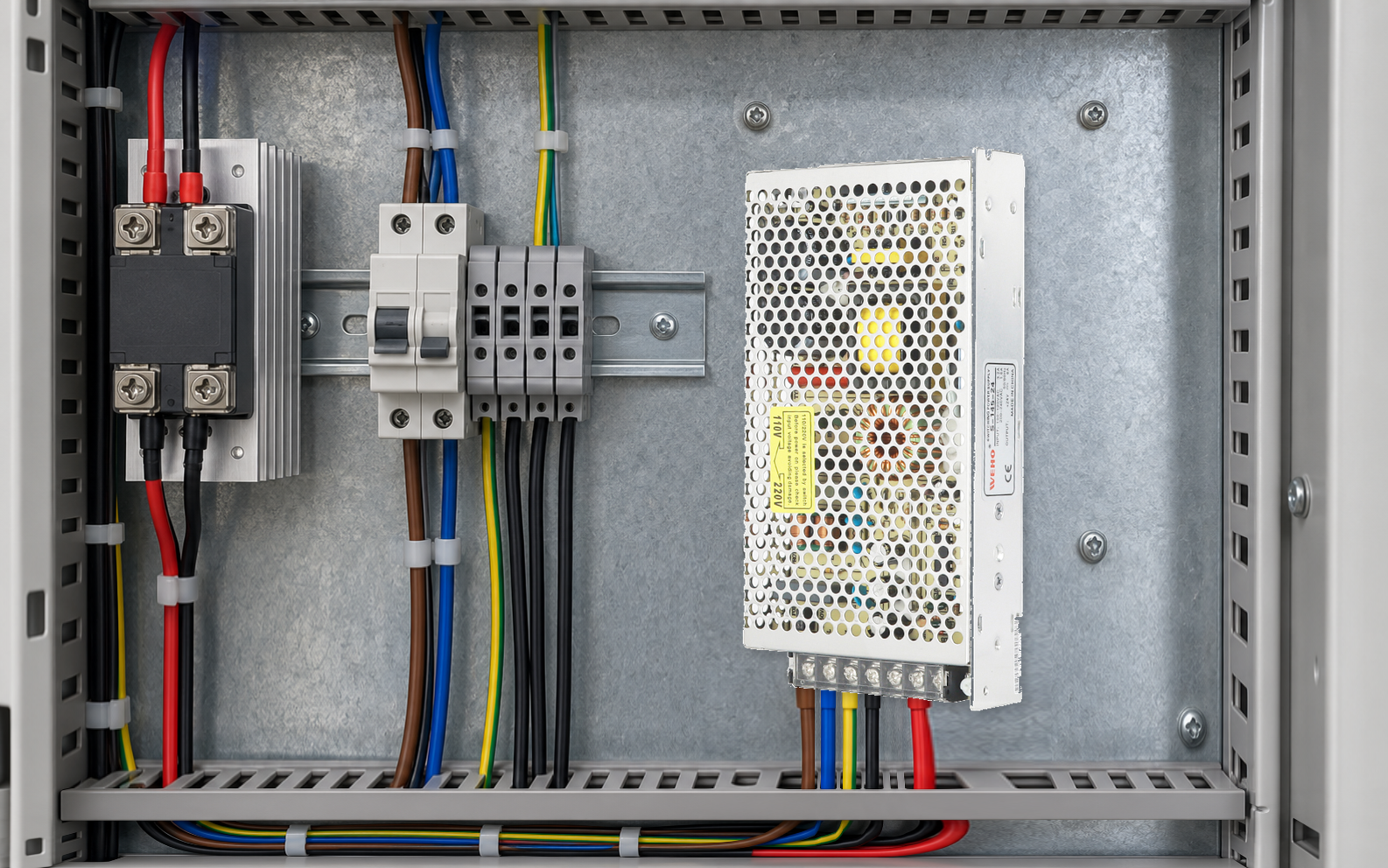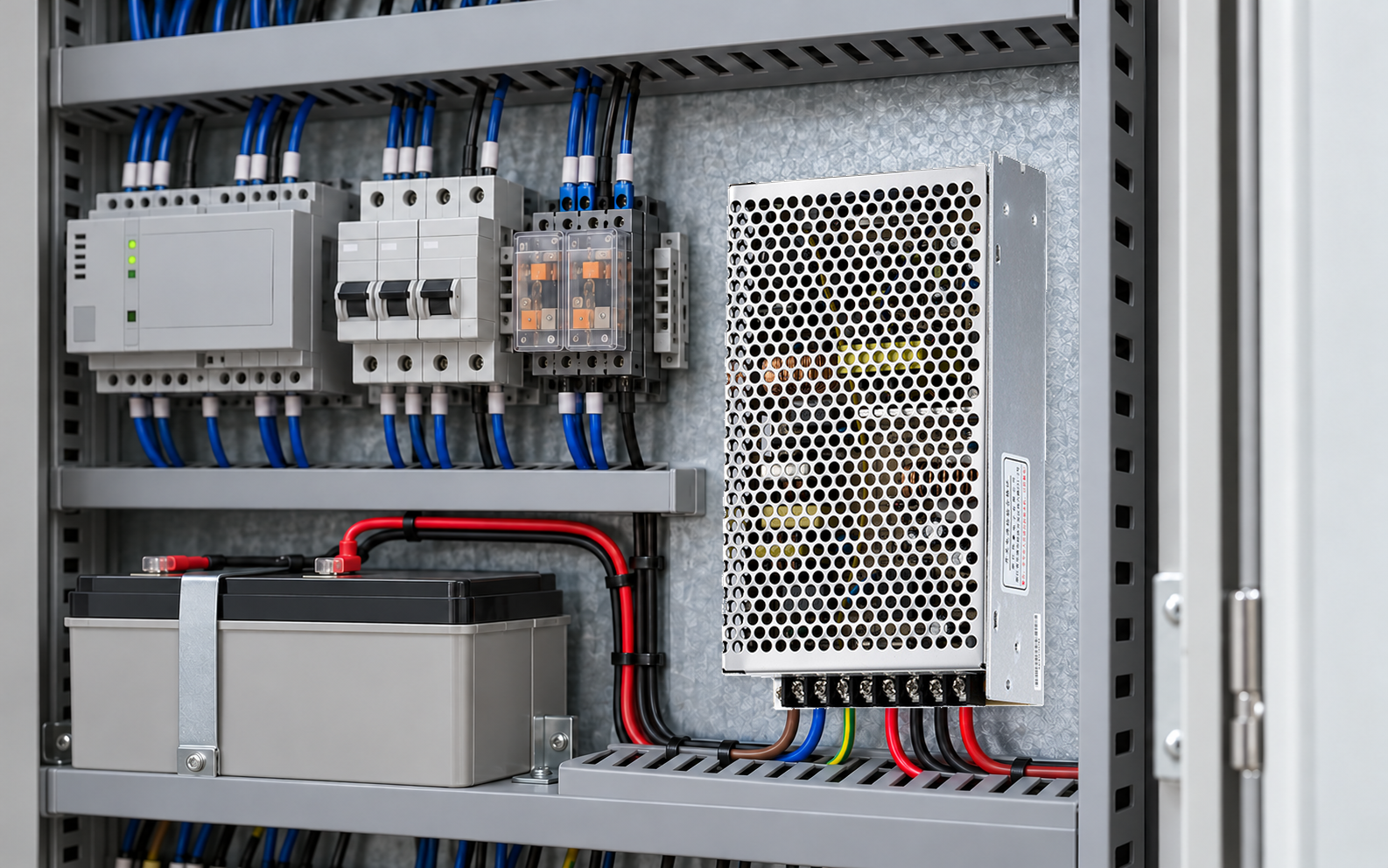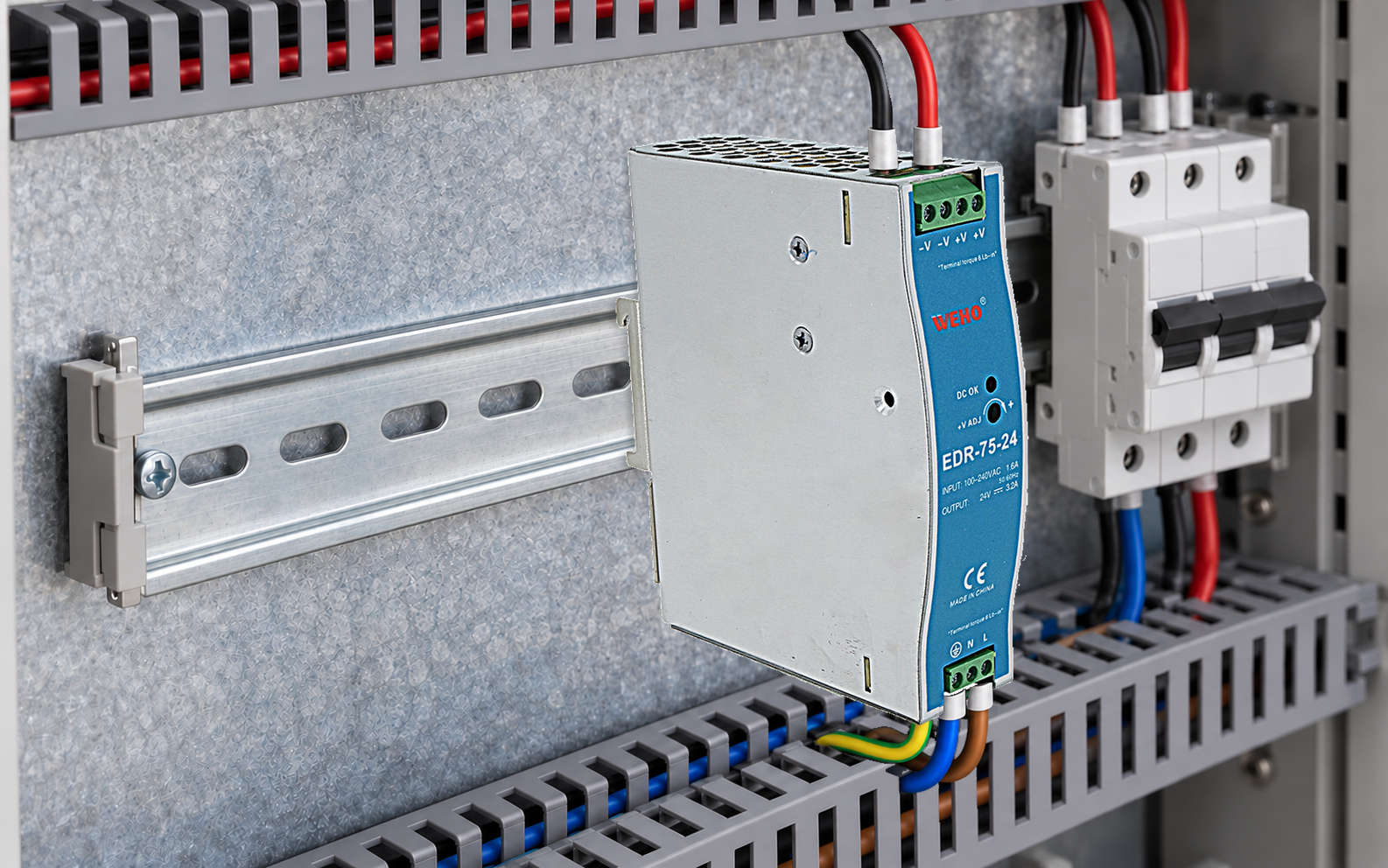
Establish the overvoltage-category requirement at the supply’s installation location, then obtain evidence that the exact power-supply version meets the applicable insulation-coordination requirements. Neither a DIN-rail housing nor a nominal input-voltage range settles that decision.
This article helps a panel designer assemble the location and product evidence needed for an assessment. The WEHO EDR-75-24 is the product example; no overvoltage-category qualification is asserted for it from the available public documents.
Separate an input rating from a transient requirement
A normal input-voltage range describes a supply’s permitted operating input under stated conditions. Overvoltage category concerns the transient environment considered in insulation coordination. A surge-immunity test entry, an output overvoltage-protection function and a dielectric test value answer other questions; they are not interchangeable evidence.
IEC 60664-1 addresses insulation coordination for low-voltage supply systems, including clearances, creepage distances, solid insulation and related tests. Its public listing also identifies a consolidated version incorporating Amendment 1:2025. The assessor should identify the edition and any product-specific requirements applicable to the project.
TDK-Lambda’s overvoltage-category overview relates the categories to locations within an installation. Use such guidance to frame the question, then apply the actual project standard. “Industrial power supply” is a product description, not a documented category assignment.
Write a location statement that a supplier can assess
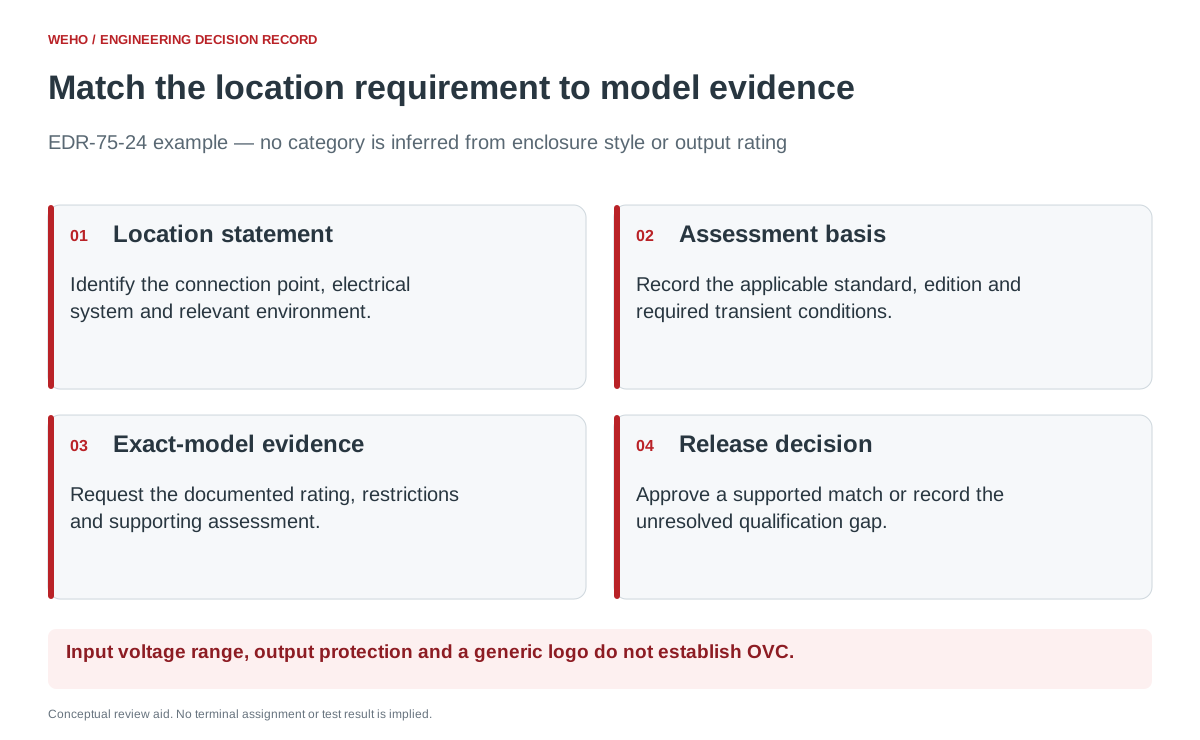
Identify the proposed point of connection using the electrical drawing. State the supply system, the relevant voltage, how the equipment connects to the installation and the environmental conditions required by the assessment. If upstream protective measures form part of the proposal, identify their exact documentation and configuration.
Do not shorten this to “inside a control cabinet.” That phrase does not tell a reviewer where the cabinet is supplied from or what transient assumptions the design relies on. Similarly, placing a device farther from a distribution board does not, by itself, prove a particular transient boundary.
| Assessment input | What to put in the project record | Reason it affects the decision |
|---|---|---|
| Connection location | Drawing reference, supply origin and equipment connection arrangement. | Makes the installation assumption traceable. |
| Electrical system | Applicable nominal voltage, earthing-system description and assessment standard. | Prevents comparison of ratings based on different conditions. |
| Required category / impulse basis | Requirement, responsible assessor and supporting standard clause or assessment report. | States what the selected product has to satisfy. |
| Installation environment | Pollution, altitude and other conditions required by the applicable assessment. | Category alone does not define every insulation condition. |
| Proposed protection | Exact devices and installation conditions if relied upon. | Allows the complete arrangement, rather than a component name, to be reviewed. |
The record is an information request for the responsible designer or conformity assessor. It is not a method for assigning a category by visual inspection.
Request evidence for EDR-75-24 without filling gaps by inference
The WEHO EDR-75 product page and EDR-75 specification sheet identify the DIN-rail family and a 24 V model. The available sheet does not provide an explicit overvoltage-category declaration. General product-page certification text is not sufficient evidence for that missing field.
Ask for the current document applicable to the exact suffix and construction revision: the category or rated impulse-withstand claim, its standard and conditions, any restrictions, and the test or approval reference supporting it. If the supplier provides a certificate, check that the covered model and relevant scope match the offered unit.
HUMMEL’s technical definitions distinguish rated voltage from rated impulse voltage, which describes specified insulation withstand against transient overvoltages. That distinction is useful when comparing document fields, but HUMMEL component data does not establish an EDR-75 rating.
A missing category field is an unresolved qualification question. It is not evidence that the product passes or fails the proposed location requirement. Keep the model as a candidate only within the project’s document-review status.
A panel quotation can be complete electrically and incomplete for location
In a hypothetical procurement review, a cabinet designer selects a 24 V DIN-rail supply that fits the available space and the continuous load. The customer specification also calls for installation suitability under a stated transient environment. The quotation includes an output table and a generic compliance statement, but no exact-model evidence for that requirement.
The appropriate disposition is “request installation qualification evidence.” The output table can support the load-selection discussion while the location requirement remains open. Approving the full assembly because the supply has enough watts would combine two independent decisions.
If someone proposes an upstream surge-protective device, refer the complete arrangement to the responsible assessor. Its presence alone does not prove the insulation qualification of the supply, establish a category reduction or eliminate the need to assess coordination and installation conditions.
Close the requirement-to-evidence loop
The release record should place the required installation condition beside the offered model’s documented condition. Where they differ, record the approved engineering resolution and its evidence. A verbal assurance that a product is commonly used in cabinets cannot close a model-specific qualification item.
Retain the exact document revisions with the bill of materials. Recheck the decision if the supply construction, installation location, system voltage or relied-upon protection changes. Purchasing should request approval of substitutions against these recorded conditions, rather than treating all DIN-rail supplies with the same output voltage as equivalents.
This approach lets engineering and purchasing make a clear decision: approve a documented match, request the missing evidence, or select a candidate with the necessary supported rating. It avoids inventing an EDR-75-24 category that the public material does not state.
Use the project record
Open the blank Supply Installation Location — Insulation Evidence Record to record your conditions, evidence and decisions. The worksheet contains no pre-approved result.
Request the EDR-75-24 evidence needed for your installation
Send WEHO your exact installation-location requirement, applicable standard and edition, supply-system details and proposed model. Ask for the current model-specific documents so your panel designer can assess the offered construction against that requirement.