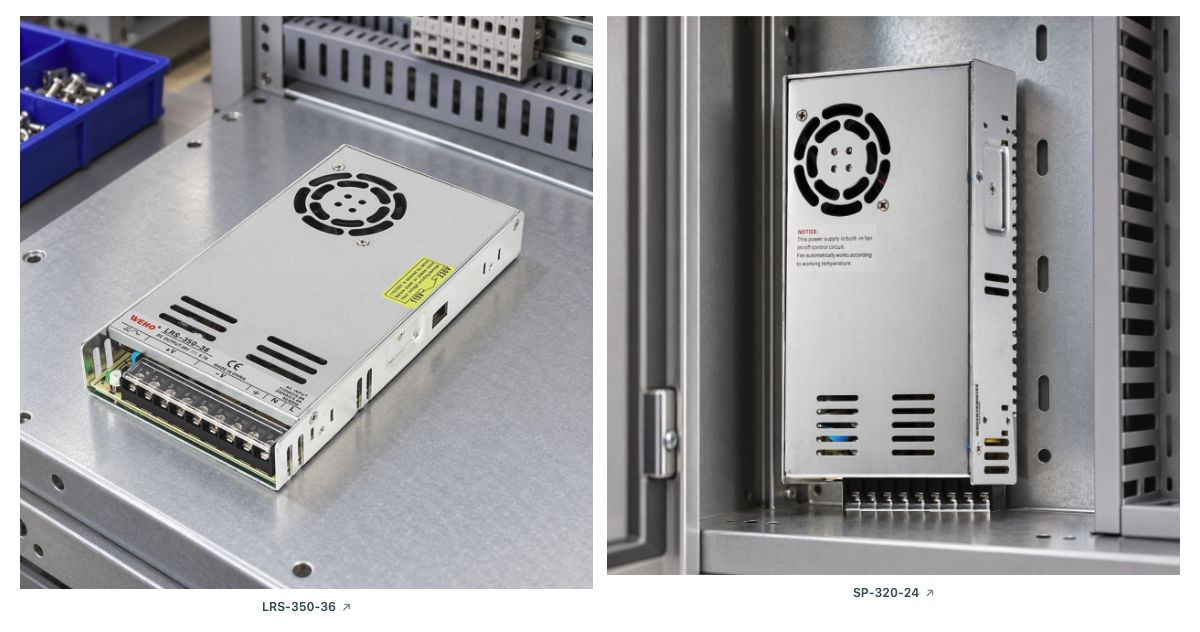
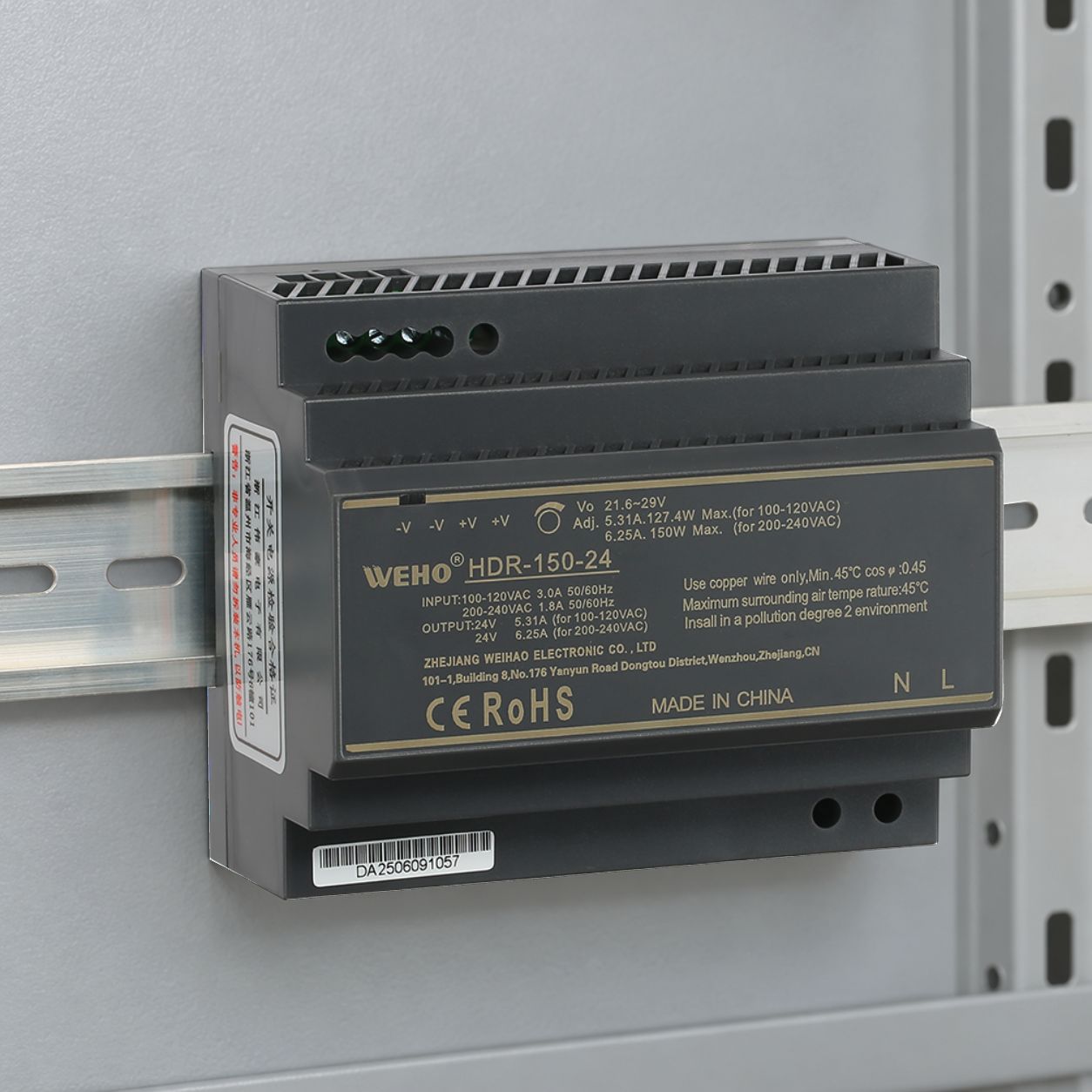
A power supply’s DC output rating does not determine a control panel’s short-circuit current rating (SCCR). For a panel containing an HDR-100-24, establish the panel’s circuit scope and applicable evaluation method, then assemble the relevant component and protective-device evidence. Compare the documented assembly rating with the available fault current at its installation point.
This is a document-preparation workflow for an OEM or panel builder supplying equipment to a project that requires an SCCR assessment. It does not assign an SCCR, UL approval or tested fault performance to the WEHO HDR-100-24, and it does not replace evaluation by the responsible panel specialist.
Separate three quantities before collecting certificates
| Quantity | What it describes | Record it with |
|---|---|---|
| DC output voltage / current | The supply output used by the control loads. | Exact supply model, revision and operating conditions. |
| Available fault current | The prospective fault condition at the installation supply point. | Site location, system conditions, study/source and date. |
| Panel SCCR | The assembly rating established by the applicable evaluation. | Voltage, configuration, protection conditions and evaluation record. |
The WEHO HDR-100 product page and HDR-100 specification sheet identify an HDR-100-24 24 V variant. They differ on several other parameters, including the listed output current. Neither document is used here as evidence of a panel SCCR. Confirm the controlled supply revision for the ordinary load budget and obtain separate evidence for the panel evaluation.
Keep those two reviews connected through the same BOM, but do not convert watts, DC output current or an overload-protection percentage into a fault-current withstand rating.
Let the circuit classification set the evidence scope
UL Solutions’ SCCR FAQ, written in the context of NFPA 79’s 2021 edition, explains that ordinary DC power supplies generally do not need their own SCCR; it distinguishes panels with only control circuits from those containing power circuits. It also identifies UL 508A Supplement SB as a method for industrial-control-panel SCCR determination. Apply the requirements and edition specified for the actual project with the responsible evaluator.
First draw the supply boundary, incoming sources, feeders, branches and connected loads. Ask the panel specialist to classify the circuits and identify which components enter the assessment. Do not include or exclude a component solely because it is mounted on the same DIN rail as a 24 V control supply.
For a machine with several panels or supply points, identify the boundary of each rating and the site information that belongs to it. A record for one incoming supply should not silently be reused for a different installation point.
Build a component evidence file with conditions intact
Eaton’s UL 508A control-panel design guide illustrates that panel design combines the circuit arrangement, protective devices and specific component selections. Use the current project method to determine the relevant evidence; a collection of logos is not an assembly calculation.
| File item | Minimum useful content | Common gap to resolve |
|---|---|---|
| Controlled circuit and BOM | Part numbers, revisions, ratings and circuit location. | A family name without the ordered variant. |
| Component evidence | Relevant rating, voltage and installation conditions. | A rating copied without its required protection. |
| Protective-device evidence | Exact fuse/breaker type, rating and applicable combination data. | An unspecified “equivalent” upstream device. |
| Supply documentation | HDR-100-24 identity and required application records. | Conflicting public revisions treated as one specification. |
| Assembly evaluation | Method, configuration, limiting conditions and reviewer. | A target rating with no traceable assessment. |
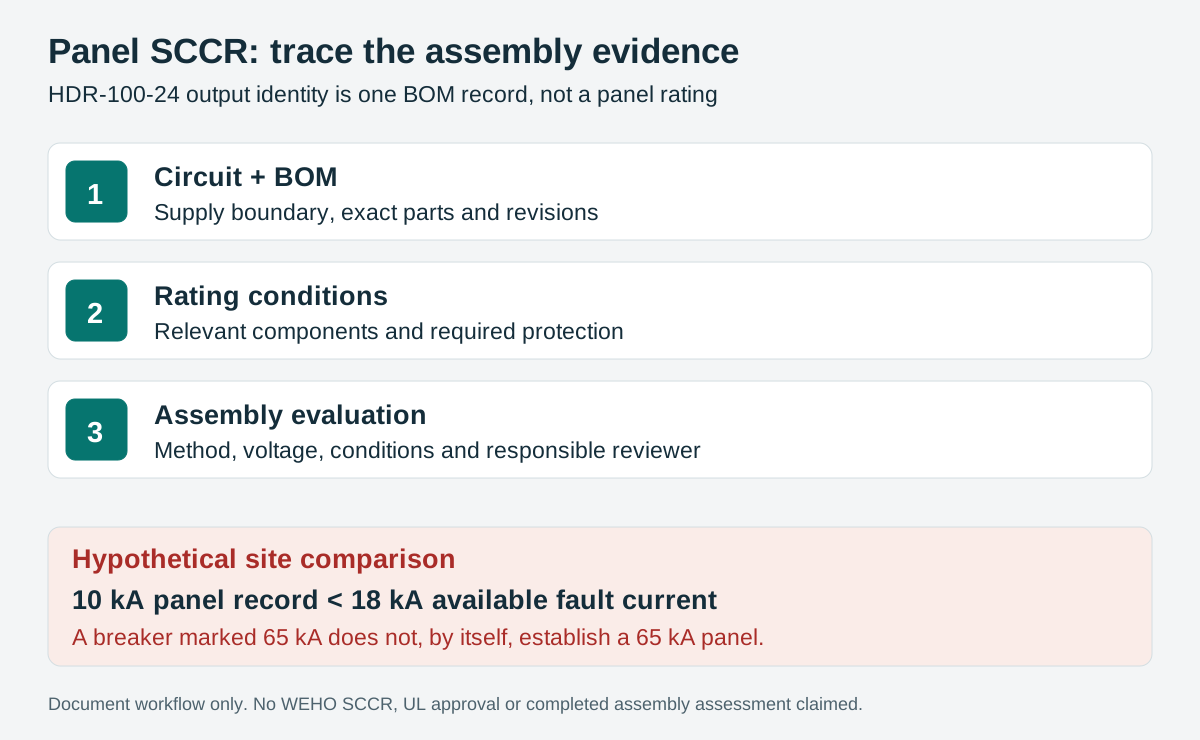
Attach the actual evidence behind every row. Where a component rating depends on a specified protective device, retain the condition beside the rating so a later substitution cannot erase it. If evidence is missing, assign an owner and keep that gap visible in the review record.
A higher breaker number does not complete the panel review
Consider a hypothetical project with 18 kA of available fault current at the relevant supply point and a panel documented for 10 kA under the same voltage and system conditions. The panel record is insufficient for that stated site condition. This example is a comparison of assumed documents, not a result for a WEHO-equipped panel.
Now suppose the proposed incoming breaker has a 65 kA interrupting rating. That figure alone does not demonstrate that the complete downstream panel is rated 65 kA, or even 18 kA. Obtain the applicable assembly or combination evidence and have the panel evaluator confirm the resulting rating and conditions before marking the equipment.
Also preserve the voltage and supply-system qualifications of each rating. A kA value detached from its voltage or grounding-system context is incomplete. Do not transfer a conditional rating to another system merely because the ampere value appears large enough.
Hand off a reproducible rating file
The final file should connect the panel nameplate to a controlled schematic, BOM, evaluation and relevant site fault-current information. Record the accepted protective-device conditions and any installation limitations that the receiving electrical contractor must preserve. This is an evidence handoff, not an instruction to perform a physical short-circuit test on the machine.
Before releasing a replacement part, check whether the substitution affects the circuit classification, component conditions or assembly evaluation. A different fuse class, breaker family, distribution block or contactor can require review even when its normal operating current matches the old part. Route the change to the responsible specialist instead of assuming a larger catalogue number preserves the rating.
Use the worksheet below to assign document owners and make the release decision traceable. Keep ordinary supply selection questions—24 V load demand, temperature, mounting and receiver behavior—in their own completed records. The SCCR file then answers the distinct question it was created for: what supports this assembly rating under these stated conditions?
Use the project record
Open the blank Panel SCCR evidence ownership and release record to record your conditions, evidence and decisions. The worksheet contains no pre-approved result.
When including an HDR-100-24 supply in a panel, request the exact product revision and required supporting documents from WEHO. Submit the complete circuit and protection file to the panel’s responsible evaluator before final marking.