A high-line AC/DC supply can be wrongly rejected if an incoming test station powers it from a source outside its documented input range. Before calling a unit defective because no output was recorded, verify the test source, exact sample identity, load and observation timing. Separate a valid product failure from an invalid test condition.
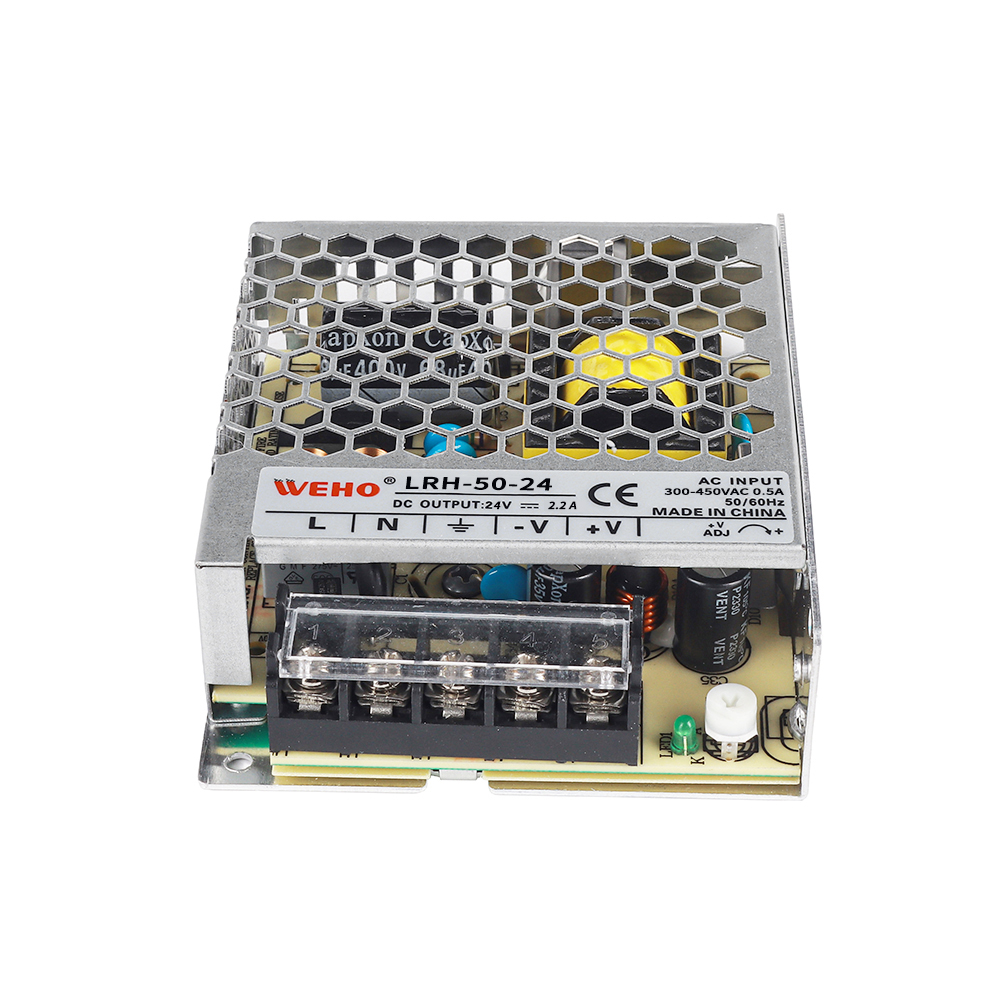
The original WEHO LRH-50-24 photo states 300–450 VAC input and 24 V, 2.2 A output. A normal 230 VAC bench connection is below that photographed AC input window. This guide concerns the design and disposition of an authorized test process; it does not provide a high-voltage wiring procedure or authorize energizing an installation.
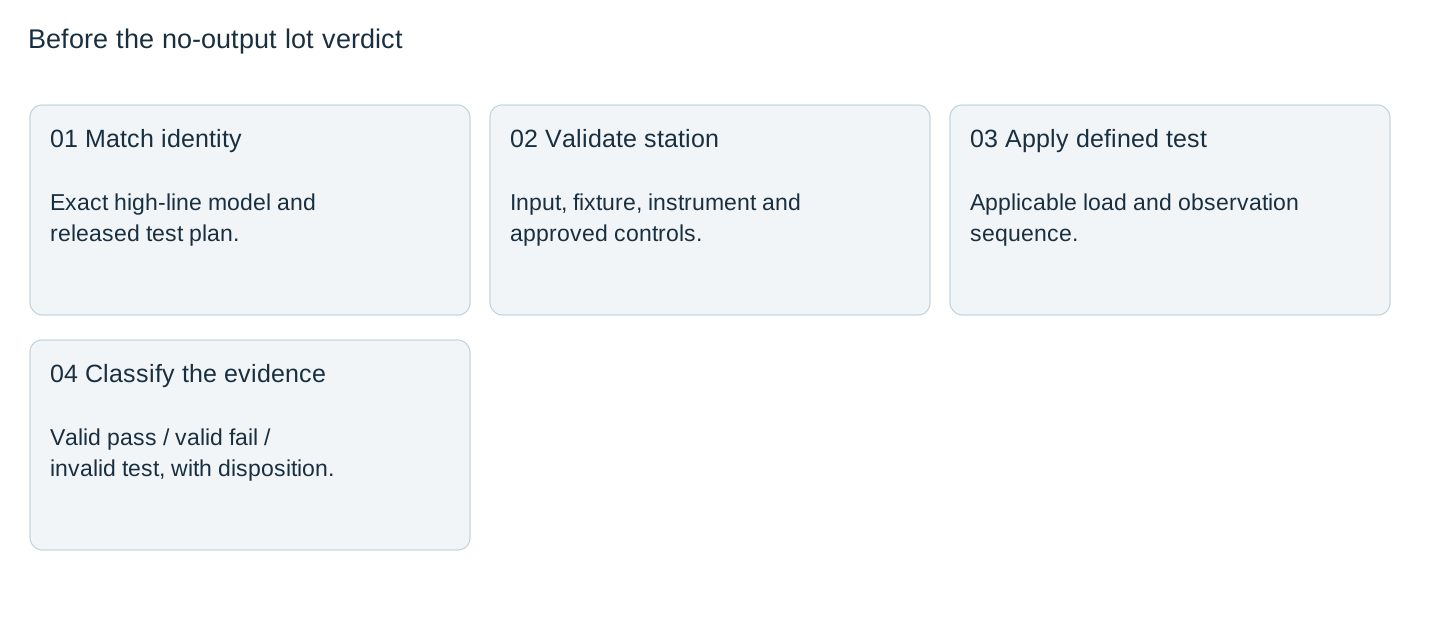
Confirm that the station is testing the intended variant
Receiving should retain the complete purchase-line model and literal sample marking, then identify the applicable supplier specification and approved test revision. Do not let a short description such as “24 V, 50 W supply” select a test programme intended for a different AC-input family.
The LRH-50-24 source image has five power-terminal positions and a high-line input marking. Its appearance can be similar to a small lower-input chassis supply, so the exact label matters before any powered test. The public product page’s output row and input window are document references, not evidence that a particular received unit has been measured.
Check the source at the intended test boundary
Record the approved source setting and the actual documented voltage and frequency at the test connection under the planned condition. Include the source, upstream conditioning equipment and test fixture revision. A control-panel indicator saying “power available” does not establish the voltage supplied to the unit.
| Arithmetic input screen for the photographed 300–450 VAC window | Result | Disposition |
|---|---|---|
| 230 VAC test source | Below the stated minimum | Invalid condition for a within-range operating test; no product-failure conclusion |
| 400 VAC test source | Inside the stated window | May proceed only under the complete applicable authorized procedure |
| 480 VAC test source | Above the stated maximum | Do not use this condition for normal operation of the pictured unit |
These are documentary comparisons, not measured station values. A range check is only one part of the test release. Source protection, grounding, enclosure, equipment ratings and operator controls belong to the responsible test-system design.
Qualify the station before sorting the lot
A new station or changed programme should be checked against its approved reference arrangement before it makes lot decisions. Record the test fixture, connector interface, instrumentation and expected state sequence. Use a controlled verification method to determine whether a failed observation could come from the source or fixture.
Keysight’s power-supply test application note explains why input conditions and appropriate settling matter when evaluating output changes. The general measurement principle applies here: a change or deficiency in the source must not be attributed automatically to the supply under test. It does not transfer a Keysight procedure or numerical limit to LRH-50.

Make load and observation timing part of the programme
State the actual load used for the incoming check, its permitted range and connection boundary. An arbitrary load can create a second invalid test even after the AC source is corrected. An unloaded identity check, a defined-load operating check and a system startup test have different purposes and should not share an unexplained pass field.
Record when observation begins and which output condition ends the waiting period. The LRH page groups setup/rise/hold-up labels with fewer timing values than headings, so this article does not invent a missing hold-up specification or adopt a universal wait time. Obtain an unambiguous applicable sequence before automated sorting depends on it.
Record invalid tests separately from failed units
If the source condition is outside the released plan, classify that observation as invalid rather than marking the unit pass or fail. Preserve the original record, identify the station issue and decide the extent of retesting after correction. Do not erase failed-looking readings merely because a later run looks normal.
If a correctly identified unit fails under a verified, applicable test condition, retain the measured evidence and contain the affected material according to the lot process. A successful repeat should have an attributable reason and disposition; repeated power cycling until one reading passes is not an acceptance rule.
| Record | Minimum useful content |
|---|---|
| Unit identity | Purchase line, received model, label photo and traceable sample |
| Station condition | Source/fixture/programme/instrument revisions and verified input |
| Observation | Load, timing, measured output and original run reference |
| Disposition | Valid pass, valid fail or invalid test; reviewer and next action |
Release a variant-specific test route
Give receiving and the test team an explicit route for high-line variants. The programme should identify which exact models it covers and prevent a familiar lower-voltage bench test from being applied merely because the output is 24 V. Keep electrical safety controls with the station design rather than relying on an operator to infer them from a photograph.
For an LRH-50-24 enquiry, provide the source conditions, actual output demand, intended incoming-test objective and the required document set. Request the applicable ordered-version specification and clarification of incomplete timing information. A useful purchasing result is a repeatable valid observation and a defensible lot disposition, without either falsely rejecting a good high-line unit or treating an invalid test as a pass.
For an LRH-50-24 incoming-test enquiry, attach the actual nameplate and revision, proposed source window, test-boundary diagram, defined load and disposition form. Request the applicable input and connection documentation before authorizing a test-station configuration or rejecting a lot.
High-line supply incoming test disposition
| Run reference | Station condition valid? | Output observation | Pass / fail / invalid | Reason and containment | Retest reference |
|---|---|---|---|---|---|
Blank project worksheet. Enter verified project data; example calculations above are not measurements.