Key Engineering Takeaways
- A stationary temperature-controlled fan is an observation, not an automatic diagnosis of a failed supply.
- Match the delivered LRS-400-24 revision and fan-control information before setting acceptance conditions.
- Record fan state, loading, ambient measurement location and output behavior on one timeline.
- Keep enclosure temperature, internal sensing and permitted operating limits distinct during equipment verification.
Why is “the fan did not start” an incomplete failure report?
A short observation after power-on does not establish whether a controlled fan should be running. The relevant OEM decision is whether the delivered unit’s fan behavior and the equipment’s thermal performance satisfy their documented requirements under the tested conditions.
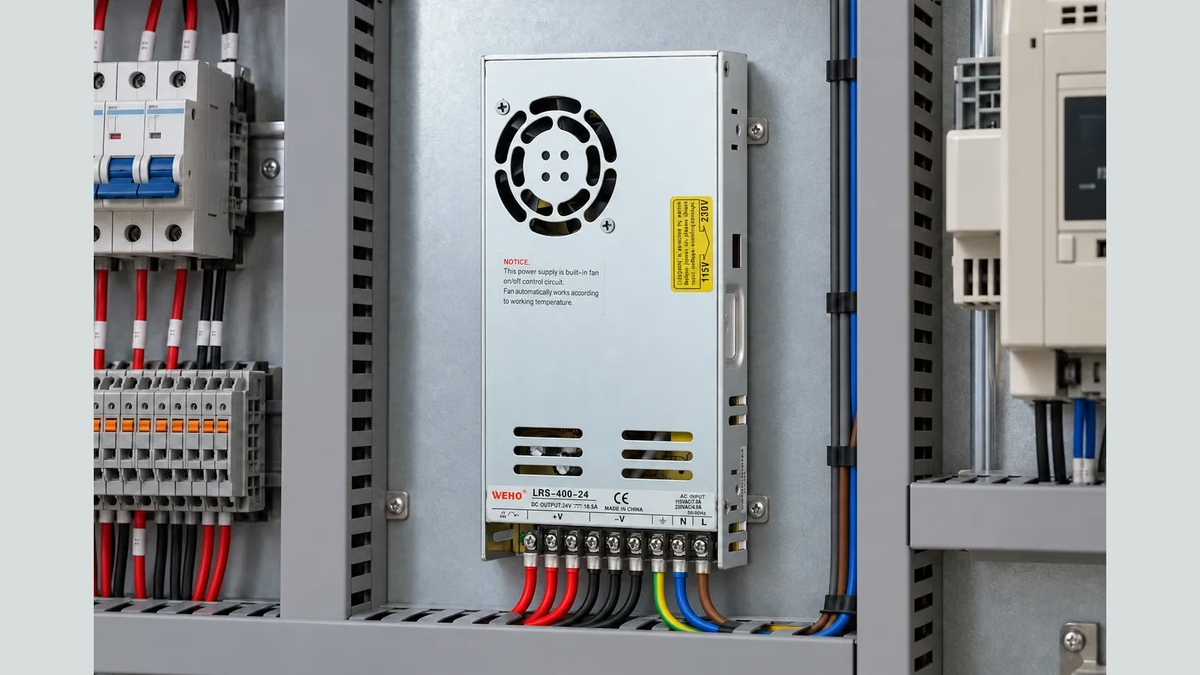
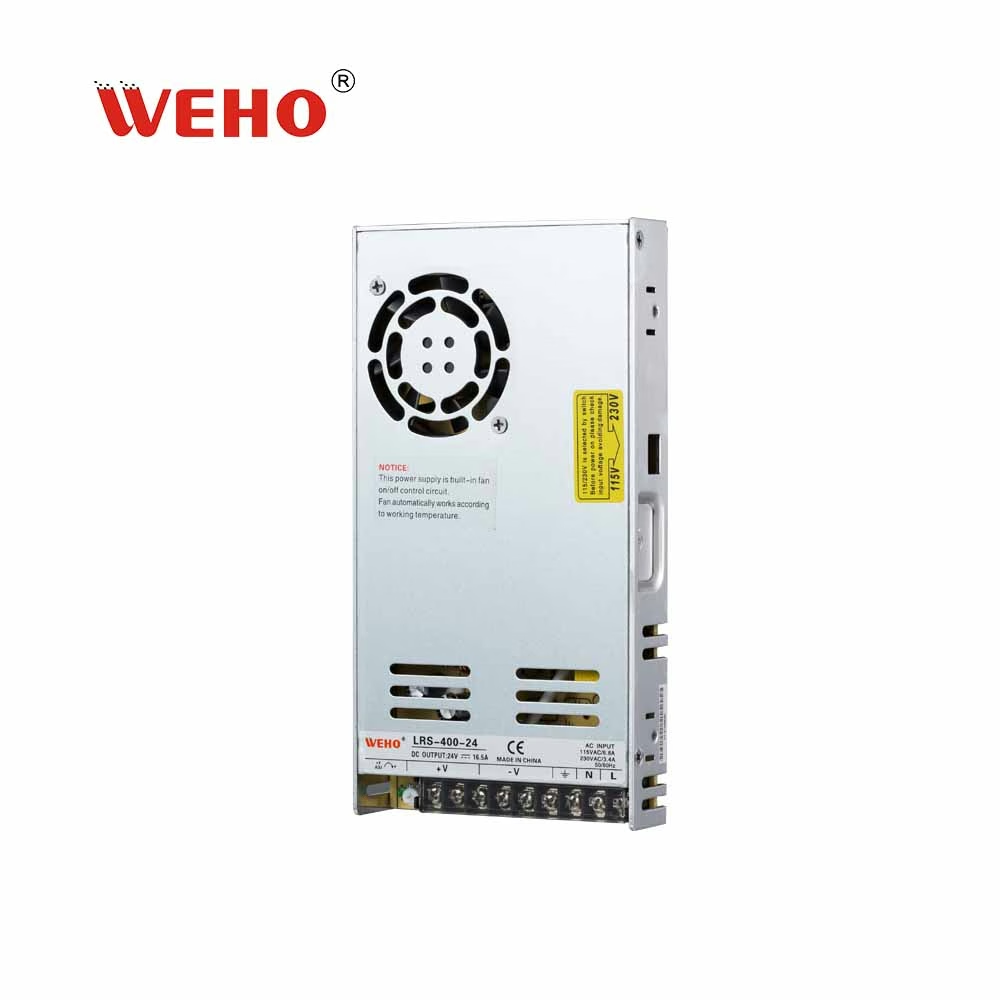
The LRS-400-24 enclosed power supply is the reference for this review. The photographed unit carries a notice describing temperature-dependent fan operation. That notice does not supply a complete acceptance procedure, a guaranteed startup delay or a cabinet-temperature switching point.
This article provides a fan-state observation record and a controlled verification sequence. It does not report a WEHO factory test, diagnose an unseen product or authorize a user to open the supply or interfere with a moving fan.
What should be confirmed for the actual unit?
Confirm the exact model, supplied revision and applicable fan-control description before deciding which observed states are expected. Do not combine a label from one unit with a threshold taken from an unrelated sheet or another product.
The current LRS-400 specification sheet identifies the family and model variants. Its operating information must be read with the installation and thermal requirements applicable to the supplied unit. A published upper ambient limit does not demonstrate full output throughout that range, and a protection value does not become an ordinary operating target.
Ask which variable controls the fan, what measurement location applies and whether the manufacturer supplies a verification method for the delivered version. If the controlling temperature is internal, a sensor placed in the cabinet cannot simply be substituted for it. A case-surface reading is also a different measurement.
Keep source versions with the record. If available documents disagree on the control behavior, retain the discrepancy and request clarification. Do not resolve it by choosing the higher threshold or running the equipment harder until the fan eventually turns.
Which observations belong in a fan-control record?
Record the fan state together with the conditions that could explain it. The observation becomes useful when another reviewer can understand the equipment configuration, sequence and measurement boundaries without relying on an unexplained pass tick.
| Record field | Capture | Interpretation limit |
|---|---|---|
| Unit identity | Model, supplied revision and relevant source documents | Family name alone does not identify a control revision |
| Fan state | Stopped, rotating, changing state or not observable | Sound alone may not establish rotation or speed |
| Loading and input | Actual output demand, operating phase and input condition | An idle observation is not a loaded thermal test |
| Thermal context | Ambient location, enclosure state and relevant heat sources | Cabinet ambient is not an unknown internal sensor temperature |
| Electrical/function result | Defined output observation and equipment behavior | Normal output alone does not demonstrate fan health |
Record the method used to observe rotation. Use suitable, permitted external observation or a documented status interface if the exact product provides one. A photograph of a fan grille does not supply a tachometer signal, and this unit’s visible terminals should not be described as a fan-monitoring connector without supporting documentation.
Also record the cabinet state. Opening a door or removing a duct cover can change the surrounding thermal conditions. If a photograph is captured with the cabinet open, it cannot by itself demonstrate the behavior of the closed equipment in service.
How does a complete observation sequence change the decision?
A sequence separates a quiet initial state from behavior under a defined operating phase. It also makes an unresolved condition visible without turning an illustrative timeline into product performance data.
Hypothetical Fan-State Review Example
Assume an OEM is reviewing a newly assembled cabinet under a documented equipment test plan. The plan contains an idle phase, a representative loaded phase and a recovery phase. The example below deliberately assigns no temperature threshold or mandatory fan-start time because those values must come from applicable documentation.
| चरण | Illustrative observation | Required comparison | Disposition |
|---|---|---|---|
| Initial idle | Fan not rotating; output observation within the plan’s required window | Does the documented control allow this state under these conditions? | Retain the observation; do not call it a fault from startup silence alone |
| Representative load | Fan begins rotating during the recorded sequence | Compare the sequence and thermal result with the applicable requirements | Rotation alone is not a complete thermal pass |
| Recovery | Fan remains rotating after demand decreases | Check the documented control behavior and actual thermal conditions | Do not infer a fault merely from delayed stopping |
| Unresolved state | Fan is not observable when the applicable method requires confirmation | Obtain the specified observation or technical disposition | Keep the affected verification open |
These are hypothetical observations, not measurements of the pictured LRS-400-24. The table illustrates the decision logic: a fan-state observation must be compared with a relevant requirement. It does not establish that the fan in a real unit followed that sequence.
If the control has different start and stop conditions, continued rotation during recovery may be expected. Whether that applies to the delivered unit must be established from its actual information. Do not infer a hysteresis width from one observation or publish a control curve made from unrelated temperature readings.
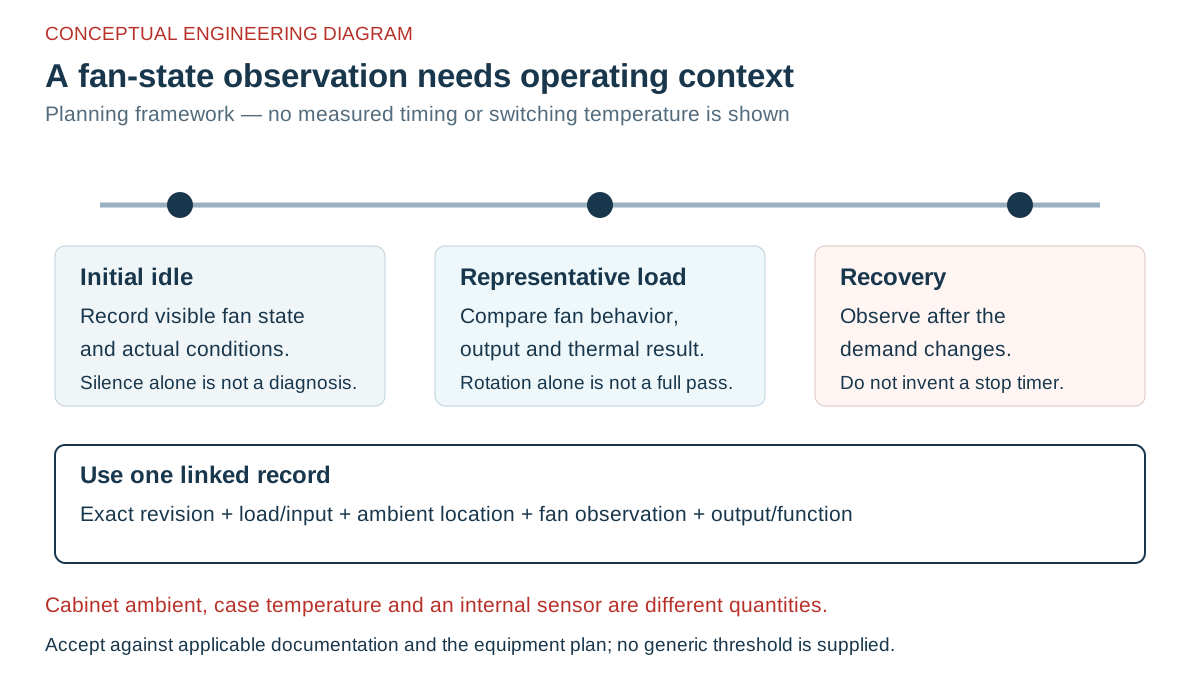
Swipe horizontally on a small screen, or open the full-size diagram.
How should the fan and thermal checks be performed?
Use a planned verification sequence within documented operating limits, with qualified personnel following the equipment’s applicable energy-control procedures. The purpose is to collect interpretable evidence without changing the supply’s protection or cooling arrangement.
- Confirm the configuration. Record the exact LRS-400-24, wiring arrangement, mounting orientation, neighboring heat sources and enclosure revision. Preserve the source for the intended fan behavior and any unresolved document differences.
- Define the expected observations. State which operating phases are required and what evidence will show that the conditions were achieved. Obtain missing fan-control or thermal acceptance information rather than inventing a timer or cabinet-temperature threshold.
- Check unobstructed observation and airflow. Follow the applicable installation instructions. Record visible obstructions or assembly differences. Do not insert objects through the grille, block the fan to create a fault or remove protective parts as an informal test.
- Record a common timeline. Associate loading changes, fan-state observations and relevant electrical and thermal measurements with the same sequence. Note door position, ambient-sensor location, instrument limits and any period in which rotation could not be observed.
- Evaluate separate acceptance questions. Compare fan behavior with its documented control, and compare equipment temperatures and output behavior with their own applicable limits. One pass does not automatically establish the others.
- Close or escalate the result. Retain the evidence supporting acceptance. Where a documented required condition is not met, stop or isolate the equipment as required by its procedure and obtain a technical disposition. Repeat the affected verification after an authorized correction.
A replacement fan is not a general accessory choice. Voltage, airflow, mechanical fit, control interaction and compliance implications may matter. This article does not authorize fan replacement, bypassing temperature control or an assumption that a quieter aftermarket part is equivalent.
For production, preserve the accepted layout and observation method. A different enclosure, obstruction or neighboring heat source can change the equipment result even when the supply model is unchanged. Reuse the procedure, but verify the changed configuration rather than copying an old result.
What should you send for a fan-behavior enquiry?
Send the LRS-400-24 unit and fan information, clear original label photographs, the relevant document revision and the actual observation sequence. Include loading, input condition, enclosure arrangement, ambient measurement location and what behavior the equipment requirement expected.
Ask WEHO about the observed fan behavior and request the information applicable to the supplied unit. A traceable condition-and-state record is more useful than a report that only says the fan was silent.
Engineering FAQ
Should an LRS-400-24 fan always turn immediately after power-on?
Immediate fan rotation should not be assumed from the presence of a fan. The pictured unit describes temperature-dependent operation. Verify the delivered version’s control information and the actual conditions before deciding whether a stationary initial state is expected.
Can a cabinet temperature be used as the fan’s switching temperature?
Cabinet temperature cannot automatically replace the fan controller’s sensing variable. Record the actual sensor location and obtain the applicable control information. Internal temperature, case temperature and cabinet ambient are different measurements.
Does normal DC output prove that the fan is healthy?
Normal DC output does not by itself demonstrate fan health or thermal acceptance. It is one observation under defined conditions. Evaluate the fan and equipment thermal behavior through the applicable method rather than relying on the output indicator alone.
Should a fan stop as soon as the load decreases?
A load decrease alone does not establish that a controlled fan should stop immediately. Thermal conditions and the delivered control behavior matter. Compare the recorded recovery phase with the applicable documentation instead of assigning an unsupported stop time.