Ultimo aggiornamento: 1 ottobre 2026
Risposta rapida: Check power supply certifications by matching the exact ordered model and revision to the applicable market rules, declarations and supporting reports. CE marking is not an EU-issued safety certificate; RoHS concerns restricted substances; FCC equipment authorization depends on device classification and the relevant procedure. A label photograph or AI-generated application image cannot prove compliance. For a B2B purchase, resolve document gaps before release and assess the finished equipment separately from its power-supply component.
An OEM buyer reviewing power supply certifications needs more than a row of logos. The practical question is whether the evidence covers the supplied product, intended market and integration conditions. A report for another voltage variant, an unsigned declaration or an attractive catalogue image leaves that question open.
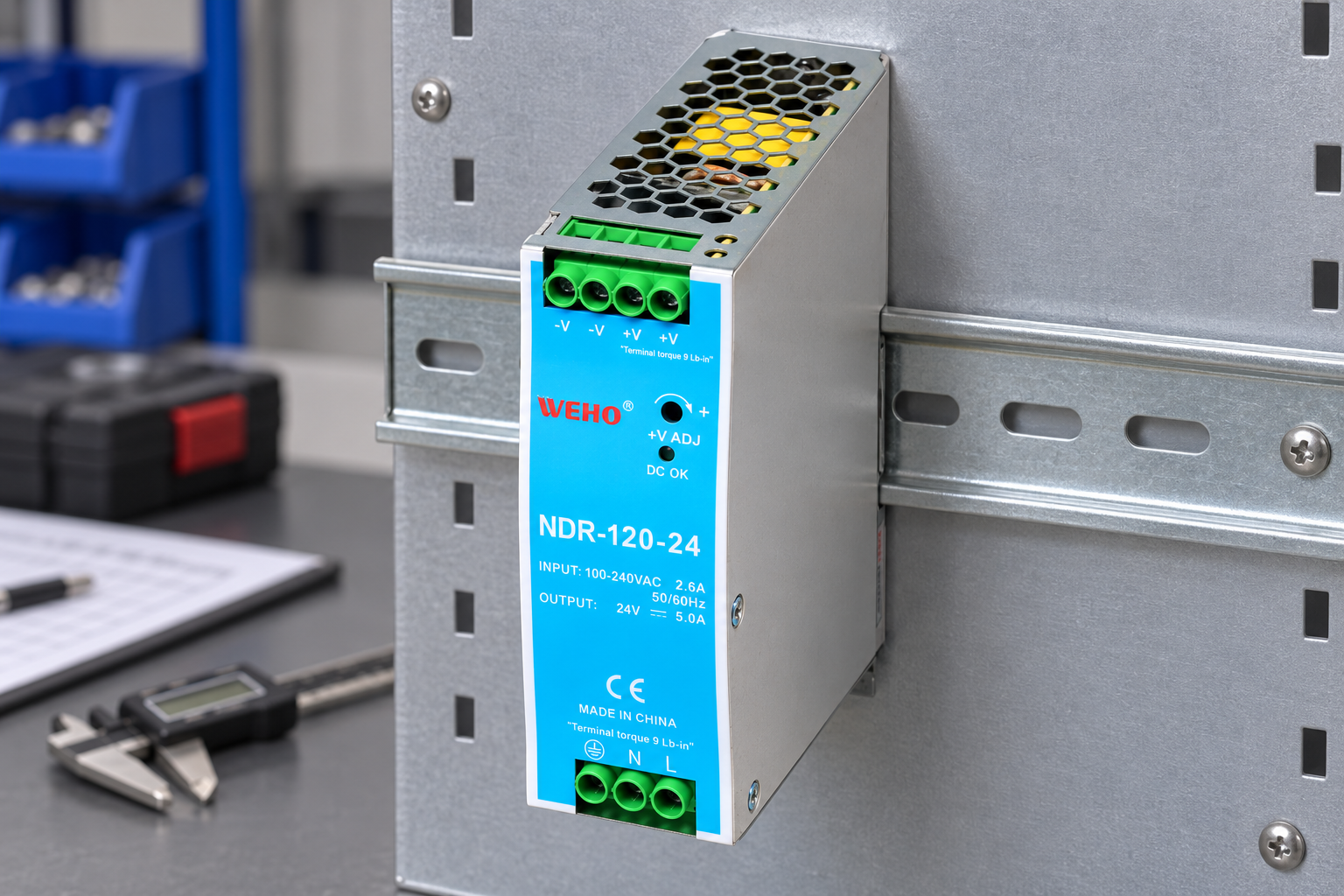
This guide uses the WEHO NDR-120-24 as a mechanical identity reference, not as a certified-product recommendation. Its approved source photograph visibly carries a CE mark. No exact-model EU declaration, RoHS material dossier, FCC authorization record or UL evidence has been verified for this article. The illustrations do not change that evidence boundary.
CE: identify the declaration behind the mark
The European Commission describes CE marking as the manufacturer’s declaration that applicable CE-marking requirements are met. The manufacturer performs the required conformity assessment, prepares technical documentation and issues the EU declaration of conformity. The mark does not mean that the EU or another authority approved the product as safe. A third-party certificate is therefore not automatically the correct document to request for every CE-marked product. European Commission CE guidance.
Start the buyer’s review with the signed declaration and its product identification. Check the responsible manufacturer, model or type, cited legislation, standards or other assessment basis, signatory and issue date. Where third-party involvement is required by the applicable procedure, verify that corresponding evidence rather than assuming the same route applies to every product. The EU’s declaration guidance also distinguishes a component supplier’s responsibility from the party placing the finished equipment on the market. Your Europe declaration guidance.
As a procurement control, compare this identification with the quotation, purchase order, received label and supplier revision record. If a declaration lists a family instead of the full model, ask for an explicit coverage explanation. Do not infer coverage merely because two units share an enclosure.
RoHS: examine material evidence and applicability
RoHS restricts specified hazardous substances in electrical and electronic equipment. Scope, exclusions and applicable exemptions matter; the directive is not a statement about output regulation, electrical safety or suitability for a particular machine. The Commission maintains the legislation and exemption references. European Commission RoHS information.
For a buyer’s file, request a dated product-specific compliance statement and an explanation of the supporting material assessment. Ask which revision, components and any claimed exemptions it covers. Depending on the evidence strategy, supporting records may include supplier material declarations and relevant analytical reports. One laboratory result on one material is not automatically a complete assessment of the assembled supply. This is a document-review recommendation, not a claim that one particular test is legally mandatory for every purchase.
Keep RoHS separate from other chemical or waste obligations. A document headed “environmental compliance” should identify the actual requirement it addresses. Missing scope or untraceable material coverage should remain an open action, not be converted into an approved status because a green logo appears in a brochure.
FCC: classify the equipment before requesting a certificate
For applicable unintentional radiators, the FCC rules specify authorization procedures by equipment type, with exemptions addressed separately. The table includes external switching power supplies and identifies Supplier’s Declaration of Conformity, or SDoC, and certification routes. It does not establish that every industrial power supply must have the same certification or FCC identifier. 47 CFR 15.101.
Have the responsible compliance specialist determine the classification and procedure for the actual product and intended use. Request matching emissions evidence and the responsible-party information appropriate to that route. Do not turn a generic “FCC compliant” sales statement into proof of an authorization that has not been checked.
Exemptions also require a specific basis. “Industrial” in a catalogue title is not enough to conclude that all equipment or every function qualifies. The exemption rule addresses particular uses and combined-device conditions. Avoid assuming that an industrial controller exemption covers an entire cabinet or unrelated equipment. 47 CFR 15.103.
Establish product identity before reviewing compliance claims
IL WEHO NDR-120 product page lists NDR-120-24 at 24 V and 5 A. The current WEHO specification records a 40 mm width × 125.2 mm height × 113.5 mm depth envelope. The source unit has a blue front, four upper DC terminals and three lower AC terminals, with an adjustment opening and DC OK indicator. These facts identify the component; they do not establish certification coverage.
For drawing and receiving inspection, match the complete suffix, terminal arrangement, physical envelope and revision to the ordered item. Treat the source label’s nominal input text separately from an operating-range table. If public information and the current specification conflict, obtain a reconciled controlled document before electrical release. Do not silently choose whichever value supports the purchase.

An electronics-assembly burn-in station can contain a separate 24 V PLC/I/O subsystem. The first application illustration shows mechanical fit with the enclosure isolated, terminals unwired and controllers dark. It does not claim that the NDR-120-24 powers the burn-in loads or that the station has passed safety or emissions tests. Verify actual subsystem demand and installation conditions independently.

A greenhouse irrigation supervisory cabinet presents a different integration context. Its electronic controller may be separate from pumps, motors and lighting. The illustration places the component in a protected dry service space for an isolated fit review; it does not establish outdoor protection, load compatibility or a completed irrigation installation. Mechanical visibility is useful for identity checks, but is not evidence of regulatory approval.
Build a procurement evidence file with a clear release decision
Keep a short index linking the ordered model and revision to the applicable requirements, declarations, supporting reports and integration restrictions. Record the document issuer, date, coverage and unresolved questions. Request traceable originals from the supplier; do not accept a screenshot with missing pages as equivalent to a complete report.
Assign each gap an owner and a release consequence. Examples include a model absent from the declaration, an unexplained revision change, unsupported exemption wording or a report sample that cannot be matched to the supplied construction. Do not replace a missing answer with an assumption. Escalate the technical question to the supplier and the buyer’s compliance specialist.

Punti chiave
- Match evidence to the exact product and revision, not just a familiar series name.
- Distinguish CE marking, substance restrictions and FCC authorization procedures.
- Keep visible markings and illustrative images separate from verified documents.
- Review the final equipment and its integration obligations independently.
- Leave unresolved evidence gaps open until the responsible reviewer closes them.
Conclusione
Effective power supply certifications review is a traceability process, not a logo-counting exercise. Ask WEHO for the current specification and available compliance documents for the exact ordered model, then have the responsible project reviewer assess applicability and coverage. The NDR-120-24 shown here provides a controlled mechanical reference only. No certificate, regulatory authorization or final-system approval is established by these illustrations.
Domande frequenti
Does a CE mark mean the EU has certified a power supply as safe?
No. The European Commission explains that the mark is not approval by the EU or another authority. Review the manufacturer’s applicable declaration and supporting conformity evidence.
Does a RoHS statement establish electrical safety or emissions performance?
No. RoHS concerns restricted substances. Check its product coverage, material evidence and any applicable exemptions separately from safety and emissions requirements.
Must every switching power supply have an FCC certificate or FCC ID?
Do not assume that. Equipment classification, applicable rules, authorization procedure and any valid exemption determine the evidence required. A generic catalogue claim does not establish that determination.
Is NDR-120-24 certified for CE, RoHS, FCC or UL by this article?
No. The approved source photograph visibly carries CE, but no exact-model declaration, RoHS dossier, FCC authorization or UL evidence was verified for this article. Images are identity illustrations only.
Do the application pictures show proven machine compatibility?
No. They depict isolated mechanical-fit contexts for controller electronics. They do not establish actual load, environmental suitability, powered operation or final-equipment compliance.
What should procurement do when the model or revision does not match the report?
Keep the gap open and obtain a traceable coverage explanation or corrected evidence from the supplier. Have the responsible compliance reviewer close it before release.