Power Supply for Railway Trackside Equipment: Build a Qualification Matrix
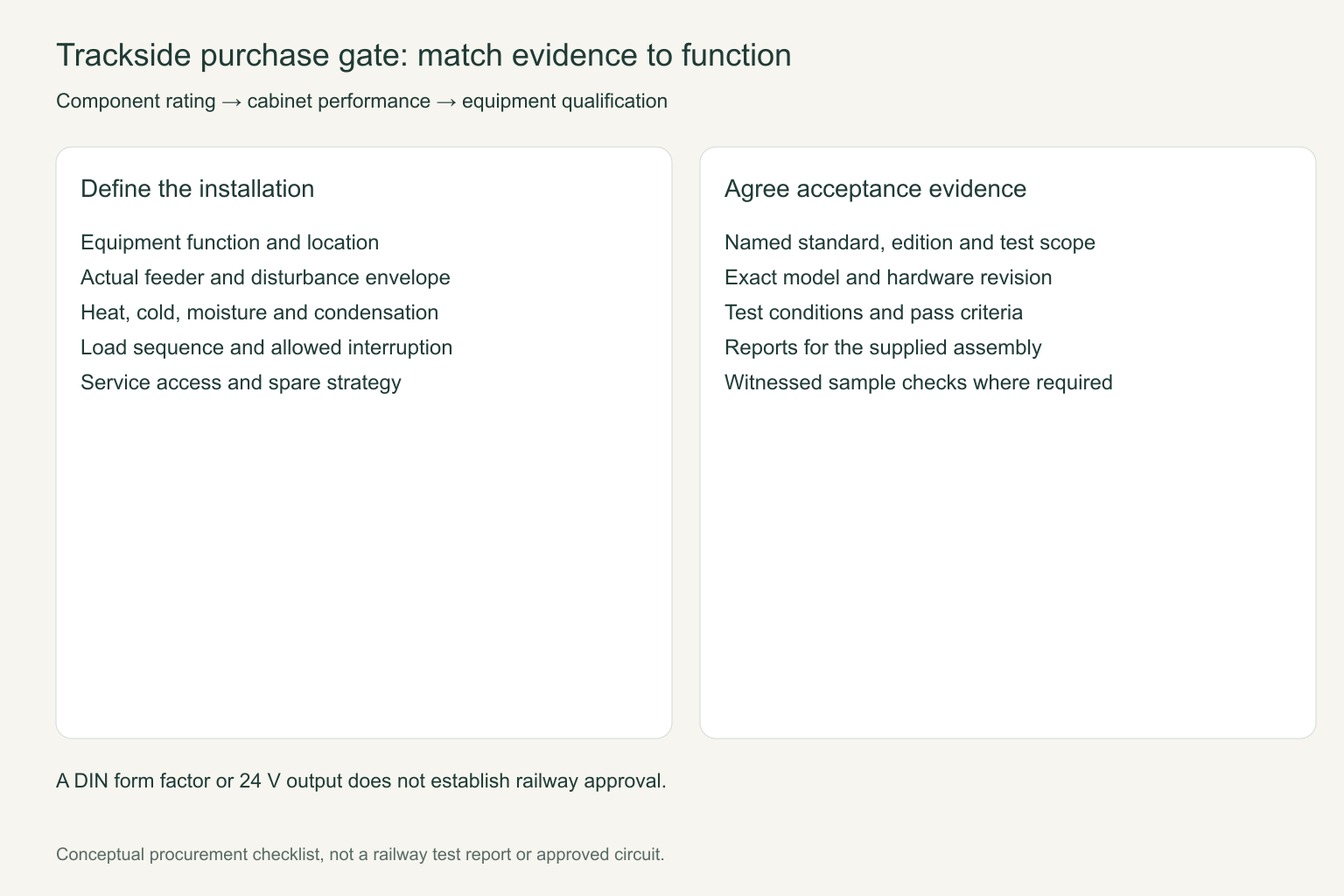
A power supply for railway trackside equipment should be selected against the asset’s function, actual feeder, cabinet environment and agreed acceptance tests. A DIN-rail housing and a 24 V output do not establish railway suitability. The useful purchasing deliverable is a qualification matrix linking each requirement to the exact offered model, revision, test conditions and responsible party.
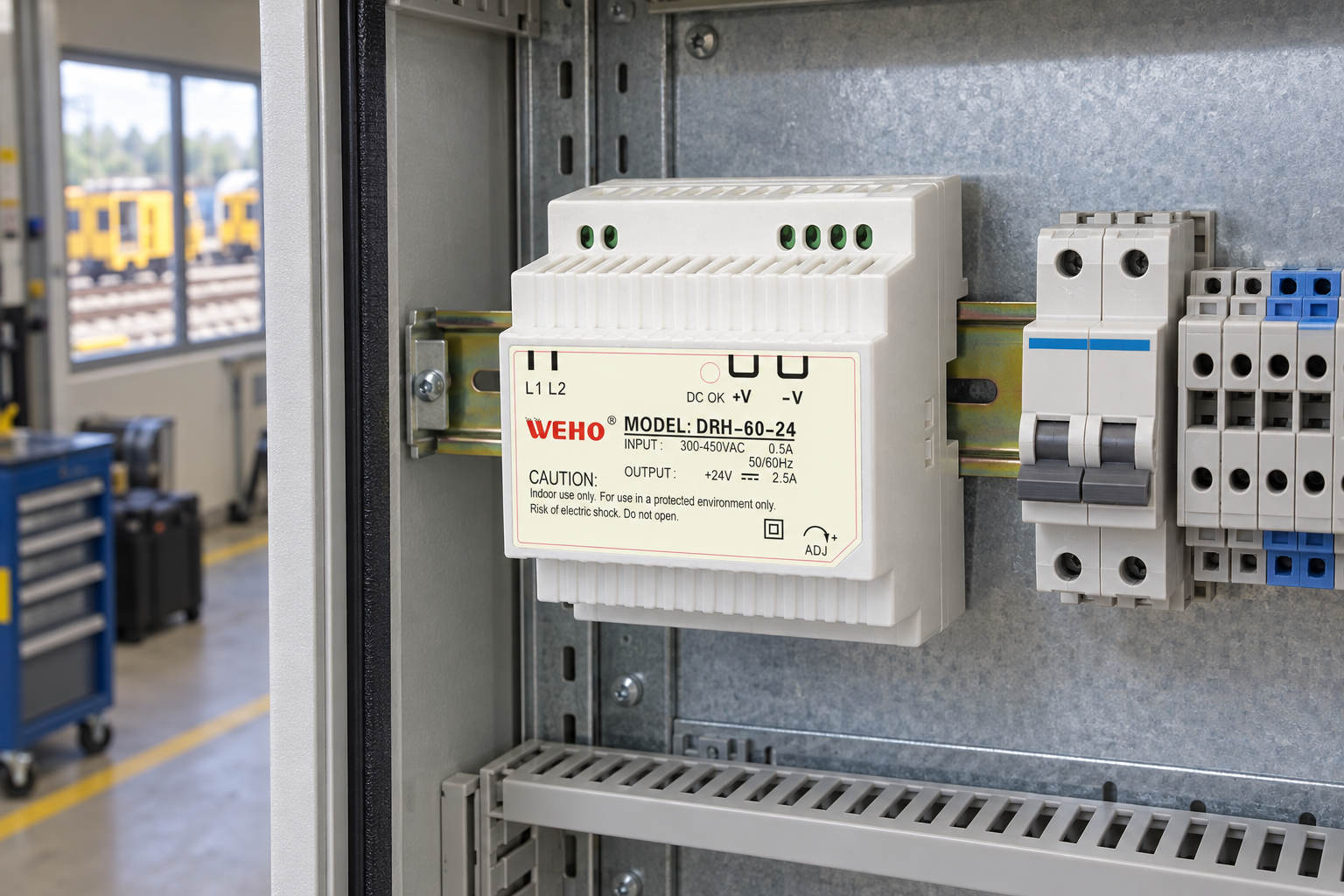
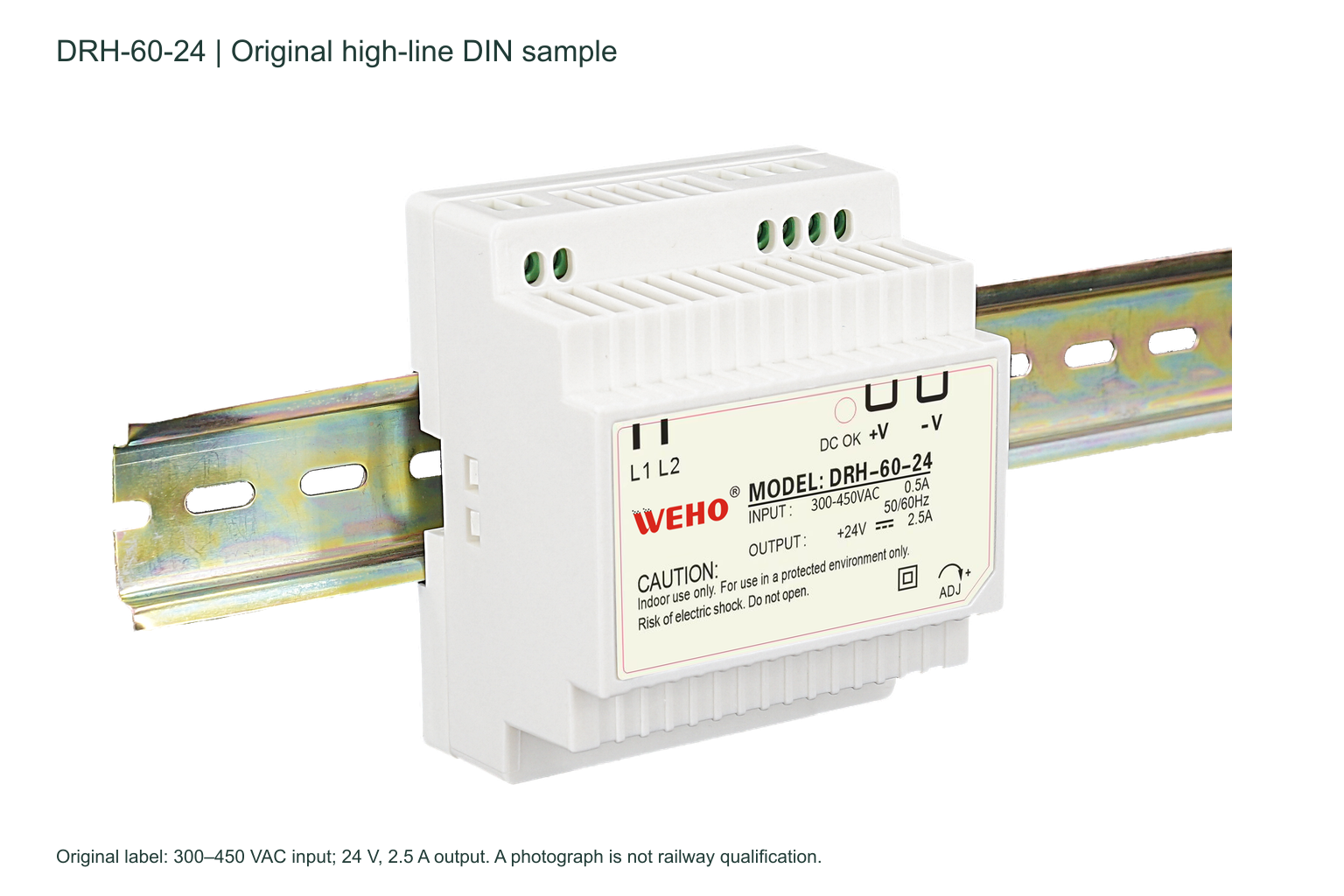
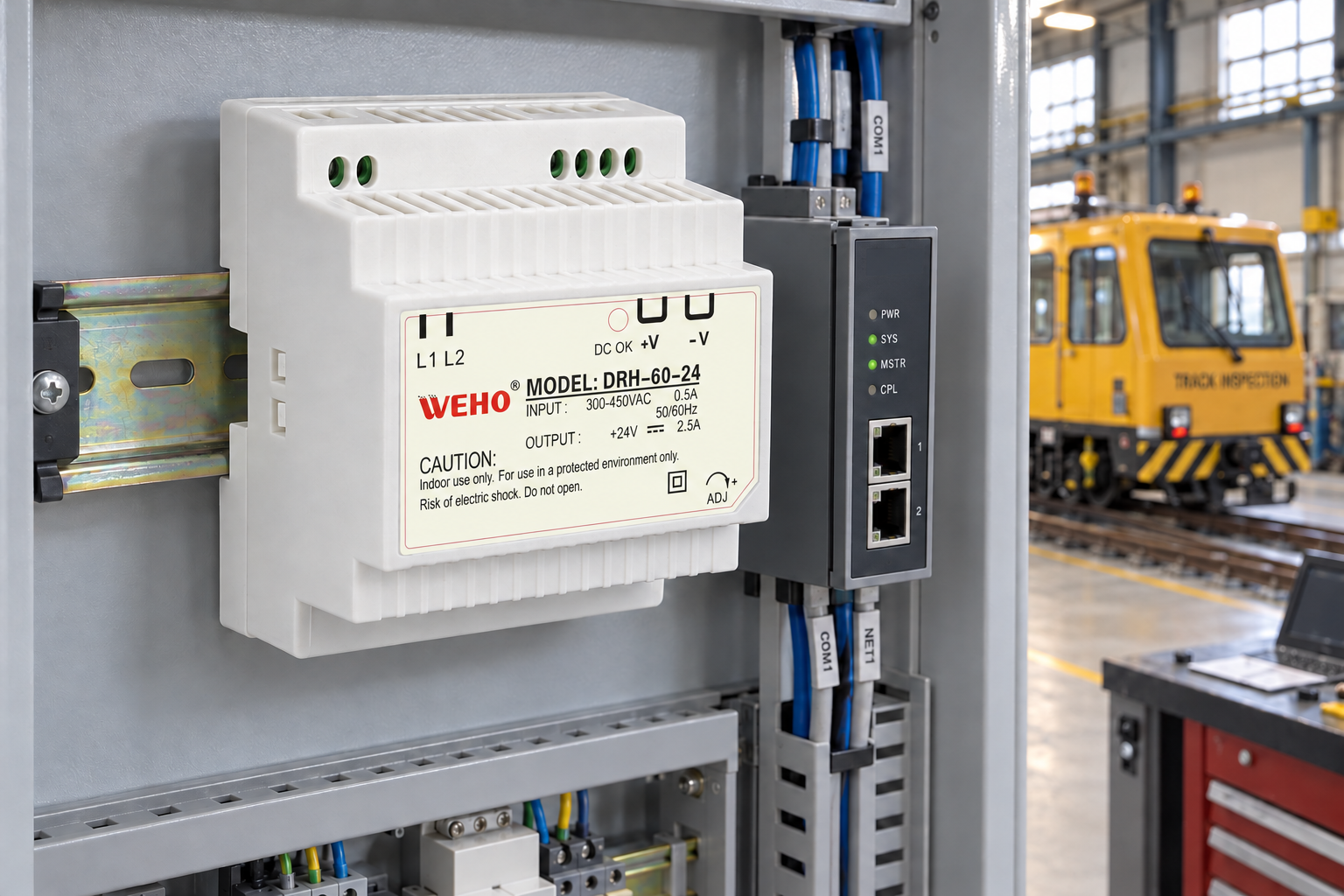
The DRH-60-24 illustrates the initial component screen. Its original label identifies a 300–450 VAC input and a 24 V, 2.5 A output. These facts do not prove that it has passed a railway project specification. The illustrations concern protected ancillary enclosure planning, not permission to power safety-related signalling equipment.
Define the railway function before naming a standard
A trackside communication cabinet, traction installation and depot maintenance enclosure need not share one qualification route. Specify the equipment function, location, customer rules and interfaces. Do not copy a rolling-stock requirement simply because the customer operates trains.
L'attuale BSI scope for BS EN 50736:2025 addresses type testing of trackside signalling and telecommunication equipment, including power systems belonging to those systems. It distinguishes vehicle-mounted equipment and does not itself cover safety considerations. The BS EN 50125-2 scope concerns certain fixed electrical installations and excludes signalling and telecommunications. Have the project authority define applicable documents and editions, rather than assuming one standard covers every cabinet.
Screen the actual feeder
The photographed DRH input is marked L1 and L2, not a universal L/N 100–240 V input. An ordinary 230 VAC branch is outside its stated 300–450 VAC window. A nominal value inside the window is only an initial screen: obtain the steady voltage extremes, interruptions, disturbances, earthing arrangement and upstream protection requirements.
The supplied sheet also lists a DC input range. That does not replace delivered wiring instructions or approve an arbitrary railway DC network. State the required input type in the RFQ and ask the supplier to identify the exact offered arrangement. Preserve actual terminal markings when comparing drawings and sample photographs.
Specify the cabinet environment measurably
The selected sheet gives a −10 to +50 °C working-temperature row. The sample label restricts use to a protected indoor environment. Neither establishes performance in a sun-heated outdoor cabinet, condensation cycle or corrosive enclosure. Specify air conditions at the supply location, including heater operation and ventilation loss, not only the local weather temperature.
Define moisture control, cable entries, contamination, airflow and access with the enclosure designer. For required vibration, shock, surge or EMC tests, identify severity, mounting, connected cables and acceptance criteria. A report for another model or different conditions must not silently become an assembly-level result.
Document loads and availability
List each receiver’s steady current, startup demand, duty cycle and voltage window. Include communication modules, relays and auxiliary electronics separately. The sample’s 2.5 A marking does not guarantee that an arbitrary load combination will start together or tolerate its protection behaviour.
State allowed interruption and recovery behaviour. If backup or redundancy is required, identify the battery, charger, isolation or redundancy equipment and failure-detection method. One DIN supply is not a complete backed-up architecture. A DC OK indicator also does not prove a remote alarm contact; verify the actual interface from its documentation.
Agree sample acceptance before freezing the panel
The matching drawing gives 78 × 93 × 56 mm and TS35/7.5 or TS35/15 mounting. Verify the offered drawing, rear rail engagement, clearances and removal access with a sample. Do not add a protective-earth terminal that the product does not provide; protective measures for the wider assembly remain the system designer’s responsibility.
Agree a revision-controlled inspection list: identity and label, input instructions, dimensions, loaded output over the specified range, startup and recovery, and project-mandated environmental or EMC checks. Define who performs each check, pass/fail limits and the changes that trigger requalification. The selected evidence does not include a railway approval report for this exact model.
Prepare an actionable RFQ
Send the function, deployment region, feeder envelope, receiver schedule, enclosure drawing, service conditions, required standards and report scope, backup expectations and planned quantities. Identify operator acceptance procedures. Request an exact model/revision offer, current documents, relevant report identifiers and an agreed sample plan.
Compare families in the WEHO product catalogue E request a project-specific review. Confirm quantities and delivery terms in the quotation rather than inferring them from a family page.
Buyer questions
Does a 24 V DIN supply automatically meet a trackside specification?
No. Electrical rating and mounting are only two requirements. The project needs matching environmental, EMC, functional and acceptance evidence.
Can the DRH-60-24 use a normal 230 VAC branch?
Not on the photographed 300–450 VAC input marking. Select a suitable input variant and confirm its instructions instead of relabelling the high-line sample.
Is a general test report enough for operator approval?
The project’s acceptance authority decides. Submit the exact model, revision, conditions and report scope so gaps can be closed before production purchasing.