Introduzione
How Inductive Proximity Sensors Work
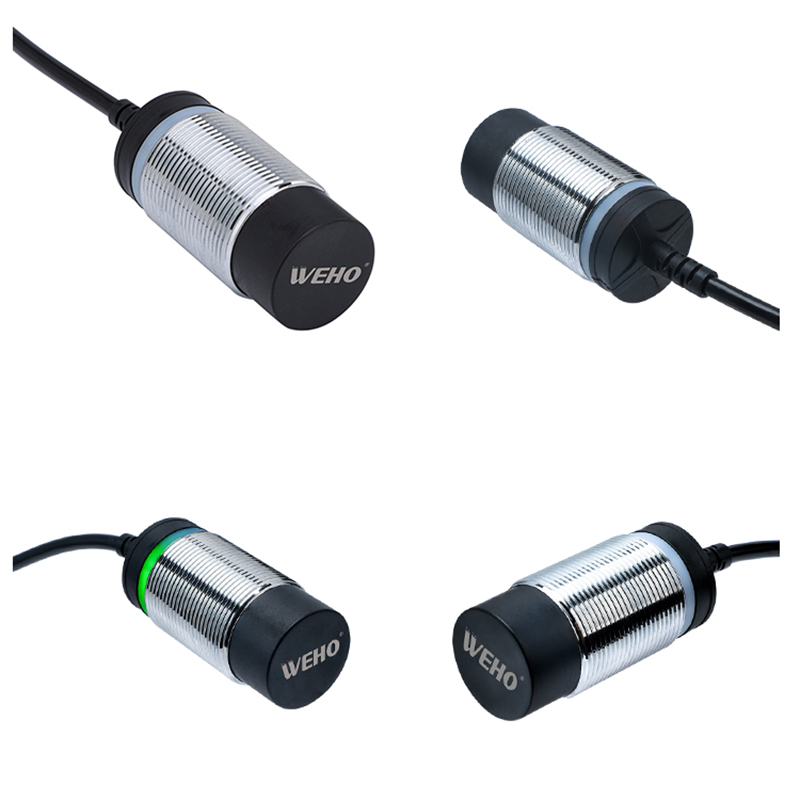
Inductive proximity sensors detect metal objects without touching them. They use an electromagnetic field, and when a metal object enters this field, the sensor sends a signal. These sensors are common in factories to help machines work smoothly.
Learn More: What is a Proximity Sensor?
Learn More: How Does a Proximity Sensor Work?
Why Understanding NPN vs PNP Matters
Knowing the difference between NPN and PNP sensors is important because it affects how you connect the sensor to your control system. Using the wrong type can cause errors or damage.
Understanding NPN and PNP
What is an NPN Sensor?
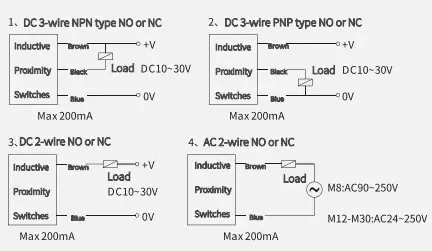
An NPN sensor connects the output to ground (negative) when it detects something. This means it “sinks” current through the load.
What is a PNP Sensor?
A PNP sensor connects the output to the positive voltage when active. It “sources” current to the load.
5 Main Differences Between NPN and PNP Sensors
| Difference | NPN Sensor | PNP Sensor |
|---|---|---|
| Signal Output | Sends a negative (ground) signal | Sends a positive voltage signal |
| ON Logic Level | ON when connected to ground (0V) | ON when connected to positive voltage |
| Wiring Setup | Load wired between positive supply and output | Load wired between output and ground |
| Regional Use | More common in Asia | More common in Europe and North America |
| Common Confusion | Often mistaken for positive output | Often mistaken for negative output |
NPN sensors send a negative (ground) signal. PNP sensors send a positive signal.
Learn More: The Switch Mode Power Supply
ON Logic Level
NPN sensors are ON when connected to ground (0V). PNP sensors are ON when connected to positive voltage.
Wiring Setup
For NPN, the load is wired between the positive supply and the sensor output. For PNP, the load is between the sensor output and ground.
Regional Use
NPN sensors are more common in Asia. PNP sensors are popular in Europe and North America.
Common Confusion
People often mix up which sensor outputs positive or negative signals. It depends on wiring and the sensor’s transistor type.
Learn More: How to Test an Inductive Sensor
Conclusione
Both NPN and PNP inductive proximity sensors detect metal objects well. The main difference is in their output signals and wiring. Knowing these differences helps you choose the right sensor and connect it correctly for safe and reliable operation.
Categorie
Prodotti popolari

SE-1500 : 1500W AC to DC Adjustable Voltage and Current Switching Power Supply
Apr 17, 2026
SE-1200 : 1200W AC to DC Adjustable Voltage and Current Switching Power Supply
Apr 17, 2026
SE-1000 : 1000W AC to DC Adjustable Voltage and Current Switching Power Supply
Apr 17, 2026
Convertitore CC-CC da 60 V-72 V a 12 V 15 A 180 W
15 aprile 2026
Convertitore CC-CC da 60 V-72 V a 12 V 10 A 120 W
15 aprile 2026Avvertimento: tentativo di accedere all'offset dell'array su false in /www/wwwroot/wehopower.com/wp-content/themes/weho/single-news.php in linea 128
"src="" >