Last Updated: 2026-09-08
48v to 24v converter selection starts by calculating the 24V load current, converter wattage, input current from the 48V source, and heat under real duty cycle. Use proper fusing, wire size, polarity checks, mounting, and derating before powering controls, lights, pumps, fans, communication devices, or vehicle accessories.
48v to 24v converter sizing starts with output current

A <strong>48V to 24V 변환기</strong> 48V 배터리, 차량 공급 장치 또는 DC 버스에서 24V 장비를 작동시킬 수 있습니다. 첫 번째 크기 조정 단계는 24V 로드 전류입니다. 컨트롤, 조명, 팬, 펌프, 릴레이, 통신 모듈 및 액세서리를 포함하여 24V 출력에 연결된 모든 장치를 추가합니다.
After the output current is known, calculate output watts. For example, a 24V 5A load is 120W. The 48V input current will be lower than the 24V output current, but it is not half exactly because conversion losses and operating conditions matter. Use datasheet efficiency and leave practical margin.
Match converter wattage and duty cycle

A converter that handles a short test load may not be suitable for continuous operation in a hot compartment. Check continuous rating, enclosure temperature, waterproof requirement, mounting surface, and airflow. If the load includes motors, solenoids, or lamps, check startup current as well as running current.
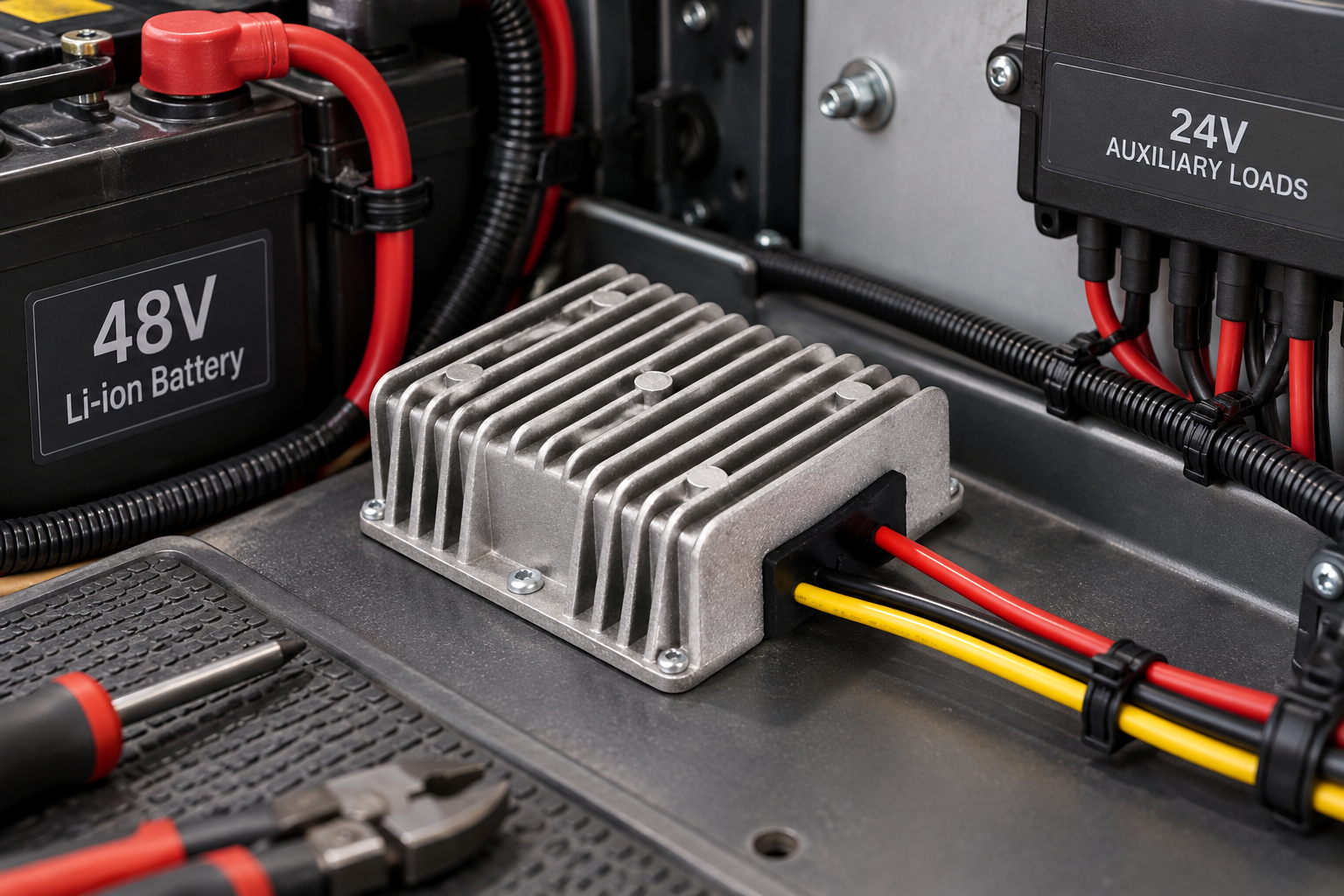
그만큼 WEHO 48V to 24V 5A DC-DC converter is a relevant product-family reference for a 120W step-down application. Higher-current models may be needed when the 24V branch includes multiple devices or long duty cycles.
Wire the input side correctly

The input side connects to the 48V source. Confirm polarity before energizing the converter. Use a fuse or breaker close to the source so the cable is protected if a fault occurs. Choose wire size from current, distance, insulation rating, and installation environment.
In battery and vehicle systems, the 48V source may vary during charging, discharge, or load transients. The converter input range must cover the real voltage window, not just the nominal 48V label.
Wire the 24V output side safely
The output side supplies the 24V load. Keep branch wiring organized and label the output polarity. If several loads share one converter, use branch protection where needed and measure voltage at the farthest load under real operating current.
Long low-voltage runs can cause voltage drop. A device near the converter may work while the farthest device resets. If that happens, improve cable size, split the load, move the converter closer, or use separate converters for distant branches.
Avoid grounding and noise mistakes
Some DC-DC converters are isolated and some are non-isolated. Isolation affects grounding, noise control, and fault behavior. Do not assume either type from the product name alone. Check the exact model documentation before connecting sensitive communication equipment or control circuits.
Noise-sensitive loads may need cable routing, filtering, shielding, or grounding attention. Keep high-current cables away from signal wiring when the installation allows it.
48V to 24V wiring checklist

Confirm input voltage range, output current, peak current, wattage, converter isolation, fuse position, wire size, polarity, mounting surface, heat path, cable distance, and environmental protection. Test under real load before connecting all branches.
FAQ
48V to 24V 컨버터는 무엇을 하나요?
48V DC 소스를 규제된 24V DC 출력으로 낮추어 24V 장비가 48V 배터리, 차량 또는 산업용 DC 버스에서 작동할 수 있도록 합니다.
48V ~ 24V 변환기의 크기는 어떻게 조정합니까?
24V 부하 전류를 추가하고 출력 와트에 24V를 곱하고 시동 전류와 마진을 포함한 다음 입력 전류, 열 및 감소를 확인합니다.
Do I need a fuse on the input side?
Yes. A suitable input fuse or breaker helps protect wiring and the 48V source if a short circuit or converter fault occurs.
Can one converter power several 24V loads?
Yes, if total current, startup demand, wiring, branch protection, and voltage drop stay within the documented limits of the converter and installation.
Where is a 48V to 24V converter commonly used?
Common uses include electric vehicles, battery systems, telecom equipment, industrial controls, forklifts, mobile machinery, and 48V power systems with 24V accessories.
What details should I provide for WEHO model selection?
Send input voltage range, 24V load current, peak current, waterproof need, mounting space, ambient temperature, cable length, and application type.
주요 시사점
- Size a 48V step-down converter from the 24V load current first.
- Input current depends on wattage and efficiency, not only the voltage ratio.
- Fuse the 48V input close to the source and verify polarity before startup.
- Check cable voltage drop on the 24V output side under real load.
- A <strong>48V to 24V 변환기</strong> 분리되거나 분리되지 않을 수 있으므로 정확한 모형을 확인합니다.
결론
A <strong>48V to 24V 변환기</strong> 48V 소스가 24V 부속품이나 제어 장비에 전원을 공급해야 할 때 유용합니다. 실제 전류, 와트, 작동 동작, 배선 거리, 환경 및 격리 요구 사항 중에서 선택하십시오. 모델 일치에 대한 도움말은 WEHO 제품 페이지, 이메일을 참조하십시오. <a href="/ko/”mailto:[email protected]”/">[email protected]</a>, 을 클릭하거나 사용하여 WEHO contact page with your input range, output load, and installation details.
다음 항목 검토 WEHO 제품 카테고리, 이메일 [email protected], 또는 연락 WEHO 입력 전압, 출력 부하, 주변 온도 및 설치 세부 정보를 포함합니다.