The phrase adjustable vs fixed power supply can describe two very different purchasing decisions. One is choosing a nominal output variant; the other is trimming the output of an already selected unit. Confusing them can lead to an incorrect order, excessive voltage at a connected device or a misleading application illustration.
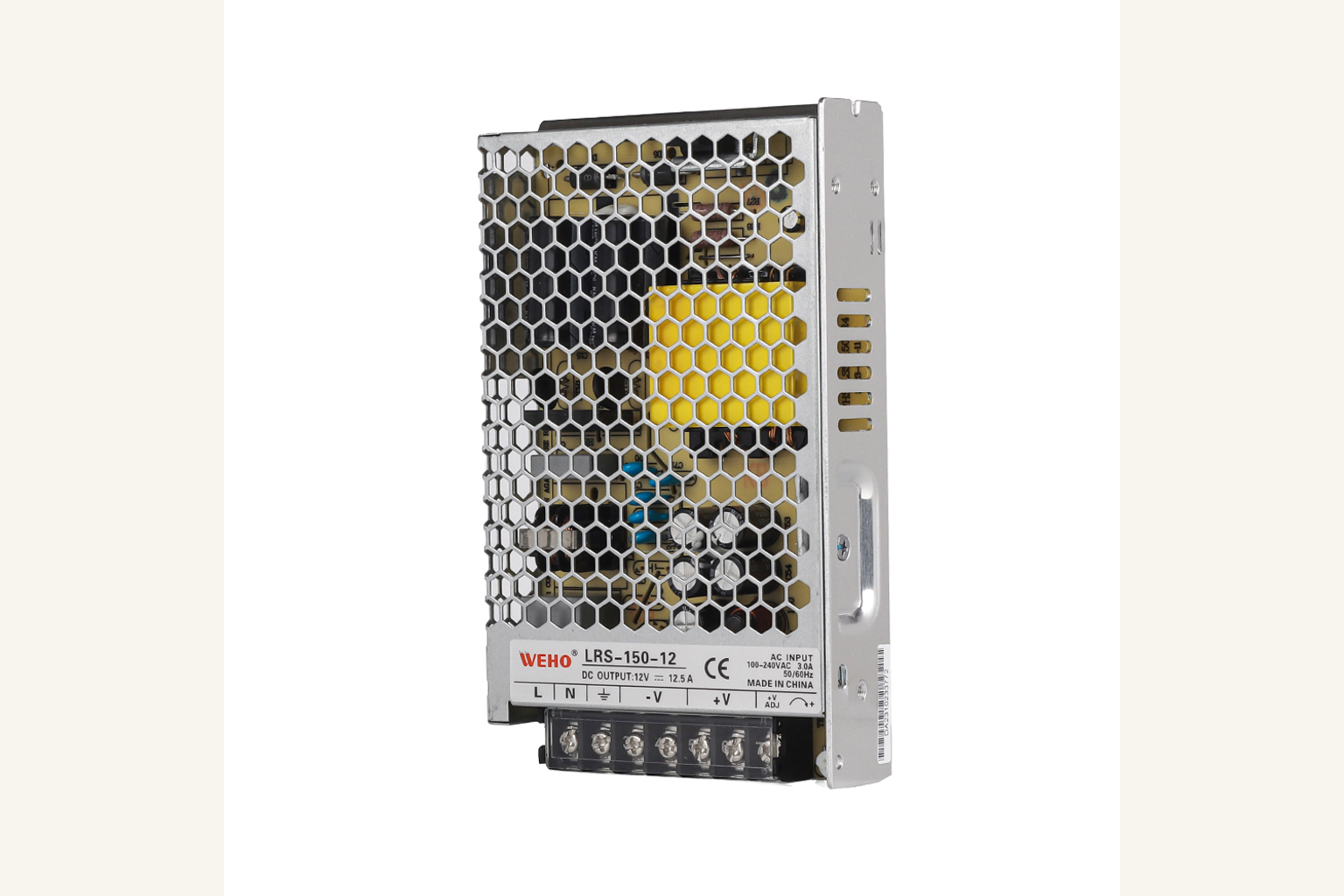
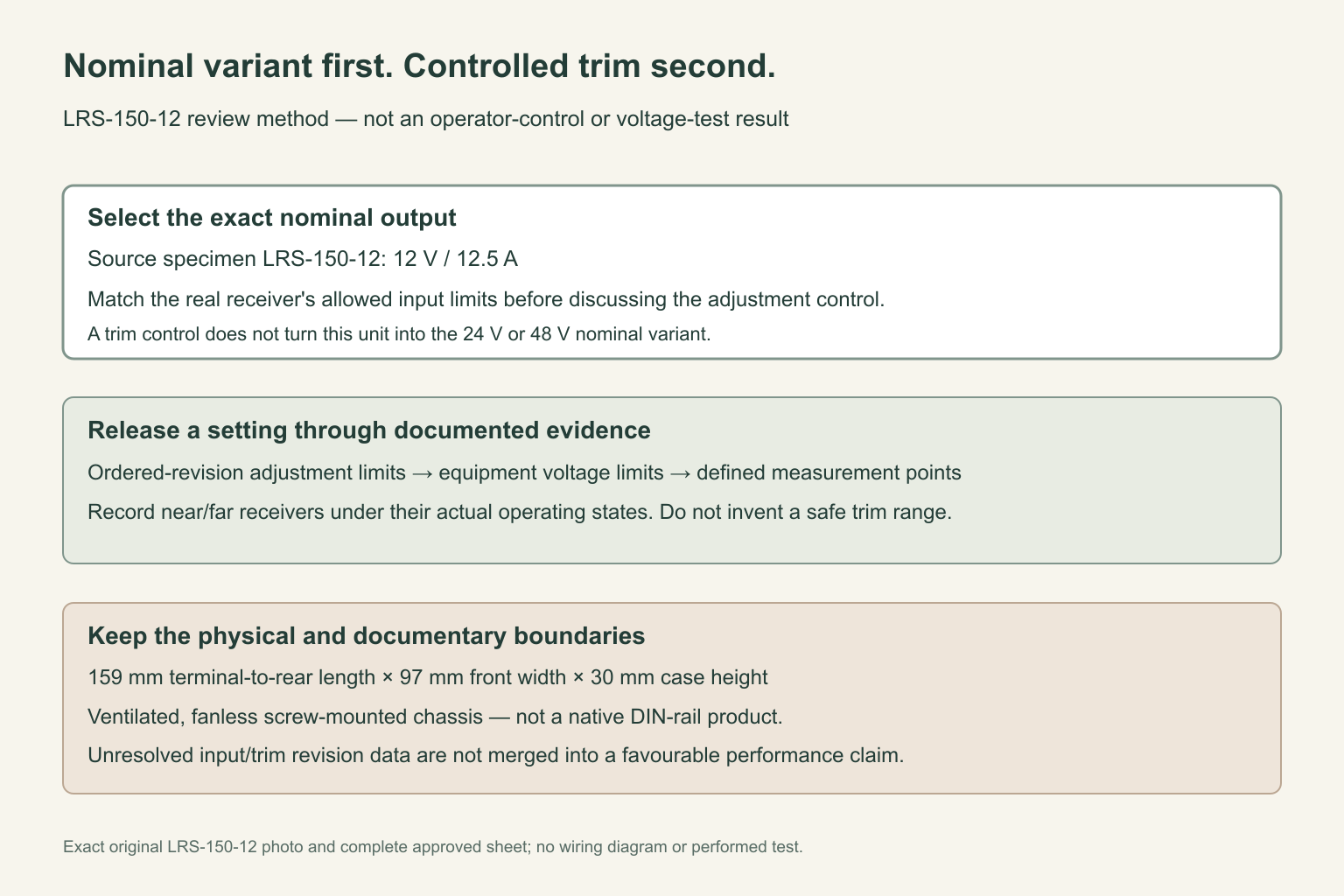
This guide uses the exact WEHO LRS-150-12 specimen. Its original label identifies a 12V, 12.5A output and its casing has a small output-adjustment control. Those facts do not make it a general-purpose laboratory supply or establish that it can replace the 24V or 48V variants in the same family.
Choose the nominal voltage before discussing trim
Begin with the connected equipment’s required input voltage and permitted range. Obtain those limits from the actual device manufacturer, not a generic description of “low-voltage electronics.” Then select the correct nominal supply variant and check its own current and power limits.
A procurement specification that says only “LRS-150 adjustable” is incomplete. Record the full model, controlled electrical revision, required setpoint and intended load. The original full-model label must remain unchanged in imagery. A rendering with a 24V label is not an acceptable illustration of the LRS-150-12, even if the article discusses adjustable outputs.
A trim control is not an unlimited voltage range
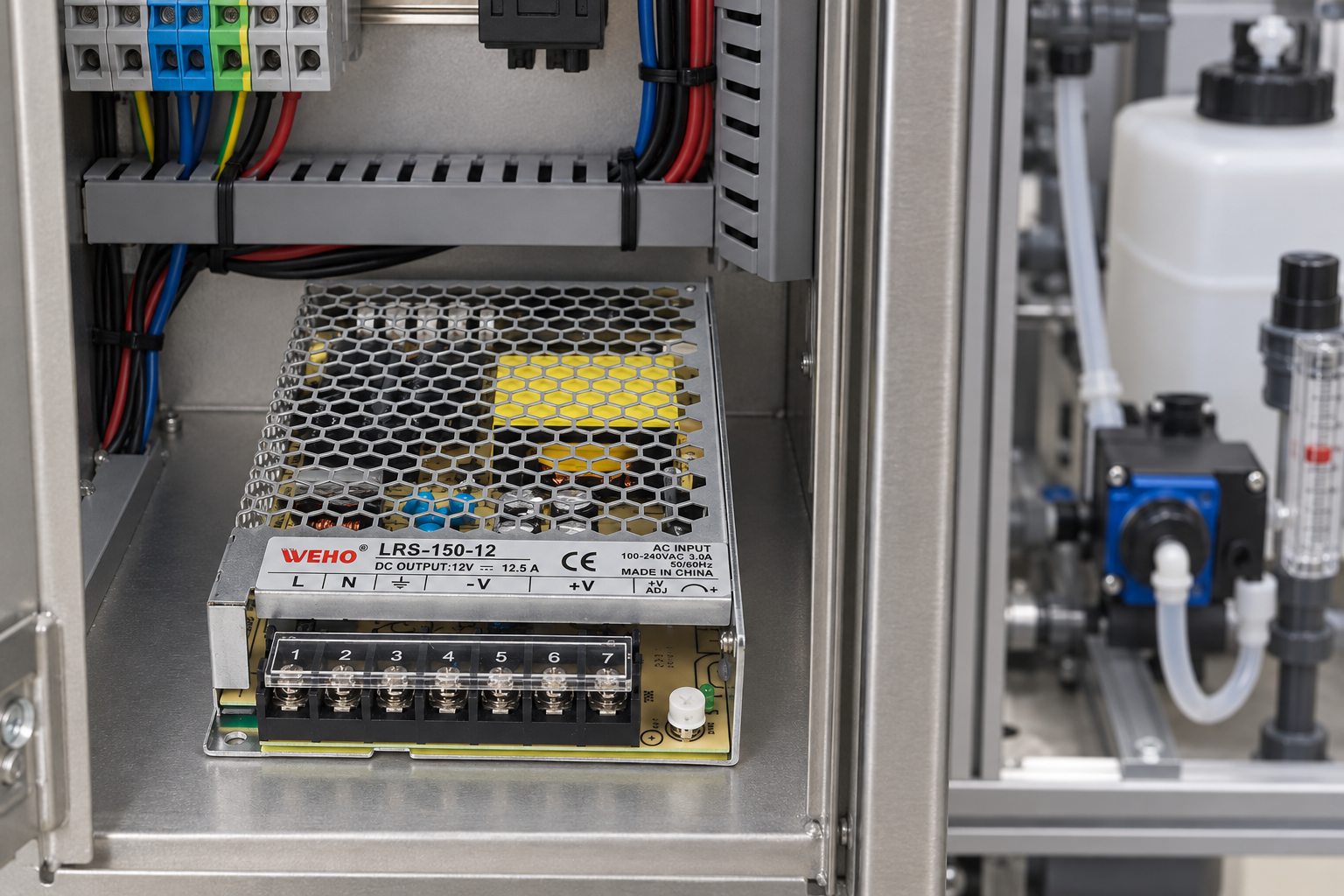
Use the ordered revision’s documented adjustment limits. This draft does not state a numeric trim range because the available physical label, approved sheet and public text require revision reconciliation before electrical release. Do not infer a safe range from the angle of a trimmer in a photograph or from the range listed for another output variant.
Adjustment also does not automatically preserve the same allowable current or power at every setting. Check the manufacturer’s conditions. If the purpose is to compensate for distribution losses, evaluate the voltage at both near and far loads under the real operating states. Increasing the setpoint to help one remote device may overvoltage another device on the same branch.
| Decision | Evidence | Record on release |
|---|---|---|
| Nominal variant | Actual load voltage requirement and exact model | Full model and controlled revision |
| Trim setting | Manufacturer’s permitted range and system limits | Defined setpoint and measurement location |
| Distribution acceptance | Near/far load voltage under operating states | Actual observations, not assumed compensation |
Define what “fixed” means in your enquiry
Some buyers mean a regulated nominal output that is not routinely changed. Others mean a product with no accessible trim control. State which meaning applies. An accessible adjustment control may need a documented production setting and change-control procedure, while a non-adjustable product still needs voltage tolerance and load-state checks.
For a machine-vision auxiliary panel or small electronic test-fixture branch, the practical objective is repeatable voltage at the equipment, not maximum knob travel. Do not portray a trimmer as an operator control unless the equipment design explicitly supports that use. Setup and electrical acceptance belong to qualified personnel following the controlled instructions.
Keep the chassis and service relationship accurate
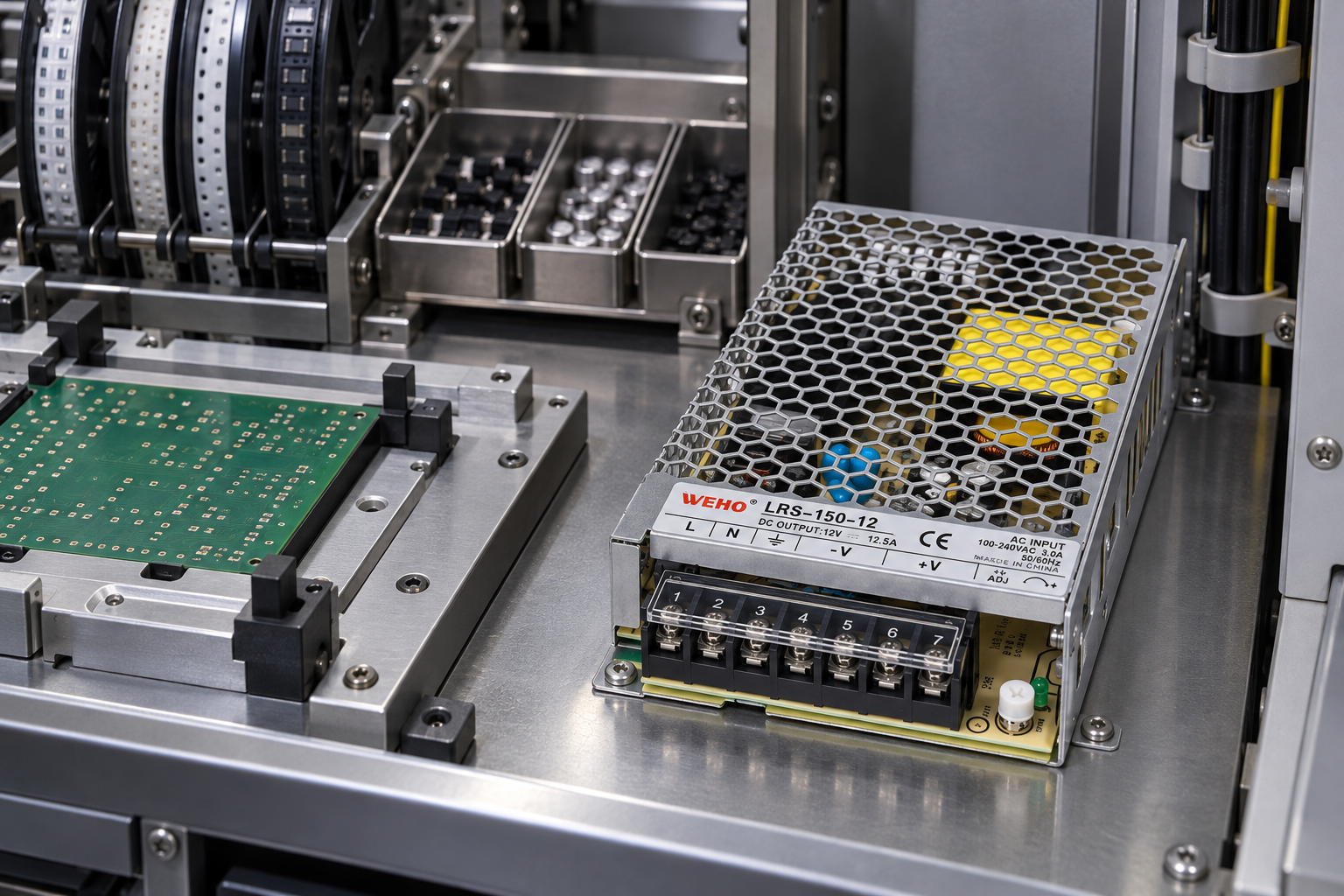
The approved mechanical drawing describes 159mm terminal-to-rear length, 97mm width across the terminal edge and 30mm case height. It is a ventilated chassis supply, not a native DIN-rail product. The permitted fixing points, fastener engagement and clearances must come from the exact drawing and installation documentation.
Leave room to access the terminals and control without inventing a bracket, hiding an unsupported side or routing cables through ventilation holes. The original seven-terminal geometry, terminal cover, adjustment control and trademark are identity evidence. Their presence in a photograph does not by itself prove that a complete application has been wired or accepted.
Questions that prevent a wrong order
Can output trim substitute for another nominal model?
Not without explicit model-specific evidence and compatible load requirements. The series name alone is insufficient.
Should the setting be raised until the remote device works?
No. Review all loads, conductor paths and allowed voltages, then establish a controlled setpoint and acceptance procedure.
What should the purchasing file contain?
Full model, controlled sheet, nominal voltage, approved setting, measurement points and actual test results. If the input revision is unresolved, retain that as an open item rather than silently merging conflicting source values.
Official LRS-150 reference. The unchanged source photo and complete approved mechanical sheet accompany this local review draft.