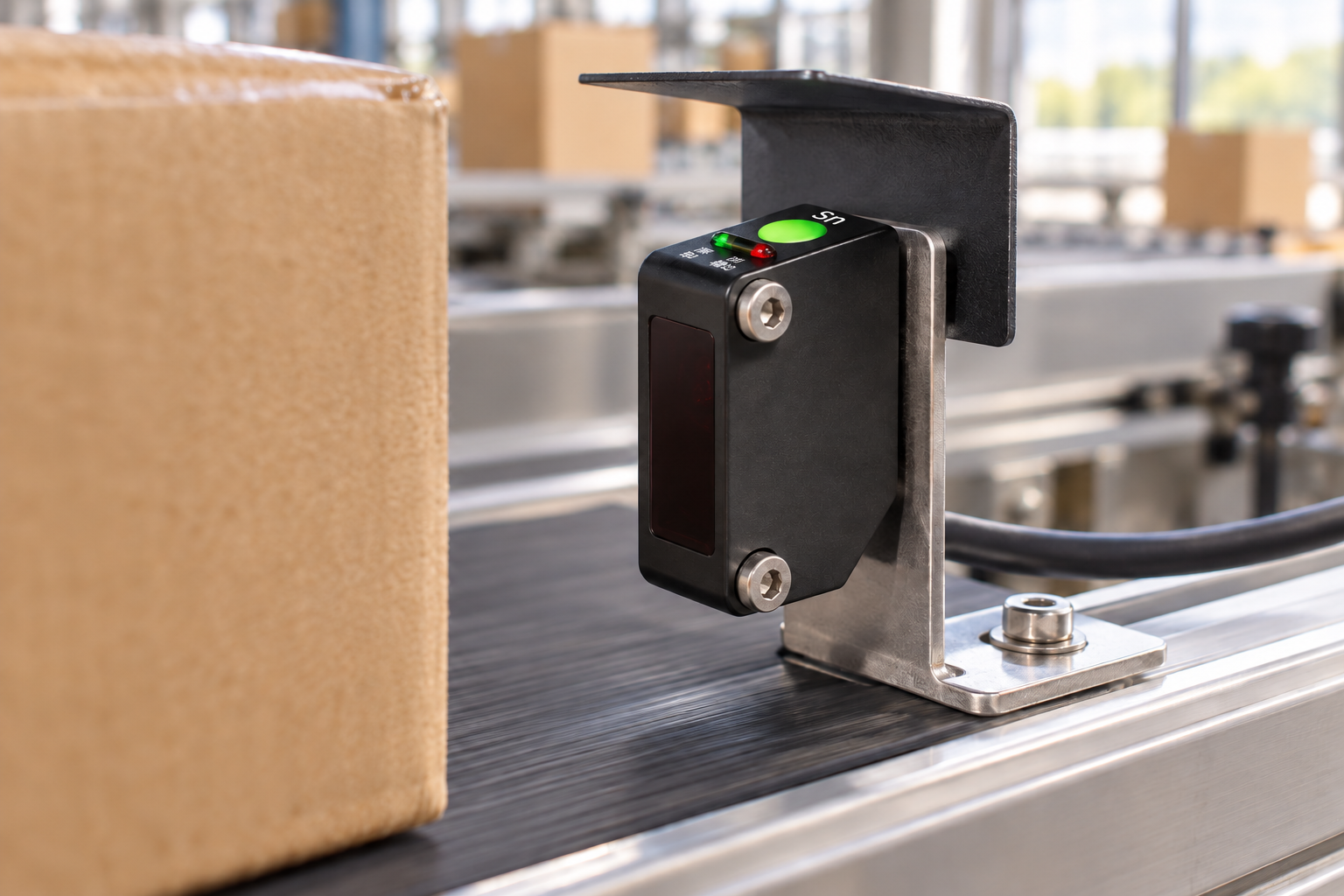
For a photoelectric sensor exposed to sunlight or work lamps, start with the illumination at the sensing position and the behaviour of the real target. The C3Z sheet lists separate ambient-light limits for incandescent light and sunlight. Those figures do not promise reliable detection under every direct-sun angle, LED source or flashing inspection lamp.
Read the light-source conditions literally
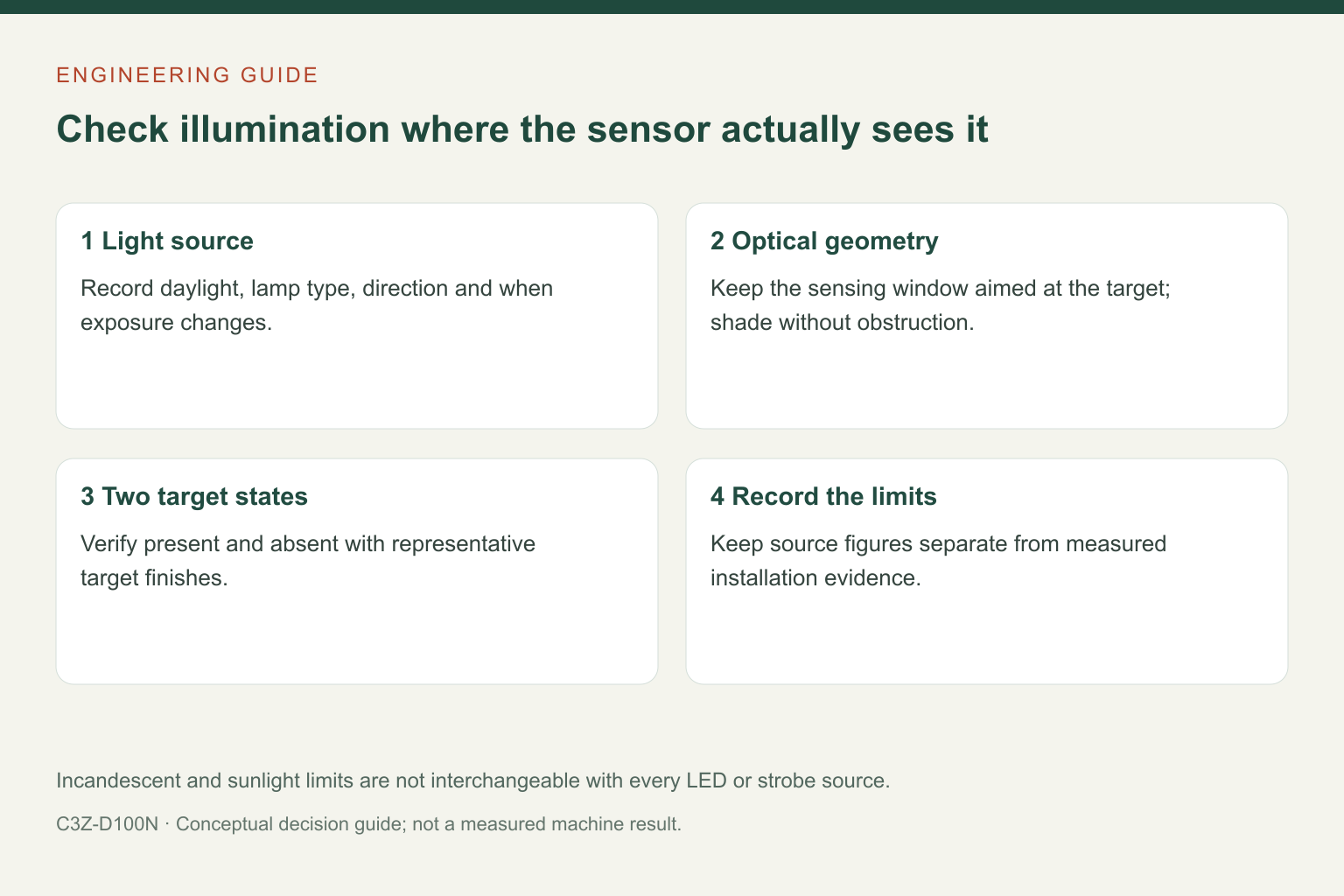
The matched sheet for the C3Z-D100 family lists incandescent illumination up to 3,000 lux and sunlight up to 10,000 lux. Keep the source category attached to each number. Do not merge them into a single universal “ambient light resistance” rating.
The available sheet does not provide a complete spectral, incidence-angle or modulation test protocol. In particular, an LED task light or strobed inspection light should not be declared acceptable solely because an illuminance reading is below the incandescent figure. Use the stated data as a boundary for engineering review, then check the actual installation.
Map exposure before moving the sensitivity setting
Record where daylight enters, whether the machine door changes reflections, and which lamps are switched or dimmed during operation. A location that is stable in the morning may be exposed differently later in the day. A maintenance light placed temporarily beside the sensor can also create a condition absent during initial commissioning.
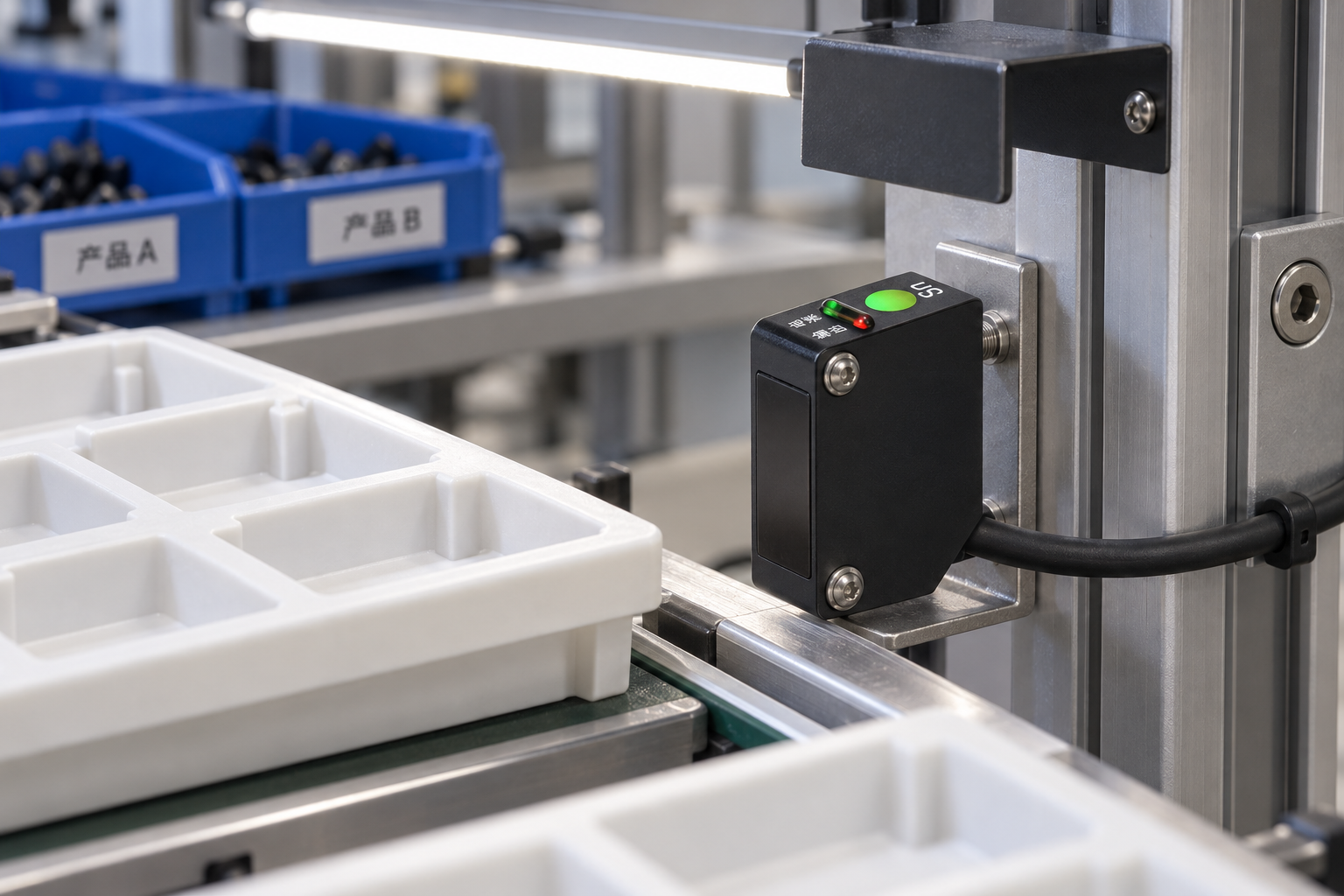
First confirm that the narrow optical face is aimed at the intended target and that the bracket is secure. A separate machine shade can reduce unwanted illumination without modifying the sensor, provided it does not obstruct the sensing path or become a new reflective object. Keep access to the original controls and cable route. Recheck detection after any change to the bracket or surrounding panels.
Use the actual surface, not the catalogue target alone
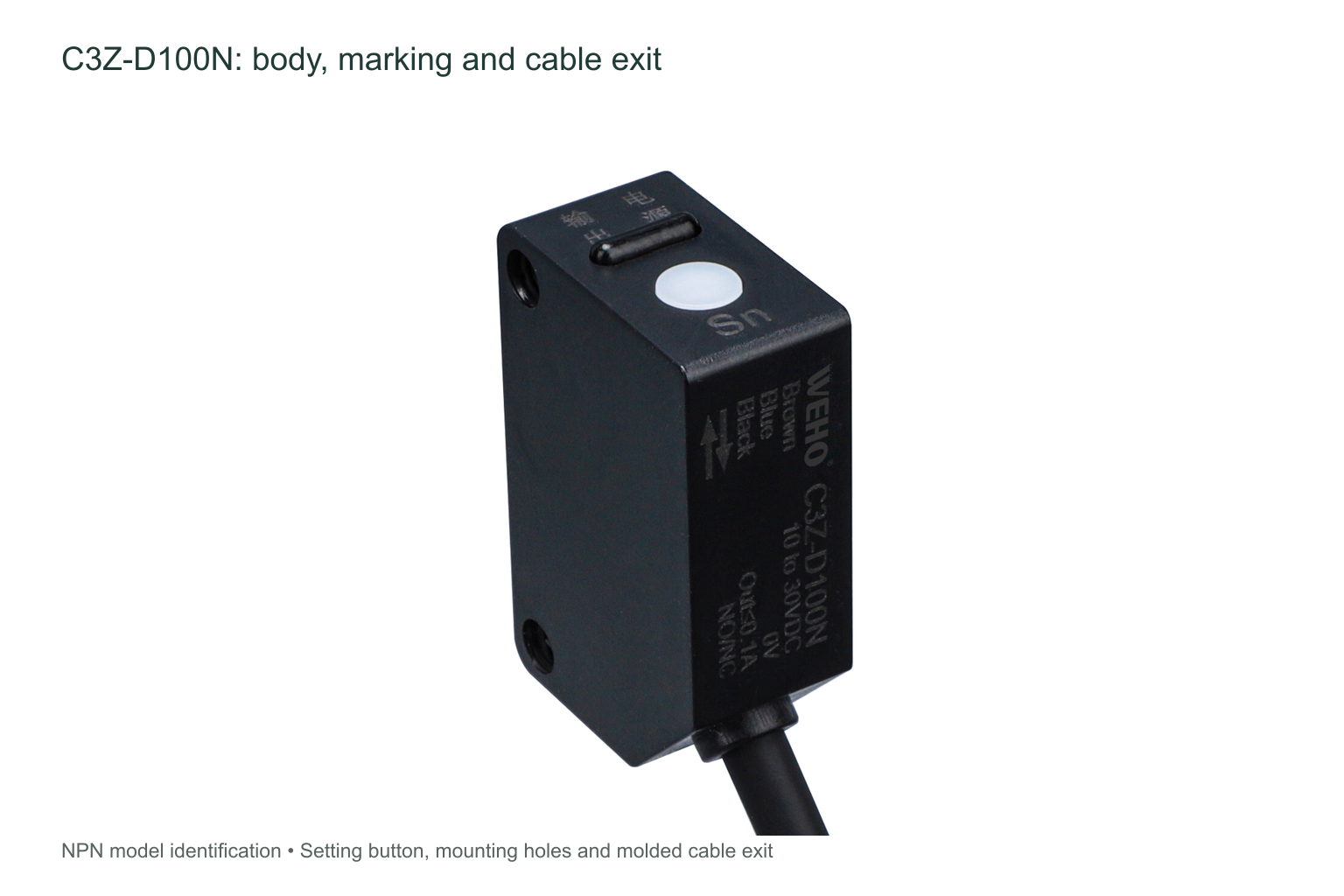
The D100N is a diffuse-reflective NPN model: detection depends on light returned by the object. Its adjustable 100 cm catalogue distance uses a 10 × 10 cm white matte paper reference target. That does not establish the same usable distance for a dark tray, a glossy carton coating or a small curved component.
Test representative target colours and finishes in both present and absent states. The absent-state check matters: backgrounds, nearby polished metal or unintended objects can contribute a return path. Keep the target geometry consistent while changing the lighting condition so that the observation has a useful explanation.
A practical lighting comparison
| Condition | What to record |
|---|---|
| Normal room lighting | Target state, sensor indication and receiving-input state. |
| Expected daylight exposure | Time, direction, shade position and measured conditions where available. |
| Work or inspection lamps | Lamp type, operating mode, position and whether the signal changes. |
| Target absent | Background surfaces and any unintended detection under the same light. |
Make the comparison with the equipment placed in an appropriate safe state and use the machine’s permitted observation method. Compare the sensor indication with the receiving control input; a change at one point but not the other calls for an interface investigation, not an immediate conclusion about ambient light.
What if detection remains unstable?
Avoid repeatedly increasing sensitivity without keeping a record. That can conceal the original cause while making the background easier to detect. Review the working distance, target presentation and unwanted-light path together. If the required operating condition is outside the documented envelope, obtain manufacturer guidance or evaluate a sensing method suited to the application.
Do not relabel a D100N as a through-beam, retro-reflective or specialised anti-interference model. Such alternatives have different optical arrangements and qualification requirements. Likewise, a generated scene or a successful brief check is not evidence of performance across all seasonal light conditions.
Frequently asked questions
Does the 10,000 lux figure guarantee operation in direct sunlight?
No. Keep the stated sunlight limit with its source conditions. The sheet does not establish performance for every incidence angle, reflection or target; verify the intended installation.
Can an LED lamp use the incandescent-light limit?
Not automatically. The available source does not equate different spectra or modulation modes. Check the actual lamp and obtain application guidance where its conditions are not documented.
Information for a useful application review
Provide the exact sensor model, target size and finish, working distance, bracket photographs, lamp types and a description of when false or missed detection occurs. Include relevant measurements and present/absent observations if available. Send the application details to WEHO to confirm the documented limits and the next qualification step.