An IP67 enclosure rating, where documented for the exact sensor and installation, does not establish that the sensor will detect correctly with water on its optical surface. Check the approved water exposure and the required target response separately, using the manufacturer’s instructions and a project-specific test plan.
Ingress protection and optical function are separate checks
OMRON’s photoelectric sensor FAQ answers an actual question about water exposure and warns that water on the lens can change detection. It describes examples for its own through-beam, retroreflective and diffuse sensors; those observations are not proof of a specific WEHO product’s wet-lens behavior.
Never wet, immerse or wash a device merely to test it. First obtain documented approval for the exact model, cable entry, operating state and intended exposure. If the manufacturer does not permit that exposure, use a different approved design or condition.
Verify the enclosure claim before discussing the lens
Record the complete sensor and connector model, rating evidence, test conditions and any installation limits. IP ratings address specified ingress protection conditions; they are not a blanket approval for high-pressure washdown, hot water, chemicals, oil or continuous immersion. Environmental suitability also depends on the cable, seal, mounting and actual process.
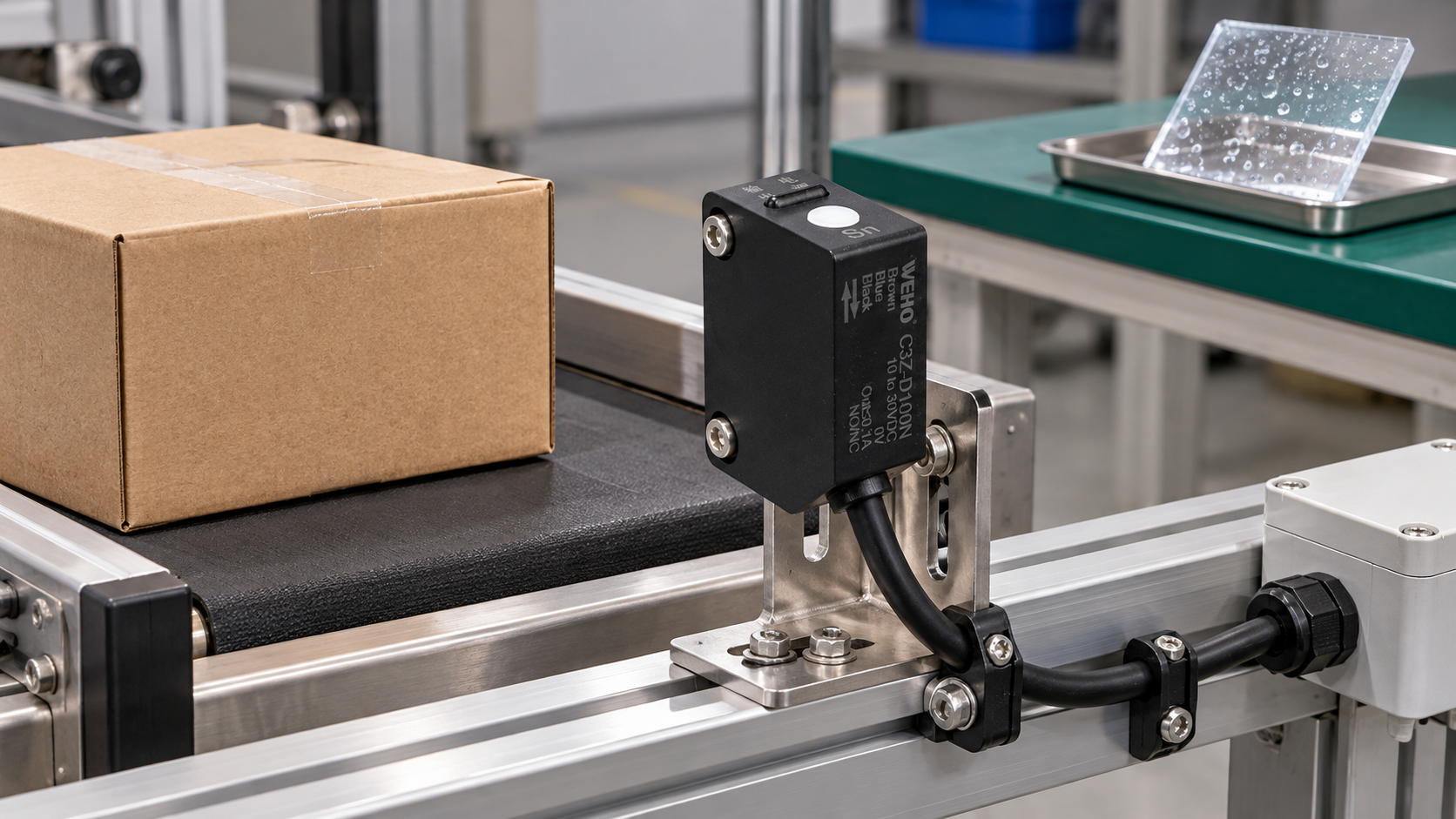
The pictured WEHO C3Z-D100N is shown in an AI-assisted dry baseline illustration. No IP67 claim or wet-operation approval for it has been established here. A product image, a similar-looking sensor or another manufacturer’s IP67 FAQ cannot supply that missing documentation.
Define what a wet optical surface could change
Water at the sensing face can alter the received optical signal or obscure the intended path. OMRON’s cited FAQ gives different examples for through-beam and retroreflective sensors versus diffuse-reflective sensors. The direction and magnitude of an actual output change depend on the device, surface, water and geometry; do not treat the FAQ as a universal outcome for all sensors.
Identify the required target-present and target-absent states, controller interpretation, sample position and operating mode. A correct enclosure test result does not reveal whether the final machine falsely counts a part, misses a part or recovers as expected after water is removed.
Plan a permissible optical verification
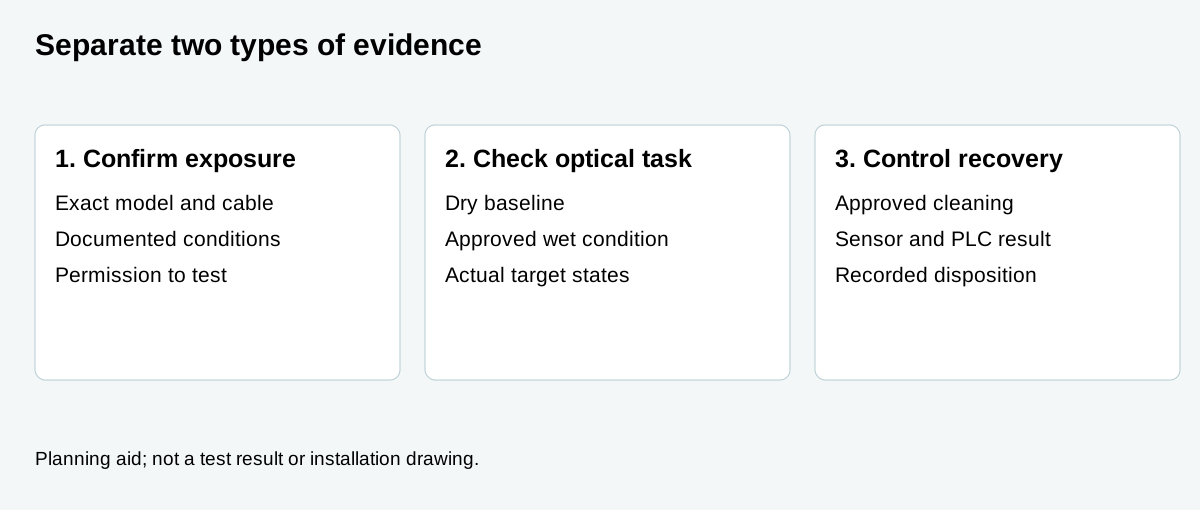
Only if the exact manufacturer authorizes the intended exposure should the responsible team prepare a controlled comparison. Define the normal dry baseline, permitted exposure, target set, position, machine state, water characteristics if relevant and the method of observing the output. Establish how the test protects equipment and people and what stops the test.
Compare target present and absent while the approved optical condition is present and after the supplier-approved restoration or cleaning. Capture transient changes and recovery at the sensor and receiving controller. If an actual process includes intermittent exposure, agree with the equipment owner whether testing must cover that state; do not claim a passing result from an unobserved transition.
Keep ingress evidence and optical results separate
| Evidence | 기록 (Record) | Decision |
|---|---|---|
| Product and rating | Exact version, cables, documented IP classification and conditions. | Is the intended environment allowed? |
| Dry reference | Actual sample, geometry and present/absent states. | Does the baseline configuration perform the task? |
| Approved wet condition | Only manufacturer-permitted exposure, lens condition and operating state. | Are false events or missed detections within the project criteria? |
| Recovery | Approved removal or cleaning, timing and output observation. | Does the required function return without unacceptable intervention? |
| Release | Settings, acceptance, documentation and remaining restrictions. | Can the accepted installation be reproduced and maintained? |
This proposed evidence record does not grant permission to expose a product to water and does not report an actual test.
Review the installation and maintenance response
If approved exposure produces an unacceptable output, ask the manufacturer and machine designer about documented alternatives: a protected sensor location, a suitable enclosure or another sensing technology may be considered if it still covers the target and process. A shield must not be assumed to have an IP or cleaning rating simply because it is shown in a diagram.
Preserve the approved cleaning agents, materials, inspection intervals and final sensor position in the machine maintenance file. Do not increase sensitivity indiscriminately: confirm both output states with the actual sample and background after any change.
Questions buyers ask
Does IP67 guarantee reliable detection through water droplets? No. Ingress classification and optical performance during an approved wet condition are different evidence.
Is the pictured C3Z-D100N IP67? This article has not established an IP67 rating for it. Ask WEHO for the exact version’s documentation before deciding where it may be used.
Can an IP67 label approve hot high-pressure washdown? No automatic conclusion follows. Verify the actual cleaning duty and product instructions.