













Last Updated: 2026-08-31
plc power supply sizing starts with the total 24V load under the worst credible operating condition. Add the PLC, I/O, sensors, relays, communication devices, and actuators; then check startup current, temperature derating, cable voltage drop, branch protection, redundancy needs, and service margin before choosing a DIN rail unit.
plc power supply sizing begins with a complete 24V load list
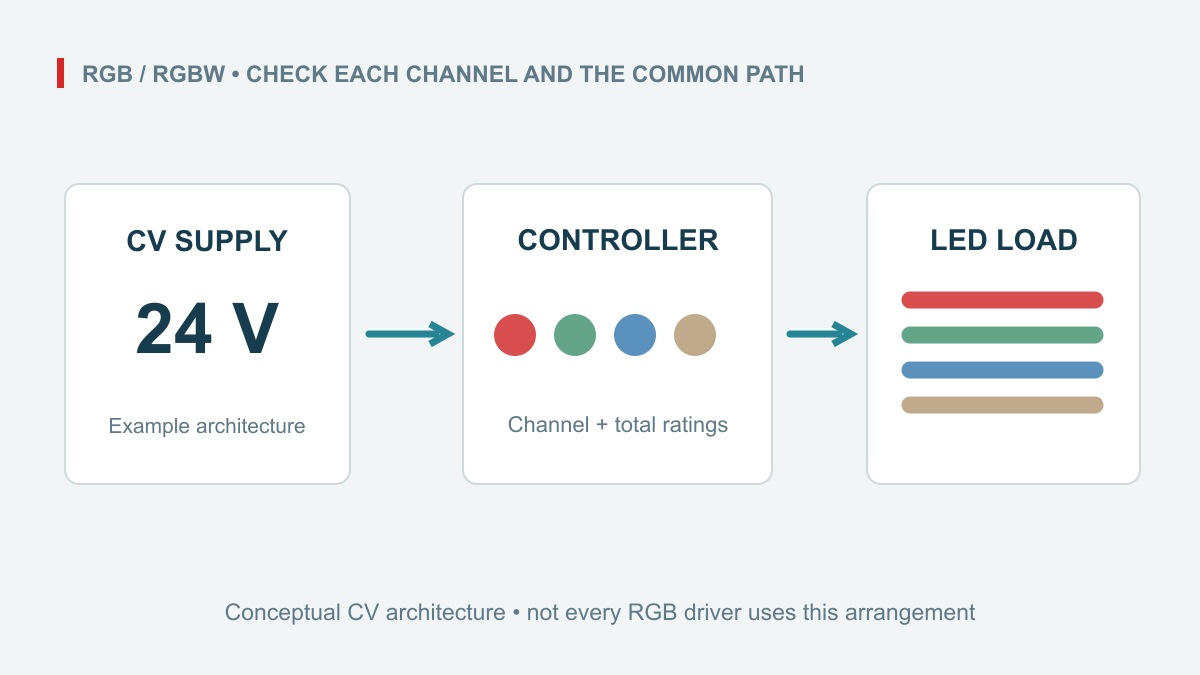
A plc power supply should be sized from the control panel’s real operating loads, not from the PLC CPU alone. Build a load schedule that includes the controller, local and remote I/O, HMI, industrial Ethernet equipment, sensors, transmitters, relays, contactor coils, valve solenoids, signal conditioners, and any auxiliary device on the same 24V bus.
Record normal current, peak or startup current, duty cycle, cable length, and the minimum acceptable voltage for each branch. Loads that switch together should be evaluated together. A valve bank, relay group, or communication device can create a short peak that is not visible in a simple nameplate total.
Use the maximum credible operating state rather than adding every theoretical load if those loads cannot run at the same time. Document that operating assumption so commissioning and future panel changes use the same basis.
Calculate current, service margin, and startup demand

Add the continuous 24V current for the selected operating state. Then compare the total with the supply’s documented continuous rating under the actual input voltage, ambient temperature, mounting orientation, and enclosure conditions. Do not apply a universal derating percentage; use the selected model’s confirmed documentation.
A practical service margin supports normal component tolerance, modest expansion, and short operating peaks. Excessive oversizing is not automatically safer. It can increase cabinet space, heat, upstream protection requirements, and available fault energy. The goal is enough verified capacity without turning the 24V distribution into an unnecessarily large source.
Check high-inrush devices separately. Some electronic loads charge input capacitors when energized, while coils and actuators can draw a short peak. If the PLC resets when a branch switches, the problem may be a transient voltage drop, cable impedance, shared return path, or supply current limiting rather than insufficient steady-state wattage.
Separate control loads from noisy or high-demand branches
Sensitive PLC and communication loads benefit from a clear distribution plan. Separate high-current actuators, solenoids, motors, heaters, or externally switched loads when their transients could disturb the control bus. Branch fusing or electronic protection can make faults easier to isolate and prevent one failed field device from dropping the entire panel.
Keep 0V reference and grounding practices consistent with the control-system design. Avoid accidental parallel return paths through shields, mounting metal, or communication wiring. AC input conductors should be routed separately from low-voltage signal and communication wiring, with spacing and protective grounding appropriate to the panel standard and local requirements.
For long field runs, calculate voltage drop at the maximum branch current and verify voltage at the load, not only at the power-supply terminals. Larger conductors, shorter routes, separate branches, or a different distribution point may be more effective than raising the supply output.
Choose a DIN rail product family that fits the panel

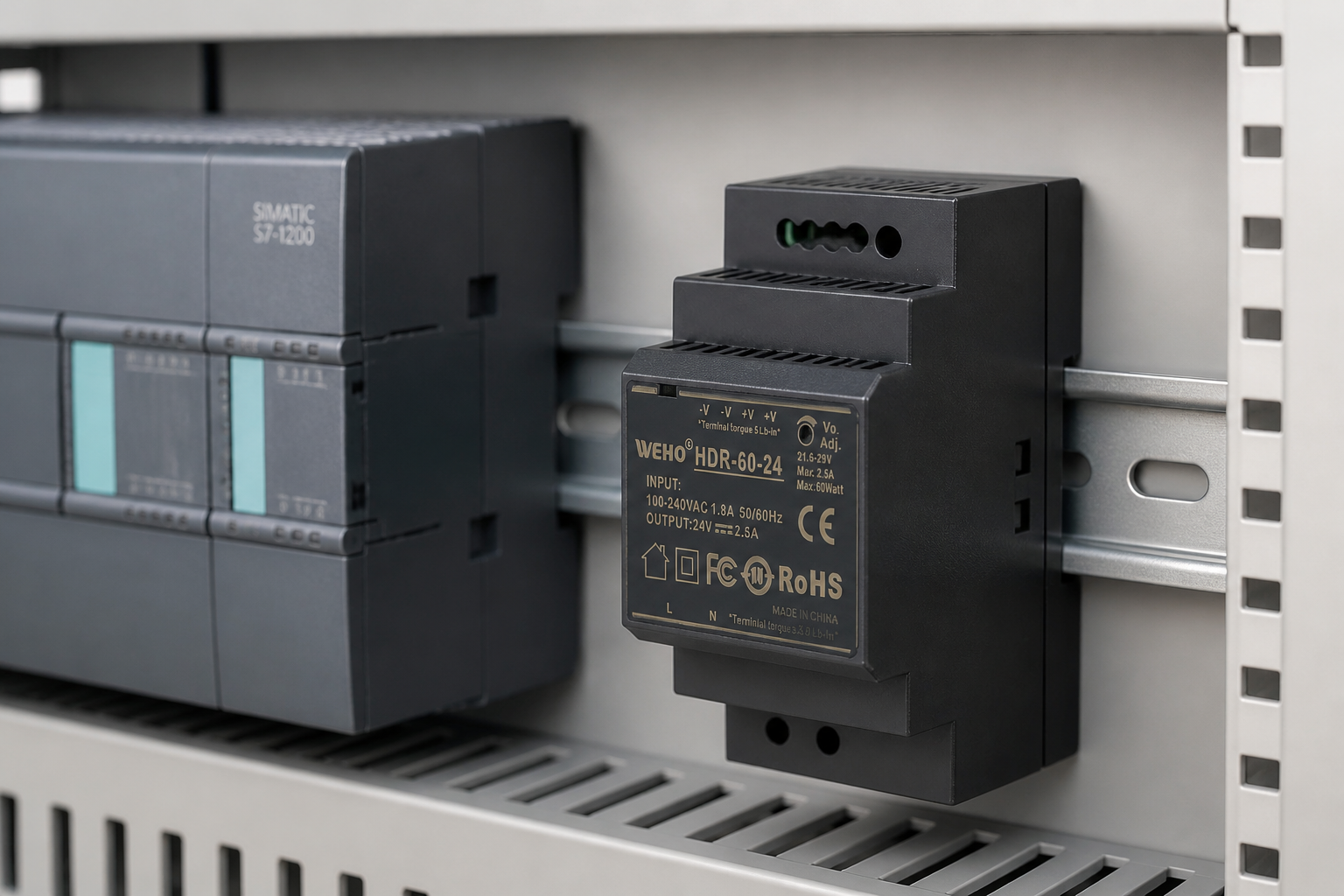
The approved WEHO DIN Rail Power Supply category is the appropriate landing page for comparing mounting formats and power ranges. For a compact 24V control-panel example, review the WEHO HDR-60 product page. Final selection still requires confirmation of the exact output variant, rating, derating curve, terminal arrangement, installation clearances, and applicable documentation.
This article focuses on the PLC load and distribution strategy. For a broader panel-level selection discussion, see the related guide on choosing a DIN rail power supply for industrial automation.
When continuity is important, decide whether the design needs a second supply, an OR-ing or redundancy module, a DC UPS, or monitored backup power. Redundancy is a system architecture decision; installing two supplies without verified isolation and load-sharing behavior does not create a dependable redundant system.
Installation and commissioning checks

Mount the unit on the specified rail and maintain the documented ventilation space. Consider the heat from adjacent drives, contactors, relays, and other power supplies. Cabinet ambient temperature can be higher than the room temperature, especially near the top of a sealed enclosure.
Before energizing, confirm input selection if applicable, protective earth, polarity, conductor size, terminal torque, branch protection, separation, and strain relief. Qualified personnel should perform installation with incoming power isolated and verified safe.
Commission the panel in stages. Measure the 24V bus with only control electronics energized, then add field branches and the highest simultaneous load. Record voltage at the supply and at remote devices, current, cabinet temperature, and behavior during actuator switching. Test how the panel responds to a branch fault and input-power interruption if those conditions are part of the design requirement.
Common PLC power mistakes

- Counting only the PLC CPU and forgetting I/O, sensors, relays, network equipment, and field devices.
- Selecting by wattage while ignoring transient current, temperature derating, mounting, and input range.
- Supplying sensitive control electronics and large switched loads from one unplanned branch.
- Checking voltage only at the supply instead of at the farthest device under load.
- Treating two parallel supplies as redundancy without an approved isolation and monitoring arrangement.
- Leaving no documented baseline for later service or panel expansion.
Soalan Lazim
How do I calculate the required PLC power supply current?
Add the current of the PLC, I/O, HMI, communication devices, sensors, relays, and field loads that can operate together. Then check startup demand and the selected model’s documented derating under the real cabinet conditions.
How much spare capacity should a PLC power supply have?
Use a practical service margin based on load uncertainty, planned expansion, and short peaks. Avoid a universal percentage; confirm the supply’s behavior and derating from the exact model documentation.
Should solenoid valves use the same 24V supply as the PLC?
They can share a source only when the distribution, transient demand, protection, voltage drop, and fault behavior are verified. Separate protected branches or supplies may reduce disturbance to sensitive control electronics.
Why does a PLC reset when an actuator switches?
Possible causes include startup current, cable impedance, a shared return path, loose terminals, branch voltage drop, or power-supply current limiting. Measure the bus at the PLC during the switching event.
When is redundancy needed in a PLC control panel?
Redundancy is considered when a single supply failure cannot be allowed to stop the process. It requires a verified isolation or redundancy arrangement, monitoring, and suitable upstream and downstream distribution.
What should be recorded during PLC panel commissioning?
Record input voltage, 24V voltage at the supply and remote loads, current in important operating states, cabinet temperature, transient behavior, branch protection tests, and the response to an input-power interruption.
Key Takeaways
- Size a plc power supply from a documented 24V load schedule and credible simultaneous operating state.
- Check startup behavior, enclosure temperature, input range, mounting, cable drop, and branch protection together.
- Separate sensitive control loads from noisy or high-demand field branches when practical.
- Use the exact model documentation for derating, terminals, clearances, and protection behavior.
- Commission the panel in stages and record measurements for future service work.
Kesimpulan
A dependable plc power supply design is a distribution and operating-condition decision, not a single wattage calculation. Start with the complete load list, verify transients and voltage drop, account for cabinet heat, and define how branch faults and power interruptions should affect the controller.
Compare options through the WEHO DIN Rail Power Supply category atau contact WEHO with the input voltage, 24V load schedule, peak-current behavior, enclosure temperature, cable distances, and redundancy requirement. You can also email [email protected] for product matching.
Review the relevant WEHO product category, email [email protected], or contact WEHO with the input voltage, output load, ambient temperature, and installation details.