Conveyor Object Counting: Specify the Sensor and the Whole Signal Chain
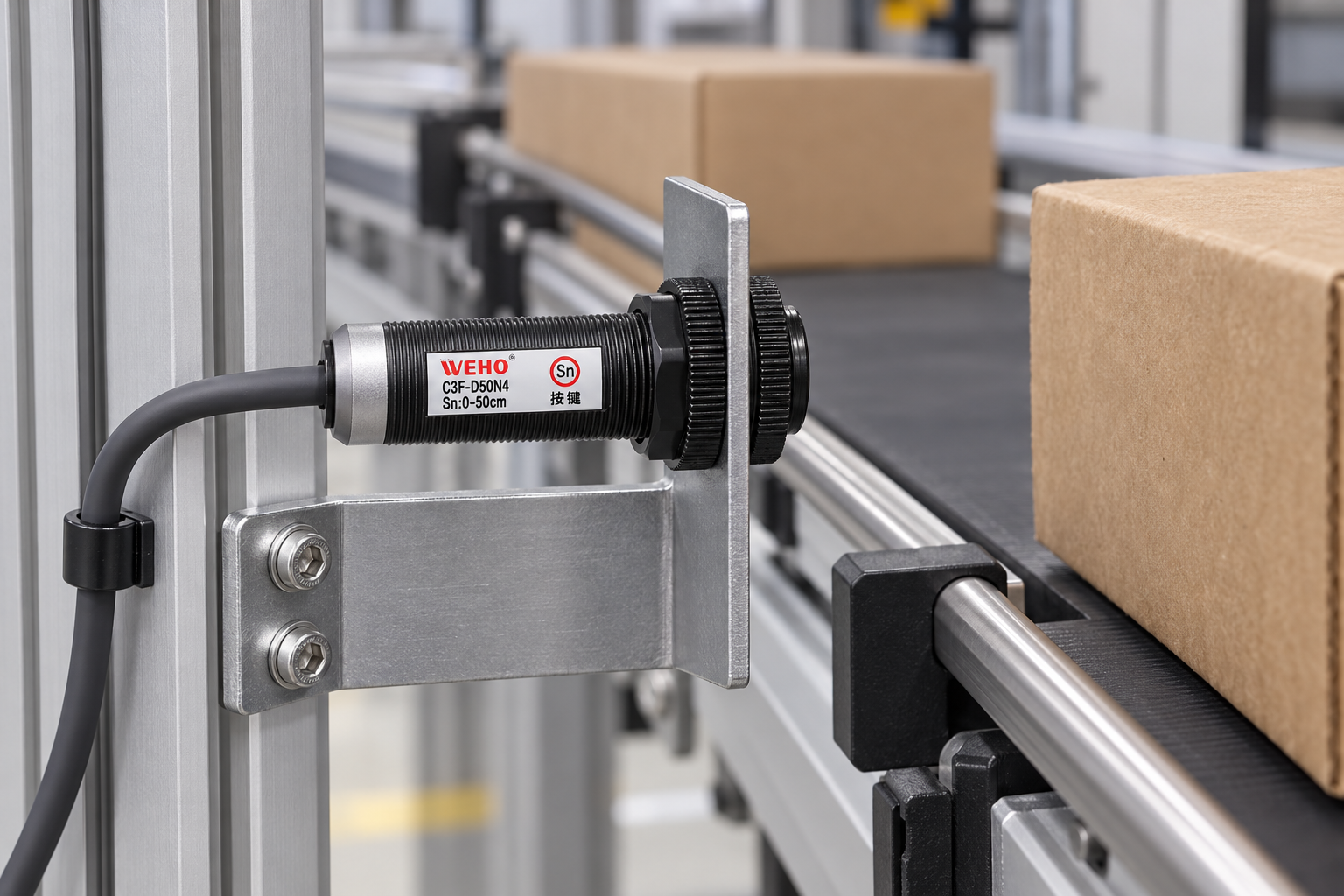
A conveyor counter is a complete sensing and counting chain, not just a sensor with a fast response specification. An OEM purchase specification should define the smallest object, shortest clear gap, belt-speed range, target appearance and controller input behavior before a sensor is approved for a repeated machine build.
The WEHO C3F-D50N4 is a useful bounded example: its matched sheet identifies a diffuse-reflective NPN sensor with complementary NO and NC outputs, a 10–30 VDC supply and a response time of no more than 2 ms. Those facts do not establish a guaranteed conveyor count rate or performance on every product surface.
Write the counting task as a product-and-gap specification
Define what constitutes one count. A carton with an open handle, a bag with a loose seam or two touching parts can create a different optical pattern from one solid test target. Describe the smallest visible face and the minimum clear space between items, including skew, height changes and the allowed conveyor lane position. State whether accumulation can eliminate the gap entirely.
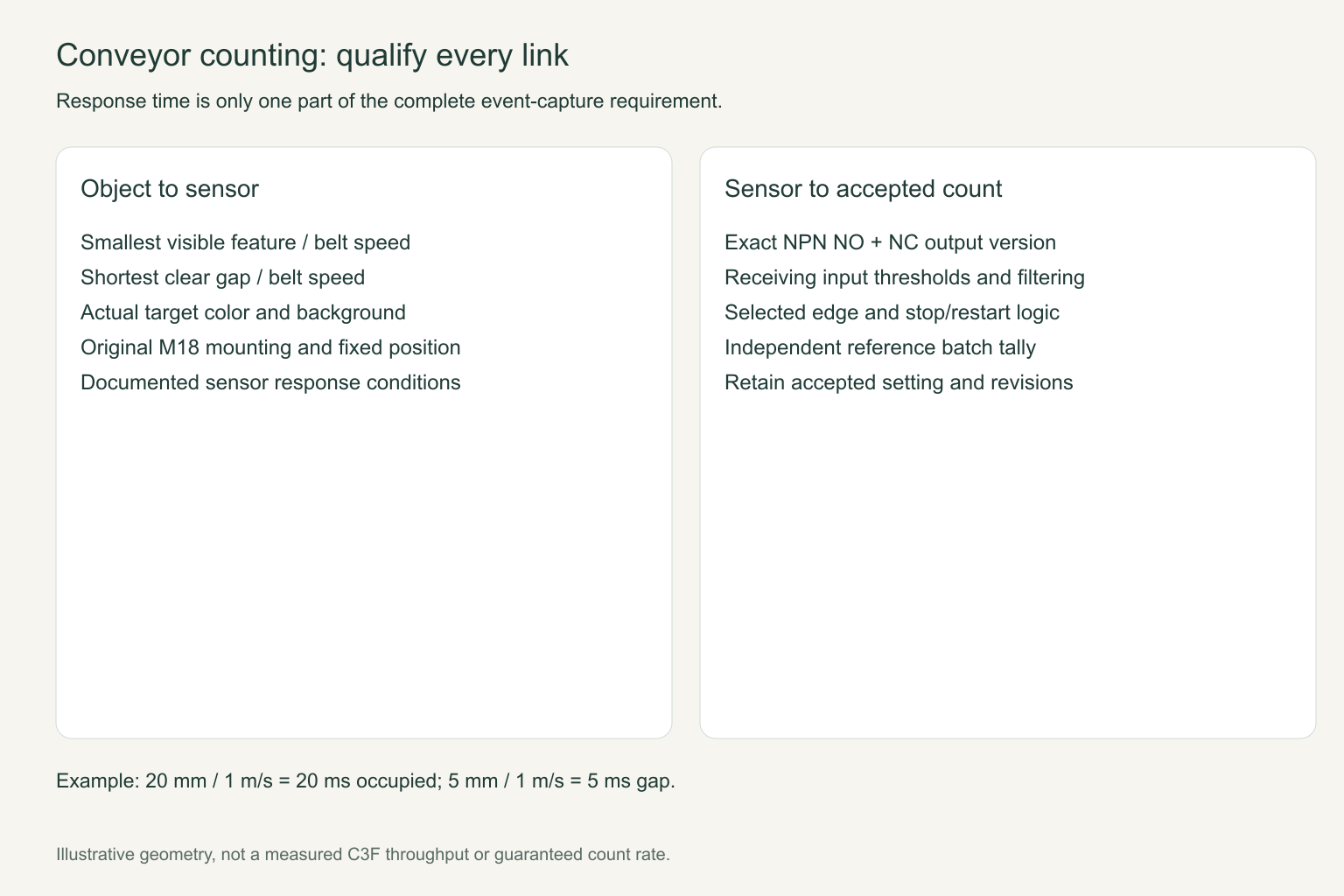
For a simple straight path, the time an object occupies the beam is approximately its effective length along travel divided by belt speed. The clear interval is the gap divided by that speed. As an illustrative calculation, a 20 mm visible feature at 1 m/s occupies the sensing line for about 20 ms, while a 5 mm gap lasts only 5 ms. These are geometry calculations, not measured C3F switching results. A favorable object interval cannot compensate for a gap that the complete system fails to recognize.
Keep the sensor output and counter input compatible
| Purchase item | What the integrator must confirm |
|---|---|
| Exact output version | C3F-D50N4 is NPN NO+NC; a similarly named PNP version is not an interchangeable wiring substitution. |
| Receiving input | Input circuit, current, voltage thresholds, filter setting and whether the selected input supports the required pulse capture. |
| Counting edge | Choose the intended transition; do not count both complementary outputs as two separate products. |
| Software behavior | Define reset, stop/restart, accumulation, reversal and duplicate-pulse handling with the machine builder. |
The matched NPN diagram assigns brown to positive supply, blue to 0 V, black to NO and white to NC. The stated output-load limit is 200 mA and residual voltage is no more than 2 V. These are interface boundaries, not permission to connect an unspecified PLC input or a motor directly. The receiving controller’s documentation must complete the circuit assessment.
Qualify the actual objects, not only white paper
The D50 specification lists an adjustable 50 cm detection distance using a 10 × 10 cm white paper reference target. A dark pouch, small molded part or shiny label is not that reference. Request samples from the extremes of the approved product mix and test them with the actual belt, guide rails and background. Keep the optical face clean and the bracket position repeatable.
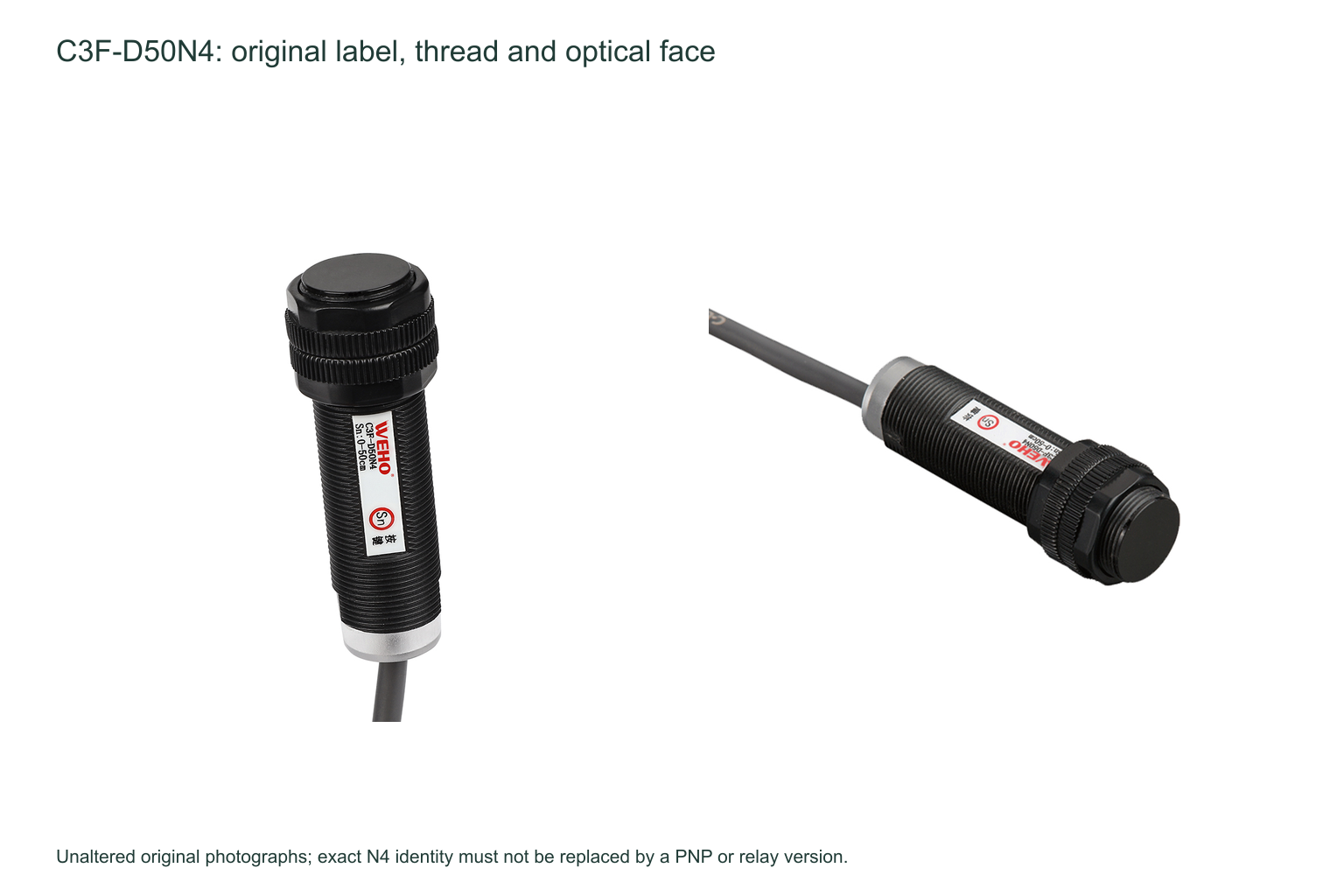
The original threaded body is M18 × 1, and the drawing gives an overall length of 64.6 ± 0.5 mm. Use its two original locking nuts to secure the sensor through a suitable bracket, leaving the optical face and setting control accessible. A bracket that moves during belt vibration can change the optical condition even when the electrical interface is correct.
Put the acceptance method in the RFQ
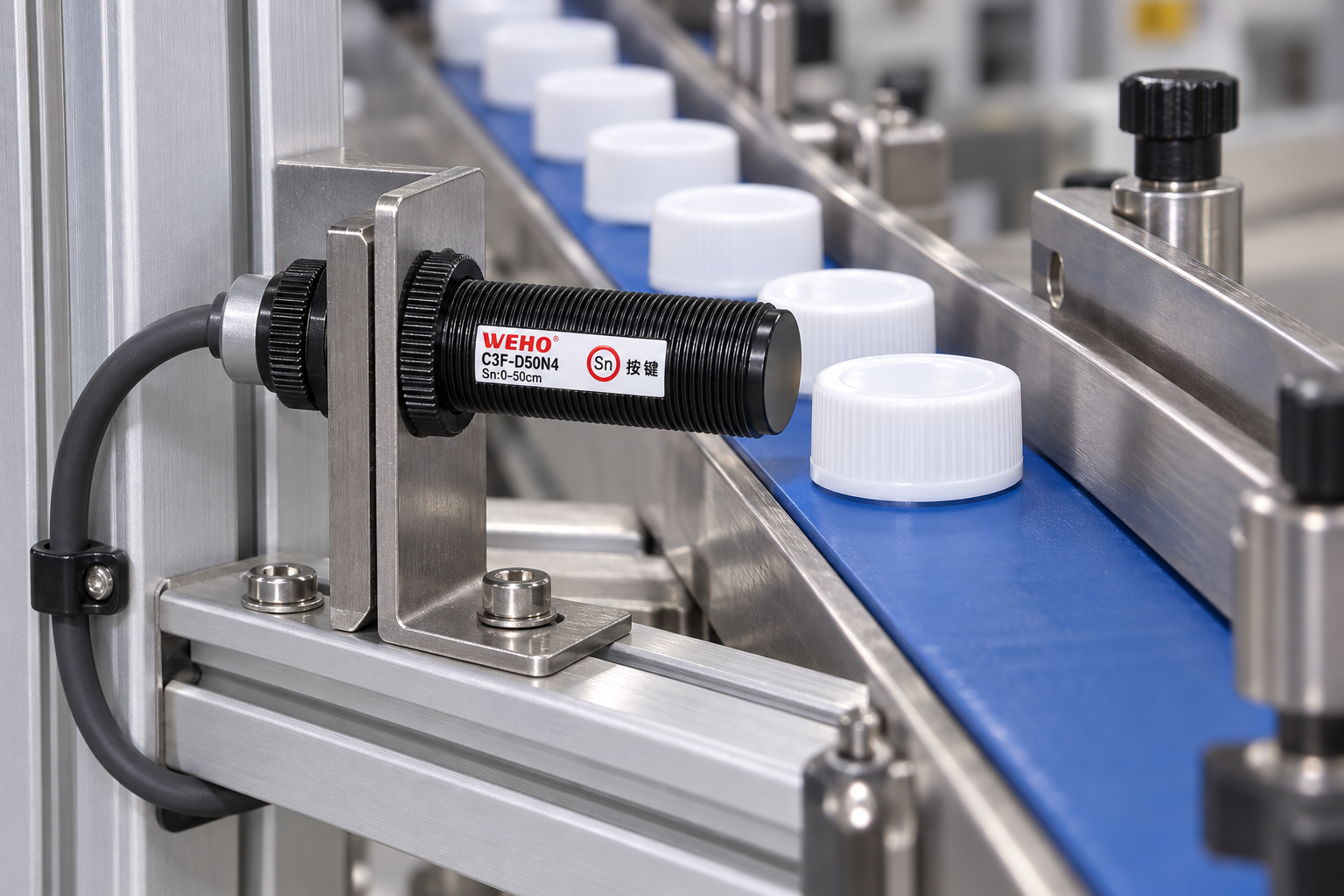
Ask the supplier and machine builder to agree a trial using the fastest speed, shortest permitted gap and hardest-to-detect approved object. Independently tally a defined sample batch and compare it with the controller’s count. Repeat after a planned stop, restart and product changeover. Record the sensor setting, bracket position, controller filtering and exact hardware revisions so that a later replacement can reproduce the accepted configuration.
For a multi-machine order, retain an accepted sample and require notification before a change to output type, cable construction, optics, label or mechanical dimensions. A nominal M18 replacement can fit the bracket yet behave differently at the controller.
Common buying questions
Does a 2 ms response mean a 500-item-per-second counter?
No. The response specification alone does not include the target-present and target-absent intervals, the receiving input’s filtering or the counting logic. Establish an application limit using the complete chain.
Can one diffuse sensor count touching cartons?
Not necessarily. If there is no distinguishable optical gap, the sensor may see one continuous target. The conveying process or sensing arrangement must create a reliably detectable event.
Send WEHO the object samples, speed and gap limits, mounting sketch, supply range and receiving-input details when requesting sensor product information. Use the contact form to define the sample-acceptance task before a repeated OEM order.