












Introdução
As a B2B buyer responsible for purchasing industrial power supply manufacturer, your burden is indeed not light. If you don’t make the right decision, it may cause the production line to stop, the equipment will fail, and cause a lot of economic losses. The global industrial power supply market is rising rapidly. The scale is about 13.29 billion US dollars in 2025, and it is expected to reach 24.76 billion US dollars by 2034. The annual compound growth rate is about 7.16%. There are more and more new suppliers every year, and there are too many options in front of you. How to pick out reliable manufacturers from it and avoid those high risks? This guide will take you one by one. Before making a decision, you must evaluate the four key directions. According to this list can help you protect your investment and find a reliable partner.
Verifying Certifications and Quality Compliance
Certification is not just a passing scene. They are the actual proof that the manufacturer meets international safety and quality standards. Don’t skip this step. It can protect your equipment, employees and the company from unnecessary responsibilities.
Safety and industry certification
You need to confirm whether the supplier has the correct certification for your target market. If you do the North American market, it depends on whether there is UL certification. The CE mark in the European market is mandatory, and the CB system is recognised in more than 50 countries. If it is a Chinese market, CCC certification is required. There may be a few more professional fields, medical Therapeutic equipment requires IEC 60601-1 certification, and IEC 61508 is usually required for industrial functional safety. These signs indicate that the product has passed the test of independent laboratories.
Quality management system
ISO 9001 is the most basic quality management standard you should require. It shows that manufacturers will also conduct regular audits with standardised processes. ISO 14001 (environmental management) and ISO 45001 (occupational health and safety) are also important plus points, which shows that an enterprise is operating correctly. Imregular
Compatibilidade eletromagnética
There is electrical noise generated by motors, drivers and other equipment in the industrial environment. Your power supply must meet the electromagnetic compatibility (EMC) standard to run stably and not interfere with other equipment. To confirm that the product meets the IEC 61000 series standard, you need more for those manufacturers who cannot produce EMC test reports. Keep an eye on it.
Assess Customization and OEM/ODM Capabilities
Things on standard shelves may not always meet various special industrial needs. Your application scenario may require specific voltage output, different sizes, or docking with existing systems, so customisation is often unaidable.
Product customisation options
You need to ask the supplier what they can help you change, whether they can adjust the output voltage, current or power level, whether they can change the physical size, installation method or connecter type, and whether they can integrate the communication protocol you want. Some suppliers can do complete customised designs from scratch, and some can only give standards. Change the brand of the product, and the two should be clearly distinguished.
Engineering Support
You need to have solid engineering ability to do customisation. You need to find industrial power supply manufacturers with an internal R&D team. They can analyse your needs and develop corresponding solutions. The best b2b industrial manufacturing will send a special project manager to follow up from the beginning of consultation to delivery. Whether the communication in the design stage is fast or not clear, you can basically see the later sales. What is the level after that?
Flexible manufacturing services
Depending on your business requirements, you may need more than just a standard power supply for industrial applications. Many buyers also require comprehensive OEM or ODM services. With OEM, the manufacturer produces products according to your specifications, while ODM involves designing and manufacturing products based on your functional and branding requirements. Suppliers that offer both services provide greater flexibility and can better support your purchasing decisions. Before placing an order, confirm whether mold tooling fees apply, whether brand logos, labels, and packaging can be customized, and whether there are any minimum order quantity (MOQ) requirements.
Analyze Product Reliability and Component Quality
Industrial power supplies need to work in an environment of high temperature, vibration, dust and long-term downtime. Reliability is a must. If a power supply fails, it may cause the production line to stop and the key system to be interrupted, which will cause a lot of economic losses every hour.
Industrial-grade components
What kind of components to use internally directly determines how long the power supply can be used. Good capacitors, transformers and semiconductors are the key. You need to ask the supplier where their components are bought from, whether they use a brand with a good reputation, whether there is an incoming material inspection, and how to ensure that it can be traced back to the source. Good components means that they can be used for a longer time, fewer problems.
Função de proteção
A reliable power supply should protect itself and protect the equipment that powers it. See if there are these protections: overvoltage protection (OVP) to prevent the voltage from suddenly rising and burning things, overcurrent protection (OCP) to jam the current within the safe range, and short circuit protection (SCP) to cut off by itself when a short circuit occurs. Output, overtemperature protection (OTP) when the internal temperature exceeds the safe value, the power will be reduced or turned off directly. These functions can prevent major problems and extend the use time of the power supply and connected equipment.
| Protection Mark | Função |
|---|---|
| OVP | Proteção contra sobretensão |
| OCP | Overcurrent Protection |
| SCP | Proteção contra curto-circuito |
| OTP | Proteção contra superaquecimento |
Thermal management and stability
Heat is the natural enemy of electronic components. If the heat dissipation is not done well, the efficiency will drop, the life will be shortened, and it may be broken inexplicably. Therefore, you should choose the kind of power supply that can withstand a wide temperature range, usually at least minus 25 degrees to 75 degrees. The heat dissipation should be efficient, the thermal performance should be good, and the efficiency should be high (advanced system It usually exceeds 90%), in many cases, the design without fans has fewer moveable parts, so it is more reliable.
Evaluate technical support and supply chain reliability
No matter how good the product is, it depends on whether there is anyone in charge later. The manufacturer you choose should be a partner, not just selling goods. Technical problems will emerge sooner or later, and the supply chain may also have problems. How suppliers deal with these situations will be much worse.
Technical Support Throughout the Project
Good technical support starts before the purchase and will last for a long time after delivery. Find a manufacturer who can provide these services. Pre-sale engineering consultation will help you choose the right product or design a customised plan. The reply is fast enough. The ideal state is to reply within a few hours. If there is a problem, it can help troubleshoot and solve it. Instructions, should Use the guide and technical materials to write clearly, and also ask how long the average response time is and whether there is a special technical support team.
Manufacturing capacity
You have to see if the manufacturer can expand the output to keep up with your future needs. Several key indicators are the factory scale (more than 2,000 square metres is good), whether it has its own research and development team, and the level of production automation. Manufacturers with larger facilities and more advanced equipment can receive larger orders and the quality can also be stable. Ask how long the production cycle is and whether urgent orders can be processed expedited.
Supply chain stability
The interruption of the supply chain in recent years has become a big problem. You need to look at the supplier’s component procurement strategy, whether the key parts are only supplied by one company, whether there are alternative suppliers, whether there are some key parts in hand, whether their production and supply chain are all crowded in one place, and the supply chain is more scattered. The manufacturer, your order is not easily delayed.
Why WEHO Is a Trusted Industrial Power Supply Manufacturer
What you need is actually a partner who can stand up in several aspects mentioned above. WEHO (Zhejiang Weihao Electronic Co., Ltd.) has been working in the field of industrial power supply for more than 16 years. They have SGS and BV certifications, which shows that they are confident in quality and compliance, and these qualifications can Can be found
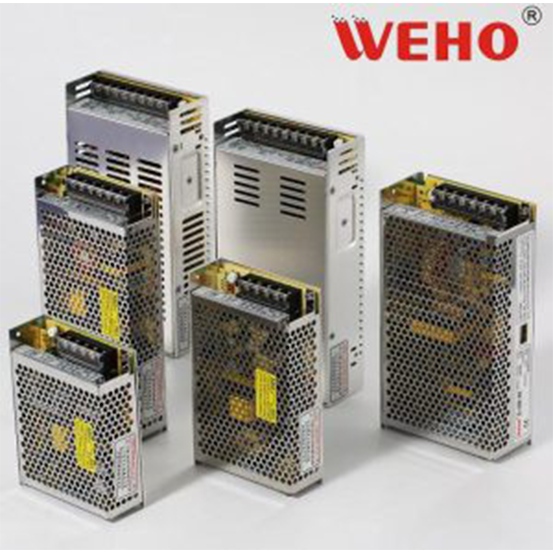
WEHO’s switching power supply product line is relatively complete, with the output voltage covering from 12V to 220V, and the power can reach up to 15,000W. The products include single-output, multi-output and high-power models, which can be used in different scenarios such as industrial automation, security monitoring systems, LED lighting and control equipment. Neighbourhood
As an internationally certified Chinese manufacturer, WEHO has both manufacturing experience and a quality system that meets global standards. Its internal engineering capabilities can support customised projects and OEM/ODM work. For B2B buyers who are looking for a reliable industrial power supply partner, WEHO is A selection worth seeing

Perguntas frequentes
What certifications should an industrial power supply manufacturer have?
UL (North America), CE (Europe), CB (International) and CCC (China) certifications are required. If it is a specific field, it also depends on IEC 60601-1 (medical standard) or IEC 61508 (functional safety standard), ISO 9001 quality management system recognition Certificates are also indispensable.
How important is OEM customization for industrial projects?
It is especially important that customisation allows you to get the precise voltage, size, connecter or function required for the application. These are what standard products usually cannot provide. Whether the supplier can redesign according to your specific requirements is an important factor in distinguishing the level.
How can you evaluate long-term supply stability?
It depends on the scale of the factory (more than 2,000 square metres is a good indicator), where the components are purchased, whether there are backup suppliers, and whether there is safety inventory. Manufacturers with relatively dispersed supply chains can bear it when the supply is interrupted.
Why does component quality affect power supply lifespan?
Industrial-grade components are designed to withstand higher stress and temperature, and have a longer service life. Poor-quality capacitors and semiconductors may break down in advance, resulting in a lot of money to stop work. The quality of components is the basis of reliability.
Conclusão
Choosing an industrial power supply manufacturer is essentially looking for a partner who can deliver safe and reliable products and ensure the continuous operation of your operation. Low prices are tempting, but they can rarely be exchanged for peace of mind. A manufacturer with proper certification, strong customisation ability, high-quality components and a resilient supply chain can help you avoid costly downtime and future troubles. Take some time to ask those sharp questions and verify the claimed promises. The efforts made in the early stage will bring you years of rewards in terms of reliability, performance and operational stability. Contact Now For More Info.