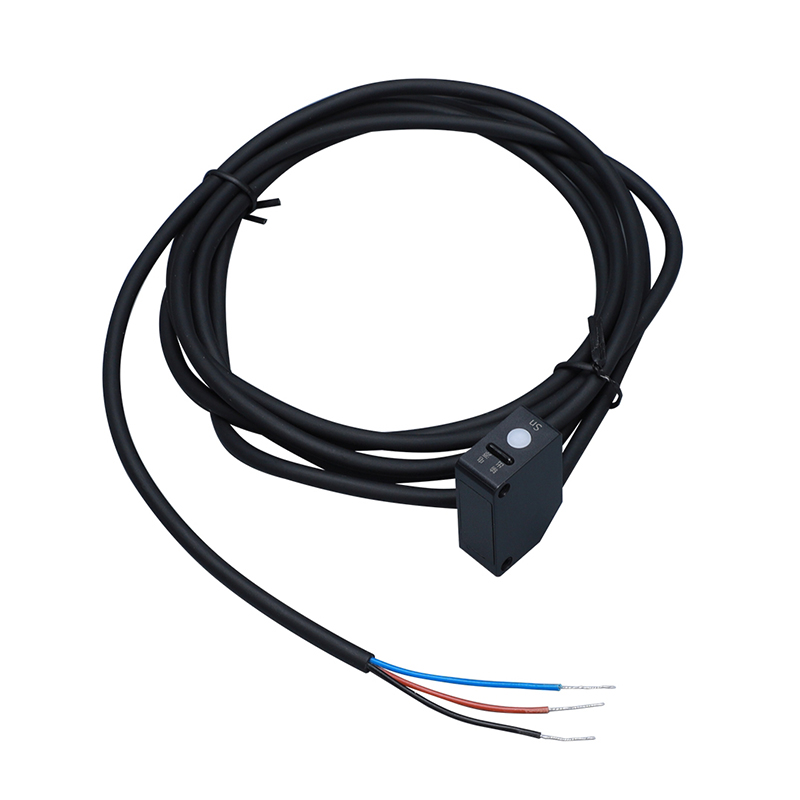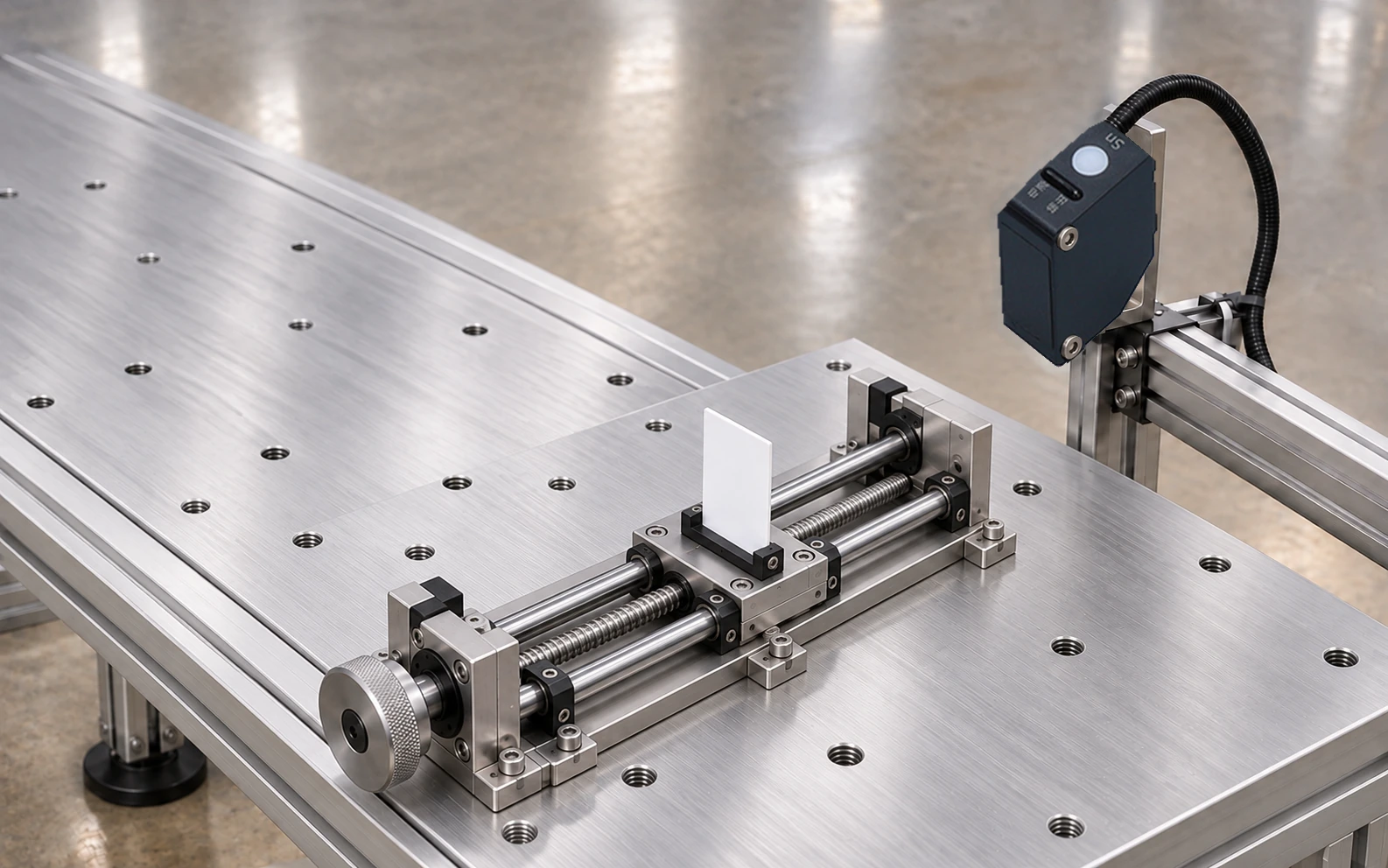
Check the nearest target position before selecting a long-range photoelectric sensor. The C3Z-TOF1 table begins its adjustable distance range at 50 mm. A target that passes closer than that is outside the listed lower boundary even if its farthest position is comfortably below 1000 mm.
For an OEM mechanical designer locating a sensor around a moving carrier, the decision is whether the entire required detection stroke fits the documented range and a verified application envelope. Maximum distance alone is not enough.
Use the TOF1 table and record the page conflict
The C3Z-TOF1 product table lists C3Z-TOF1P as PNP, describes diffuse-reflective TOF operation and gives 50–1000 mm adjustable distance using 10 ×10cm white non-glossy paper. It also lists 12–24 VDC supply and 10 ms response. The opening prose incorrectly refers to C3Z-D100, so it must not be read as independent confirmation of a TOF1 specification.
Use the explicit TOF1 table as the initial candidate description and have the applicable current model specification confirmed. Do not extrapolate below 50 mm, assume zero-distance detection or import the capabilities of another TOF product. The stated target condition also does not establish every material, angle or small object.
A threshold is not a guarantee across every closer position
Distance-settable detection has an applicable sensing region. Reducing a threshold does not automatically make the region extend to the lens surface. The OMRON photoelectric terminology distinguishes set range, sensing range and near dead zone. Those definitions help frame the question but do not supply a measured dead-zone map for C3Z-TOF1P.
Define the position at which the target must be recognized and every position where its absence must be recognized. If detection is needed only at one stopped position, say so. Requiring detection throughout motion is a broader task and needs the complete travel envelope.
Calculate the nearest and farthest points
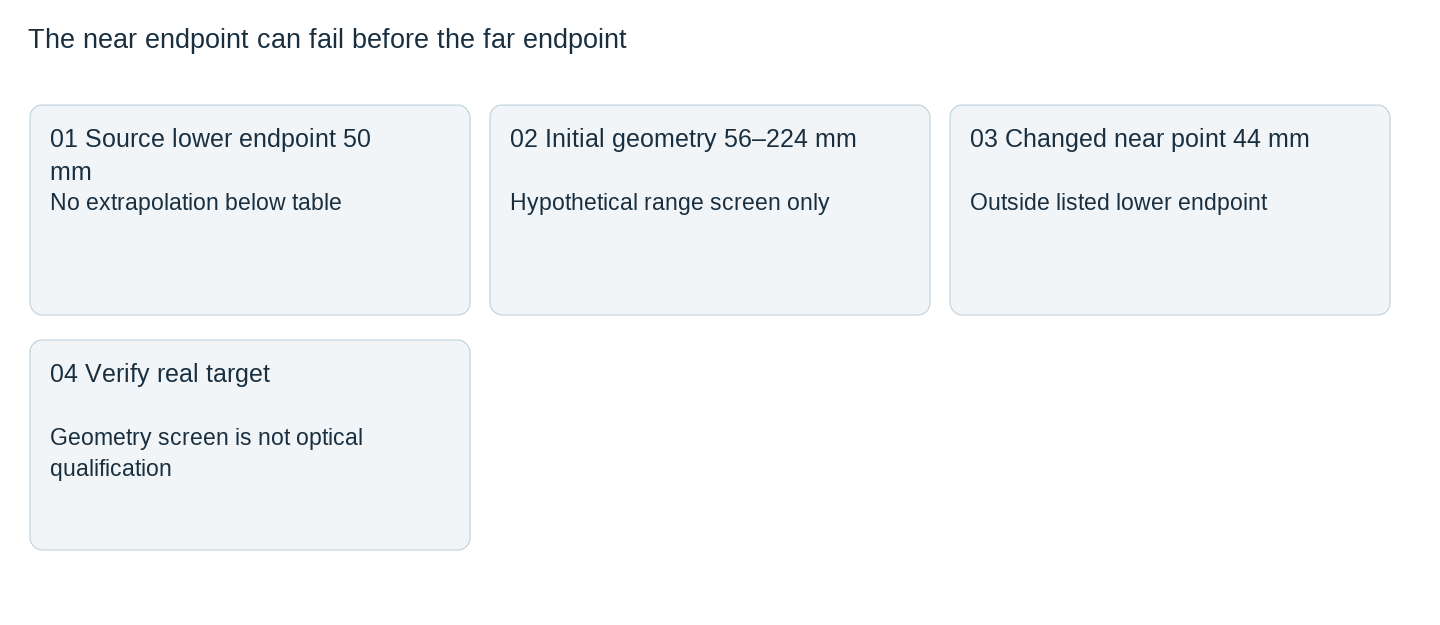

In a hypothetical machine, the target’s nominal nearest position is 70 mm from the sensing reference, and travel adds up to 140 mm away. Allow±8 mm assembly variation and±6 mm target movement unrelated to the intended stroke. The nearest possible distance is 70−8−6=56 mm; the farthest is 70+140+8+6=224 mm.
The 56–224 mm geometric envelope lies within the table’s 50–1000 mm endpoints. That is only an initial range screen. If a later fixture change moves the nominal nearest position to 58 mm, the nearest extreme becomes 44 mm, below the 50 mm endpoint. That change needs redesign or new applicable evidence, even though the far end still looks easy.
Evaluate the real optical path at the endpoints
Include the actual target area seen by the beam at the closest and farthest positions, its angle, surface and background. Do not apply a universal spot size because none has been established here. A lip or hole in a carrier can change the visible return during movement even when the central distance remains within the nominal envelope.
Keep the sensor face reference explicit: measuring to the front of a protective enclosure instead of the actual optical reference can shift the range record. Any protective window must be supported for the arrangement, rather than assumed transparent to the sensing system because it looks clear to a person.
Validate the required stroke and the change triggers
Test the real target across the required positions using a defined speed and electrical interface. Record the output and receiving state, including target-absent positions with the real background. Avoid declaring color independence from a short demonstration or a broad marketing sentence. The application record should define the surfaces and geometry actually evaluated.
Changes in carrier height, sensor mounting, protective windows or target finish can alter the qualified window. Preserve the near-distance calculation with the mechanical drawing so the next machine variant does not consume the remaining 6 mm arithmetic difference in the example without review. That 6 mm is not a recommended universal margin.
Do not use a T15 image to illustrate TOF1
The official TOF1 gallery repeats images visibly marked C3Z-T15P-D. They do not establish the TOF1P exterior or a valid installed application. Preserve those source observations in procurement review, but use an accurate TOF1P photograph for its product illustration rather than editing the printed model.
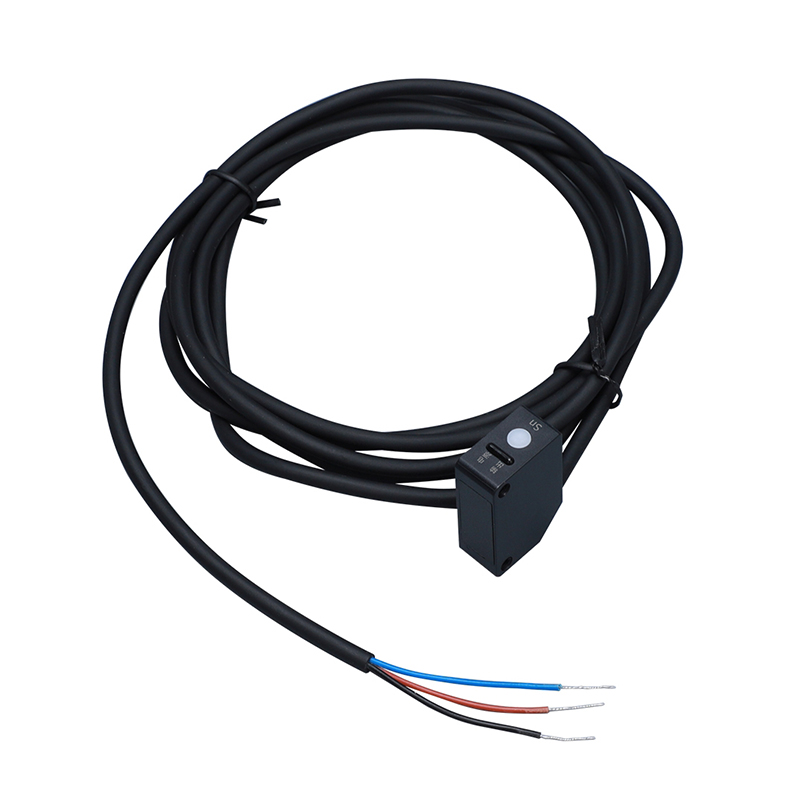
Send WEHO the C3Z-TOF1P requirement, nearest/farthest target positions, tolerance stack, target and background samples, speed and receiving input. Request the current exact-model specification and outline to complete the application review.
Full-stroke optical range record
| Initial geometry | Nearest nominal | Farthest nominal | Tolerance contributors |
|---|---|---|---|
| Bounded envelope | Nearest extreme | Farthest extreme | Source endpoints |
| Optical trial | Endpoint and transition results | Output/input | Qualified range |
| Change control | Carrier/window/finish change | New envelope | Disposition |
Blank project worksheet. Enter verified project data; example calculations above are not measurements.