For a D-120B, check three limits together: the 5 V rail, the 24 V rail and the total simultaneous output power. The published B-column ranges are 0–6 A at 5 V and 0–4 A at 24 V. Their upper-end powers add to 126 W, while the family is described as 120 W. Do not interpret both current maxima as an approved continuous 126 W operating point. Use the family rating as an initial ceiling and obtain the permitted combined-load conditions for the intended unit.
This guide is for an OEM electrical designer budgeting a machine’s 5 V logic and 24 V auxiliary loads before freezing the power-supply BOM. It provides a calculation and change-control record, rather than a claim that this supply has been tested with a particular controller or actuator.
Read the B-column before adding the loads
The WEHO D-120 product table distinguishes D-120A from D-120B. The A version lists 5 V and 12 V; the B version lists 5 V and 24 V. A family title or a similar enclosure does not identify the required output combination. Record the exact suffix on the purchase specification and compare the received marking with the approved documents.
| Budget item | Published D-120B information | What it means for selection |
|---|---|---|
| Capitão: CH1 | 5 V; 0–6 A | Check the complete 5 V branch current. |
| Então ch2 | 24 V; 0–4 A | Check the complete 24 V branch current. |
| Family power | 120 W | Check simultaneous watts; confirm the allowed combined-load envelope. |
The official D-120 specification sheet repeats those rail ranges and the 120 W family description. It does not provide a complete graph of every permitted load combination. A procurement calculation therefore identifies a candidate operating point; it does not establish cross-regulation, transient response or the final thermal limit.
Budget an operating state, not a list of unrelated peaks
List each receiver, its rail, its documented maximum current and the operating state in which that current occurs. Include interface boards, indicators and optional accessories. If a load specification gives only typical consumption, keep that uncertainty visible instead of treating the typical figure as a maximum.
For each real simultaneous state, calculate Ptotal = 5 × I5V + 24 × I24 V. If the approved output settings differ from nominal, recalculate with those settings. Check rail current limits separately even when the watt sum looks comfortable.
The following numbers are a hypothetical design exercise. They are not measurements of a WEHO supply or an identified machine. A production state requires 4.5 A at 5 V and 3.0 A at 24 V: 22.5 W + 72 W = 94.5 W. The unused arithmetic capacity is 1.5 A on the 5 V rail, 1.0 A on the 24 V rail and 25.5 W against a 120 W ceiling. Those three quantities are different constraints, not interchangeable reserves.
Three expansion requests, three different decisions
| Hypothetical state | 5 V current | 24 V current | Total at nominal voltage | Screening result |
|---|---|---|---|---|
| Present production state | 4.5 A | 3.0 A | 94.5 W | Below the three initial limits. |
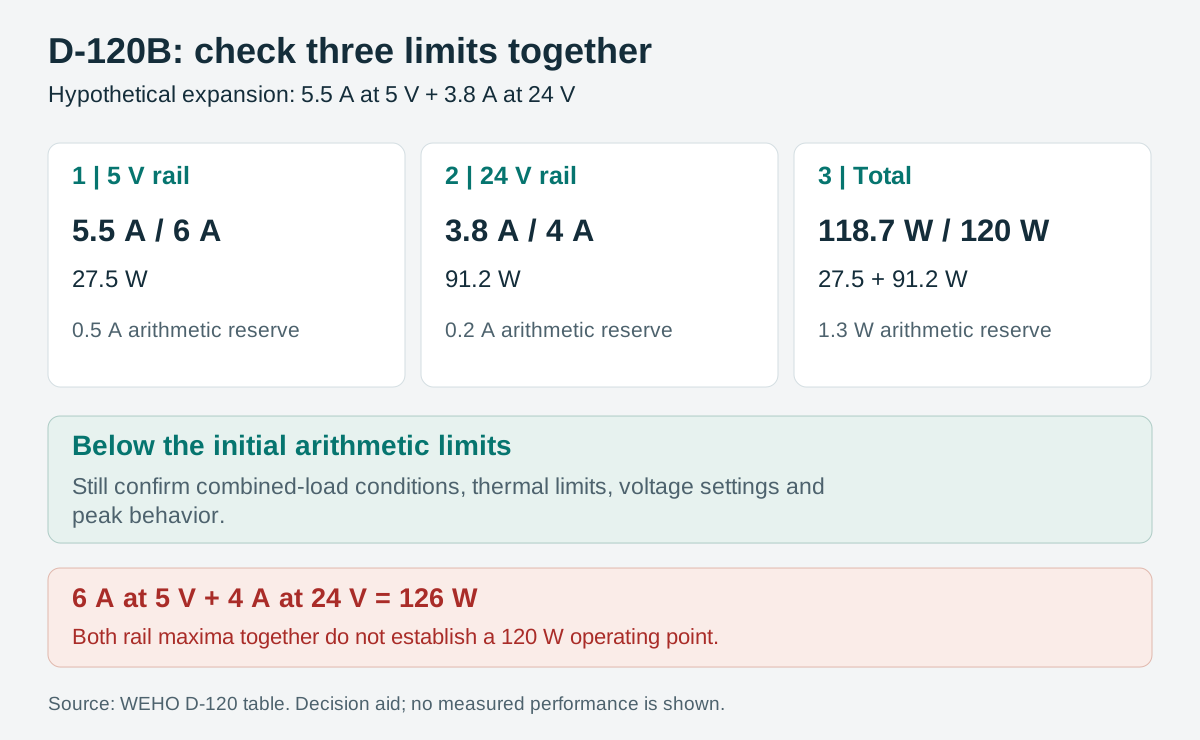
| Add 1.0 A logic and 0.8 A auxiliary | 5.5 A | 3.8 A | 118.7 W | Below the initial limits, with only 1.3 W of total arithmetic reserve. |
| Add 1.8 A logic only | 6.3 A | 3.0 A | 103.5 W | Reject: the 5 V current exceeds 6 A. |
| Use both listed rail maxima | 6.0 A | 4.0 A | 126 W | Reject as an assumed 120 W operating point. |
The 118.7 W case has passed a spreadsheet screen only. It has not earned a continuous-duty approval. Small errors in receiver demand or a higher voltage setting could consume the remaining reserve. Record the project’s required allowance, the source of that allowance and the actual enclosure conditions. Do not present an arbitrary percentage as a universal power-supply rule.
If a requested load exceeds one rail, reducing the other rail’s consumption does not automatically increase that rail’s current rating. If it exceeds the total ceiling, moving a load to another rail does not create extra power. Change the architecture or obtain a documented alternative before revising the BOM.
Resolve the conditions that the arithmetic cannot answer
Capture short-duration current separately from continuous demand, with its duration and repetition rate. A motor, solenoid driver or capacitive receiver must not be approved merely because its average watts fit. Ask for evidence of the supply’s permitted peak behavior and verify the voltage at the actual receiver during the demanding state. This article does not assign an undocumented surge capability to the D-120B.
Record ambient temperature at the supply, enclosure airflow, mounting arrangement and the applicable derating information. The product page refers to output-load derating; its temperature range alone does not prove that full power is available throughout that range in a closed machine. Also confirm that both receivers tolerate their actual rail voltage and any interaction when the other load changes.
A useful validation request is narrow: the selected D-120B revision, the two stated load currents, approved voltage settings, input conditions and enclosure temperature. Ask WEHO to confirm that combination, then test the assembled machine against its receiver limits. Keep the supplier response and the test record attached to the same budget revision.
Make the budget part of the service and purchasing record
Freeze a row for normal production, standby, maximum simultaneous action and each enabled option. Record which states are mutually exclusive and how the control design enforces that exclusion. If the software later permits two actions together, the old budget no longer describes the machine.
Use the worksheet below for the next review. Enter a source or measurement record for every demand figure, mark unverified values and give one person ownership of the combined-load confirmation. Reopen the budget when a board, actuator, firmware mode or output setting changes. This preserves a concrete explanation of why the chosen supply fits the machine, rather than leaving future teams only a “120 W” purchase description.
Use the project record
Open the blank D-120B simultaneous-load budget record to record your conditions, evidence and decisions. The worksheet contains no pre-approved result.
Send WEHO the two rail budgets, simultaneous states, enclosure conditions and required voltage settings when enquiring about the D-120B dual-output power supply. Request confirmation of the combined-load operating point and the current specification revision before ordering.