Principais pontos de engenharia
- First-pass yield counts units meeting the defined requirements on their first valid pass.
- Final accepted fraction includes approved recovery and answers a different question.
- Preserve unit identity and attempt history instead of counting test rows as units.
- Separate station-invalid runs, rework and product failures with an agreed counting policy.
First-pass yield and final accepted fraction should be reported separately because successful retests can hide the effort needed to obtain accepted units. Define the process boundary, unit population and first-pass eligibility before calculating either measure. A percentage without those definitions is difficult for an OEM buyer to compare or use.
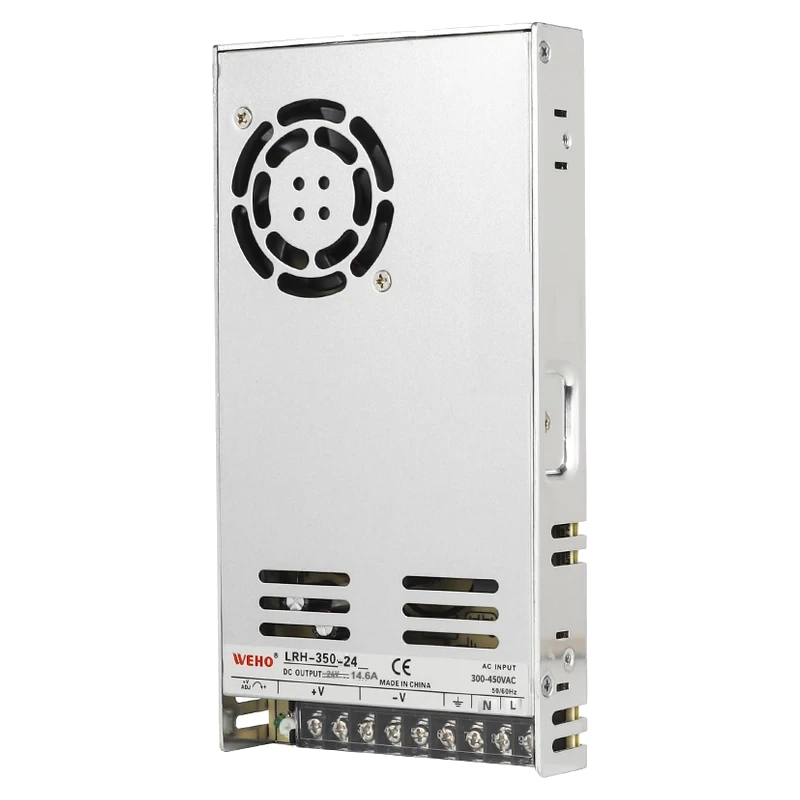
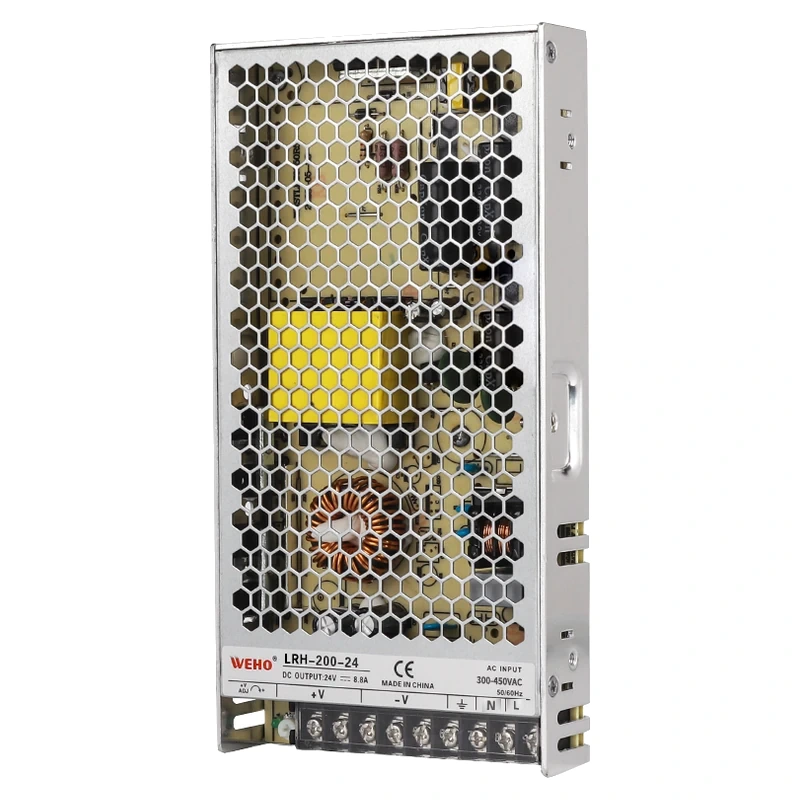
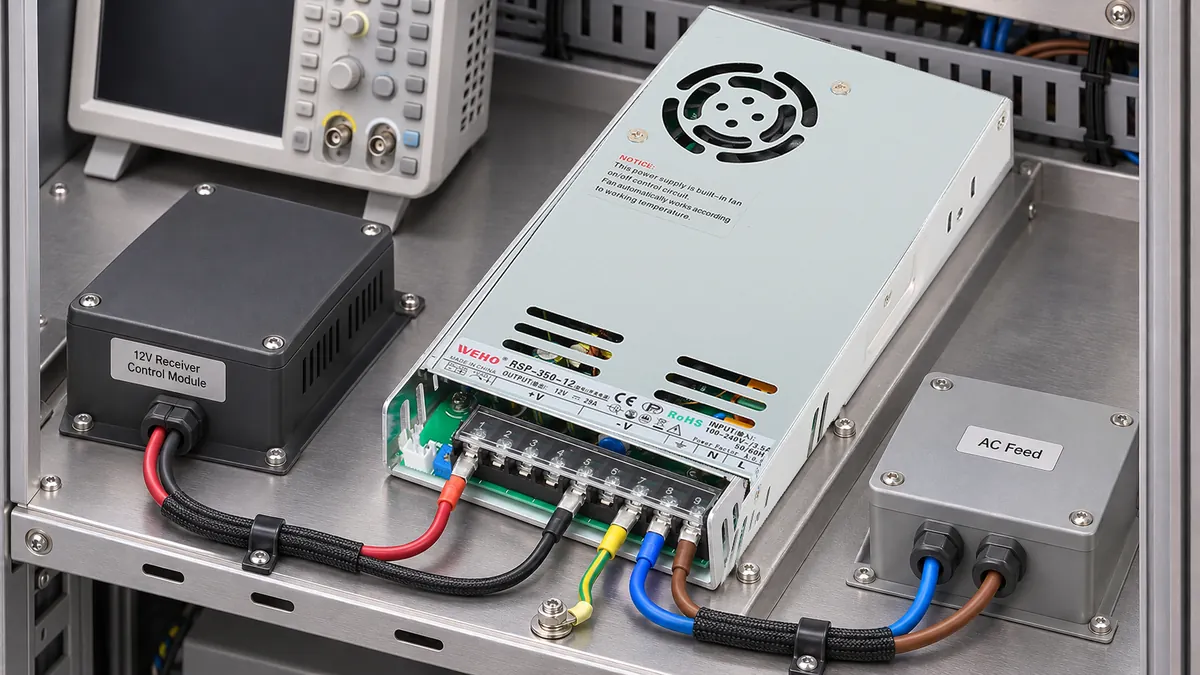
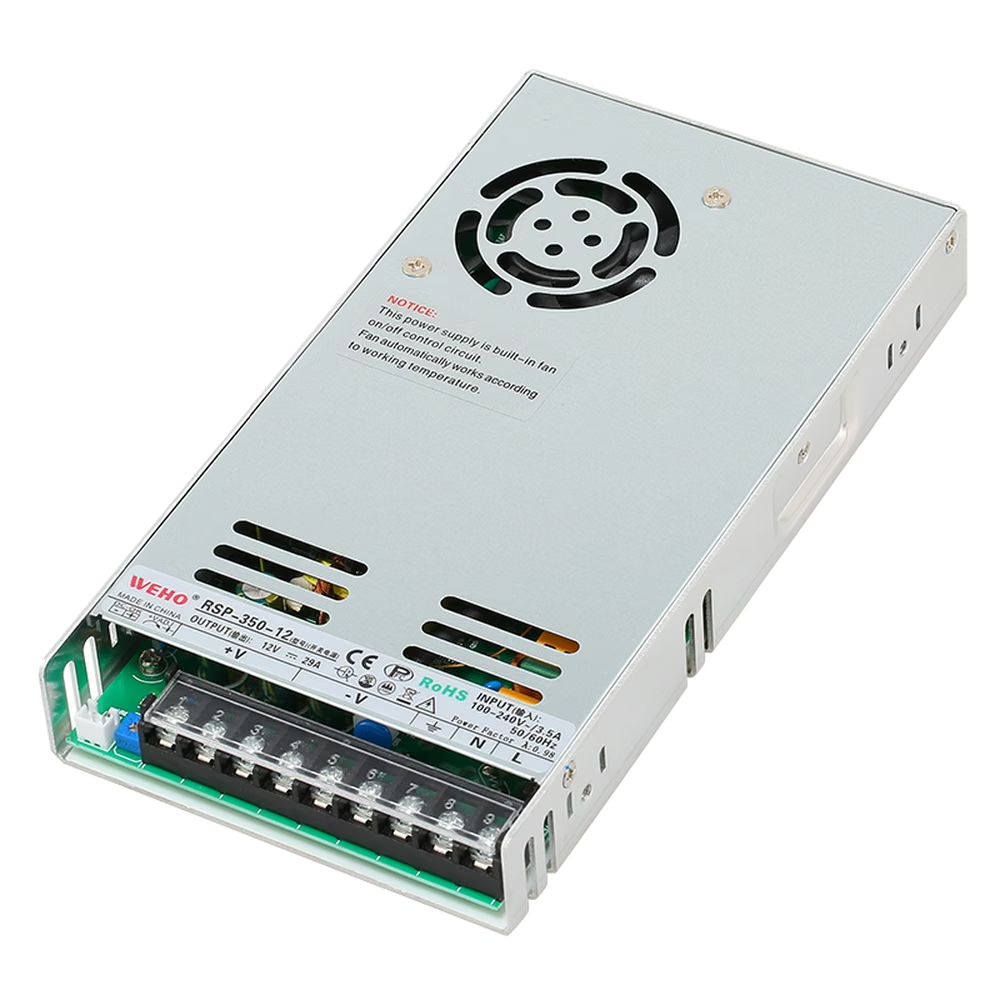
For an enquiry about the WEHO RSP-350-12, request the agreed metric definition as well as its value. The model identifies the purchased item; it does not supply a WEHO yield claim. The fictional cohort below illustrates recordkeeping and arithmetic, not factory performance or a delivery commitment.
Define the unit and the process boundary
A unit-level yield requires a stable unit identifier and a defined set of requirements. State whether the boundary covers one station, an assembly operation or an entire manufacturing route. A passing voltage check alone cannot count as a complete first-pass unit when the stated route also requires other inspections.
Minitab's throughput-yield glossary describes the percentage acceptable the first time through the process. Use that meaning with an explicit local counting policy. Report any exclusions so a reader can see whether the percentage represents all units entering the boundary or a narrower population.
A test attempt and a physical unit are different entities. Repeated attempts increase the number of data rows without creating additional products. If a dashboard divides passing attempts by all attempts, label that measure accordingly; it is not automatically first-pass yield or final unit acceptance.
A reporting period also needs a cohort rule. Units entering near the end of a shift may still be awaiting rework or disposition when the report closes. Keep their pending status visible rather than excluding difficult units or counting later recoveries in a different denominator without explanation.
| Measure | Numerator | Denominator | Decision supported |
|---|---|---|---|
| First-pass yield | Units meeting the defined first-pass rule | Unique units entering the defined boundary | Initial process effectiveness |
| Final accepted fraction | Units finally accepted by the cutoff | The same defined unit cohort | Completed disposition outcome |
| Attempt pass fraction | Passing executions | All included executions | Test activity, under stated exclusions |
| Rework recovery | Initially unsuccessful units later accepted | Specified recovery population | Recovery outcome and workload |
Preserve why the first route was unsuccessful
A product failure, a fixture contact problem and a communication timeout should not be collapsed into a single unexplained retry category. They may require different technical responses and counting treatment. Define how invalid station runs are handled, while retaining their frequency and the associated lost time.
An invalid run can be excluded from a particular valid-test denominator only under a transparent, approved rule. Exclusion must not erase evidence of station instability or allow operators to relabel genuine product failures as invalid. Retain the original status, reason, reviewer and any replacement execution.
Minitab's first-pass-yield discussion distinguishes initial conformity from recovery through rework, repair, adjustment or reinspection. Apply the agreed boundary consistently. A later passing attempt does not retroactively turn a recorded first-pass failure into a first-pass success.
A rework record should identify the authorized action and the requirements reverified afterward. Repeating a measurement without an intervention and repairing an assembly are different activities even if both eventually produce PASS. Preserve those differences for root-cause analysis and capacity planning.
Recompute a fictional 100-unit cohort
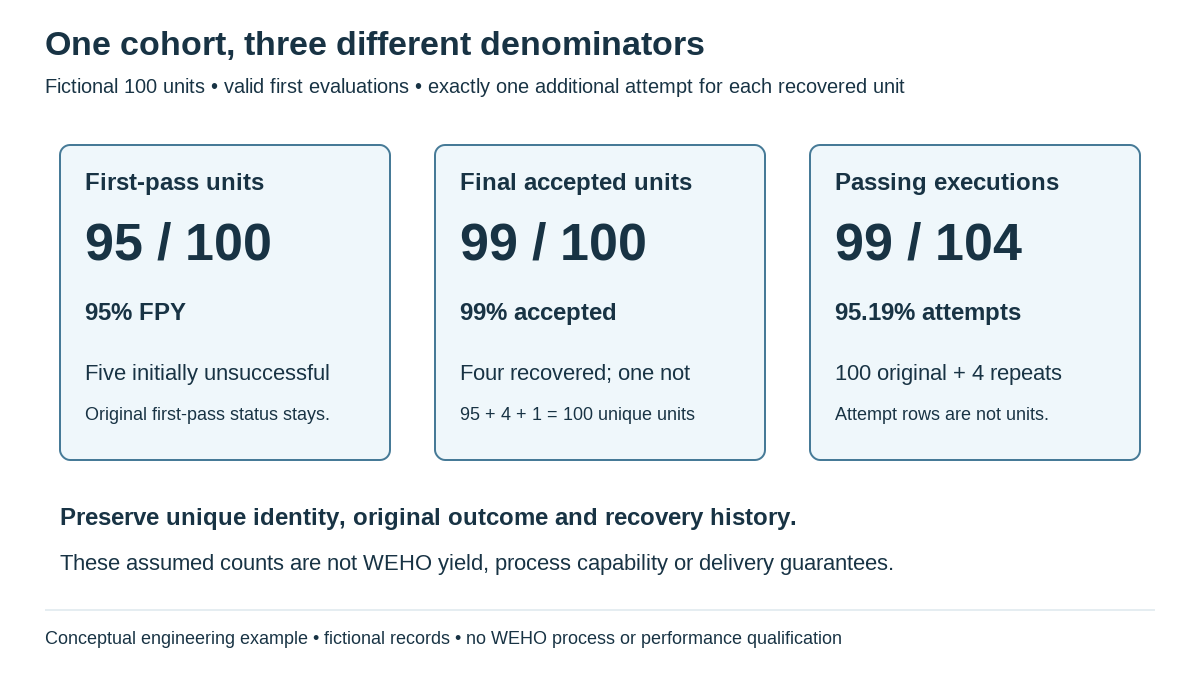
Assume 100 unique units enter one fully defined inspection boundary. All have a valid first evaluation, with no station-invalid runs in this simplified example. Ninety-five meet all first-pass requirements; five do not. First-pass yield is therefore 95 / 100 × 100% = 95%.
Assume four of the five initially unsuccessful units later pass an authorized recovery process and complete required verification. One remains not accepted at the reporting cutoff. The final accepted fraction is (95 + 4) / 100 × 100% = 99%, while the first-pass yield remains 95%.
If each of the four recovered units receives exactly one additional test, the database contains 104 attempts. Under these assumptions there are 99 passing attempts, so the attempt pass fraction is 99 / 104 = 95.19%. That number differs from both unit-level metrics and must not silently replace them.
| Fictional cohort field | Count | Calculation | Interpretation |
|---|---|---|---|
| Unique units entering | 100 | Fixed cohort denominator | No unit duplicated by retest |
| First-pass accepted | 95 | 95 / 100 = 95% | Initial route result |
| Accepted after recovery | 4 | (95 + 4) / 100 = 99% | Final accepted fraction |
| Passing / total attempts | 99 / 104 | 95.19% | Execution statistic only |
The recovery fraction among initially unsuccessful units is 4 / 5 = 80%. State that denominator if the number is reported; it is not an 80% yield for the whole cohort. A small example illustrates the distinction but does not establish a stable future recovery probability.
Deslize horizontalmente em uma tela pequena, ou abra o diagrama em tamanho completo.
The arithmetic also provides a reconciliation check: 95 first-pass accepted + 4 recovered accepted + 1 not accepted = 100 unique units. Attempt rows reconcile differently: 100 original evaluations + 4 recovery evaluations = 104. A dataset that cannot satisfy its own stated reconciliation needs investigation before publication.
Keep defects, units and opportunities distinct
A single unit can contain more than one defect. Counting three defects on one unit as three failed units inflates a unit-based failure count. Conversely, retaining only a final unit status can hide the multiple problems that consumed rework effort.
Minitab's product-performance documentation uses separate measures for defects, units and opportunities. Preserve those distinctions in a buyer-facing report. Do not convert a unit yield into defects per million opportunities without defining and defending the opportunity count.
A route-level first-pass result also differs from multiplying unrelated station percentages. A defensible rolled measure requires a compatible route definition and assumptions about the contributing data. Keep the simple unit cohort as the primary evidence when individual serial histories can directly answer the buyer's question.
O WEHO first-article approval checklist addresses configuration and acceptance records for a product introduction. Yield reporting adds a time-ordered population and recovery history. Neither a single approved sample nor a final shipment count describes first-pass process performance by itself.
Build a report that preserves the route history
- Fix the definition. State process boundary, unique unit key, cohort dates and required first-pass checks. Record invalid-run and cutoff rules; verify that another reviewer can identify the same population.
- Retain every attempt. Store original result, timestamp, station, recipe and reason for repetition. Link later attempts to the same unit; verify that no retry creates a new denominator unit.
- Record recovery actions. Distinguish remeasurement, adjustment, repair and rework with approvals. Record required reverification; verify that final acceptance rests on complete evidence.
- Calculate parallel metrics. Show first-pass yield and final accepted fraction beside the counts and pending population. Record attempt statistics separately; verify the numerator and denominator reconciliation.
- Review the causes. Stratify losses by actual product and station mechanisms without changing definitions to improve the result. Record actions and follow-up periods; verify whether later cohorts support the intended improvement.
For supplier comparisons, agree definitions before asking for a target percentage. Differences in product mix, inspection boundary, invalid-run treatment and recovery cutoff can make nominal percentages incomparable. Request the denominator and relevant context without assuming access to confidential individual manufacturing records.
Prepare a yield-definition enquiry
Send WEHO the exact RSP-350-12 enquiry identity, order configuration, acceptance boundary and reporting definition you need. State whether the request concerns supplier manufacturing, your incoming inspection or final equipment assembly. Agree the available evidence; the hypothetical 95% and 99% figures are not WEHO performance claims or guarantees.
Perguntas frequentes
Does a successful retest improve first-pass yield?
No. Under a fixed first-pass definition, the original first-pass outcome remains. A successful authorized recovery may improve final accepted fraction and should remain linked to its original history.
Can passing test rows be divided by units shipped?
Not as a defined first-pass metric. Test rows and shipped units are different populations, and retries can create several rows per unit. Use matching numerators, denominators and reporting boundaries.
Must invalid station runs be counted as product failures?
No. Define their treatment explicitly and retain their separate frequency and effect. An invalid-run exclusion must not erase genuine product failures or conceal unstable station operation.
Does a 99% final accepted fraction prove a 99% first-pass yield?
No. In the fictional cohort, final acceptance is 99% while first-pass yield is 95%. Recovery outcomes answer a different question and require their own records.