

Key Engineering Takeaways
- A setpoint step can produce a derivative transient when derivative action uses the control error.
- A fixed-setpoint process disturbance and measurement noise are different diagnostic events.
- Derivative filtering and derivative signal selection must be verified for the actual controller.
- Capture setpoint, process value and output together before changing tuning or approving a ramp.
1. Diagnose the output jump at the setpoint event
An output jump immediately after a setpoint change requires a synchronized event record before a tuning decision. Derivative kick is one possible contribution, alongside proportional response, output limits and operator actions. A temperature trend alone usually cannot show which contribution caused the command change.
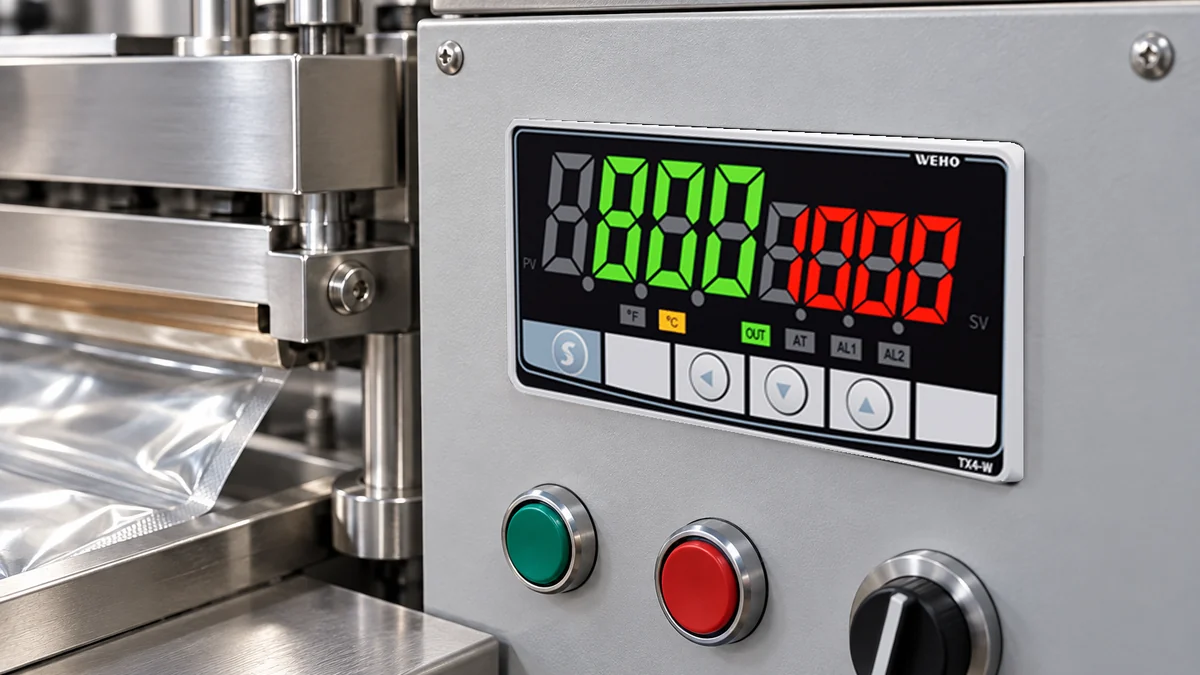
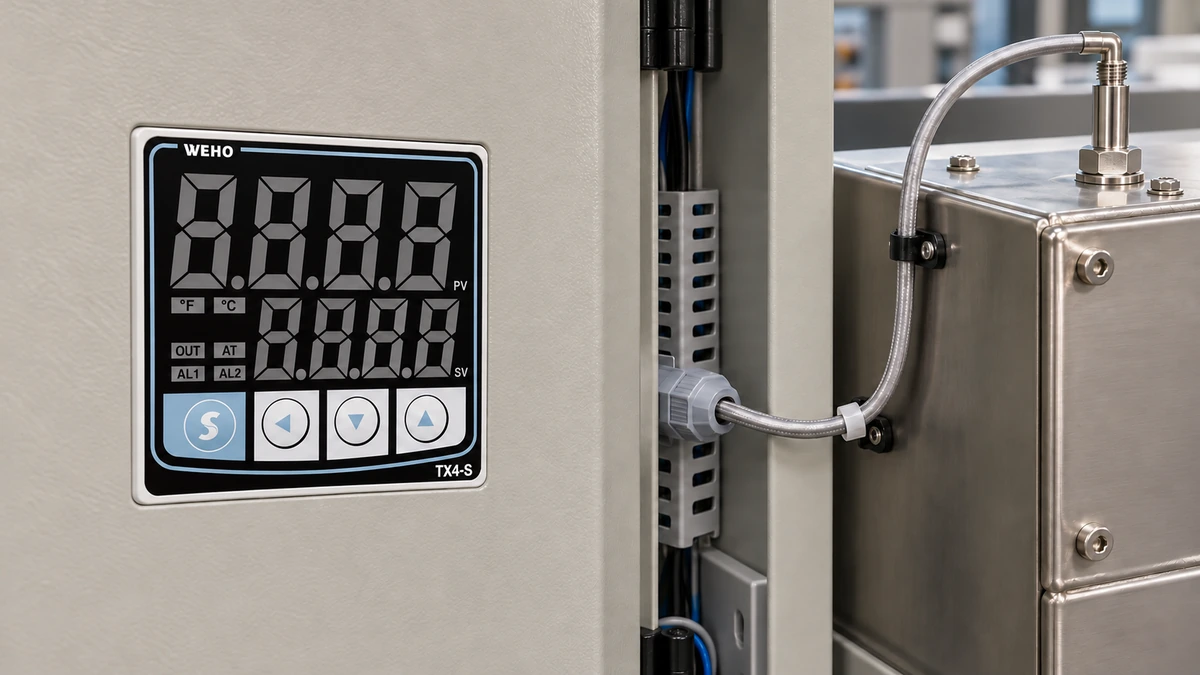
For a WEHO TX4-S temperature controller installation, record the complete unit code and current parameters before testing. The family description does not establish whether a particular derivative signal selection, filter adjustment, setpoint weighting or ramp function is available. Obtain that information for the ordered unit instead of importing another controller's algorithm.
2. Identify which signal the derivative uses
For a general PID loop, let SP denote setpoint and PV denote measured process value. The error is e = SP − PV. Derivative action on error responds to changes in both quantities; derivative action on PV does not receive the direct setpoint-change term. This distinction is a control-structure question, separate from the size of the derivative setting.
MathWorks illustrates a two-degree-of-freedom controller whose derivative path uses c × SP − PV. Setting c to zero removes the direct setpoint contribution to that path. This is a documented architecture example, not evidence that TX4 exposes a weighting parameter or implements that structure. MathWorks two-degree-of-freedom PID example
An output change after a setpoint step is not automatically derivative kick. Proportional action can change output immediately, and the combined request may encounter an actuator limit. Compare the timing and shape against the documented algorithm; do not diagnose a hidden internal term solely from the final commanded percentage.
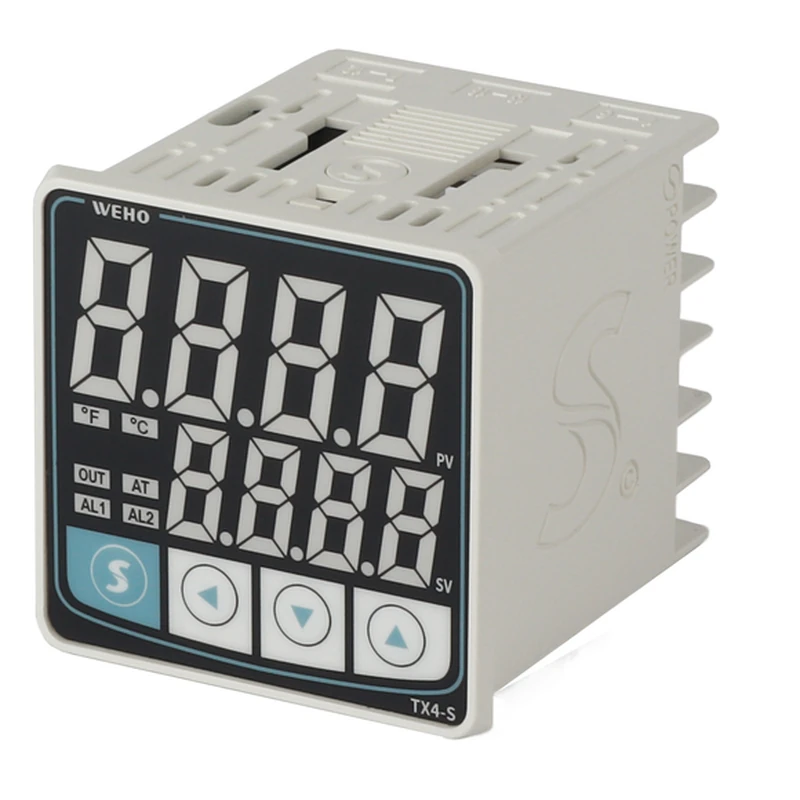
The TX4 manual provides the applicable parameter and operating reference for the controller family. Use the actual ordered unit and relevant documentation to resolve supported controls, units and restrictions before changing settings. A generic PID explanation cannot authorize entering an undocumented parameter or applying a gain from a different PID form. WEHO TX4 instruction manual
3. Recalculate a filtered derivative example
Consider an assumed continuous-time derivative path D(s) = Kd × s / (1 + Tf × s). Let Kd = 2 output-percentage-points·s/°C and Tf = 0.5 s, with zero initial derivative state. This first-order filtered structure follows a standard parallel PID representation; all numerical choices here are teaching assumptions. MathWorks parallel PID model
At time zero, the hypothetical setpoint increases by 10°C while PV remains constant. If derivative acts on error, its isolated response for t ≥ 0 is uD(t) = (Kd × 10 / Tf) × exp(−t/Tf). The initial value is therefore +40 output percentage points, decaying toward zero. This is the derivative contribution before summation or limiting, not the total actuator command.
| Time after assumed step | Derivative on error | Derivative on unchanged PV | Interpretation |
|---|---|---|---|
| 0 s, initial limit | +40.000 points | 0 points | Direct setpoint contribution |
| 0.5 s | +14.715 points | 0 points | One filter time constant |
| 1.0 s | +5.413 points | 0 points | Two filter time constants |
| 2.0 s | +0.733 points | 0 points | Four filter time constants |
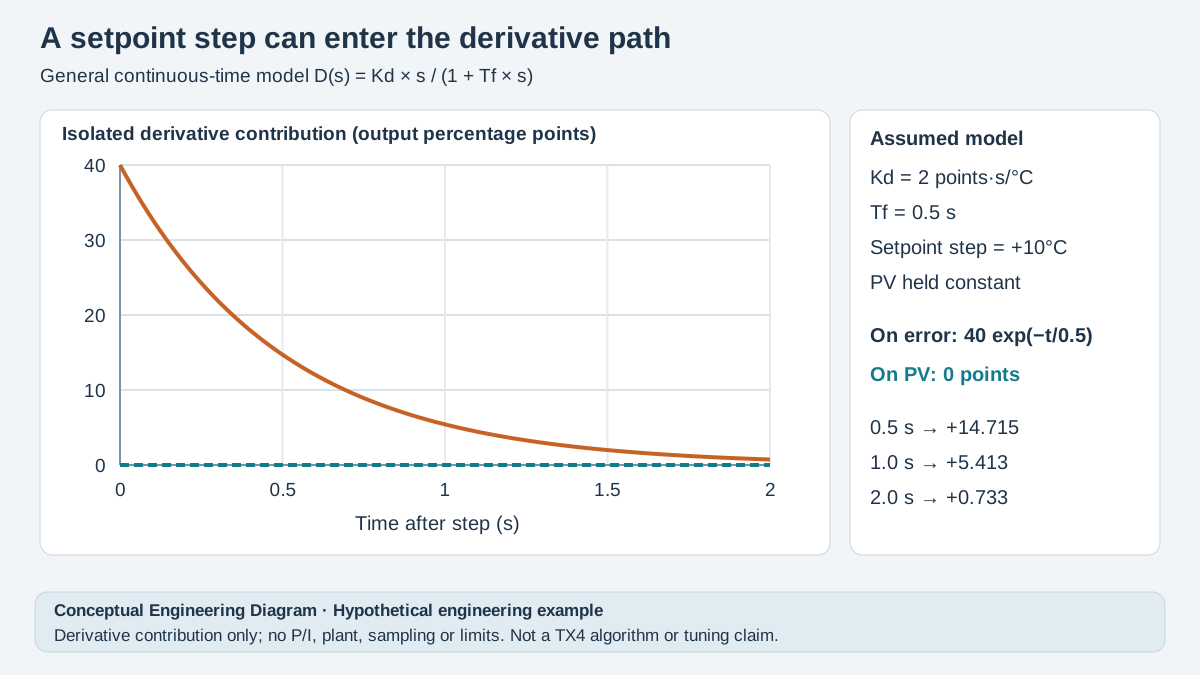
Swipe horizontally on a small screen, or open the full-size diagram.
The zero column does not mean derivative on PV can never react during a setpoint change. Once the process value moves, that path can respond to the measured movement. The table freezes PV deliberately to isolate the direct setpoint term; it omits proportional action, integration, process dynamics, sampling and output constraints.
Increasing the assumed filter time constant reduces the initial isolated peak but changes the derivative path's response. Choosing a filter is therefore a dynamic trade-off, not a free cure. A different digital implementation, derivative definition or parameter convention can produce different numbers; the example is not a recommended TX4 tuning setting.
4. Separate three events that can resemble one problem
A setpoint event begins with the requested target changing. A load disturbance begins with a process change while the requested target remains fixed. Measurement noise appears in the measured signal and can drive derivative activity even when the physical temperature is relatively steady. Record event identity before comparing traces or deciding that every output movement needs the same remedy.
Manufacturer guidance on PID signal conditioning distinguishes measurement-noise amplification and derivative filtering from the setpoint-induced kick mechanism. A smoother displayed PV does not, by itself, identify the signal used inside a controller or prove that the final control output has become suitable. Maple Systems PID signal conditioning guide
| Observed event | Record first | Candidate explanation | Next verification |
|---|---|---|---|
| SP changes; PV initially steady | SP, PV, output and timestamp | Proportional response or direct derivative contribution | Confirm algorithm and event-aligned response |
| PV moves with SP fixed | Load event and measured response | Process disturbance response | Compare recovery against process criteria |
| PV fluctuates without known process event | Raw/reference measurements and wiring conditions | Measurement noise or real rapid variation | Resolve signal quality before tuning around it |
| Output remains at a limit after the event | Limit state and recovery history | Combined command saturation or other constraints | Investigate recovery separately |
Use a time base capable of resolving the suspected event. A slow trend can miss a short command transient and make a later process response look like its cause. Record the source and update interval of every available signal, and mark unavailable internal terms as unavailable instead of reconstructing them as measured facts.
5. Run a bounded test before selecting a remedy
- Preserve the starting configuration. Record controller identity, PID form if documented, parameter units, output arrangement and permitted limits. Verify that the original settings can be restored and that the test has an approved process boundary.
- Define the event and acceptance criteria. Record the intended setpoint change, allowed output behavior and acceptable temperature excursion. Verify that independent protection and operating procedures remain effective throughout the test.
- Capture synchronized evidence. Record SP, PV and available output indications around the event, together with acquisition timing. Verify that the observed output change follows the event rather than a coincident load or operator action.
- Confirm the supported control structure. Record the manual or supplier answer identifying derivative signal, filtering and any available setpoint treatment. Verify that the proposed adjustment exists on the actual ordered unit before making it.
- Change one documented factor. Record the authorized adjustment and repeat comparable conditions. Verify both setpoint response and fixed-setpoint disturbance behavior so an improvement in one task does not conceal unacceptable behavior in another.
Reducing derivative action may reduce an unwanted transient while also changing useful disturbance response. A supported setpoint ramp may reduce the abrupt request but adds a transition time that the process must accept. Document these trade-offs in process terms, including the permitted temperature excursion and cycle-time effect, instead of choosing the smoothest-looking plot.
An unexpected final actuator response also needs an output-interface check. Use the WEHO TX4 alarm and external-interlock guide to distinguish controller control, alarm and independent shutdown roles. An improved tuning trace does not demonstrate the function or coverage of a separate protective device.
6. Send WEHO the event record and supported-function question
Send WEHO the exact TX4-S unit information, parameter photographs and an event-aligned SP/PV/output record. State whether the concern occurs after a setpoint step, during a fixed-setpoint load change or with apparently noisy measurement. Ask which derivative structure and supported adjustments apply to that ordered unit.
The next action is to resolve the algorithm question, agree on a bounded comparison and retain before-and-after records. Approve the selected change against the process response and output behavior required by the equipment, with any missing signal evidence stated explicitly.
7. Frequently asked questions
Is every output jump after a setpoint change derivative kick?
No, proportional action, output constraints and coincident operating changes can also affect the output after a setpoint change. Use synchronized signals and documented controller structure to identify the contribution before changing derivative settings.
Does derivative on PV remove all response to a setpoint change?
No, derivative on PV removes the direct setpoint term from that path, but it can react when the measured process value subsequently changes. Proportional and integral actions can still respond to the setpoint request.
Can I use the example's Kd and filter values in a TX4 controller?
No, the example values describe an assumed mathematical model and are not TX4 settings. Confirm the actual PID form, supported parameters, units and process requirements before selecting or changing tuning.
Should I add filtering whenever the temperature trend is noisy?
Filtering should follow a signal-quality investigation and a documented response trade-off. Establish whether the variation is real or electrical, then verify that the supported filter does not introduce unacceptable delay or conceal a relevant process excursion.