- A manual-to-automatic transfer should preserve the applied command at the switching instant.
- Matching the setpoint to the measured temperature does not necessarily align the controller output.
- State tracking and subsequent closed-loop recovery require separate observations.
- Verify the ordered controller’s documented behavior before specifying a bumpless takeover.
Define the takeover the machine actually needs
A thermal machine can operate acceptably in manual mode and still receive an unwanted command step when automatic control takes over. The immediate commissioning question is output continuity at that transfer. Tuning the later temperature response cannot remove an initial discontinuity that the mode-switching arrangement itself creates.
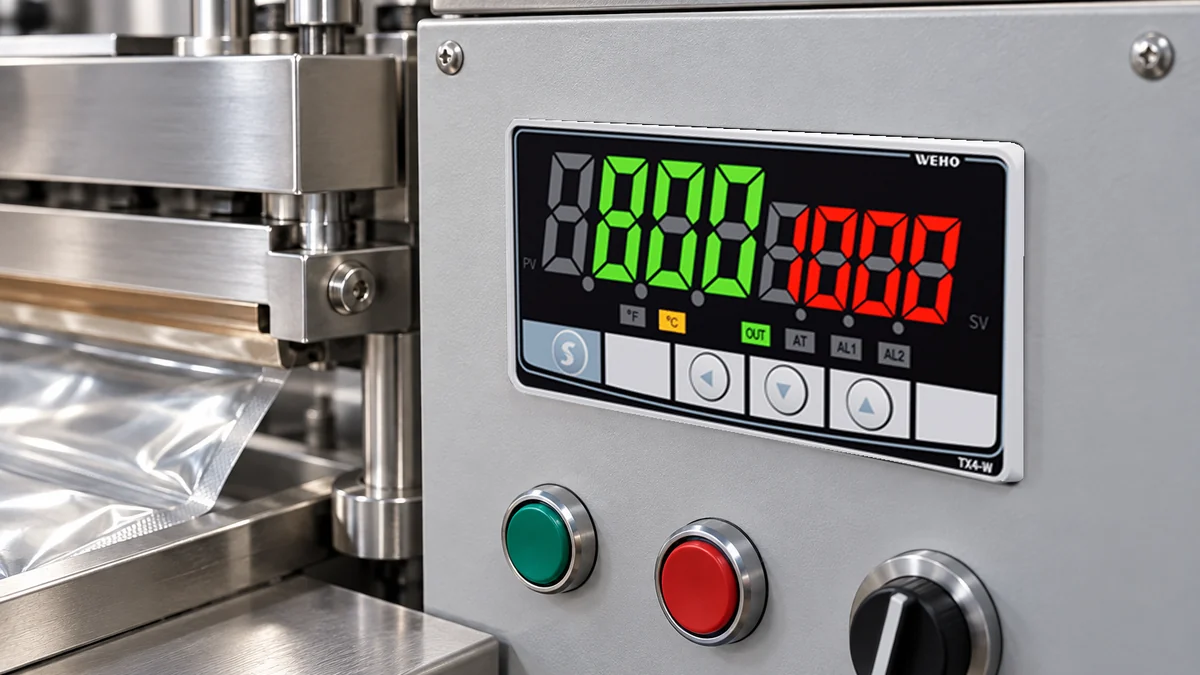
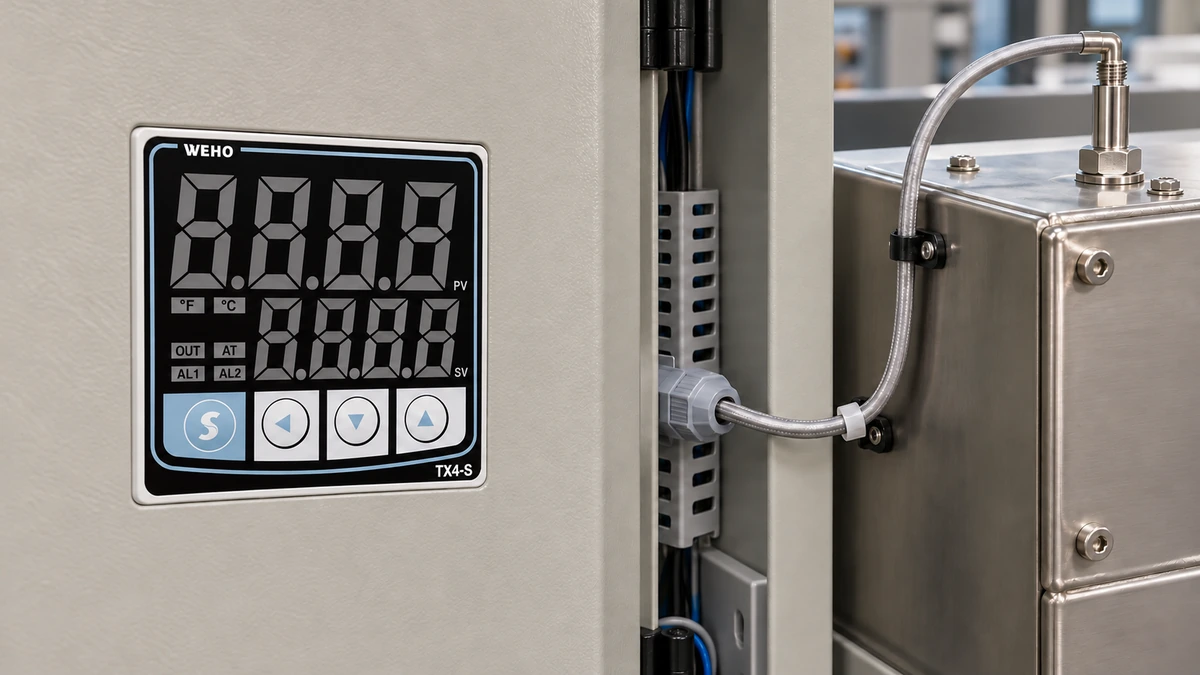
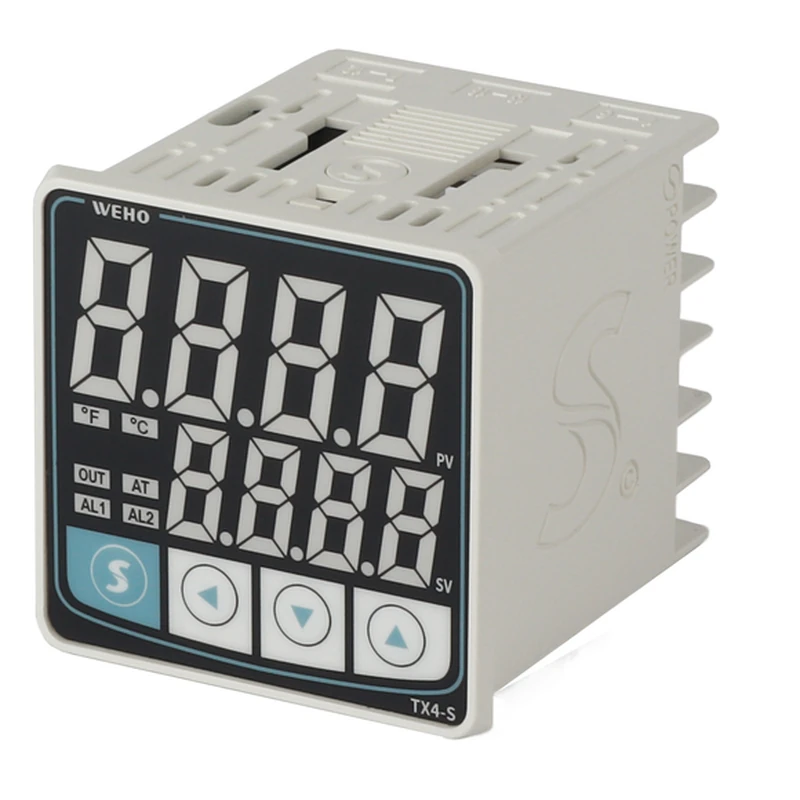
For a project considering the TX4-S temperature controller reference, document where manual control resides and which device selects the actuator command. A front-panel mode, an external selector and a supervisory PLC can create different transfer arrangements. The model name alone does not establish how their internal states interact.
The available TX4 series instruction manual includes a manual-output context. That does not, by itself, document output tracking, integrator initialization or a guaranteed bumpless transition. Confirm the matching revision and obtain the relevant behavior description before writing such a requirement into an equipment release.
Keep the acceptance statement measurable. “Smooth changeover” might mean no abrupt electrical command change, a bounded temperature excursion, or both. Declare the selected signal, observation interval and permitted discontinuity. A slowly responding thermal mass can conceal a sharp command step in a temperature-only trend.
Separate the selected command from the controller state
In a simplified proportional-integral model, automatic demand is the sum of proportional contribution and integrator contribution. Manual demand can be supplied by a different path. Switching the selector changes which demand reaches the process; it does not automatically make those two values equal.
MathWorks’ manual-to-PID transfer example illustrates a tracking arrangement that adjusts controller state during manual operation. The implementation belongs to that model. Its engineering purpose is to bring the automatic output into agreement with the command already being applied before transferring control authority.
Tracking the applied command and tracking the setpoint are different actions. Setting the setpoint equal to the current process value may reduce proportional error, but the stored integral contribution can still differ from manual demand. Output limits, bias, filtering and derivative state may also matter in an actual controller implementation.
Likewise, freezing an integrator is not generally equivalent to aligning it. A frozen state can retain an old value while an operator changes manual demand. At takeover, the preserved value may be entirely reproducible and still unsuitable. Ask which signal the state follows, when that following is active, and what happens at a limit.
Calculate the initial step in a hypothetical transfer
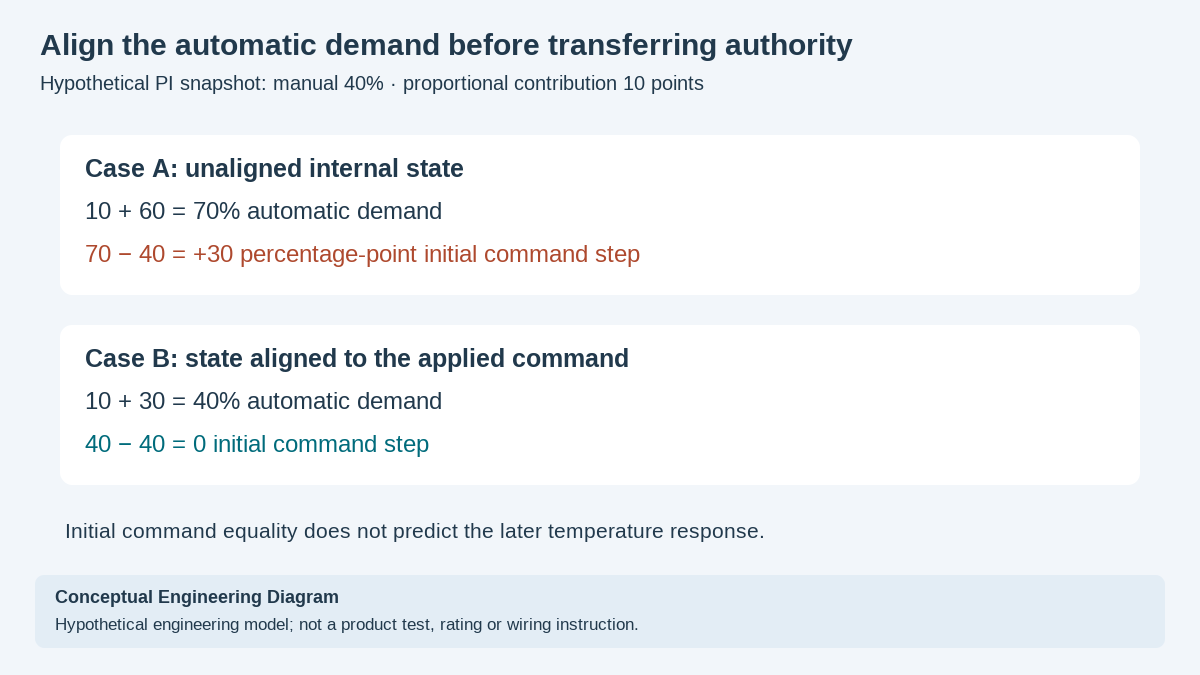
Consider an illustrative static PI snapshot, with output expressed on a common zero-to-one-hundred-percent command scale. Assume all signals use that same scale, the proportional contribution is 10 percentage points, and no derivative contribution is present at the switching instant. These assumptions describe the calculation, not a TX4 implementation.
Before transfer, the operator’s selected manual command is 40%. In case A, the automatic controller carries an integral contribution of 60 percentage points. Its candidate automatic demand is therefore 10 + 60 = 70%. Changing the selector from manual to automatic produces an initial command difference of 70 − 40 = +30 percentage points.
In case B, a suitable state-alignment mechanism has established an integral contribution of 30 percentage points under the same assumed proportional contribution. Automatic demand is 10 + 30 = 40%, so the initial difference from manual demand is zero. This demonstrates an initial equality, not a prediction that the output will remain at 40% afterward.
| Snapshot quantity | Case A: unaligned | Case B: aligned | Meaning |
|---|---|---|---|
| Applied manual demand | 40% | 40% | Selected before takeover |
| Proportional contribution | 10 points | 10 points | Assumed common condition |
| Integral contribution | 60 points | 30 points | Different internal state |
| Candidate automatic demand | 70% | 40% | Sum in this simplified model |
| Initial command difference | +30 points | 0 points | Automatic minus manual |
A 30-percentage-point command difference is not a 30°C process excursion or a claim of 30% excess heater energy over an unspecified interval. Actual actuator behavior, supply conditions and plant dynamics determine the delivered event. Retain their observations rather than converting one command quantity into another without a model.
Swipe horizontally on a small screen, or open the full-size diagram.
An actual recorded zero step also needs an adequate observation method. A trend sampled slowly enough can miss a short discontinuity, while a rounded front-panel percentage may conceal a smaller change. Establish time alignment, resolution and the required command location before interpreting apparent continuity as a passed transition.
Define the conditions around the transfer
A useful qualification covers the required operating states instead of testing only a convenient midrange condition. The manual command, process value, setpoint and selected output path belong in the same time record. Include the state immediately before and after transfer, not merely two screenshots taken at unrelated times.
| Transfer condition | Record before switching | Observe afterward | Decision supported |
|---|---|---|---|
| Ordinary operating point | Manual and candidate automatic demand | Initial step and response | Nominal takeover |
| Changed manual demand | State-following behavior | Whether alignment was retained | Operator adjustment |
| Active output constraint | Applied command and active limit | Limit release and continuity | Constrained takeover |
| Return to manual | Manual path’s retained value | Selector output at transfer | Reverse transition |
Test direction explicitly. Evidence for automatic-to-manual transfer does not establish the reverse direction. If the manual path retains a stale command, a return to manual can introduce its own step even when the initial automatic takeover was satisfactory. Preserve the operator sequence that the service procedure actually permits.
Setpoint changes during transfer need another declared condition. Combining an authority switch, a new setpoint and an actuator-limit release in one event makes attribution difficult. Qualify their intended combined sequence when required, but also retain enough separate observations to identify which action produced an unwanted change.
Verify continuity without bypassing the process protections
- Identify the control paths. Draw the selector, controller, manual source and actuator interface. Record signal units and scaling; verify that the drawing matches the installed revision and documented operating modes.
- Set the transition criterion. Identify the applied-command measurement point and allowed discontinuity or process envelope. Record sampling and timing capability; verify that the method can resolve the event being accepted.
- Establish the pre-transfer state. Capture manual demand, candidate automatic demand where accessible, setpoint, process value and active limits. Verify any claimed tracking behavior from documentation and appropriate observations.
- Execute the authorized sequence. Qualified personnel perform the planned transition under the equipment procedure. Retain the continuous command and process record, and compare the actual event with the declared criterion.
- Release the operating method. Keep settings, software revision, selector arrangement and required operator actions with the result. Verify the affected conditions again after a change to any participating control path.
The control test does not replace independent overtemperature or other equipment protections. Configure suitable interlocks and access controls before testing. Do not bypass a protective device, alter undocumented parameters or switch hazardous heater wiring to manufacture a desired trace. The equipment owner defines the permitted commissioning procedure.
After a successful initial transfer, evaluate subsequent regulation separately. The automatic loop can begin continuously and still recover poorly because of tuning, saturation or changing process conditions. Conversely, a temperature trace that eventually settles cannot excuse an unacceptable initial output step. Keeping both criteria prevents a single favorable graph from answering two different questions.
Send WEHO the actual mode-switching arrangement
For a TX4-S operating-mode enquiry, provide the full unit label, applicable manual, manual-command source, output interface and desired transition sequence. Attach the command and temperature traces with their timing and acceptance definition. Ask which documented behavior applies to that ordered version rather than requesting an undefined promise of smooth control.
Engineering FAQ
Does matching the setpoint to the process value guarantee no output step?
No. Stored controller state and other output contributions can still differ from the applied manual command. Evaluate output alignment and the actual selector behavior, not only the displayed temperature error.
Is bumpless transfer the same as anti-windup?
No. Bumpless transfer addresses continuity when control authority changes. Anti-windup addresses state behavior associated with constraints; an implementation may relate the mechanisms, but evidence for one does not automatically establish the other.
Does a zero initial step prove that tuning is satisfactory?
No. Initial continuity and later closed-loop performance are separate observations. Assess the permitted process response and output constraints over the required interval after the transition.
Can the example percentages be used as TX4 acceptance limits?
No. They are imposed values in a simplified calculation. Obtain applicable controller behavior and define the machine’s actual signal and process criteria before commissioning.