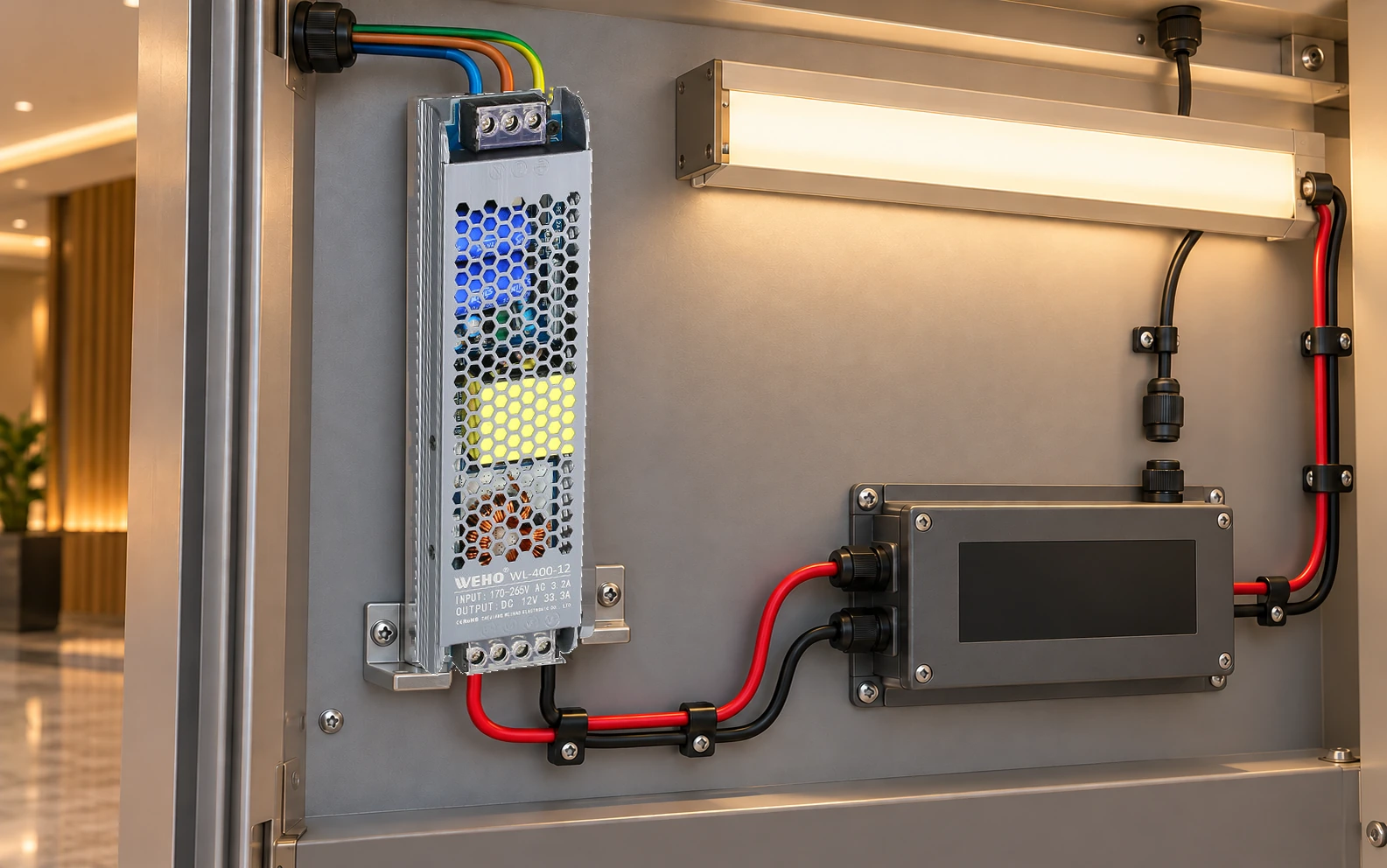
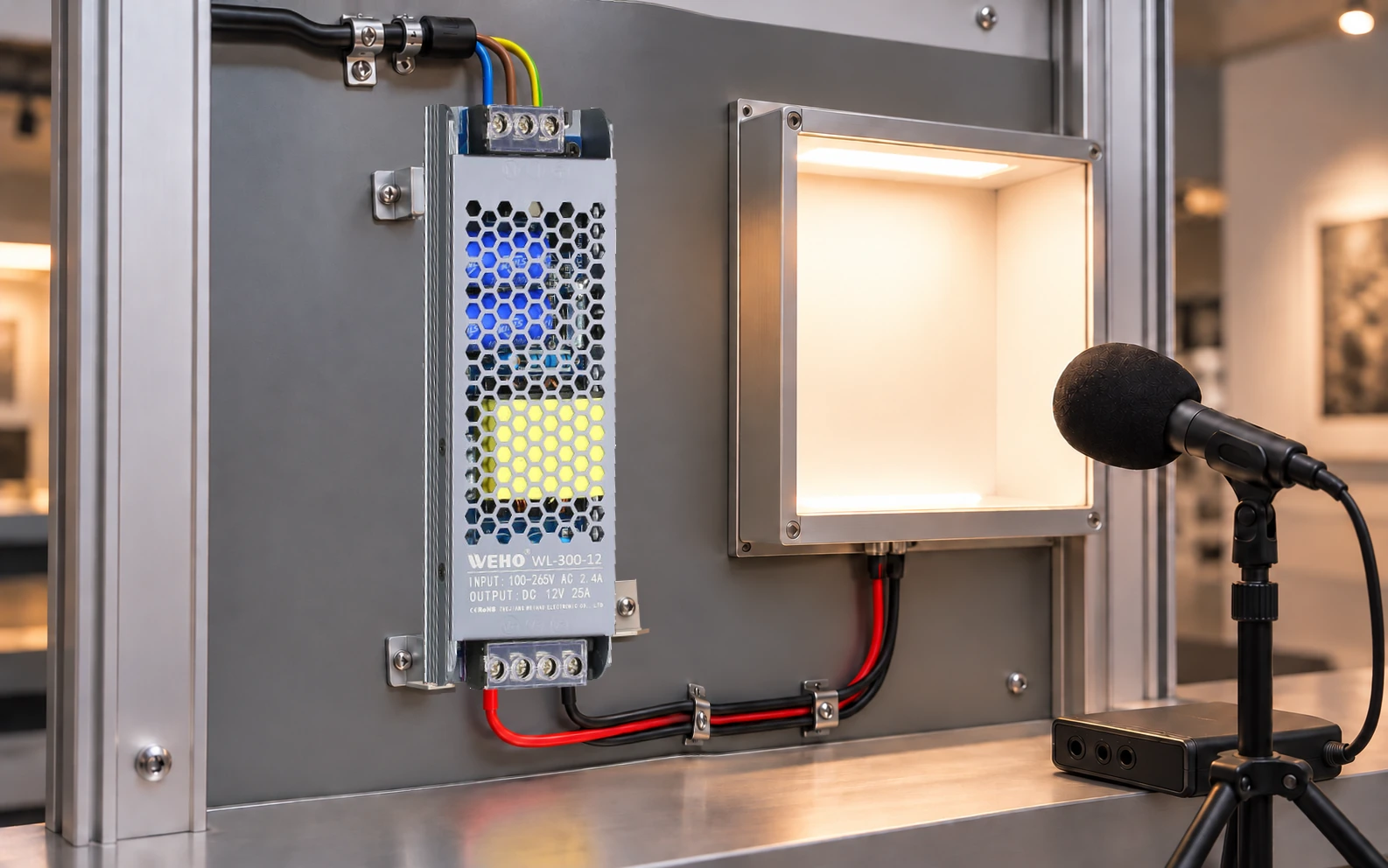
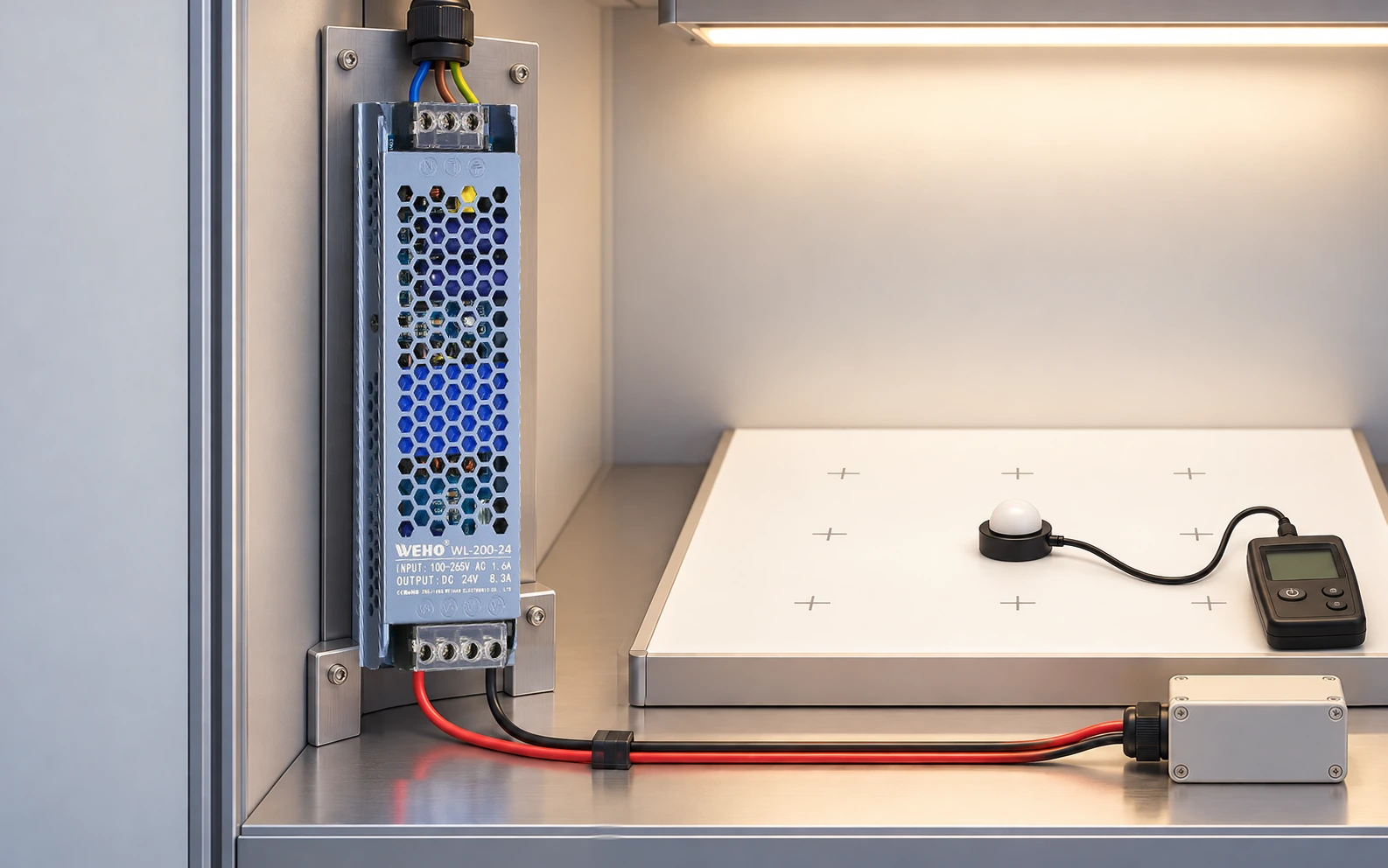
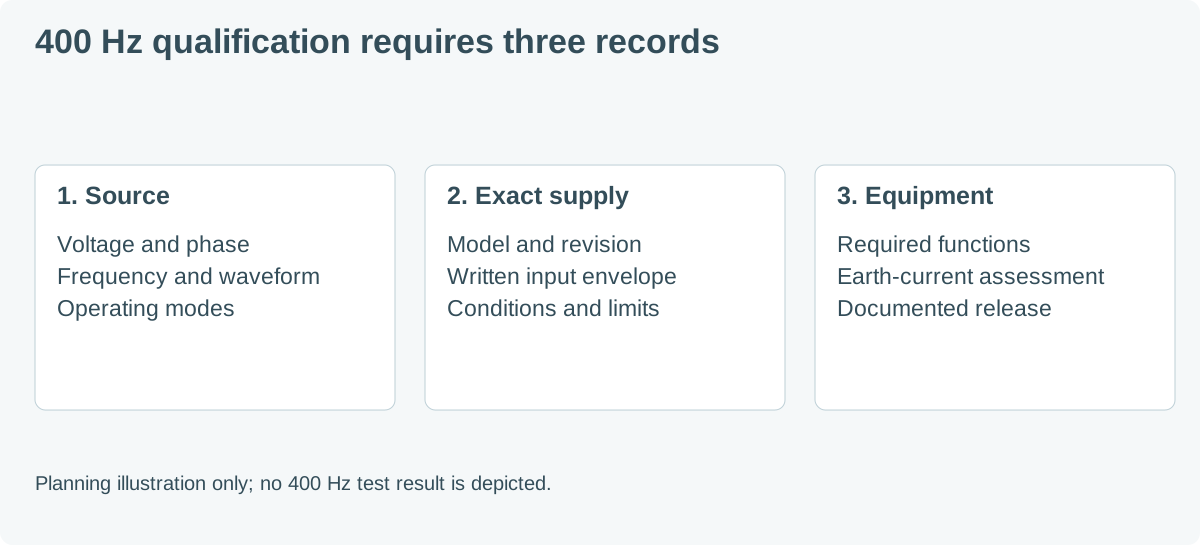
A 50/60 Hz AC input rating does not by itself authorize operation from a 400 Hz ground-power source. Match the exact power supply and revision to the source voltage, frequency, waveform and operating conditions, then obtain the manufacturer’s written limits. Evaluate protective-earth current, protection and the complete equipment separately before release. A supply that starts on a bench has not necessarily passed those checks.
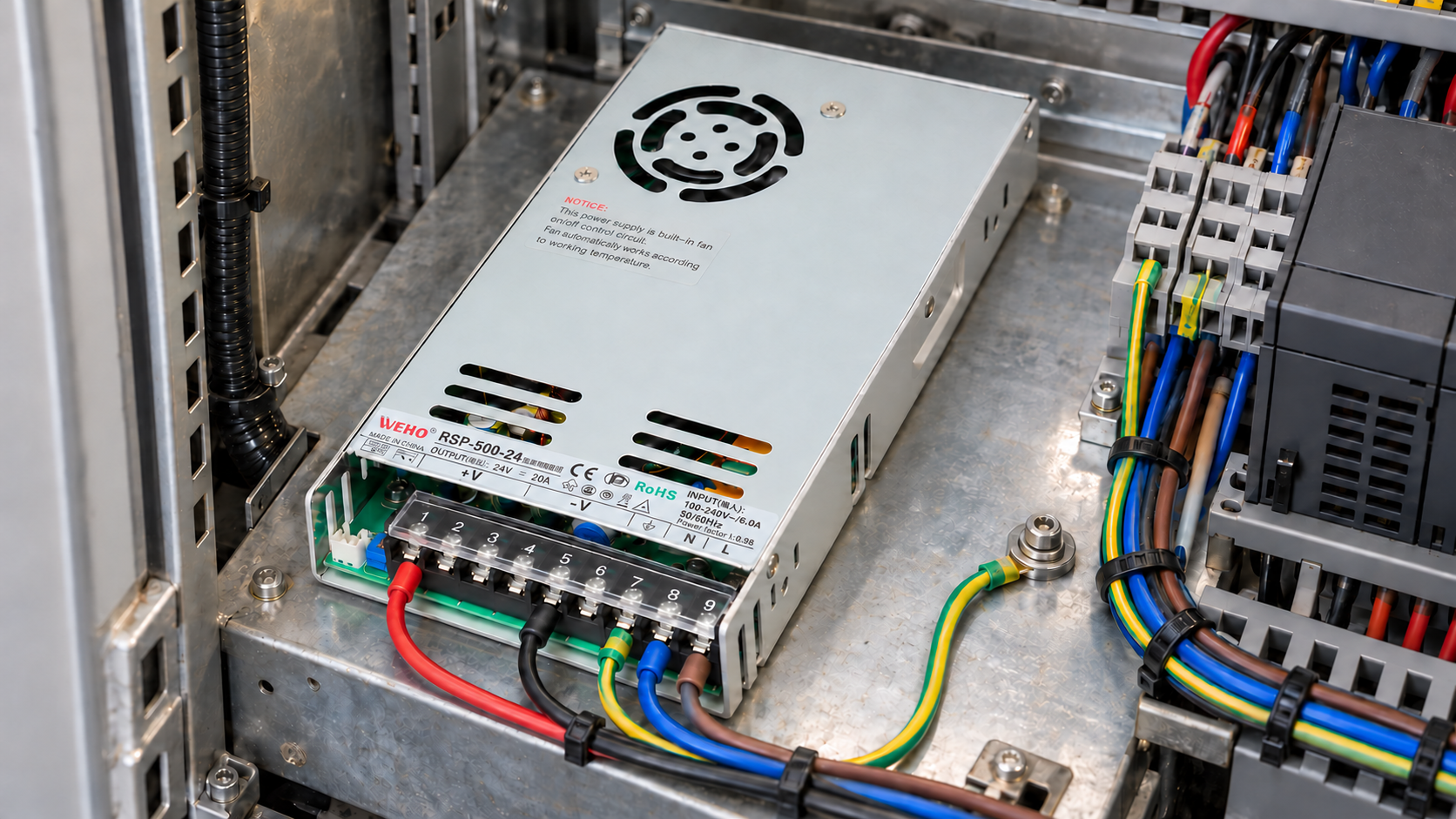
This guide is for teams considering an industrial AC/DC supply in ground-support equipment or another installation with a 400 Hz AC source. It treats a supplier frequency statement, an equipment-level acceptance test and the electrical installation as separate evidence. Aircraft-installed equipment may have additional requirements and is outside the example.
Describe the source, not just the frequency
Record the source’s nominal and operating voltage, whether the relevant voltage is line-to-neutral or line-to-line, its phase configuration, frequency tolerance, waveform and operating modes. Include transfer, startup and any source limits that apply to the equipment. “115 V, 400 Hz” alone does not describe every interface or transient.
TDK-Lambda’s discussion of 400 Hz sources notes that manufacturers receive questions about using industrial supplies with aircraft ground power and explains several input-circuit effects. Its overview is useful for identifying questions; it does not approve another manufacturer’s supply or replace the requirements of a particular installation.
Do not confuse the AC source frequency with an internal switching frequency. Also check the other AC-fed components in the equipment: an acceptable power-supply input alone does not establish that fans, contactors, filters, measurement devices or the overall assembly are suitable.
For a supply with active power-factor correction, ask how its input-current waveform and power-factor behavior are specified at the intended frequency. The cited TDK-Lambda discussion illustrates that higher input frequency can change current harmonics; it does not establish a universal failure mechanism or an approved operating range for every PFC design.
Read the exact model’s input record
The first decision is documentary: does the current model-specific data sheet explicitly include the intended frequency and voltage together, or has the manufacturer supplied a written assessment for that exact configuration? An input range expressed only as 50/60 Hz, or 47–63 Hz, does not communicate a 400 Hz rating. A universal voltage range is not the same thing as a universal frequency range.
As a contrast, the TDK-Lambda ZPSA40/60 data sheet explicitly states a 47–440 Hz input range for that series. Its frequency rating, separate 60 Hz leakage-current test condition and other specifications apply to those products and conditions, not to the WEHO unit illustrated here. The example shows the kind of model-specific evidence a buyer should request.
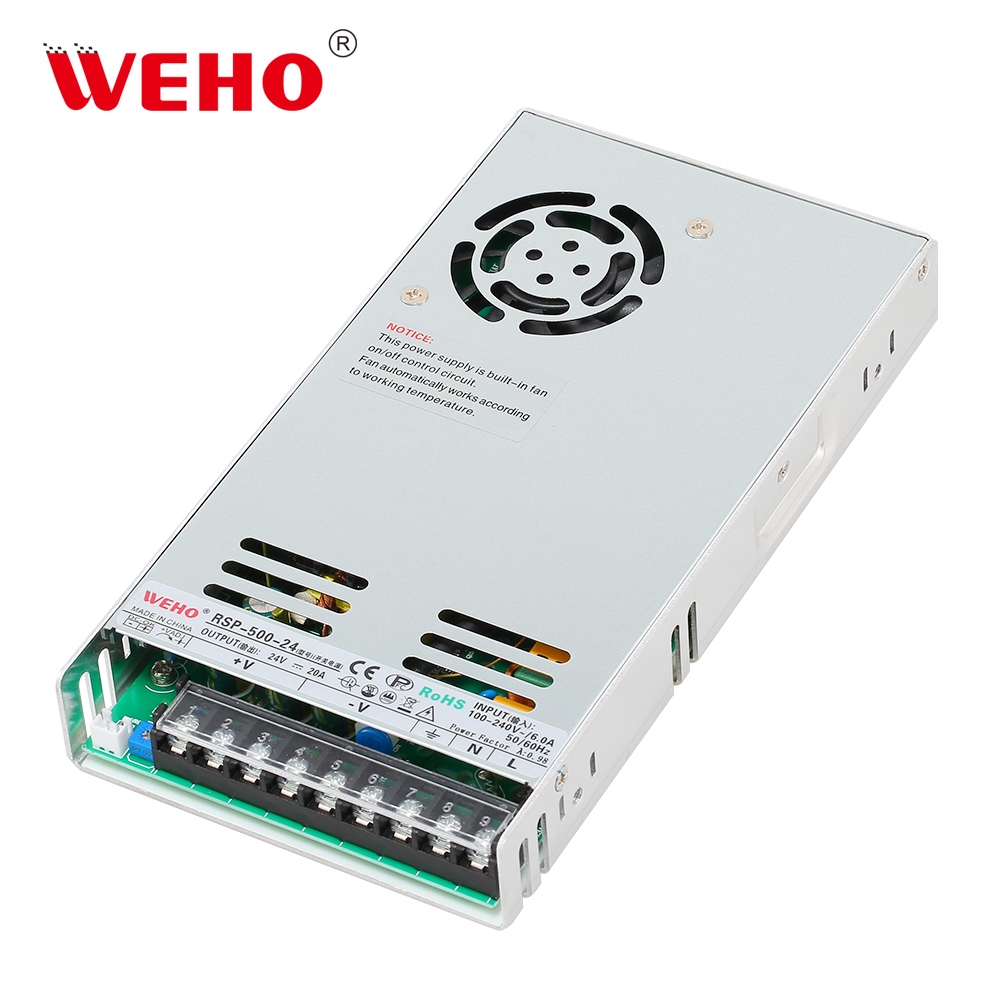
If a data sheet is silent, treat the 400 Hz condition as unresolved. Ask for the permitted frequency, voltage and load envelope; input-current and power-quality conditions; earth-current information; and the applicable safety and EMC evaluation. Record the answer with the supplied revision rather than inferring an extension from a related model.
Understand why earth current can change
AC input filters may contain safety capacitors between the supply conductors and protective earth. In an ideal sinusoidal calculation for one unchanged capacitor, its current increases with both frequency and voltage: I = 2πfCV. The manufacturer’s discussion describes this mechanism. The calculation is a way to recognize a question, not a substitute for the specified measurement method or an equipment safety evaluation.
The complete earth or touch current can include multiple paths, tolerances, source harmonics, other connected equipment and the measurement network. Its measured result cannot automatically be obtained by multiplying a 50/60 Hz data-sheet limit by a fixed ratio. The applicable limit and measurement arrangement depend on the equipment, installation and applicable requirements.
Calculate one limited capacitance example
Assume, only for illustration, one ideal 2.2 nF capacitor exposed to an unchanged 115 V RMS sinusoid. At 60 Hz, 2π × 60 × 2.2 nF × 115 V ≈ 95 µA RMS. At 400 Hz under the same simplified assumptions, the result is approximately 636 µA RMS, about 6.67 times the 60 Hz value.
These are calculated currents through one hypothetical capacitor, not measurements, a complete protective-earth current, a regulatory limit or a specification for RSP-500-24. A real filter may contain several components and additional leakage paths, and a non-sinusoidal source changes the comparison.
Set an equipment acceptance matrix
Before energizing a candidate, the responsible engineering and safety team should agree on the applicable requirements, test arrangement, instruments and stop criteria. Keep protective-earth connections as required by the equipment design; do not remove them to make an earth-current reading look smaller.
On small screens, scroll sideways to compare the evidence and acceptance questions.
| Review item | Record for the exact configuration | Освобождение вопроса |
|---|---|---|
| Source envelope | Voltage reference, phase, frequency range, waveform and operating modes. | Does the source remain inside the documented supply and equipment limits? |
| Supplier statement | Model, revision, approved input-frequency and voltage conditions, plus any derating. | Is 400 Hz explicitly covered for this exact unit? |
| Input behavior | Input current and power-quality behavior at the required input and load conditions. | Are both the source and equipment requirements met? |
| Protective-earth current | Applicable measurement method, connected equipment, source waveform and result. | Does the assembled equipment satisfy its applicable limit and protective arrangement? |
| Startup and load changes | Startup, steady operation and relevant load transitions under stated source conditions. | Does the equipment perform its required function throughout the specified envelope? |
| Evidence and changes | Test configuration, component revisions, unresolved observations and responsible reviewer. | Will a later filter, source or supply substitution trigger an appropriate review? |
Keep the proposed matrix proportional to the project: its rows are a planning aid, not a claim that a particular WEHO supply or a complete machine has been tested. Any facility, aircraft, certification or customer standard must be identified for the actual installation.
Close gaps before selecting the supply
If the exact supply’s documented input range includes the required frequency and voltage, the data sheet is a starting point for the equipment review. If it does not, obtain an explicit assessment or select a candidate with an appropriate documented range; do not treat successful startup as authorization. When the supply is accepted, retain its revision, source conditions and full equipment configuration with the test record.
When a suitable supply is unavailable, an engineering team can also assess a separately rated frequency-conversion system that accepts the actual source and supplies the required voltage and frequency to the complete load. A transformer may provide voltage conversion or isolation, but by itself does not convert 400 Hz to 50/60 Hz. A DC-bus architecture is a different option only when the exact supply, rectifier and DC protection are documented and qualified for the whole operating envelope. Neither alternative is automatically approved by this article.
For the familiar 50/60 Hz export-machine question, compare the AC frequency and voltage of each component separately. A 400 Hz source adds a substantially different frequency condition and should have its own supplier response and equipment-level acceptance record.