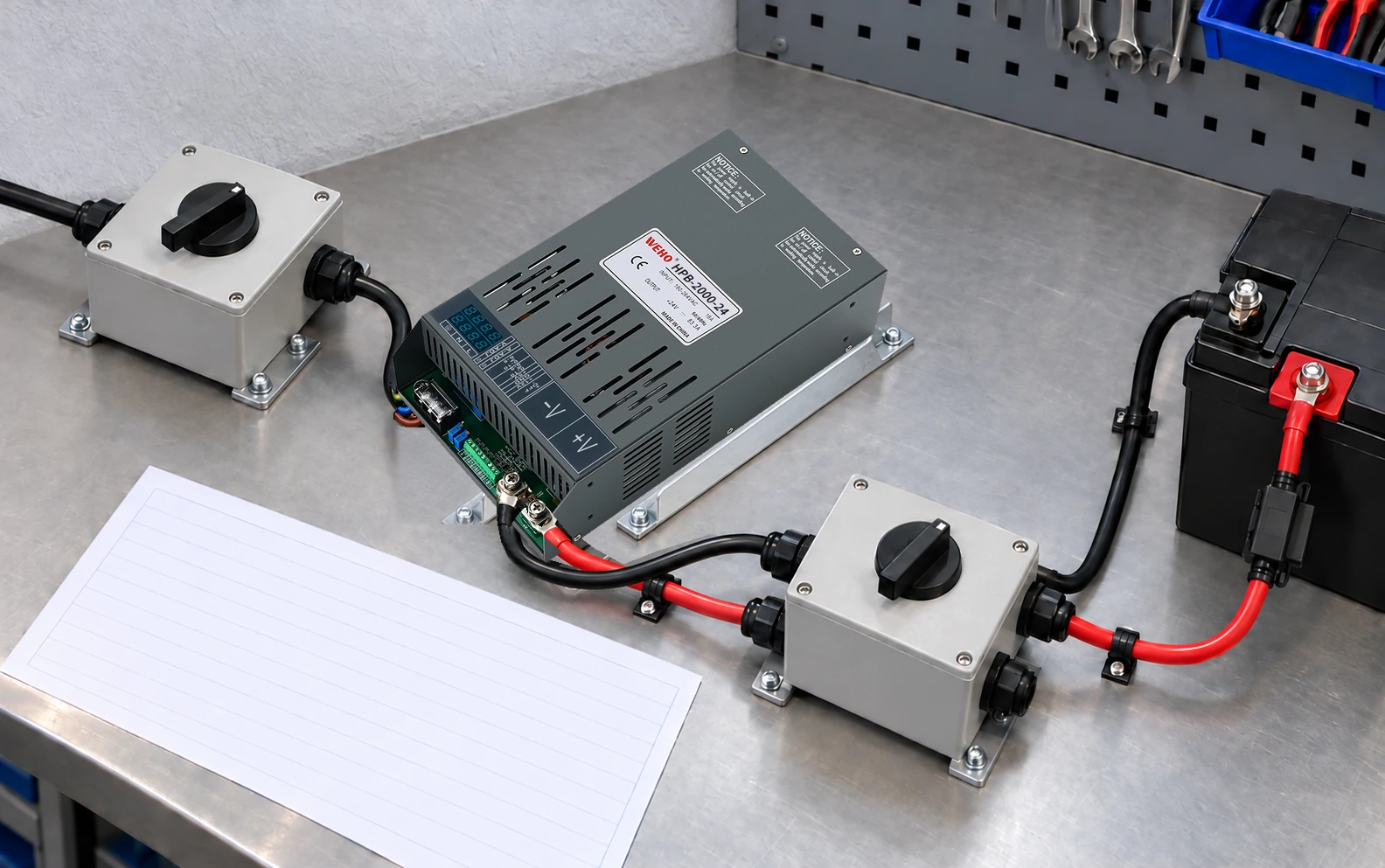
Specify whether the task is to stop charging, disconnect the battery, or establish a service-isolation condition. A remote enable input is an operating control unless its applicable documentation establishes more. It does not automatically isolate AC input, battery energy or internal stored energy.
А WEHO HPB-2000-24 charger is the product reference for a control-state record. Its public table describes a remote control switch; this article does not supply an undocumented pinout or claim a safety-rated shutdown function.
Name the stop requirement before choosing a control
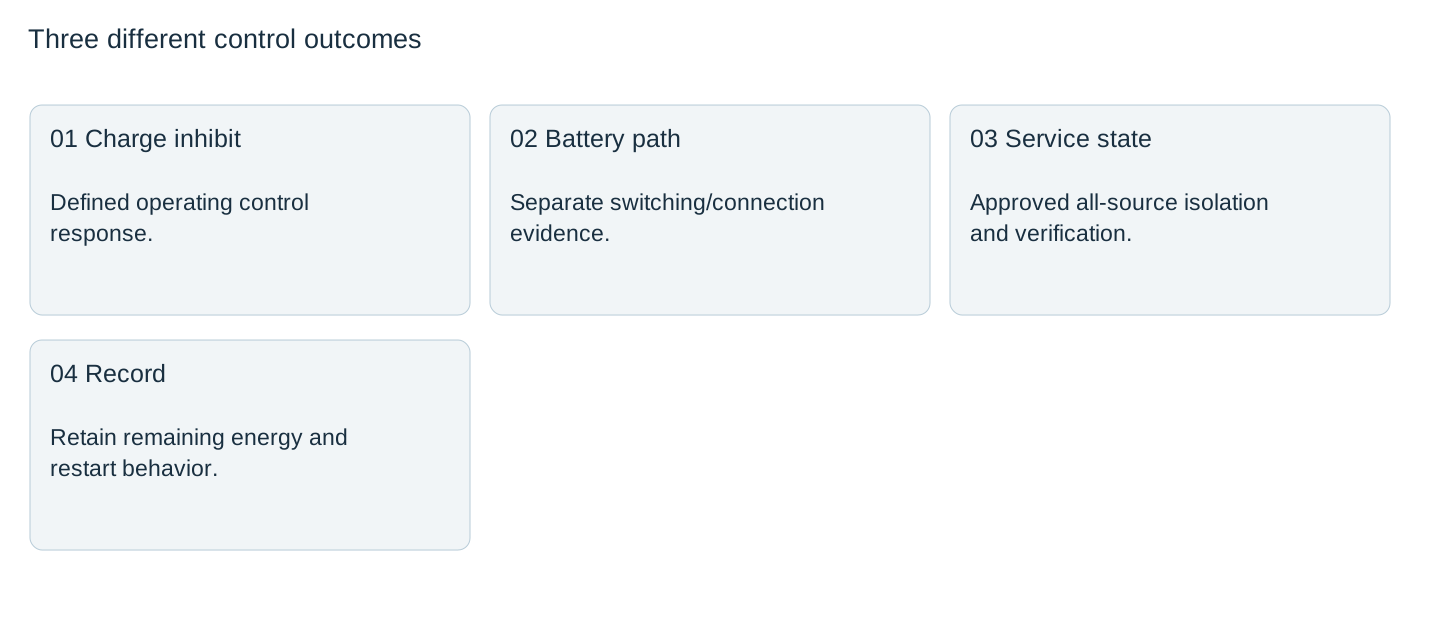
| Required outcome | Evidence to establish | Do not assume |
|---|---|---|
| Stop normal charging | Defined control response and output behavior | That battery conductors become isolated |
| Disconnect a battery path | Applicable switching design and ratings | That a low-power logic input opens that path |
| Prepare for service | Approved all-source isolation/verification procedure | That a front switch or remote-off command makes work safe |
Choose the requirement from the actual equipment task. An operator pause, a BMS charge-inhibit request and maintenance access have different consequences. Do not combine them into a single button label without defining the resulting states.
Read the remote-off entry as a limited control description
The HPB-2000 page lists a remote control switch with default power on and a 3–12 V high-level off description. The corresponding 24 V column and official photograph identify the HPB-2000-24 output as 24 V/83.3 A.
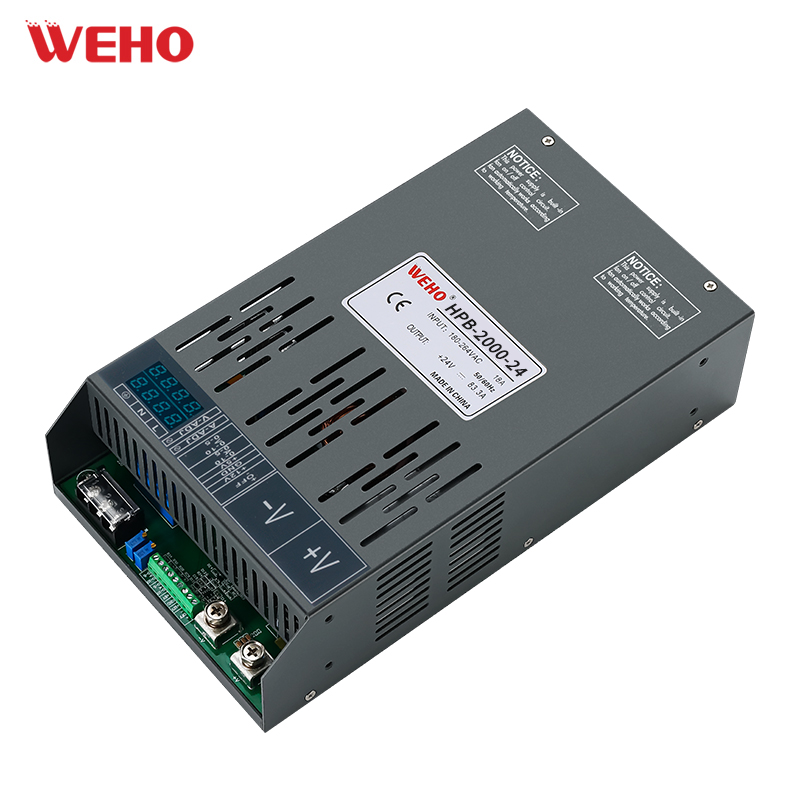
The table entry does not establish pin numbers, reference potential, input current, galvanic isolation, reaction time, diagnostic coverage or behavior after a failed control wire. Obtain the exact revision’s connector/control instructions before designing a connection.
Do not transfer another manufacturer’s control wiring to this connector. Even similarly named enable inputs can use different references and default states.
Map the energy paths that can remain
Identify AC input, the battery, external supplies to control circuitry and any other connected energy source in the actual design. A charger output can remain connected to an energized battery even while conversion is stopped. A measured low output current does not prove disconnection.
A manufacturer’s remote-control example must be read only for the products it documents. For this project, use the HPB unit instructions and the complete equipment’s isolation design.
State which paths each action controls and what remains energized. Keep residual-energy discharge and verification requirements with the applicable service procedure; do not invent a discharge time from an off command.

Create a state record with actual observations
For each manufacturer-permitted control state, record command, expected output behavior, remaining sources and the evidence needed. Include loss/restoration of the control signal only under an approved test plan. A default-on description makes it especially important to define unintended re-enable behavior rather than guessing it.
Observe output voltage/current and battery state using a suitable method, and record the time basis if response timing is part of the requirement. Do not force a hazardous battery condition to prove a shutdown.
A transition from 10 A to a low measured current, for example, would establish only that observed current change under the covered conditions. It would not prove a contact opened, an isolating gap exists or every conductor is safe to touch. Those require their own evidence.
Release operating control and service isolation separately
The final record should distinguish the ordinary charge-inhibit interface from the independently designed disconnection and service provisions. If a safety function is required, the responsible designer must specify and validate an architecture appropriate to that function; a convenient enable terminal cannot be promoted into one by description alone.
Retain connector revision, reference potential, allowed signal levels, default behavior, response evidence and system state together. Mark unsupported assumptions before they reach a panel drawing or operator instruction.
Reassess the record after changing charger revision, BMS output, external supply, disconnect arrangement or software behavior. The aim is clear operational meaning: which command stops which activity, and which separate action establishes the required isolation condition.
Request the defined control interface
Send WEHO the HPB-2000-24 revision, proposed controller/BMS interface, stop objective and system energy-path diagram. Request connector, reference and state-response information before connecting the remote control.
Charger control and isolation state record
| Command / event | Defined output behavior | Remaining energy sources | Observation / document | Operating or isolation decision |
|---|---|---|---|---|
Blank project worksheet. Enter verified project data; example calculations above are not measurements.