- Adding encapsulant to a finished power assembly is a design and process change requiring manufacturer review.
- Check cure compatibility on representative materials, including existing coatings, sealants and cable surfaces.
- Higher thermal conductivity does not overcome every thickness, interface or blocked-airflow problem.
- Release a changed assembly only against documented cure, thermal, electrical and mechanical requirements.

Why a protective fill can create a new failure mode
An OEM proposes filling a power-supply enclosure with resin to improve environmental protection. The proposal changes the materials touching the assembly, the cure exposure, heat transfer and access for inspection. A cured surface or a favorable bulk material datasheet cannot establish that the complete modified assembly remains suitable.
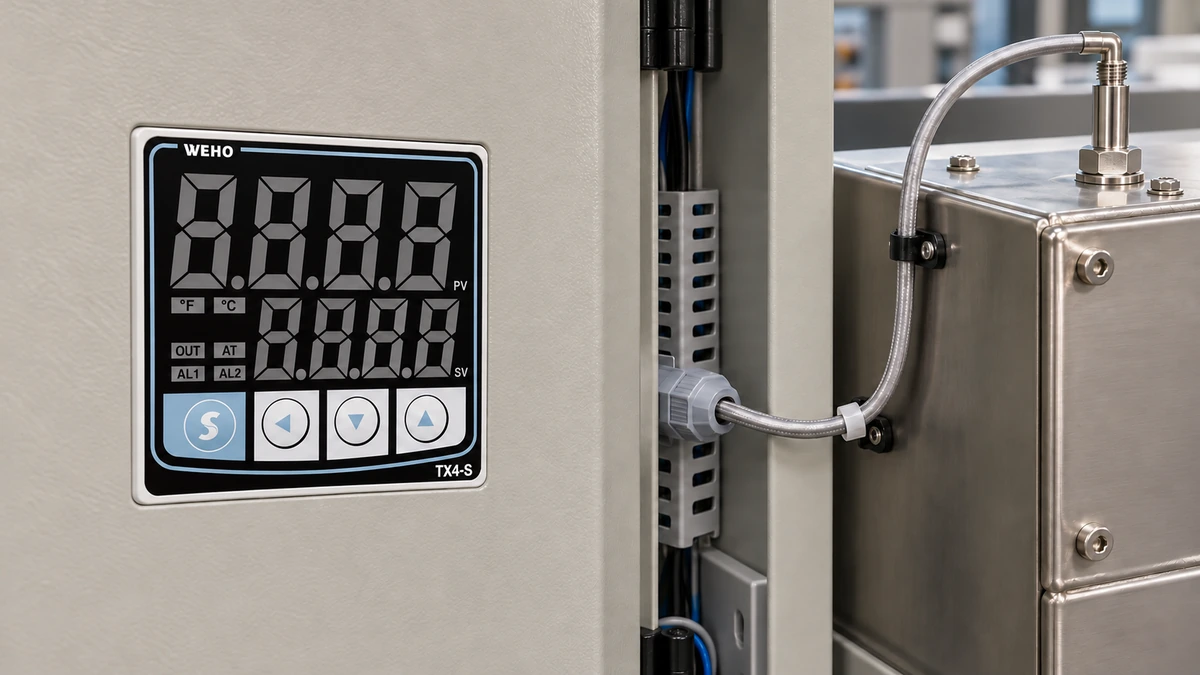
А WEHO LRS-400-24 product reference provides an enclosed-supply context for discussing that change. The pictured product is not an approved secondary-potting design. Do not pour material into its enclosure, cover openings or obstruct its fan based on this article; obtain an applicable manufacturer assessment before considering a modified construction.
Define the proposed change before comparing materials
Document whether the proposal concerns a new subassembly designed for encapsulation or a finished purchased power supply. State the boundaries, proposed fill depth, materials contacted, components excluded and required environmental outcome. A request saying only “make it waterproof” leaves the mechanical interfaces and validation target undefined.
Identify every function that relies on space or access in the original construction. Ventilation, moving parts, terminal access, adjustment points and service inspection may conflict with the proposed fill. A sealed material sample does not establish an assembled enclosure rating or permission to modify a product's cooling system.
Keep the proposed process separate from the material's advertised properties. Mix ratio, application window, cure temperature and final properties belong to the exact material revision and process conditions. Existing product approvals and electrical ratings must not automatically be transferred to a construction changed by the integrator.
Check compatibility where the encapsulant actually touches
Cure compatibility requires contact tests with representative production surfaces. Dow's encapsulant guidance identifies potential inhibitors for platinum-catalyzed addition-cure silicones, including certain amines, sulfur-containing materials and tin compounds. That chemistry-specific warning does not mean every silicone or every contaminant behaves identically.
Build a material-contact list that includes PCB coatings, adhesive residues, labels, cable jackets, cleaning residues and previously applied sealants. Use representative processed parts rather than assuming a bare metal coupon captures the assembly. A release agent or substitute cable compound can matter even when its location is hidden after filling.
Compare a control coupon with a coupon contacting each relevant surface under the proposed process. Record material lot, preparation, ratio basis, mixing method, time and actual thermal exposure. Inspect the interface as well as the outer surface using acceptance criteria agreed with the material supplier; a dry-looking top does not prove complete cure underneath.
Use the selected material's instructions to define tests and permissible process changes. For example, Dow describes DOWSIL CN-6015 as allowing room-temperature or heat-accelerated curing. That statement is a property of that product and provides no universal oven schedule or permission to expose a finished WEHO supply to the same process.

Review cure heat, geometry and mechanical stress
The cure itself can impose thermal and mechanical loads before the product ever operates. The Electrolube ER2220 technical datasheet reports exotherm with a stated 100 mL sample, cylinder diameter and initial temperature. Preserve such test conditions when reviewing a material; a small successful mix does not automatically qualify a different production fill.
Record the proposed dispensed volume, maximum local depth, initial temperatures and cure environment. Compare the actual assembly exposure with the permitted conditions of its components and materials. Where void control is required, select and validate an applicable process rather than adding a generic vacuum or heating step to an unreviewed assembly.
Thermal expansion, shrinkage and stiffness also require a construction-specific review. A material that helps transfer heat can still load components or interfaces during cure and temperature cycling. Define which electrical, mechanical and environmental properties must remain within their requirements after the process and through the intended operating conditions.
Calculate the thickness penalty in a simple heat path
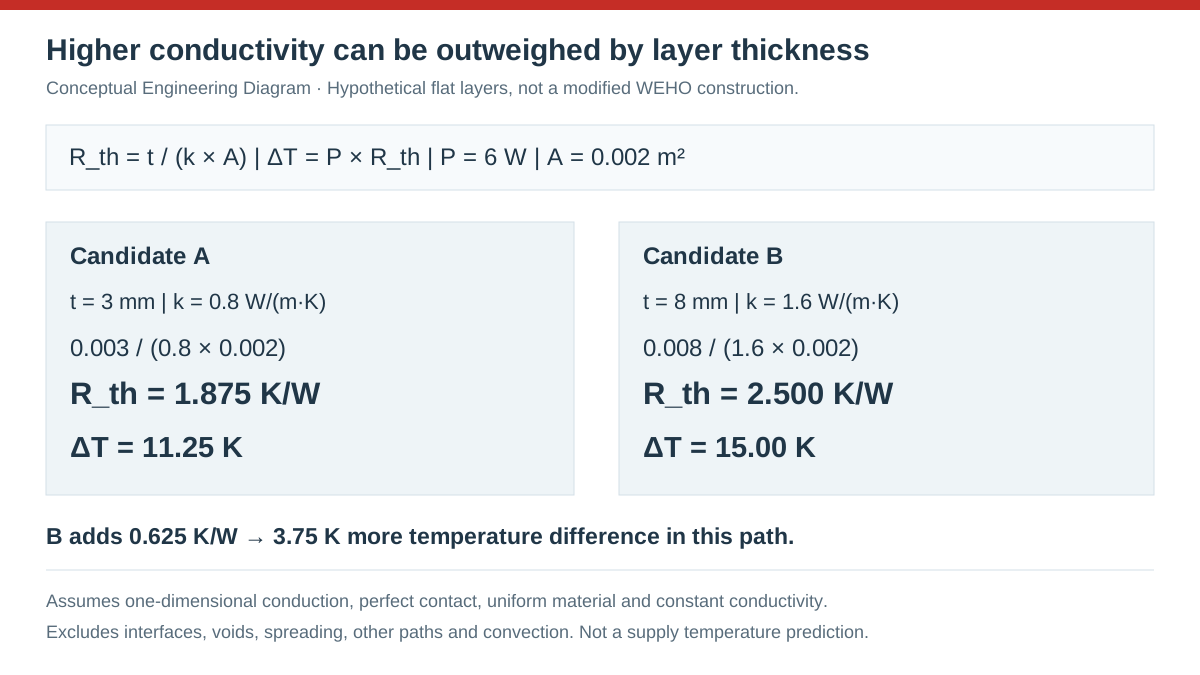
Consider a hypothetical flat slab carrying 6 W through an effective area of 20 cm², or 0.002 m². Assume one-dimensional steady conduction, uniform thickness, perfect contact and constant thermal conductivity. The example isolates a material layer; it does not represent the internal construction, losses or temperature of LRS-400-24.
For this model, thermal resistance is R_th = t ÷ (k × A), and temperature difference is ΔT = P × R_th. Candidate A has an assumed thickness of 3 mm and conductivity of 0.8 W/(m·K). Its layer resistance is 0.003 ÷ (0.8 × 0.002) = 1.875 K/W, producing an 11.25 K temperature difference at 6 W.
Candidate B doubles conductivity to an assumed 1.6 W/(m·K) but increases thickness to 8 mm. Its layer resistance becomes 0.008 ÷ (1.6 × 0.002) = 2.500 K/W, producing a 15.00 K temperature difference. Despite the better bulk conductivity, the thicker layer has the higher resistance in this particular model.
| Hypothetical layer | Thickness and conductivity | Calculated layer resistance | Temperature difference at 6 W |
|---|---|---|---|
| Candidate A | 3 mm; 0.8 W/(m·K) | 1.875 K/W | 11.25 K |
| Candidate B | 8 mm; 1.6 W/(m·K) | 2.500 K/W | 15.00 K |
| Comparison | Same assumed 20 cm² path | B is 0.625 K/W higher | B is 3.75 K higher |
This model excludes interface resistance, voids, lateral heat spreading, other parallel heat paths and any change to convection. It therefore cannot predict the hottest component or approve a potted supply. Blocking a designed airflow path changes the thermal system and cannot be justified by the slab calculation alone.
Swipe horizontally on a small screen, or open the full-size diagram.
Qualify the changed assembly through explicit gates
Separate material screening from assembly approval so that an early coupon result is not treated as final product acceptance. Define the applicable requirements and decision owners before destructive or irreversible work. Use representative samples and the manufacturer's permitted construction boundaries in a controlled development program.
- Define the construction change. Record the product revision, fill boundaries, contacted materials and required outcome. Accept the proposal for investigation only when the manufacturer and responsible engineering reviewers agree on the scope.
- Screen the cure interfaces. Prepare control and contact specimens with the proposed materials and process. Save lot, mixing and exposure records; accept only interfaces meeting the agreed cure and adhesion criteria.
- Verify the process exposure. Measure the relevant cure-time and temperature conditions on representative development samples. Record volume, geometry and observations; reject conditions that exceed permitted component or material limits.
- Test the assembly requirements. Evaluate the agreed thermal, electrical, mechanical and environmental cases after processing. Preserve the tested construction and raw results; accept only the requirements actually demonstrated under their specified conditions.
- Freeze the approved process. Release the exact materials, ratios, tooling, cure profile and inspections with change control. Require re-evaluation when suppliers, geometry, coatings or process conditions change outside the approved range.
Define how hidden defects will be detected before adopting a production process. Cross-sections or other suitable inspections may reveal interfaces and voids that are invisible at the top surface, but the inspection method must match the assembly and acceptance requirement. A finished appearance is useful visual evidence, not a substitute for the required qualification.
Use WEHO's thermal-test configuration review when planning the separate assembly thermal evidence. Matching a model to a chamber configuration is a different task from proving cure compatibility, and neither result automatically closes the other.
Prepare an LRS-400-24 construction enquiry
Send WEHO the LRS-400-24 reference, an annotated construction drawing and the reason for considering encapsulation. Include the proposed material data, fill geometry, cure exposure, load and environmental requirements. Use the WEHO contact page to request the applicable construction guidance before modifying purchased units or asserting that an existing rating remains valid.
Frequently asked questions
Can an electronics-grade resin be added to any finished power supply?
No, material suitability alone does not authorize a construction change. Cooling, contacted surfaces, component exposure and the modified assembly's requirements need manufacturer and engineering review.
Does a cured outer surface prove that the complete fill is cured?
No, the interface or a deeper region can behave differently. Use the material supplier's suitable checks on representative contact specimens and assembly geometry.
Does higher thermal conductivity always lower component temperature?
No, thickness, effective area, interfaces and the complete cooling arrangement also affect temperature. The hypothetical example shows why a thicker layer can outweigh a higher conductivity.
Does secondary potting automatically create a waterproof product rating?
No, an assembled protection claim requires evidence for the actual enclosure, interfaces and exposure requirements. A resin property or coupon result cannot establish that rating for a modified supply.