Transparent Object Sensors: Specify the Sample Before the Order
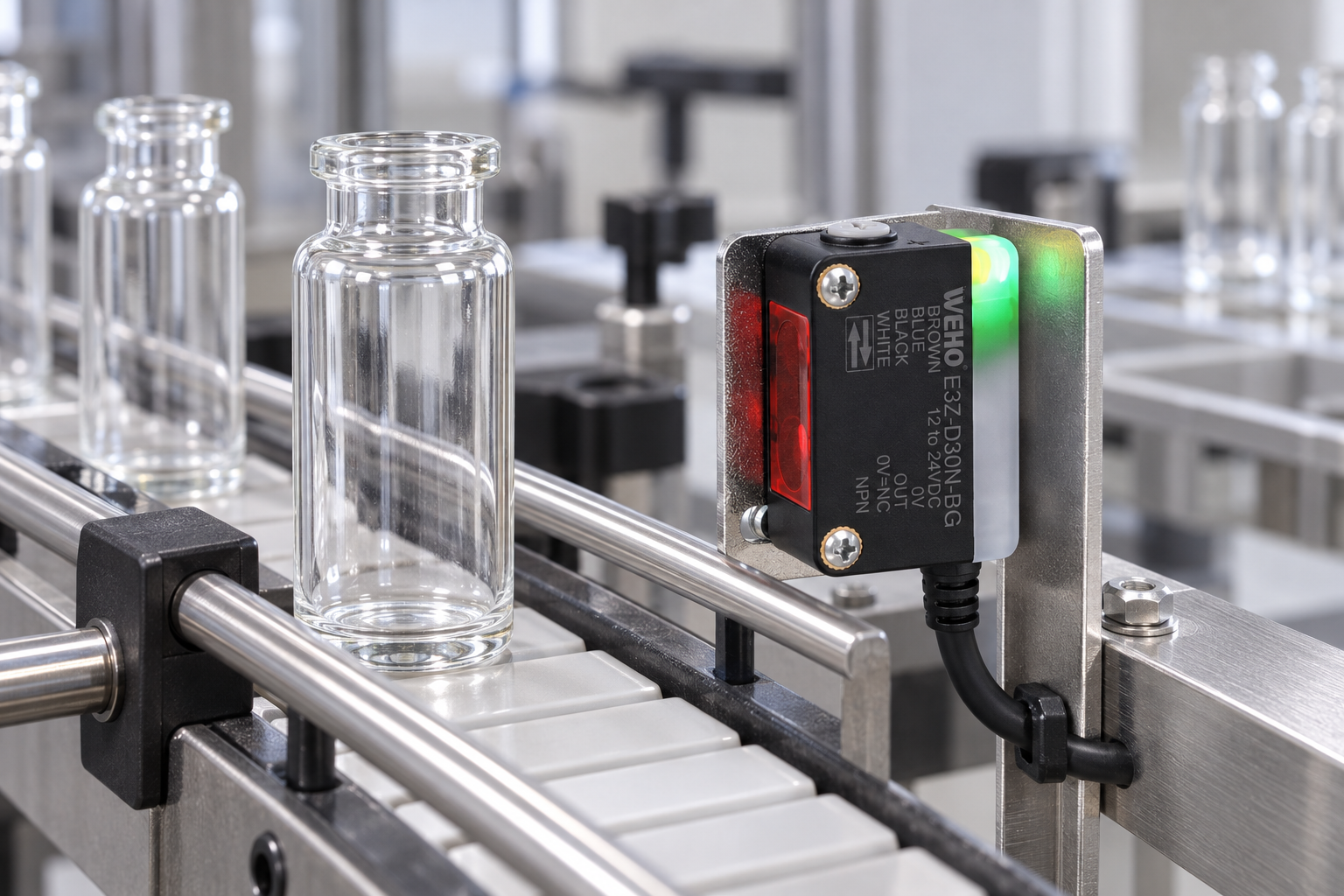
For an OEM packaging line, “transparent object detection” is not a complete sensor specification. A clear glass bottle, a thin PET tray and a curved empty vial can present different targets. Define the exact object, its position and the required switching result before requesting a production quotation.
The E3Z-D30N-BG sheet explicitly lists transparent glass among detectable materials. However, its 30–300 mm setting range is stated with a 100 × 100 mm white-paper target; the black-paper range is 30–295 mm. Those figures do not establish an identical working distance for every clear container. Use the model as a candidate for sample evaluation, not as a blanket approval for transparent packaging.
Turn the packaging description into a testable requirement
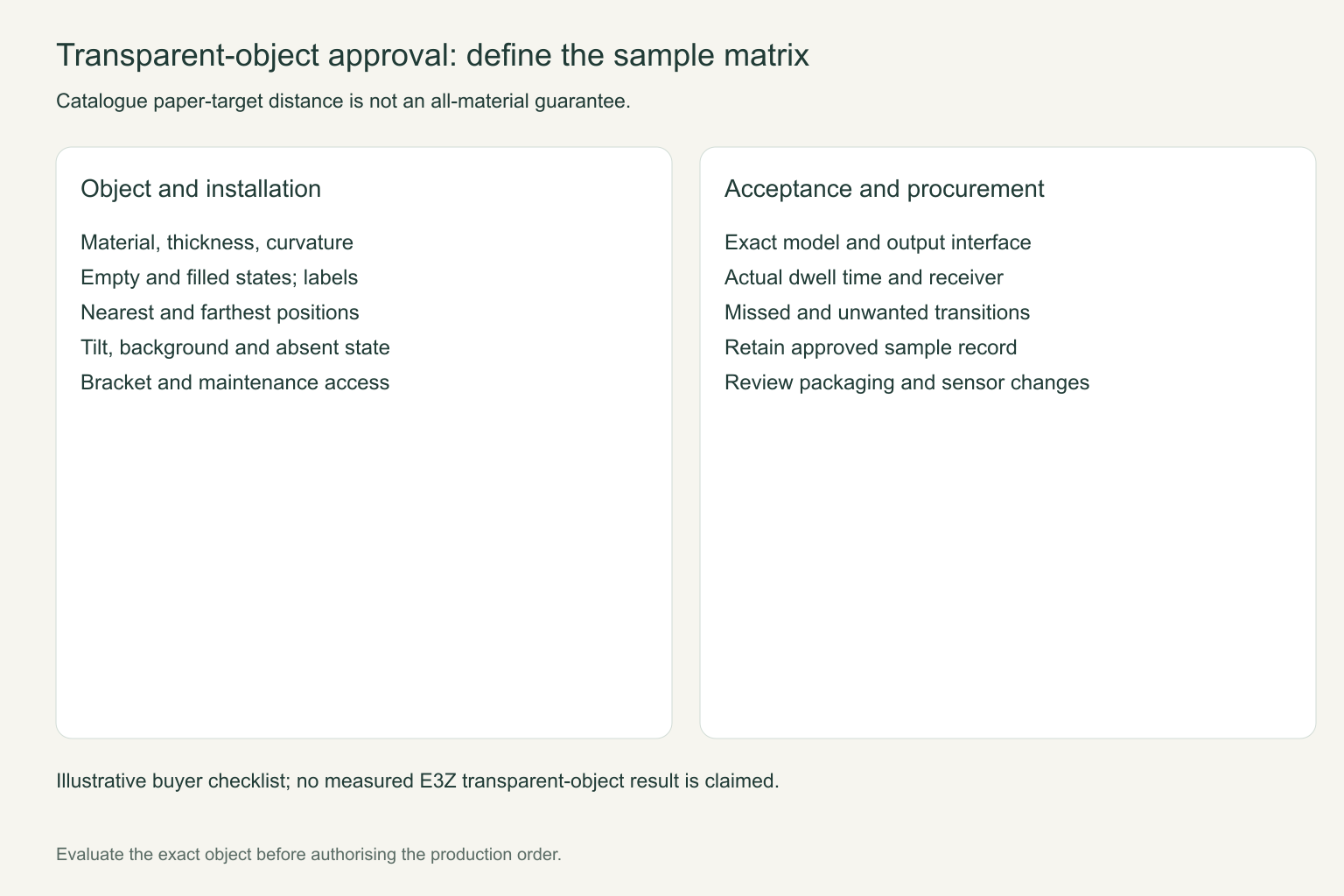
Send actual samples or dimensioned drawings with the inquiry. Record material, wall thickness, colour tint, surface finish and shape. State whether the container is empty or filled, whether a label crosses the sensing area, and whether moulding seams or ribs can pass the optical axis. For replaceable packaging, identify the most difficult permitted variant rather than sending only the easiest sample.
Describe the expected output for both states: object present and object absent. A commissioning check should include the empty conveyor or fixture, not just a target held in front of the sensor. Specify the nearest and farthest object positions, allowable tilt and lateral movement, and the background that remains when the object is absent. The acceptance record should state which combinations were tested and which remain outside scope.
Separate the catalogue target from the production object
| Available model evidence | Buyer validation still required |
|---|---|
| Transparent glass is listed as a detectable material. | The exact glass or plastic part, its shape, contents and operating position. |
| D30 distance figures use specified paper targets. | The usable distance window and repeatable switching for the actual clear object. |
| The sheet gives an average response-frequency limit using a standard target. | The shortest actual object dwell time, spacing and input filtering of the receiving system. |
| The pictured model is E3Z-D30N-BG, an NPN variant. | PLC or receiver compatibility and the required present/absent output logic. |
Do not turn the sheet’s “200 Hz or below” response-frequency entry into a guaranteed bottle-counting rate. The target and measurement conditions matter, and the PLC input can impose a separate limit. Agree a sample-test sequence at the proposed line conditions and record missed detections and unwanted transitions against an agreed criterion; do not invent a universal acceptance percentage.
Keep the optical arrangement repeatable
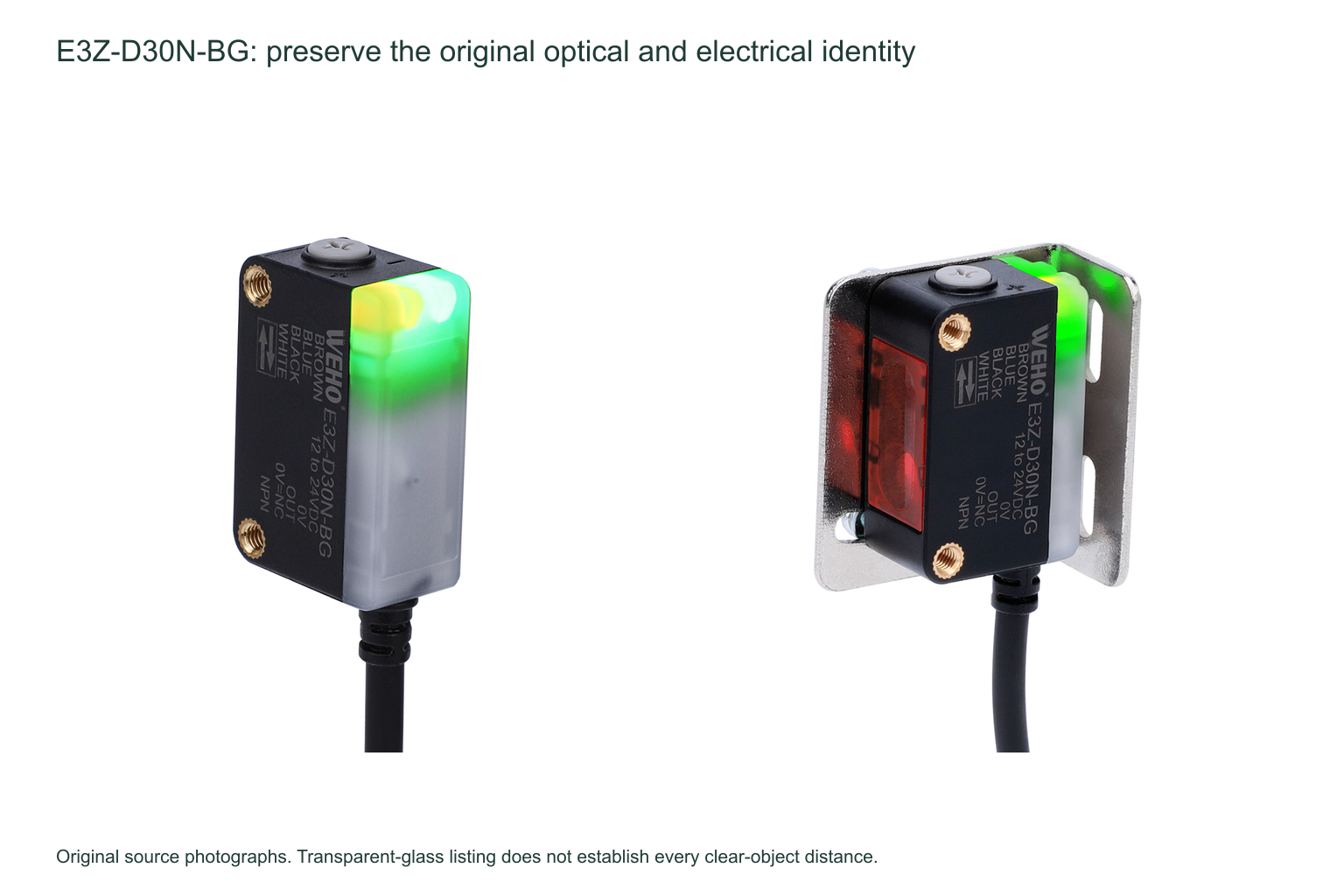
The original unit has a red optical window on a narrow face, two M3 fixing positions and a separate adjustment screw. Its mechanical drawing shows 25.4 mm between the fixing positions. Use these features to define a repeatable bracket and optical axis. Do not treat the broad printed side as the sensing window or drill additional holes through the moulded housing.
Allow access for adjustment and cleaning without loosening the bracket. Support the cable independently so normal maintenance does not move the sensor. If the machine changes object height or guide-rail position between jobs, document the allowed adjustment and how the operator restores the approved position. A sensor that works during a hand-held demonstration has not yet proved the installed arrangement.
Specify the electrical interface before placing a batch order
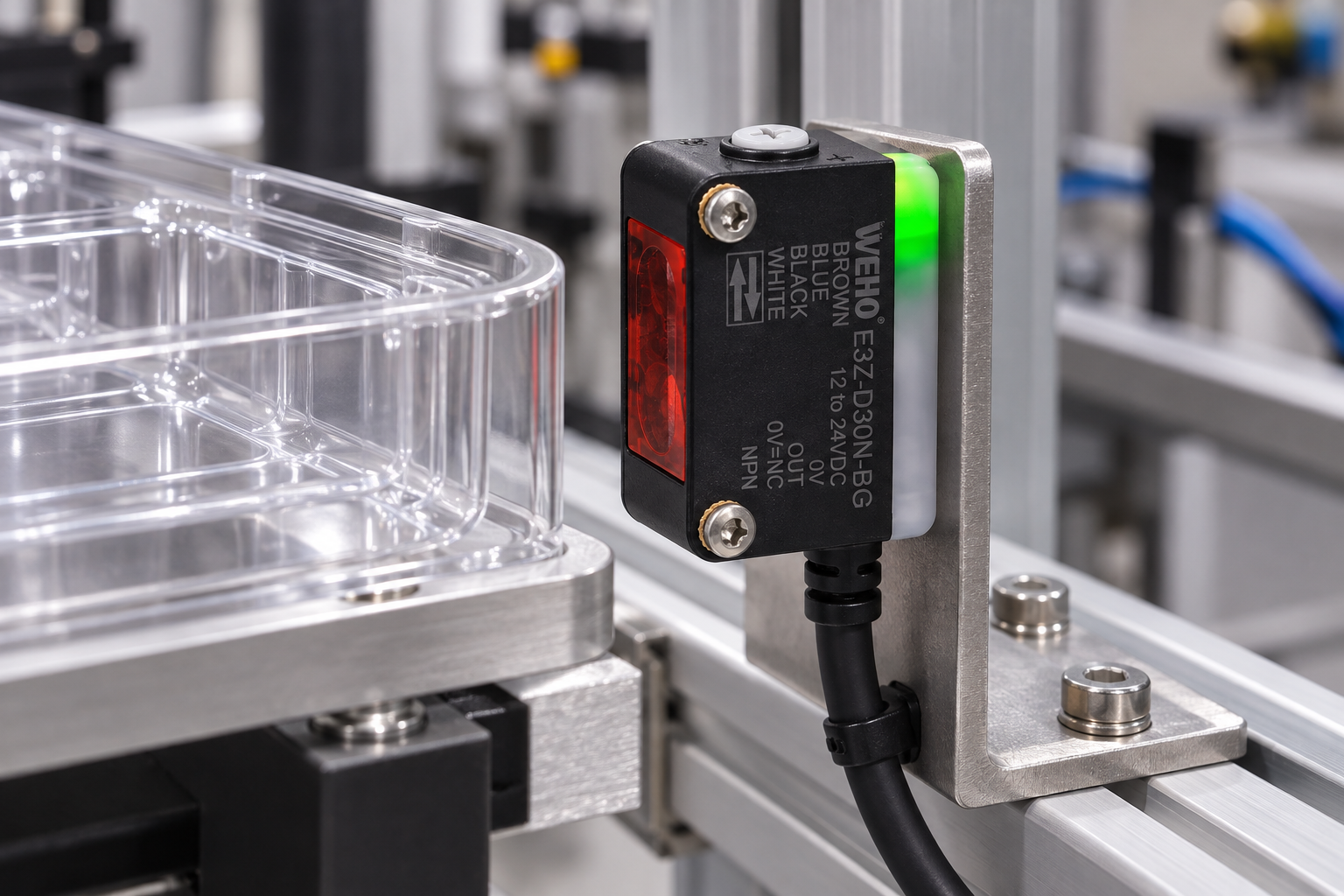
The matched sheet specifies a 12–24 VDC supply and a load-current limit of 100 mA for this family. The actual D30N label identifies NPN output. Verify the receiver input circuit, supply reference and required action with the supplied wiring diagram; a PNP substitution is not automatically interchangeable. The white lead selects output action as described in the model documentation and should not be treated as an unspecified spare conductor.
Include full model and suffix, cable arrangement, mounting drawing, original label photograph and the agreed sample-test conditions in the purchase specification. Require review of changes that affect the optical head, output circuit, cable or mechanical envelope. Retain one approved reference sample and its test record for incoming inspection. Neither a matching case colour nor a similar family name establishes an equivalent replacement.
What to put in the RFQ
Provide the object sample set, distance and movement limits, background photographs, line speed and minimum spacing, receiver details, supply range, environmental conditions and maintenance method. Ask the supplier to identify the proposed exact model and the evidence supporting the application. For an unresolved clear-object combination, request a documented sample evaluation before authorising a larger order.
Buyer questions
Does the 300 mm figure guarantee detection of a clear bottle at 300 mm?
No. The D30 range is tied to the stated paper targets. Transparent glass is listed separately, so the actual bottle and installation still need evaluation.
Can an approved glass application be extended to clear PET film?
Not automatically. A new material, shape or thickness changes the agreed target. Reopen the sample-validation matrix instead of carrying over the earlier approval without testing.
Обзор The WEHO sensor product range, then send the sample definition and receiver requirements through the WEHO enquiry channel. Request the exact E3Z variant documentation and an application-specific evaluation; availability and commercial terms require a separate quotation.