Start an OEM power-supply RFQ with four inputs: source voltage range, continuous and peak output load, installation temperature and mounting space, and expected quantity. When evaluating a 24 V power supply manufacturer for a control cabinet, use the same conditions to compare each bidder’s proposed model, supporting documents and commercial scope. As the shortlist narrows, expand the request into a response matrix, sample acceptance plan, and agreed production requirements. You can begin an inquiry before every matrix row is complete.
สารบัญ
Start with four inputs, then align the RFQ revision
A request for quotation becomes difficult to compare when one supplier assumes 230 VAC, another prices a different enclosure, and a third excludes the required test record. For initial screening, share the four inputs above and identify any unknowns. When requesting comparable quotations, put the requirement revision and response deadline on the RFQ cover page and use the same matrix row IDs for every bidder.
Separate mandatory requirements from preferences. A preferred smaller enclosure may be negotiable; a minimum valid load voltage may define whether the equipment operates. Identify who resolves each open item so an unanswered engineering question is not converted into a purchasing assumption.
The minimum useful electrical input is the source range and load profile rather than a wattage label. Include continuous current, startup demand with duration, standby conditions, output setting, load-terminal voltage limits, and how distribution loss will be handled. Use the 24 V sizing method to establish that profile before asking suppliers to propose capacity.
Request a response that can be checked
| Requirement block | Buyer supplies | Supplier returns |
|---|---|---|
| Electrical operating points | Input range, frequency or DC source, output setting, continuous and transient load, permitted voltage and noise | Exact model and suffix; supported operating points; limits and exceptions with document references |
| Installation | Mounting, usable space, orientation, ambient range, airflow, altitude, connectors, and service access | Dimensioned drawing, terminal limits, mounting and cooling instructions, applicable derating data |
| Interfaces and behavior | Required signals, remote control, fault recovery, startup sequence, continuity objective | Interface levels, timing, isolation, protection behavior, and any unsupported functions |
| Product evidence | Required model-specific documents and intended markets | Current specification, relevant declarations or certificates, test evidence, and installation conditions |
| Sample acceptance | Equipment configuration, test points, operating cases, pass limits, and record format | Identified sample configuration and agreed scope of supporting data |
| Commercial scope | Quantity tiers, delivery location and term, forecast basis, packaging, and requested schedule | Price basis, included items, exclusions, validity, order conditions, and proposed schedule |
| Production control | Traceability and notification needs, approved revision, alternate-model policy | Available identification, change-notification proposal, deviation process, and document handoff |
At the detailed quotation stage, ask for “meets,” “exception,” or “information required” on each row, with the proposed model and a supporting reference where relevant. This lets procurement route a simple question to the right person and compare the remaining gaps fairly. For the installation row, use the mounting-format comparison to record the installed envelope, cooling space, and service access alongside the candidate drawing.
Request the document that answers the question: a specification for operating limits, a test report for test conditions and results, a certificate for its covered scope, and an installation manual for use conditions. The distinction also appears in MEAN WELL’s official documentation FAQ; it is useful when organizing responses from any supplier.
Normalize bids before comparing price
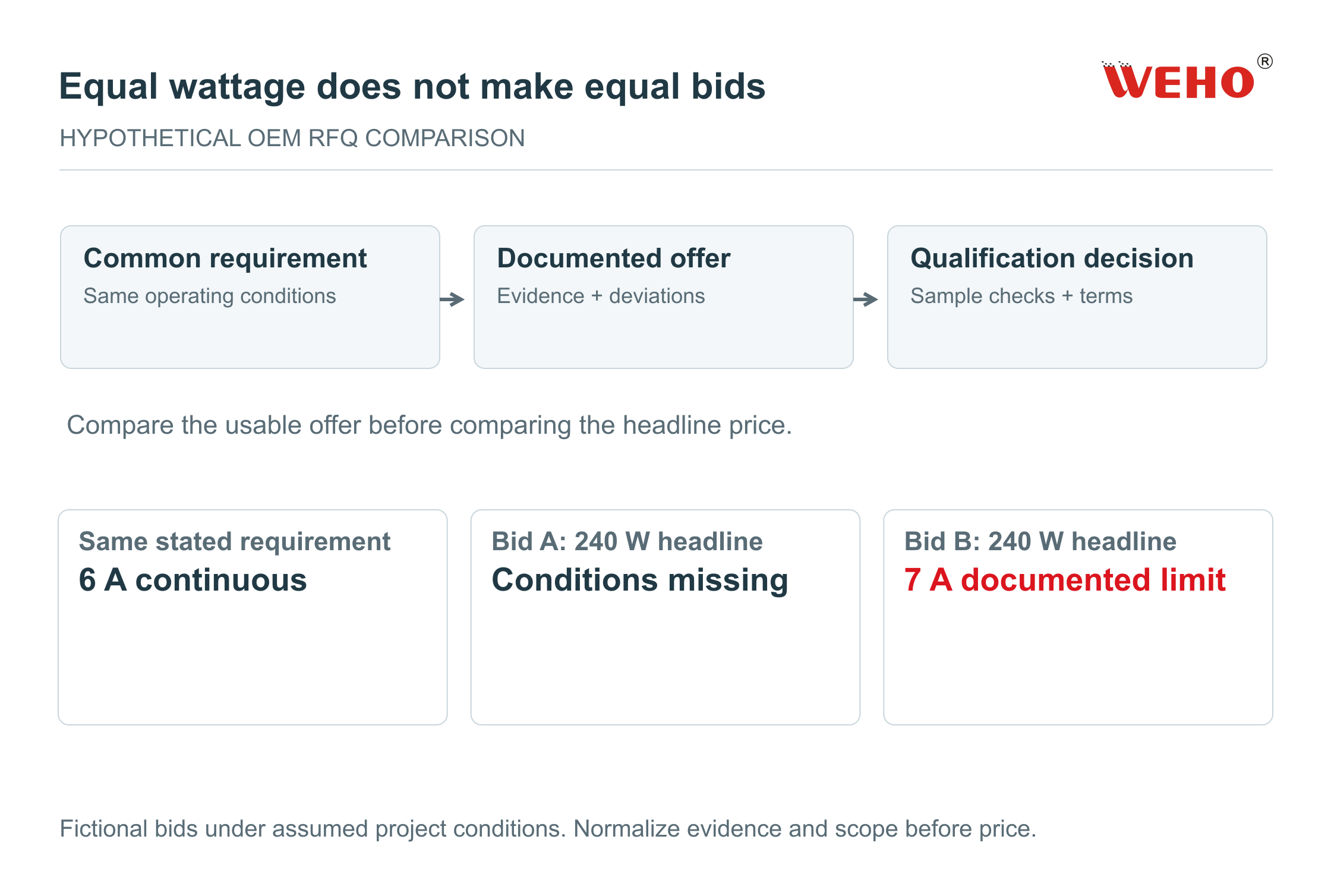
Consider a hypothetical OEM control cabinet with a 24 V, 6 A continuous load and an 8 A startup demand lasting 200 ms. Assume its required input range is 100–240 VAC, its enclosure ambient is 50°C, and it uses the mounting orientation and airflow described in the RFQ. These are project requirements chosen for the example, not WEHO specifications.
Two unnamed bids arrive with the same 240 W headline. Bid A supplies only a room-temperature rating. Bid B documents a permitted continuous current of 7 A at the specified installation conditions and supplies a transient record covering the stated 8 A, 200 ms case. Use the power-supply derating guide to check the installation operating point behind that continuous-current evidence. Neither bid has yet passed the OEM’s equipment tests.
| Comparison row | Bid A | Bid B | Purchasing action |
|---|---|---|---|
| 6 A continuous at stated installation conditions | No supporting operating point | Documented 7 A limit | A needs clarification; B has 1 A of documented arithmetic headroom |
| 8 A for 200 ms during startup | Not addressed | Supporting record supplied for matching conditions | Review B’s endpoint and repeat conditions; include both bids in the same sample test if A resolves its gap |
| Sample configuration | Family name only | Exact suffix and revision stated | Identify A’s model before ordering a comparison sample |
| Commercial comparison | Packaging excluded | Requested packaging included | Obtain the same scope before calculating a price difference |
The ratio 6 A ÷ 7 A is about 85.7% utilization at B’s documented condition. This describes continuous-capacity use at that condition; sample testing still has to cover startup, temperature, and the final equipment. Bid A needs clarification rather than automatic rejection. A single clarification could change the comparison, which is why the response matrix should preserve both the gap and its resolution.
For the commercial review, compare the same currency, quantity, shipping term, destination, packaging, test scope, and validity period. List tooling, engineering charges, freight, taxes, and other costs only where they actually apply and are quoted. Do not bury unknown costs inside an invented “total cost” figure.
Separate component evidence from equipment acceptance
A power supply’s evidence helps assess the component. The equipment manufacturer still has to evaluate how it is installed and used. Cables, load, and the final assembly influence system EMC; the component-power-supply EMC statement from MEAN WELL explains this boundary. Request component test conditions and include the complete equipment in the evaluation plan.
Make document requests specific: full model and output suffix, document revision, covered input range, mounting and cooling conditions, and the exact evidence needed for the intended market and application. Ask the responsible compliance specialist to identify the applicable requirements; a generic request for “all certifications” is difficult to answer and does not define product suitability.
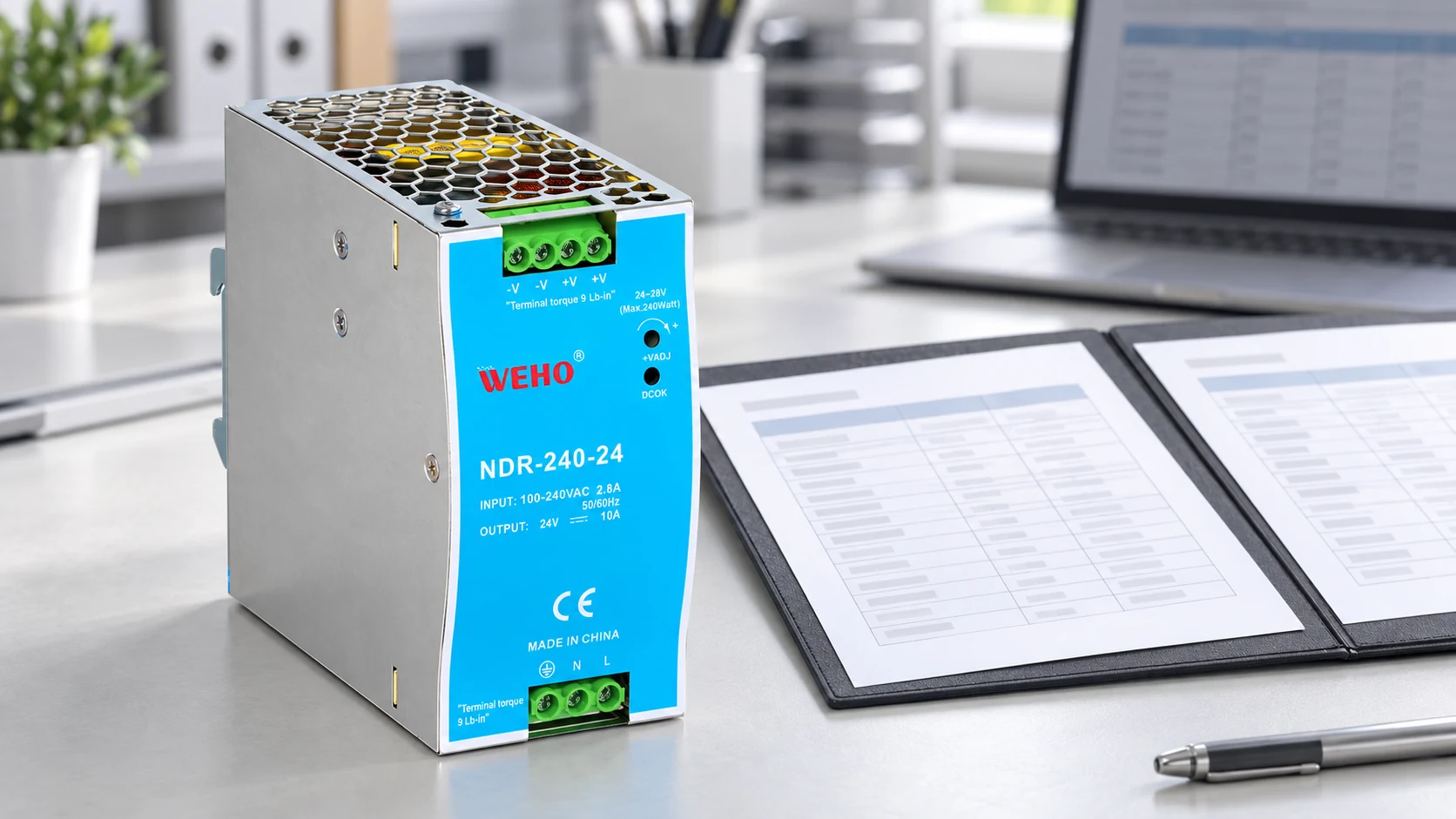
Use the public NDR-240 specification as a document-review example: identify the complete output suffix, then mark which requested operating and installation conditions the sheet states and which still need confirmation. Keep those gaps in the RFQ matrix rather than treating a family headline as a complete requirement match.
Make the sample stage resolve the bid’s assumptions
Identify the sample before testing: model, suffix, hardware or document revision, sample number, voltage adjustment, and any accessories. The sample owner should know whether the item represents the quoted production configuration. If an alternate is supplied, record and assess it as an alternate.
Test the actual points that distinguish proposals. For the hypothetical cabinet, that means steady operation at the specified environment and input corners, the defined startup event, voltage at the critical load, thermal observations, and recovery from the required faults. Include ripple acceptance conditions only where the load needs them, with a consistent measurement boundary for every sample.
Preserve raw records and link each result to its RFQ row. Classify an issue as a failed requirement, an incomplete test, or a proposed change. A supplier clarification is useful evidence, but it does not retrospectively change a test condition or replace a missing system result.
Carry the chosen configuration into production
Convert the resolved RFQ into a purchase specification or controlled reference set. Record the accepted model, revisions, agreed deviations, packaging and identification, and the evidence retained with the qualification. Avoid placing an unrestricted family name on the bill of materials after qualifying one exact variant.
Discuss notification expectations for component substitutions, hardware changes, firmware where applicable, manufacturing-location changes, and discontinuation. Ask what the supplier can provide and agree the terms; do not assume every supplier offers the same notification period or traceability depth.
An alternate model needs its own interface and application review. Use the replacement compatibility checklist when a purchasing change affects terminals, dimensions, grounding, output behavior, or installation limits. A matching voltage and wattage label is only the start.
Contact WEHO to start an OEM model review. Send four inputs: input range, output load profile, installation temperature and space, and expected quantity. Flag unknowns rather than delaying the inquiry. Use the downloadable RFQ matrix to record model-specific answers as the project moves from screening to sample approval and production.
Optional project record: Download the OEM RFQ response matrix (CSV). Use it to record your own inputs and evidence; example entries are illustrative.