การแนะนำ
หากคุณเป็นผู้ซื้อ ระบบชาร์จแบตเตอรี่, อุตสาหกรรม พาวเวอร์ซัพพลาย หรือ Battery Charger การเลือก Charging Voltage ที่ถูกต้องไม่เพียงส่งผลต่อความเร็วในการชาร์จ แต่ยังกําหนด Battery Charging Efficiency อายุการใช้งานแบตเตอรี่และค่าใช้จ่ายในการดําเนินงานโดยรวมโดยตรง.
ไม่ว่าคุณจะใช้แบตเตอรี่ลิเธียมไอออนแบตเตอรี่ LiFePO4 หรือแบตเตอรี่ตะกั่วกรดมันเป็นสิ่งสําคัญที่จะรู้พารามิเตอร์แรงดันไฟฟ้าที่ถูกต้อง บทความนี้จะช่วยให้คุณสามารถเรียนรู้วิธีการเลือกแรงดันการชาร์จที่เหมาะสมและปรับปรุงประสิทธิภาพการชาร์จโดยรวมได้อย่างรวดเร็ว.
แรงดันชาร์จแบตเตอรี่คืออะไร?
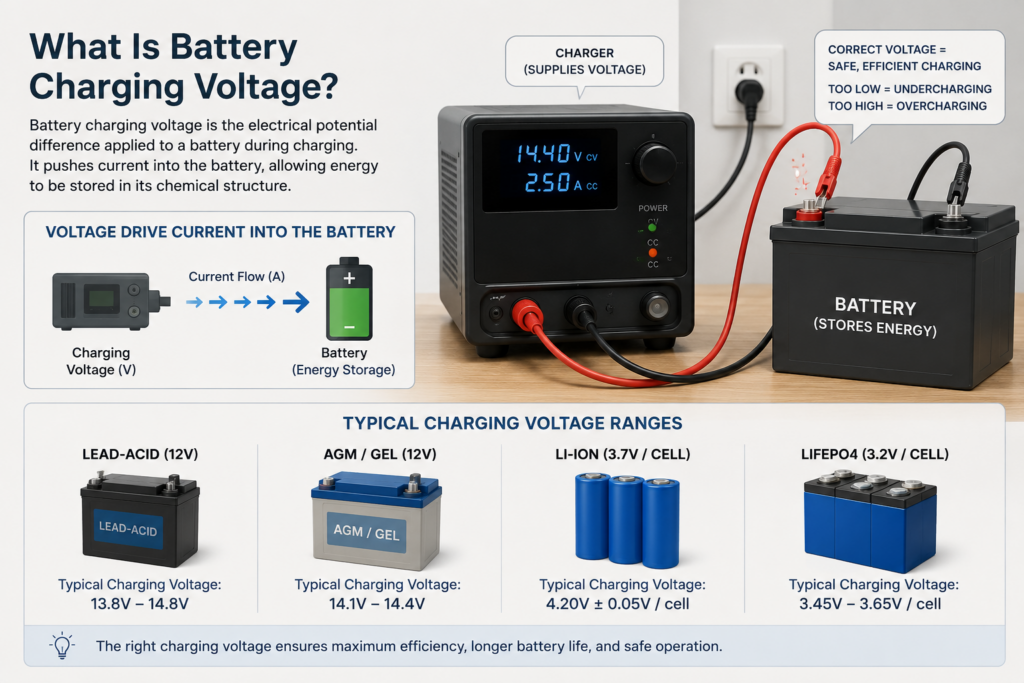
แรงดันไฟฟ้าในการชาร์จแบตเตอรี่ หมายถึงแรงดันไฟฟ้าที่ใช้กับขั้วแบตเตอรี่ระหว่างการชาร์จ.
คุณสามารถเข้าใจได้ว่าเป็นแรงผลักดันที่ขับเคลื่อนพลังงานไฟฟ้าเข้าสู่แบตเตอรี่ หากแรงดันไฟฟ้าต่ําเกินไปแบตเตอรี่จะไม่เต็ม หากแรงดันไฟฟ้าสูงเกินไปอาจทําให้เกิดความร้อนสูงเกินไปการลดทอนความจุและความเสี่ยงด้านความปลอดภัย.
สําหรับผู้ซื้อการทําความเข้าใจช่วงแรงดันไฟฟ้าในการชาร์จที่จําเป็นสําหรับแบตเตอรี่ที่แตกต่างกันเป็นพื้นฐานสําหรับการเลือกที่เหมาะสม พาวเวอร์ซัพพลายอุตสาหกรรม.
ทําไมการชาร์จแรงดันไฟฟ้าจึงสําคัญสําหรับประสิทธิภาพของแบตเตอรี่
ผู้ซื้อจํานวนมากให้ความสําคัญกับความเร็วในการชาร์จ แต่ไม่สนใจผลกระทบของการชาร์จแรงดันไฟฟ้าที่มีประสิทธิภาพ.
เมื่อการตั้งค่าแรงดันไฟฟ้ามีความสมเหตุสมผล:
- ลดระยะเวลาในการชาร์จ
- ช่วยลดการสูญเสียพลังงาน
- อุณหภูมิของแบตเตอรี่จะลดลง.
- ยืดอายุแบตเตอรี่
- การปรับปรุงเสถียรภาพของระบบ
ข้อมูลการวิจัยแสดงให้เห็นว่าแรงดันไฟฟ้าชาร์จผิดอาจนําไปสู่การสูญเสียประสิทธิภาพ 10%-30% และลดอายุการใช้งานแบตเตอรี่.
สําหรับระบบจัดเก็บพลังงานในระยะยาว AGV ระบบชาร์จ EV และระบบสํารองข้อมูลการสูญเสียนี้จะแปลโดยตรงเป็นต้นทุนการดําเนินงานที่สูงขึ้น.
คู่มือฉบับย่อ: แรงดันชาร์จที่แนะนําสําหรับแบตเตอรี่ประเภทต่างๆ
ต่อไปนี้เป็นช่วงแรงดันไฟฟ้าชาร์จที่ผู้ซื้อส่วนใหญ่มักจะอ้างถึง.
| ชนิดของแบตเตอรี่ | แรงดันไฟฟ้าที่กำหนด | แรงดันชาร์จที่แนะนำ |
| แบตเตอรี่ลิเธียมไอออน | 3.7V/Cell | 4.2V/Cell |
| แบตเตอรี่ LiFePO4 | 3.2V/Cell | 3.6-3.65V/Cell |
| Lead-Acid Battery | 2.0V/Cell | 2.4-2.45V/Cell |
| AGM Battery | 2.0V/Cell | 2.35-2.45V/Cell |
| Gel Battery | 2.0V/Cell | 2.3-2.4V/Cell |
แบตเตอรี่ลิเธียมไอออน
If you purchase a Lithium-Ion Battery Pack, the standard charging termination voltage is usually 4.2V/Cell.
Although increasing the voltage can increase the capacity utilization rate, exceeding the recommended value will significantly accelerate aging.
แบตเตอรี่ LiFePO4
LiFePO4 Battery is becoming more and more popular in industrial applications.
The recommended charging voltage is generally 3.6V-3.65V/Cell. This chemical system has higher safety and longer cycle life, which is very suitable for Energy Storage System and Industrial Equipment.
แบตเตอรี่ตะกั่ว-กรด
Traditional Lead-Acid Battery is still widely used in UPS, communication equipment and backup power supply systems.
It is recommended to keep the charging voltage within the range of 2.4V-2.45V/Cell to avoid vulcanization and capacity loss.
แบตเตอรี่ agm และเจล
Although both belong to the VRLA Battery type, AGM and Gel batteries are more sensitive to voltage.
When purchasing, the manufacturer’s recommended parameters should be specially confirmed, otherwise it is easy to have a decrease in life.
ประสิทธิภาพในการชาร์จแบตเตอรี่: 7 ปัจจัยที่ต้องพิจารณาเมื่อเลือกแรงดันไฟฟ้าในการชาร์จ

เคมีแบตเตอรี่
Different Battery Chemistry have completely different requirements for charging voltage.
For example:
Lithium-Ion Battery: 4.2V/Cell
LiFePO4 Battery: 3.65V/Cell
Lead-Acid Battery: 2.45V/Cell
Therefore, the battery chemical system must be confirmed before purchasing.
ความจุของแบตเตอรี่
Large-capacity batteries usually require a longer charging cycle.
If you purchase a high-capacity energy storage system, you must ensure that the Power Supply can stably output the target voltage without fluctuations due to load changes.
สถานะการชาร์จ (SOC)
With The Improvement Of The State Of Charge (SOC), The Ability Of The Battery To Accept The Charging Current Will Decrease.
Therefore, modern chargers usually adopt:
Constant Current Mode
Constant Voltage Mode
Combine strategies to improve efficiency.
กำลังชาร์จปัจจุบัน
The voltage and current must be matched.
If the current is too high, even if the voltage is correct, it may lead to:
- Excessive heat
- Reduced lifespan
- Loss of efficiency
Therefore, Charging Current and Charging Voltage should be considered at the same time when purchasing.
อุณหภูมิในการทำงาน
Temperature has a great impact on the charging performance.
| อุณหภูมิ | Charging Performance |
| Below 0°C | Significant Efficiency Reduction |
| 0°C-25°C | Optimal Charging Range |
| 25°C-45°C | Good Performance |
| Above 45°C | Increased Battery Stress |
In extreme environments, a power supply system that supports Temperature Compensation is particularly important.
อายุแบตเตอรี่และสุขภาพ
As the usage time increases, the internal resistance of the battery will gradually increase.
Even with the same voltage, the charging efficiency of aging batteries will be significantly reduced.
Purchasers should monitor regularly:
- Internal resistance
- Capacity Retention
- Cycle life
ความเสถียรของแหล่งจ่ายไฟ
This is the most easily ignored problem for many buyers.
Even if the battery parameters are completely correct, unstable Power Supply will still reduce efficiency.
Therefore, more and more enterprises are beginning to choose highly stable WEHO Industrial Power Supply solutions to ensure long-term stable charging performance.
ข้อผิดพลาดทั่วไปเกี่ยวกับแรงดันไฟฟ้าในการชาร์จซึ่งช่วยลดประสิทธิภาพของแบตเตอรี่
การชาร์จไฟมากเกินไป
Overcharging is one of the most common causes of battery damage.
The consequences include:
- Capacity loss
- Excessive heat
- Reduced lifespan
- Safety risks
การชาร์จไฟต่ํา
Long-term Undercharging will also affect the performance.
For Lead-Acid Battery, undercharge will lead to vulcanization, thus reducing capacity.
ไม่สนใจการชดเชยอุณหภูมิ
Many systems use fixed voltage charging.
However, temperature changes will change the optimal charging parameters, so the lack of Temperature Compensation will reduce efficiency.
การใช้แหล่งจ่ายไฟที่ไม่เสถียร
Voltage fluctuations will lead to:
- Incomplete charging
- Increased Heat Generation
- Battery stress
Therefore, stable output is an important requirement for industrial charging systems.
แหล่งจ่ายไฟอุตสาหกรรมปรับปรุงประสิทธิภาพการชาร์จแบตเตอรี่อย่างไร
For buyers, the battery performance depends not only on the battery itself, but also on the power supply system.
High-quality Industrial Power Supply can provide:
- Precision Voltage Regulation
- Stable output
- Low ripple
- Multiple Protection Functions
- Long-term reliability
For example, WEHO Industrial Power Supply is widely used in:
- Energy Storage System
- EV Charging Station
- UPS system
- Industrial Automation
- Telecom Power System
Help enterprises improve the overall Battery Charging Efficiency through stable power supply.
วิธีการเลือกแรงดันชาร์จที่เหมาะสมสําหรับระบบแบตเตอรี่ของคุณ
ทำความเข้าใจเกี่ยวกับข้อมูลจำเพาะของแบตเตอรี่ของคุณ
First of all, confirm:
- Battery type
- ความจุ
- Voltage rating
- Manufacturer’s Recommendations
These data determine the best charging parameters.
ตรงกับความต้องการของแรงดันไฟฟ้าและกระแสไฟฟ้า
Don’t just focus on voltage.
You also need to make sure that:
- แรงดันขาออก
- กระแสไฟขาออก
- Charging profile
It can be matched with the battery system.
คํานึงถึงสภาพแวดล้อม
If the device is running in:
High temperature
Low temperature
Outdoor environment
Then priority should be given to power supply systems with temperature compensation and protection functions.
เลือกแหล่งจ่ายไฟที่เชื่อถือได้
For long-term industrial applications, stability is more important than simple price.
When purchasing, it is recommended to focus on evaluation:
Efficiency rating
คุณสมบัติการป้องกัน
Certification Compliance
Brand Reliability
Choosing a mature brand such as WEHO can help you reduce maintenance costs and improve system reliability.
บทสรุป
Choosing the right Charging Voltage is one of the key factors to improve Battery Charging Efficiency.
For buyers, in addition to understanding the battery parameters, they also need to pay attention to Power Supply Stability, environmental conditions and system matching. By choosing reliable พาวเวอร์ซัพพลายอุตสาหกรรม solutions, such as WEHO, you can get higher efficiency, longer life and lower operating costs.
คำถามที่พบบ่อย
What Is The Best Charging Voltage For Lithium-Ion Batteries?
The recommended charging termination voltage of the standard Lithium-Ion Battery is 4.2V/Cell.
Can Higher Charging Voltage Improve Charging Speed?
To a certain extent, it is possible, but exceeding the recommended range will damage the battery life and increase safety risks.
Why Does Temperature Affect Charging Efficiency?
Temperature will change the internal chemical reaction rate of the battery, thus affecting the charging acceptance capacity and efficiency.
How Important Is Power Supply Stability?
It is very important. Stable Power Supply can improve charging efficiency and reduce battery aging.
Which Power Supply Is Suitable For Industrial Battery Charging?
It is recommended to choose WEHO Industrial Power Supply with high stability, low ripple and multiple protection functions.