A power supply does not have one universal shelf life that can be inferred from its wattage or series name. Before installing stored stock, identify the exact unit, review its storage history and obtain the manufacturer’s applicable storage and release instructions. A sealed-looking carton and a recent purchase date do not, by themselves, establish suitability for service.

Separate shelf life from service life
Shelf life concerns the period before use and the conditions under which the product was kept. Service life concerns operation under a particular electrical and thermal duty. Warranty duration is a commercial term. These three concepts are not interchangeable, and none should be calculated from another without explicit manufacturer information.
A spare bought recently may have an earlier manufacturing date. Conversely, an older spare with a complete history may be easier to assess than a newer unit from an unknown source. Keep purchase, manufacturing and installation dates as separate fields in the inventory record.
Build a storage record that follows the unit
| Record | Why it matters |
|---|---|
| Model, revision and lot identity | Connects the spare to the correct instructions and project requirement |
| Storage duration and location | Shows whether the history is known rather than assumed |
| Packaging and handling events | Identifies opened cartons, transit damage or repeated unpacking |
| Temperature, humidity or contamination incidents | Gives the manufacturer evidence for a condition review |
| Inspection and release decision | Preserves who accepted the unit and against which instructions |
Retain the original protective packaging where practical and keep inventory away from conditions excluded by the manufacturer’s instructions. Do not invent a humidity or temperature limit from a general warehouse policy and call it a product specification.
What the LRH-150-12 example does—and does not—tell us
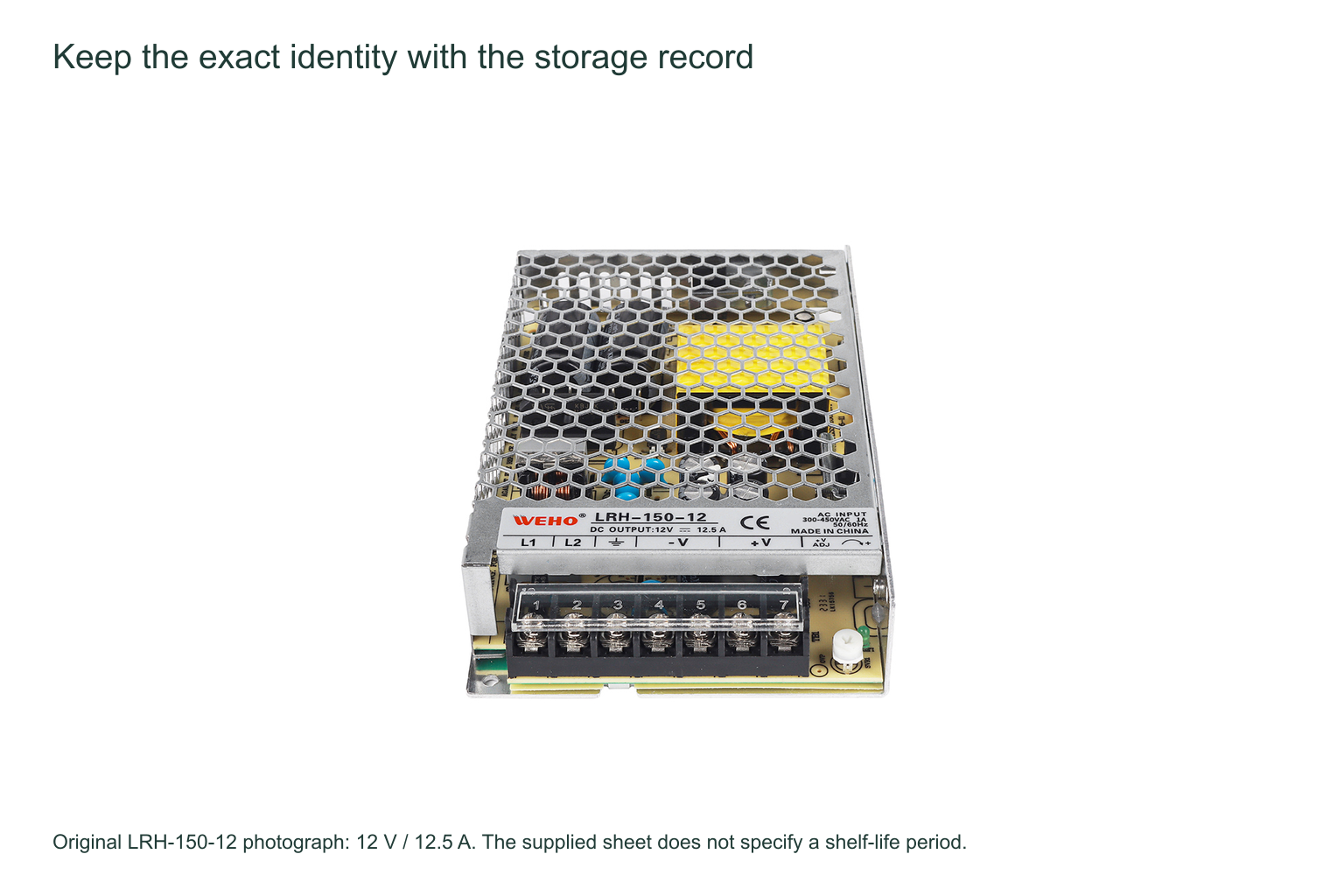
The photographed WEHO LRH-150-12 is marked 12 V, 12.5 A with a 300–450 VAC input. Its complete supplied sheet includes electrical ratings, an operating-temperature row and a mechanical drawing. It does not give a shelf-life period or a step-by-step procedure for returning long-stored units to service.
That absence is a reason to ask for the applicable instructions, not a reason to assign a one-year, two-year or five-year rule. In particular, an operating-temperature range is not automatically the permitted storage range. A drawing can confirm chassis fit while leaving the storage decision unresolved.
Inspect condition without treating appearance as a test result
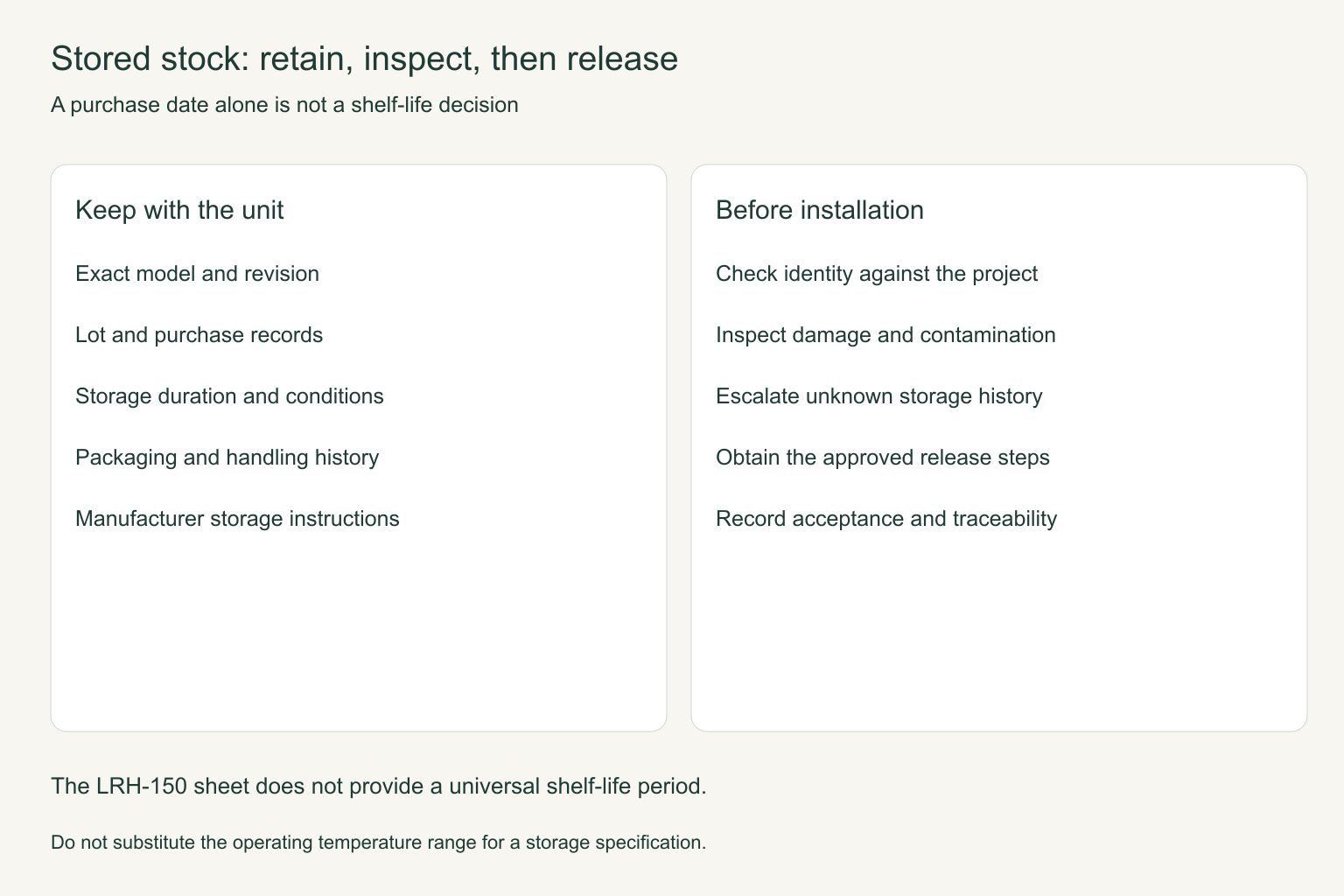
Before installation, check for damaged packaging, loose parts, bent casing, blocked ventilation, corrosion, contamination and signs of moisture exposure. Match the label and revision to the approved project documents. Hold a suspect unit for review rather than cleaning away evidence and returning it to stock without a record.
An external inspection cannot establish internal electrical condition. Do not open the supply, apply an improvised voltage ramp or attempt capacitor reforming simply because a generic online article suggests it. Any required inspection or conditioning should follow instructions for the exact product and be performed by appropriately qualified personnel.
Plan the release before the machine needs the spare
For critical stock, resolve missing records during scheduled inventory reviews instead of during a breakdown. Ask whether the supplier recommends an inspection, test, conditioning process or replacement for the documented age and storage history. Record the required competence, equipment and acceptance criteria; an instruction to “power it up and see” is not a complete acceptance plan.
First-in, first-out stock rotation helps keep records manageable, but it is not a substitute for condition review. A unit exposed to an unsuitable environment should not move to the front of the queue merely to reduce its time on the shelf.
Make the supplier enquiry specific
For the LRH-150 family, send WEHO the model label and storage record. Include the manufacturing or lot information available, elapsed time, packaging condition, environment, any unusual exposure and the intended installation. Ask for the current storage limits and release instructions applicable to that revision.
Common buyer questions
Can a supply that looks new go straight into service?
Not on appearance alone. Identity, storage history and the required acceptance process still matter.
Does opening the carton automatically make the unit unusable?
No universal conclusion follows. Record the event and assess the subsequent protection and handling against the manufacturer’s instructions.
Can I use the same storage rule for every power supply?
Use a common record format, but retain model-specific requirements. Different construction, components and manufacturer instructions can lead to different decisions.