Last Updated: October 1, 2026
Quick Answer: A DIN rail power supply converts a documented electrical input into regulated DC for compatible control equipment and mounts on a cabinet rail. For a 24 V control bus, WEHO NDR-120-24 is a documented 24 V / 5 A model, giving 120 W. Choose it only after checking the exact ordered revision, simultaneous and startup loads, temperature, voltage drop, protection and mechanical installation. It is not a motor drive, battery charger or household AC supply.
What a DIN rail power supply does
A DIN rail power supply combines an AC-to-DC conversion function with a mounting format suited to electrical panels. Typical compatible DC loads include PLCs, remote I/O, sensors, communication modules and relay interfaces. The rail simplifies mechanical assembly; it does not establish voltage compatibility or guarantee sufficient output capacity.
Define the electrical boundary before choosing a model. A building-services panel may supply control electronics while a separate circuit powers the air-handler motor. A conveyor panel may power sensors and PLC inputs while an engineered drive handles traction. These power paths must not be combined merely because their components share a cabinet.
Specify the model, not just the series wattage
An OEM request should identify input conditions, DC voltage, credible maximum current, mounting format, ambient conditions, protective devices and required documentation. “120 W DIN supply” is insufficient because variants can have different output voltages, current ratings, terminal arrangements and approvals.
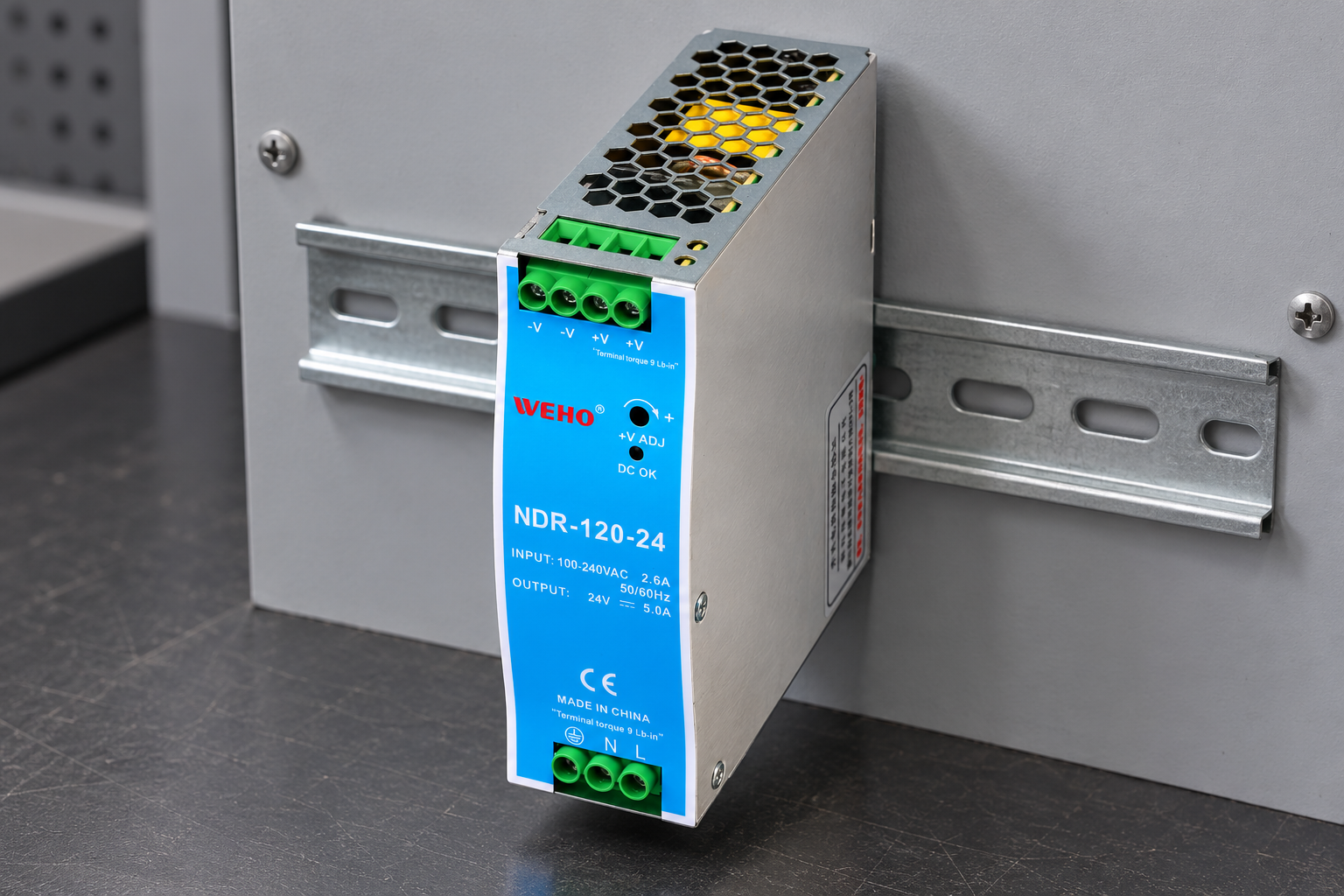
The WEHO NDR-120 product page identifies the NDR family and model options. The current enterprise-drive NDR-120 specification lists NDR-120-24 at 24 V and 5 A. Its exact source photograph also shows OUTPUT 24 V / 5.0 A. Those two output records agree; 24 multiplied by 5 gives the 120 W arithmetic limit.
Input wording differs. The photographed label states 100-240 VAC, 2.6 A, 50/60 Hz. The current specification lists 85-264 VAC or 120-370 VDC and 47-63 Hz for AC. Record these separately and obtain exact ordered-revision confirmation. Do not silently substitute a wider family-sheet range for the delivered unit’s label or assume DC-input operation from its photograph.
Build a simultaneous-load schedule
List each device’s approved voltage range, normal current, startup demand and operating state. Determine which loads can overlap during mains restoration, control startup, alarms and output actuation. A normal-running average can conceal the demanding state.
The following is a hypothetical 24 V control-panel example, not a measured system or ratings for specific devices:
| Example load group | Simultaneous current | Power at 24 V |
|---|---|---|
| Controller and communications | 1.20 A | 28.8 W |
| Remote I/O | 0.60 A | 14.4 W |
| Sensors and interfaces | 0.70 A | 16.8 W |
| Relay interfaces | 0.40 A | 9.6 W |
| Indicators | 0.30 A | 7.2 W |
| Defined engineering allowance | 0.40 A | 9.6 W |
| Illustrative total | 3.60 A | 86.4 W |
This leaves 1.40 A below the 5 A nameplate before considering transients, derating and installation effects. It does not prove suitability. Replace every value with the project BOM; capture peak magnitude, duration and overlap. Avoid a universal percentage margin unsupported by the load and revision evidence.
Check building-control duty separately

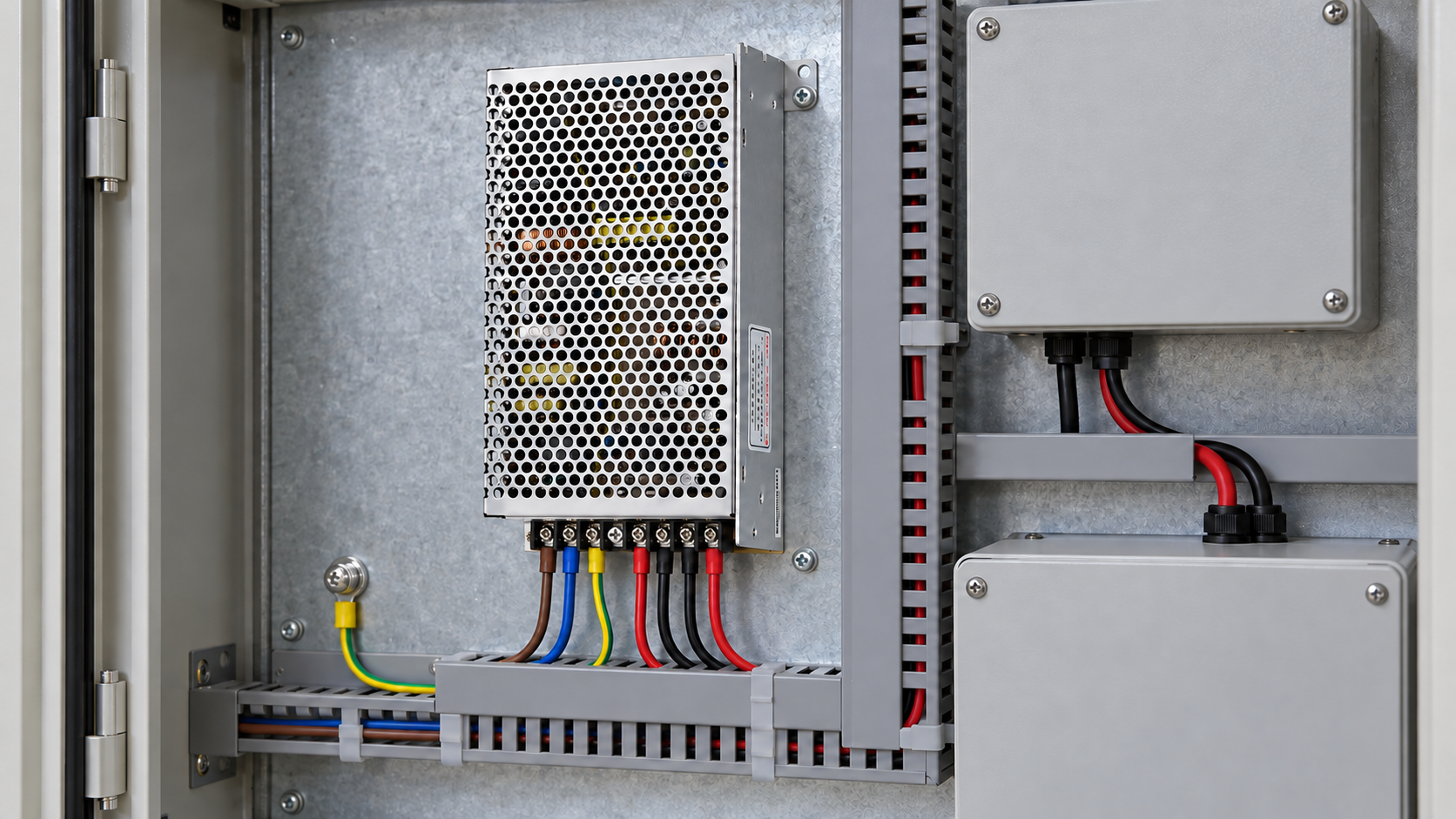
The first illustrative scene is an open building-services cabinet near air-handling equipment. It depicts mechanical fit planning, not a tested wiring design. The source-controlled product remains visible at rail-based scale; its empty terminal positions must not be interpreted as a working installation.
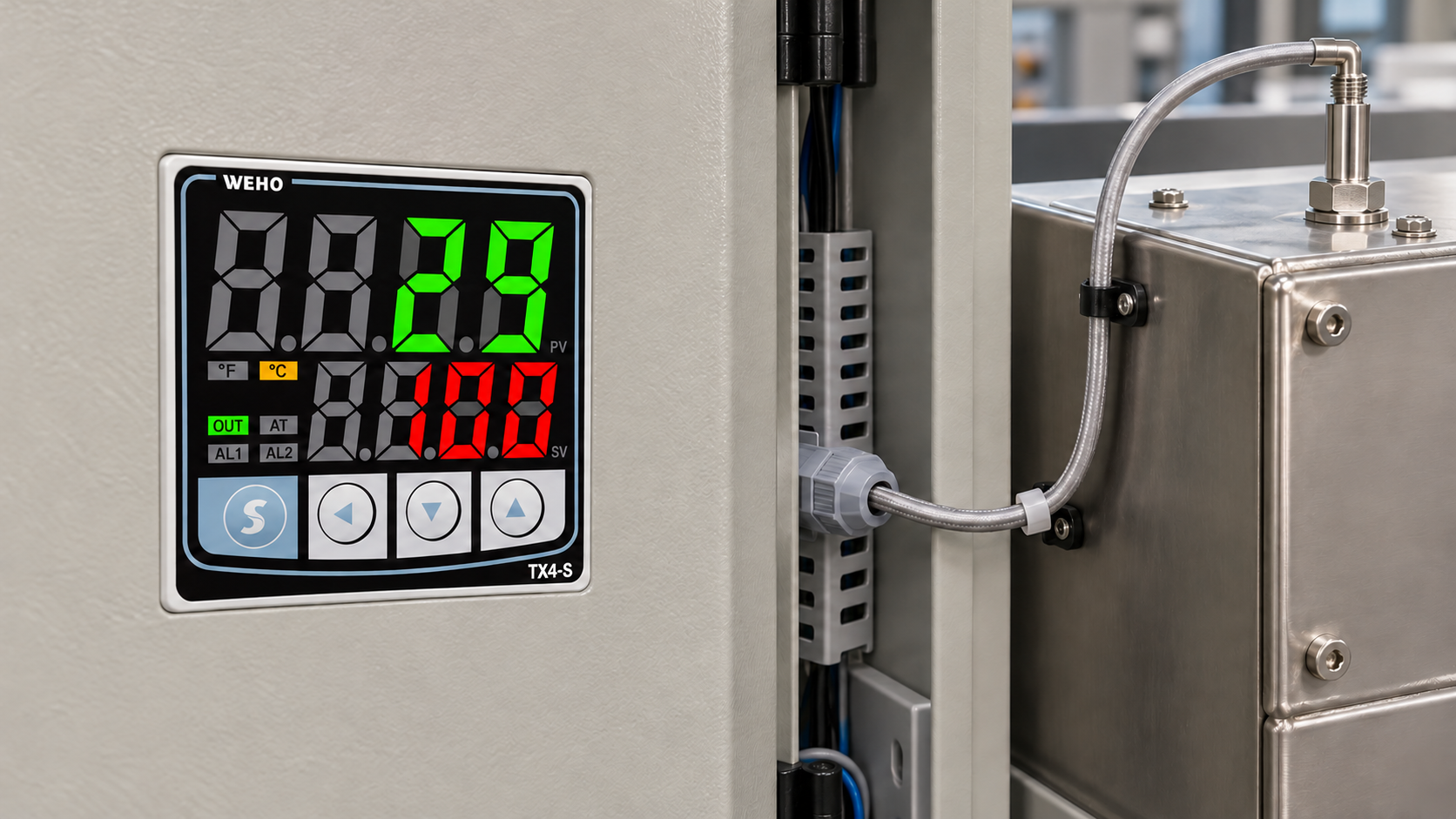
HVAC controls can experience continuous duty, long sensor runs and heat from neighboring devices. Review the air temperature around the supply, not only room temperature. Verify load behavior across the control sequence. Motors, heaters and other high-power AC equipment require their own engineered circuits; this 24 V example concerns compatible controls only.
Use a different load review for conveyors

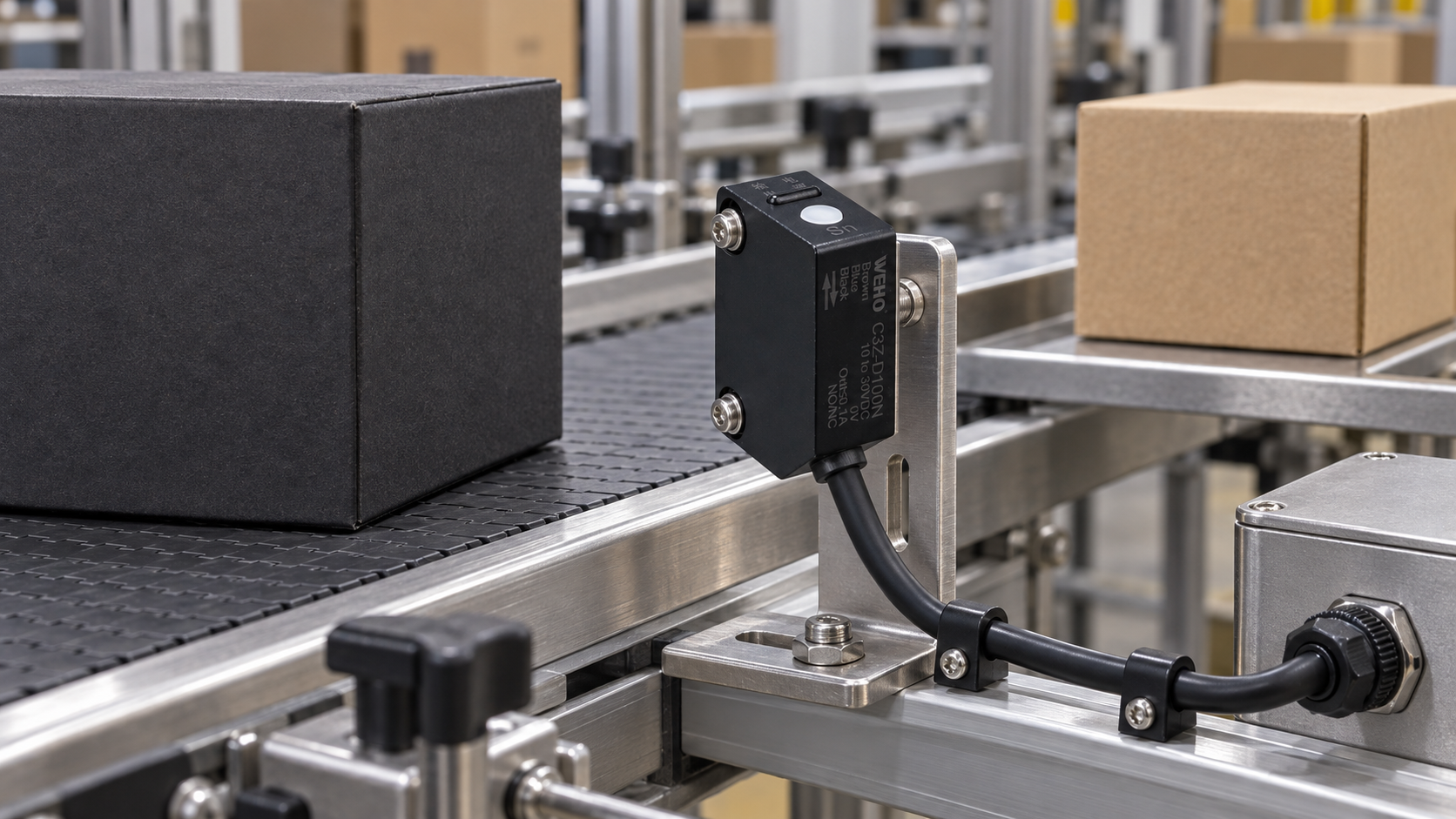
The second application is a packaging line with conveyor sensing and PLC equipment. It illustrates panel arrangement, not production commissioning. Nearby controllers or field devices do not establish a measured load or wiring relationship to the illustrated supply.
Review sensor, communication and output-interface demand as one defined control bus. Do not include conveyor traction motors in a copied low-voltage budget. Inductive interfaces may need appropriate suppression, and recovery after a supply interruption should be checked against the machine’s approved control strategy.
Verify the mechanical envelope and orientation
The NDR-120 drawing specifies 40 mm width along the rail, 125.2 mm vertical height and 113.5 mm front-to-rear depth. These case dimensions are not installation clearances. Reserve space for conductor bends, terminal access, convection, neighboring heat sources, rail engagement and safe removal according to the exact instructions.
Keep the unit upright in its documented orientation, with the blue front label accessible and its rear mounting interface engaging the supported DIN rail. The drawing references standard 35 mm TS35 rail. Do not mount the label face against the backplate or invent brackets from a plausible-looking photograph. Confirm rail retention and enclosure depth on the actual assembly.
Understand terminals, adjustment and cooling

The source shows four upper DC positions ordered -V, -V, +V, +V, and three lower input positions ordered protective earth, N, L. The duplicated DC connections are not evidence of independent protected channels. The source front places +V ADJ above DC OK; the enclosure has honeycomb ventilation and no fan.
Qualified personnel should follow the ordered product’s instructions and approved panel design for isolation, conductor selection, stripping and torque. Never use ventilation openings as cable-entry points. Do not raise the adjustment setting to conceal excessive cable resistance or assume a status indicator proves adequate far-end voltage.
Coordinate protection and acceptance tests
Select branch protection and conductors together. Consider short-circuit response, inductive transients, earthing, return paths and recovery so one fault does not unnecessarily remove unrelated control functions. Supply protection does not replace branch protection or the complete panel’s safety assessment.
Measure voltage at the supply and the most demanding remote load during startup and operating-state changes. Include both outgoing and return conductor resistance, connectors and temperature effects in voltage-drop calculations. Repeat relevant tests after thermal stabilization. Record input conditions, steady and peak current, panel temperature, recovery behavior and the exact model/revision tested.
For procurement, request the approved specification, mechanical drawing, label confirmation and applicable compliance evidence for the ordered variant. A website description or CE marking alone does not establish every certification required by a customer’s market. Do not carry forward an unevidenced UL claim from an older article.
Key Takeaways
- Select a DIN rail power supply from the verified control architecture, not cabinet appearance.
- NDR-120-24 is documented at 24 V / 5 A; validate dynamic and thermal duty separately.
- Confirm differing photo-label and specification input wording before approving an order.
- Preserve the 40 mm width, 125.2 mm height and 113.5 mm depth axes; add installation clearances.
- Verify terminals, branch protection, far-end voltage and recovery on the actual panel.
Çözüm
The NDR-120-24 is a defensible 24 V DIN rail power supply candidate when an evidenced control load fits its documented output and the ordered revision passes mechanical, dynamic, thermal and protection checks. Use the WEHO product guide to compare documented alternatives, then approve the exact model through project evidence rather than a generic wattage label.
Sık sorulan sorular
What is a DIN rail power supply?
It is a power converter with a mounting format for electrical-panel rails. A compatible model supplies regulated DC to documented loads such as PLCs, sensors and communication equipment; the rail format alone does not establish electrical suitability.
What output is documented for NDR-120-24?
The current NDR-120 specification and exact source-photo label both identify 24 V and 5 A, corresponding to 120 W. The usable project load must also pass transient, temperature, wiring and protection checks.
Why do the input ranges need revision confirmation?
The exact source-photo label states 100-240 VAC, 2.6 A, 50/60 Hz; the current specification lists 85-264 VAC or 120-370 VDC and 47-63 Hz for AC. Confirm the exact ordered revision rather than silently widening the delivered unit’s acceptance range.
What dimensions should panel designers reserve?
The documented case width along the rail is 40 mm, vertical height is 125.2 mm and front-to-rear depth is 113.5 mm. Additional conductor-bend, ventilation, terminal-access, rail-engagement and service clearances must follow the exact instructions.
Can this supply power the conveyor or air-handler motor?
This article evaluates compatible 24 V control electronics only. Motors and other high-power loads need a separately engineered power path; the illustrative cabinet scenes do not prove motor-drive or actual system-load capability.
Do the duplicated output terminals provide separate protected channels?
No separate protected-channel capability is established by the source. The source shows two -V and two +V positions on the upper output block; coordinate distribution conductors and branch protection using the approved panel design.