Last Updated: 2026-10-03 Quick Answer: A report of led driver flickering needs evidence of the light output over time, a separately documented electrical record and the operating events associated with both. Do not turn a ripple specification, a phone video or a single voltage reading into a confirmed cause. For a luminaire that explicitly accepts regulated 24V, this guide uses the WEHO DR-120-24 as a conditional sample identity—not as a universal constant-current LED driver or a proven replacement.
Separate three evidence channels
A lighting OEM can receive several reports that all say “flickering” but describe different observations. One observer may report a brightness variation while illumination remains present. Another may describe repeated complete light loss and restart. A camera-only complaint may arrive without a corresponding observation from a person at the site. These are descriptions to retain, not diagnoses to collapse into one fault code.
Create separate fields for the customer’s observation, the optical record and the electrical record. Give each attachment its own provenance: who collected it, which specimen it describes and what conditions were known. Leave missing information explicitly unknown. An OEM complaint review then asks whether the records describe the same event before asking which component should be replaced.
The distinction matters commercially. A supplier receiving only an edited clip cannot know which fixture revision, sample or operating state it represents. A purchasing team receiving only a normal DC number cannot know whether the customer’s light-output concern was evaluated. Preserve both concerns without asserting that one has already disproved the other.
Set a conditional 24V sample boundary
The WEHO DR-120 product page lists the exact DR-120-24 as a 24V, 5A, 120W DIN-rail supply. Its source envelope is 65.5mm width along the rail, 125.2mm upright height and 100mm front-to-back depth. This makes it a documented example for an interface that explicitly accepts regulated 24V; it does not establish compatibility with an unspecified luminaire, direct LED string or dimming system.
Before assigning that specimen to a lighting evaluation, obtain the approved luminaire input requirement and actual assembly bill of materials. A description such as “24V LED lighting” is not a substitute for the input-mode and interface documentation. No connected load, channel count or measured operating point is supplied here.
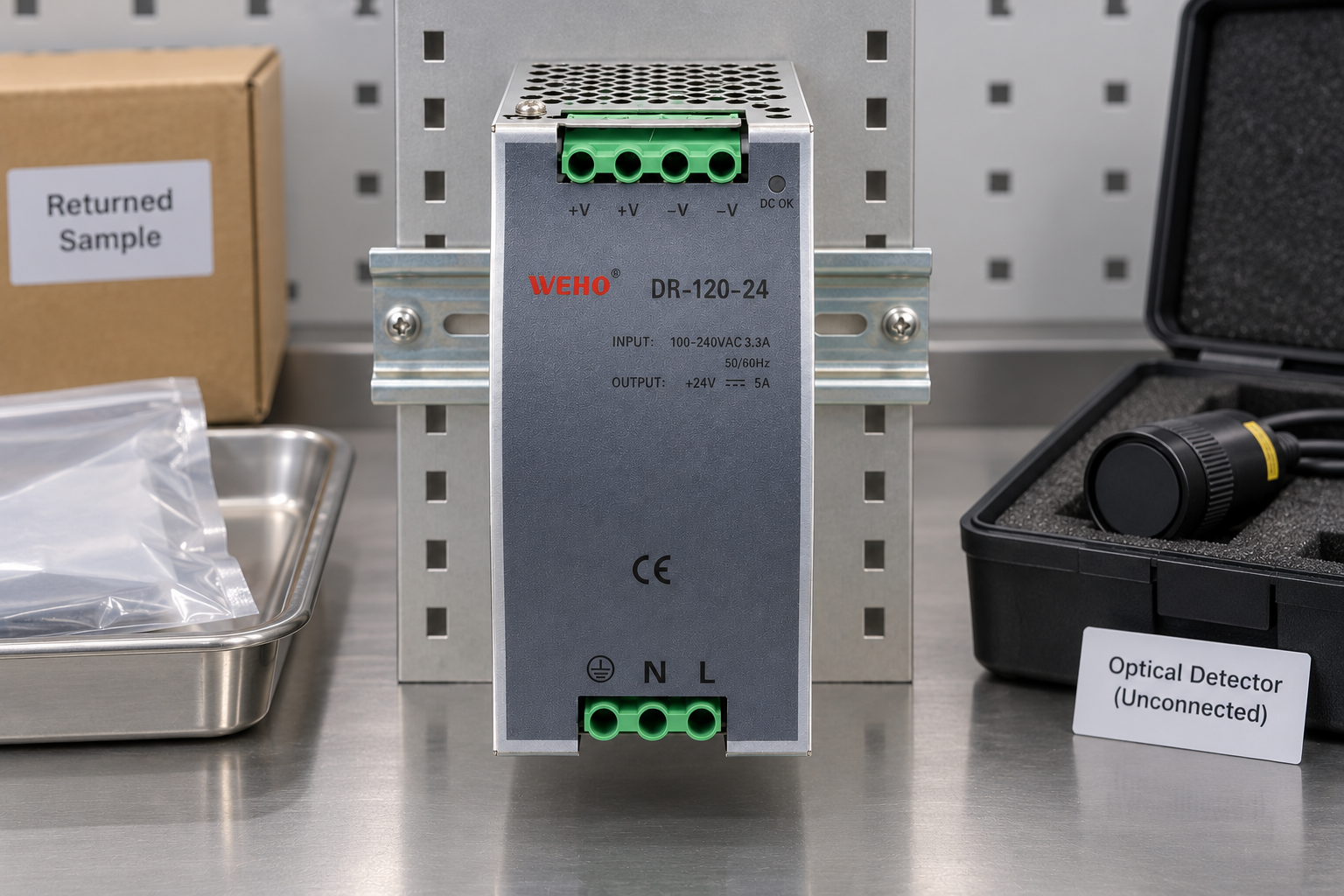
The approved photograph’s nominal input text is 100–240VAC, 3.3A, 50/60Hz. The current specification separately lists an operating range of 85–264VAC, 47–63Hz, while public input statements are not fully aligned. Keep the physical label unchanged and resolve the ordered revision with WEHO; do not merge conflicting statements into a new range.
Freeze the complaint specimen, not just the product name
Assign a case identifier to the received item and retain the exact model, label photograph and available lot or serial information. If a serial cannot be read, record that fact instead of creating one. Keep the luminaire assembly revision, controller revision where applicable and any customer-supplied installation record with the case. The point is traceability, not assuming that all samples with the same headline wattage are interchangeable.
Identify which item was actually returned. A driver returned without the luminaire cannot independently establish the luminaire’s light performance. A complete assembly returned after a component substitution may not represent the configuration shown in the original complaint. Record changes and unresolved gaps before arranging further work.
A useful record distinguishes “as received,” “as documented” and “as evaluated.” Photographs establish visible identity and condition; documents establish intended interfaces; a later qualified evaluation produces its own observations. None should silently overwrite another. This simple separation prevents a neat-looking service report from becoming a claim about an item that was never assessed.
Align records around events, not invented timings
For led driver flickering evidence, define the event of interest in the customer’s own terms. It might be an observed brightness change, an interruption, a documented command change or another reported occurrence. The case worksheet should have a field for the event description and the origin of its timestamp—not a prefilled duration that appears to be a test result.
A qualified evaluation plan can then specify how the light-output record, electrical record and relevant documented system-state record will be associated. Confirm which records share a time reference, which require an alignment method and where timing uncertainty remains. “Simultaneous” should mean supported by the recording arrangement, not merely that two screenshots look similar.
Retain the original files, relevant acquisition settings, identification of the recording points and the conditions covered by the evaluation. If only a customer video exists, preserve it as complaint context and state its limitations. Do not draw an electrical waveform from the appearance of a brightness band or retrospectively invent camera settings.
When the concern cannot be reproduced, report the conditions actually covered and the unresolved difference from the reported event. “Not observed in this evaluation” is more precise than “the complaint is impossible.” It also tells the customer what additional context could help the next review without pretending that another test has already been completed.

Keep electrical ripple and light modulation separate
The DR-120-24 specification’s 85mVp-p wave/noise entry is an electrical parameter. It is not a universal optical flicker threshold, a measured result for the pictured specimen or a guarantee about every luminaire connected to a nominal 24V supply.
Optical evidence addresses light output over time. CIE TN 012:2021 provides recommendations for reproducible measurement of temporal light modulation. The US Department of Energy's measurement explanation describes obtaining a waveform from the light signal. These sources support keeping the optical measurement basis explicit; they do not provide a product-specific approval for this WEHO sample.
Agree the applicable assessment method and project acceptance criteria with the responsible lighting engineer or laboratory. Record the relevant method version, instrument suitability, acquisition conditions and uncertainty. This article supplies no universal frequency, percentage, sample duration or pass value. It also does not certify human-health, camera-performance or museum-lighting suitability.
Make any comparison specimen genuinely comparable
If the responsible team authorizes a comparison, document what remains the same and what changes. The luminaire revision, actual accepted input, control configuration, measurement arrangement and conditions should be identified for each record. A different fixture or altered acquisition setup cannot silently become the reference for the original complaint.
Changing several items at once may remove the visible symptom while leaving its cause unresolved. A procurement decision should therefore separate a practical recovery action from a root-cause conclusion. If a component is substituted under an approved procedure, retain the substitution record and the resulting evidence; do not label an untested replacement “flicker-free.”
All electrical evaluation must be performed by qualified personnel using appropriate equipment and manufacturer-controlled instructions. This is an evidence-management guide, not a live-mains measurement procedure. Do not bypass protection, expose energized terminals or improvise optical/electrical test connections to reproduce a customer clip.
Return an evidence packet with an explicit decision
The service response should connect each conclusion to the record that supports it. Include the specimen identity, confirmed interface boundary, original complaint description, records collected, covered conditions and unresolved items. Distinguish observed behavior from a working hypothesis and from an engineering release decision.
An unsupported cause should remain open with a named owner and requested evidence. If the ordered revision or luminaire input requirement is not controlled, hold the pairing decision rather than choosing another familiar-looking supply. If the light record has not been obtained, do not use the electrical ripple entry as a substitute.
The two application illustrations show different preparation contexts: a lighting-OEM return desk and an exhibit-luminaire manufacturing fixture. Both show an identifiable, correctly oriented DR-120-24 with empty terminals and unpowered lighting components. Neither depicts a proven field installation, an actual complaint, a light-output test or confirmed luminaire compatibility.


اکثر پوچھے گئے سوالات
Does DR-120-24 replace any LED driver that flickers?
No. The worked example is conditional on a documented interface accepting regulated 24V. It is not a direct constant-current string driver or a confirmed dimming-compatible replacement.
Is the 85mVp-p specification a flicker pass value?
No. It is an electrical wave/noise specification, not an optical acceptance metric or the result of a test shown here.
What should be recorded before an optical evaluation?
Retain specimen and assembly identities, the original complaint, known operating conditions, the agreed method and criteria, and the provenance and timing basis of each planned record. Mark missing evidence explicitly.
Can a video alone prove that the supply is faulty?
This guide treats video as complaint context unless its measurement purpose, acquisition conditions and interpretation are established. It does not replace a controlled optical/electrical evaluation or establish a component fault by itself.
What if the evaluation does not reproduce the complaint?
State the conditions actually covered, what was and was not observed, and the remaining information needed to compare those conditions with the customer report. Do not claim every possible operating state was cleared.
Do the illustrations demonstrate a successful repair?
No. They show isolated source-guided mechanical preparation only: empty terminals, dark indicators and disconnected lighting components. No measured result or actual fixture pairing is claimed.
Key Takeaways
- Preserve customer observation, optical record and electrical record as separate evidence channels.
- Align records to documented events with an explicit timing basis and uncertainty.
- Use DR-120-24 only as a conditional regulated-24V sample example; verify the ordered revision and luminaire interface.
- Do not substitute electrical ripple data, an edited clip or a generated illustration for optical acceptance evidence.
- Keep unresolved causes and untested substitutions separate from the release decision.
نتیجہ
An effective LED-driver complaint response is an auditable evidence packet, not a fast component verdict. Keep the specimen, interface, optical record, electrical record and event history connected without overstating what has been measured. Contact WEHO with the exact label, ordered revision and documented luminaire requirements before arranging a model-specific evaluation or substitution.
Frequently Asked Questions
Does DR-120-24 replace any LED driver that flickers?
No. The worked example is conditional on a documented interface accepting regulated24V. It is not a direct constant-current string driver or confirmed dimming-compatible replacement.
Is the85mVp-p specification a flicker pass value?
No. It is an electrical wave/noise specification, not an optical acceptance metric or a test result shown here.
What should be recorded before an optical evaluation?
Retain specimen and assembly identities, the original complaint, known conditions, the agreed method and criteria, and each record’s provenance and timing basis. Mark missing evidence explicitly.
Can a video alone prove that the supply is faulty?
Video is complaint context unless measurement purpose, acquisition conditions and interpretation are established. It does not replace controlled optical/electrical evaluation or establish a component fault by itself.
What if the evaluation does not reproduce the complaint?
State the conditions covered, actual observations and the remaining information needed to compare with the customer report. Do not claim every operating state was cleared.
Do the illustrations demonstrate a successful repair?
No. They are isolated source-guided preparation: empty terminals, dark indicators and disconnected lighting components. No measurement or actual fixture pairing is claimed.