- A battery conductance or internal-resistance result does not by itself establish discharge capacity or inverter runtime.
- Trend electrical indicators under repeatable conditions, using the identified battery and tester instructions.
- Verify capacity at a defined discharge rate, temperature and endpoint when the project requires that evidence.
- Keep battery acceptance separate from inverter selection; all numerical records below are hypothetical.
Match the battery test to the required decision
A battery analyzer reports a healthy-looking number, but the equipment must remain available for a specified operating period. Those are different decisions. An OEM purchasing record should identify whether a test screens battery condition, verifies a discharge-capacity requirement or demonstrates the complete equipment duty.
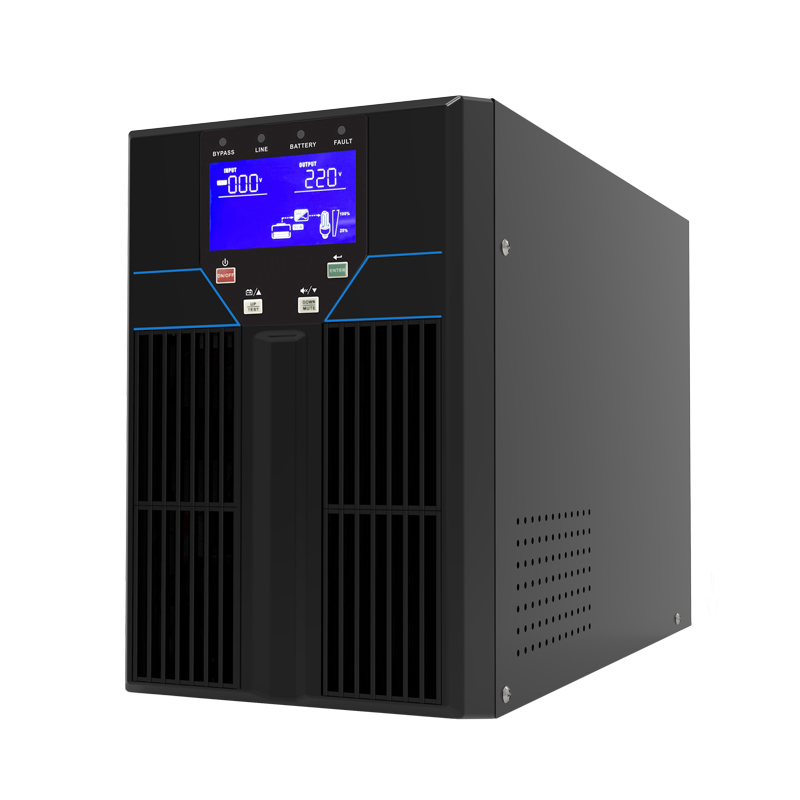
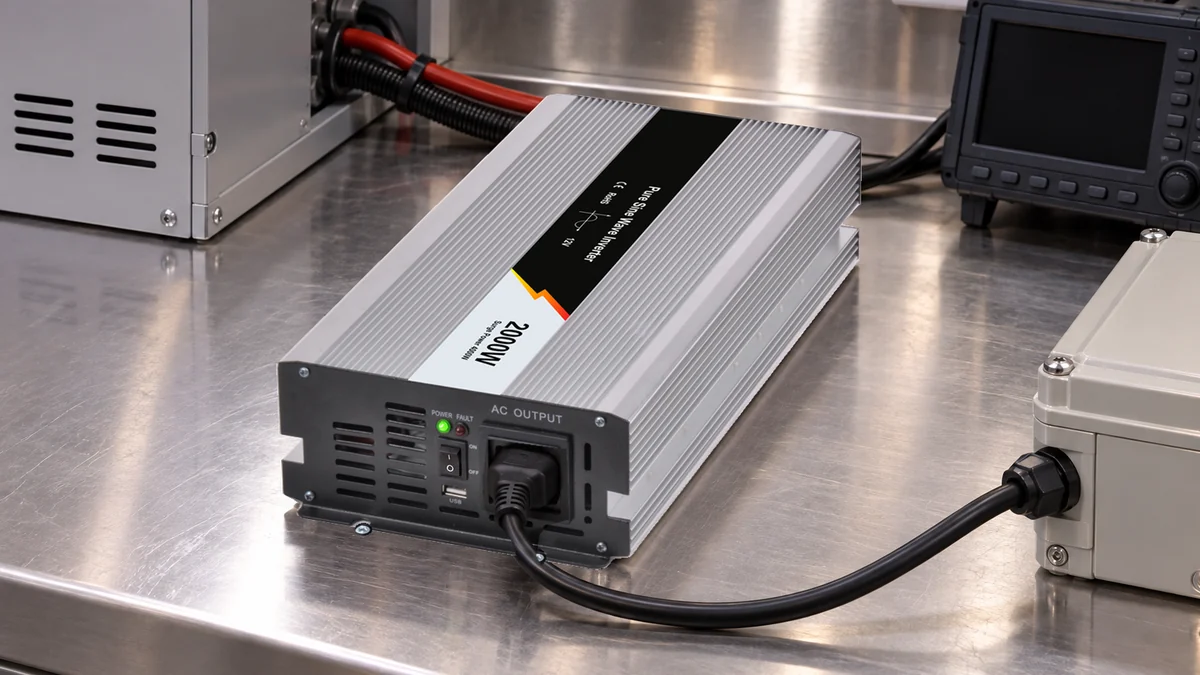
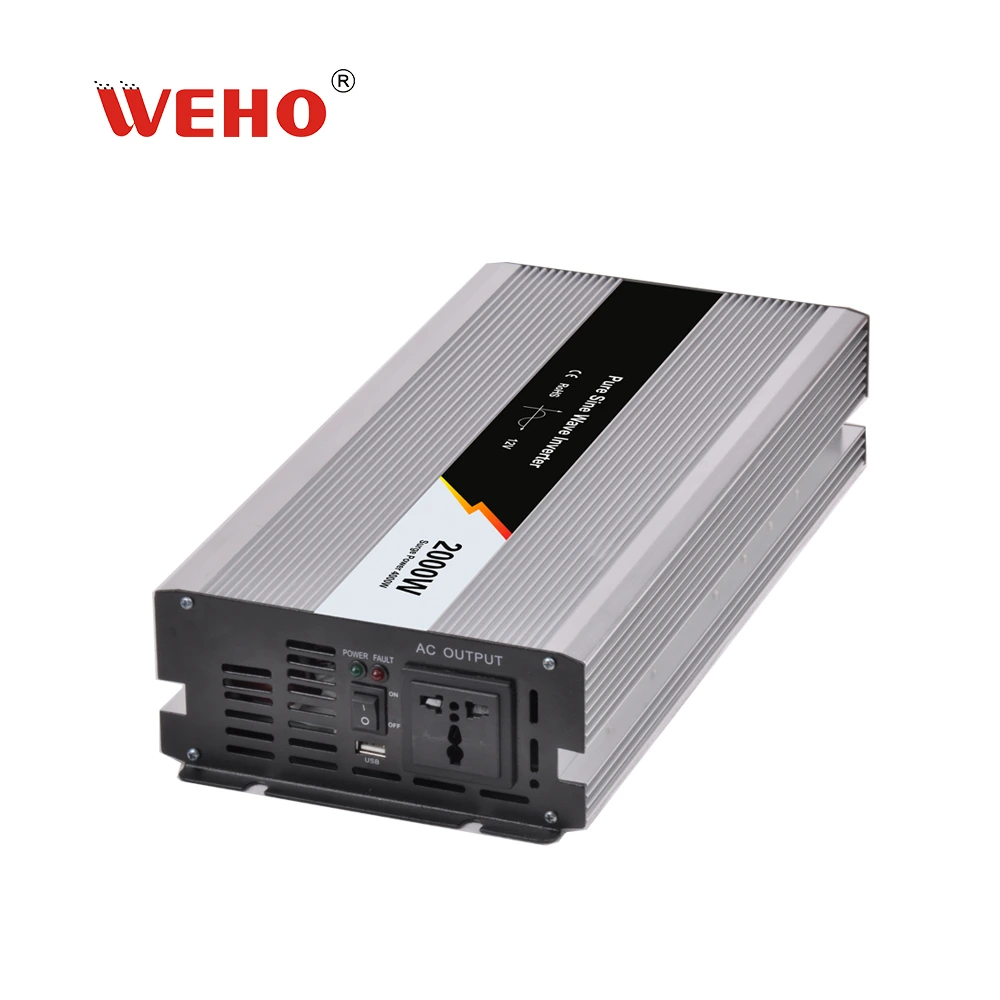
các WEHO WHP-2000 inverter family is an identity reference for the downstream equipment discussion. The family photograph does not identify a complete battery system, its chemistry or the ordered inverter's full voltage configuration. No battery-testing function is attributed to the inverter.
Separate an electrical indicator from stored charge
Conductance describes an electrical response measured by the particular test method. A reported internal resistance or impedance also depends on how the instrument excites the battery and calculates its result. Record the instrument method rather than assuming that different analyzers' values are interchangeable.
The Cadex-referenced Battery University internal-resistance explanation distinguishes resistance and impedance methods from capacity assessment. Its examples show why a small electrical-response measurement is not a universal remaining-charge indicator. Do not copy a method's numerical examples to another battery chemistry or construction.
Midtronics' battery conductance training guide explicitly separates conductance trending from discharge-capacity results. Its discussion also identifies contact condition, charging-system interference and discharge conditions as factors that can change an assessment. The document does not supply a universal conversion from a conductance percentage to available ampere-hours.
Capacity in ampere-hours is the integral of discharge current over time to a defined endpoint. For a constant-current test, Q = I × t, with current in amperes and time in hours. The rate, starting condition, temperature and endpoint belong to the result; an Ah number without them is incomplete.
An analyzer may use additional algorithms or extended tests to report a capacity-related estimate. Review exactly what that instrument measures and the supported battery population. Do not dismiss such functions as conductance-only, but do not relabel a quick electrical indicator as a directly measured capacity result either.
Read the rating before comparing percentages
The reference behind a percentage matters. A conductance result expressed as a percentage of an instrument baseline is not automatically a percentage of the battery's rated Ah. Likewise, a measured capacity percentage is meaningful only when the measured and rated quantities have a compatible basis.
GS Yuasa's battery performance-rating explanation distinguishes Ah capacity from cranking and reserve-capacity ratings under its stated conditions. Those conditions are examples for the identified battery products and ratings. They are not default endpoints, test currents or discharge permissions for every lead-acid or lithium battery.
For a battery supplied with a protective electronic system, the permitted test must also account for that system's operating limits and interruption behavior. A cutoff caused by protection is an event to record, rather than a reason to bypass protection to complete an assumed capacity test. Obtain the applicable battery instructions first.
Work a hypothetical receiving-inspection decision
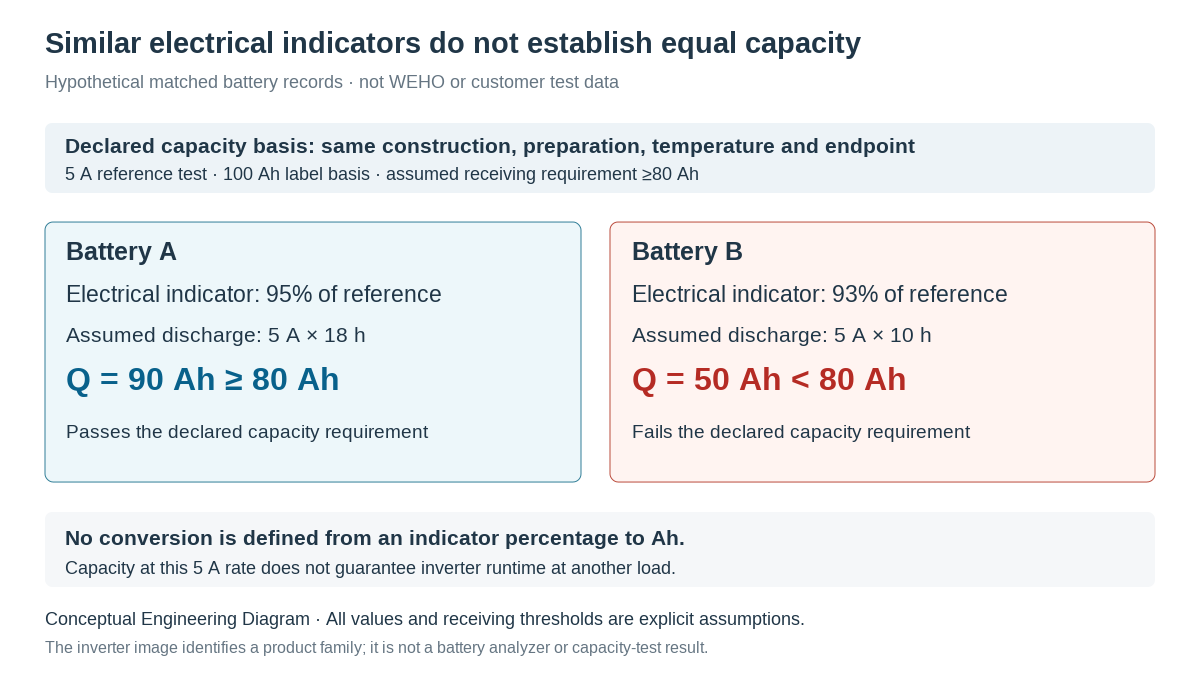
Assume two batteries of the same identified lead-acid construction are each labelled 100 Ah on an agreed 5 A, 20-hour reference basis. The fictional receiving plan requires at least 80 Ah when tested under its matched preparation, temperature and endpoint conditions. These are declared example conditions, not instructions for an actual battery.
An assumed electrical-trend review flags results below 90% of the relevant reference. Battery A reads 95%; battery B reads 93%. Both avoid that illustrative review flag, but the flag contains no mathematical rule establishing their available Ah.
Now assume separate, correctly executed capacity records show A supplying 5 A for 18 hours and B supplying 5 A for 10 hours to the agreed endpoint. Their results are QA = 5 × 18 = 90 Ah and QB = 5 × 10 = 50 Ah. A satisfies the assumed 80 Ah requirement; B does not.
| Record | Battery A | Battery B | Permitted conclusion |
|---|---|---|---|
| Electrical indicator/reference | 95% | 93% | Neither triggers the assumed below-90% review flag |
| Matched 5 A discharge duration | 18 h | 10 h | Duration applies only to the stated test basis |
| Calculated delivered charge | 90 Ah | 50 Ah | 90% and 50% of the matched 100 Ah reference |
| Assumed receiving requirement | 90 ≥ 80 Ah | 50 < 80 Ah | A passes this requirement; B fails it |
The example deliberately gives similar indicator percentages and different capacity results. It illustrates the missing inference, rather than a measured correlation or a prediction of how real batteries will behave. No conductance-to-capacity calibration is created by the table.
Swipe horizontally on a small screen, or open the full-size diagram.
Do not divide either 5 A capacity result by a much higher operating current and present the quotient as guaranteed inverter runtime. The battery's applicable discharge behavior and the complete system conditions remain relevant. A constant-power inverter load can also demand increasing DC current as terminal voltage falls.
Keep capacity verification and equipment duty distinct
A matched battery capacity result is useful supplier evidence, but equipment autonomy is a system result. Inverter load, battery-terminal voltage, connection losses, operating temperature, protective cutoffs and duty sequence can change the achieved service time. Define the required completed function and endpoint for the equipment separately.
các WEHO inverter input-voltage discussion addresses the related task of matching the ordered inverter's DC variant to a battery system. That compatibility decision does not establish battery capacity. Retain both decisions instead of letting one healthy-looking indicator close the complete equipment review.
A quick screening method still has value. Repeated measurements taken consistently can identify changes deserving investigation without repeatedly performing a full discharge. The limitation concerns the conclusion drawn from that screening, not a claim that only one test technology is useful.
Midtronics' comparison of battery-test technologies distinguishes conductance-only testing from approaches that add profiling and charge-acceptance information. Use the tester's documented scope when choosing a receiving or maintenance method. A product-specific algorithm must be evaluated on its own stated basis.
| Question | Useful evidence | Record conditions | Do not infer |
|---|---|---|---|
| Has an electrical indicator changed? | Repeatable trend | Tester, reference, contacts, charge state, temperature | Exact remaining Ah |
| Does the battery meet a capacity requirement? | Applicable capacity procedure and result | Rate, preparation, temperature, endpoint | Every operating-duty runtime |
| Will the equipment complete its duty? | Documented system acceptance record | Actual load sequence and termination criterion | All future ages and temperatures |
| Is an estimated result usable? | Validated instrument/model scope | Battery population and method limitations | A universal conversion |
Create a test record that preserves the boundaries
- Identify the battery. Record manufacturer, complete model, chemistry, configuration, rating basis and service history. Verify that the test method applies to that construction and protective system before selecting settings.
- Define the decision. Record the screening flag, capacity requirement or equipment-duty criterion separately. Accept the plan only when each result has an owner, a defined endpoint and an applicable comparison basis.
- Control indicator conditions. Record tester version, contact locations, charge state, temperature and repeated readings. Investigate inconsistent contact or charging interference under the equipment procedure instead of averaging away unexplained results.
- Obtain the required capacity evidence. Use a manufacturer-permitted procedure with the specified preparation, load and endpoint, performed by qualified personnel. Retain current and time records; do not accelerate the discharge arbitrarily or bypass protection.
- Close the system decision. Record battery disposition and, where required, the complete inverter/load duty result. Preserve unresolved operating conditions and the recharge/recovery instructions before returning the equipment to service.
Include the battery evidence in the inverter enquiry
Send the WHP-2000 configuration enquiry the exact battery configuration, documented voltage limits, load duty and required service time. Attach the applicable battery evidence and identify what remains unverified. Ask which ordered inverter variant and operating limits apply, without treating an analyzer's health indicator as a WEHO runtime guarantee.
Engineering FAQ
Can a conductance percentage be read as remaining Ah?
No, a conductance-reference percentage is not automatically a capacity percentage. The tester's method and reference control its meaning. An applicable capacity result needs its own discharge conditions and endpoint.
Does low internal resistance guarantee long inverter runtime?
No, low measured resistance does not guarantee service duration. Available charge, operating rate, voltage limits and the complete equipment duty remain separate. Keep resistance-method details with the reading.
Are all capacity-related analyzer outputs invalid?
No, some instruments use additional tests or validated models. Check what the identified instrument measures, its battery scope and its limitations. Distinguish an estimate from a directly executed discharge-capacity record.
Does a passed capacity test qualify every operating load?
No, a capacity pass applies to its recorded conditions. A different load sequence, temperature, endpoint or protective system can change the result. Verify the required equipment duty on its own basis.