Cập nhật lần cuối: October 1, 2026
Trả lời nhanh: A power supply for aquarium lighting must match the actual luminaire’s regulation requirements, verified simultaneous load and installation conditions. For a commercial-lighting example with a 230VAC feed and a verified compatible 24V LED fixture circuit drawing 120W/5A, WEHO XLG-150-24 is a documented driver candidate. Its model table lists 24V/6.3A, a 12-24V constant-current range and 151.2W output, while its family is described as 150W. Keep the example’s design screen at 150W and obtain driver-to-fixture compatibility confirmation. Put the driver and all mains junctions in protected dry services. This is lighting only, not approval for pumps, heaters, submersion, dimming or an aquatic-life lighting schedule.
Commercial display aquariums and nursery facilities need a documented lighting circuit, not a driver selected from a tank-size rule. A fixture’s LED array or integrated input electronics determines the required electrical behavior. A label reading 24V does not by itself establish that a general 24V luminaire is compatible with every LED driver.
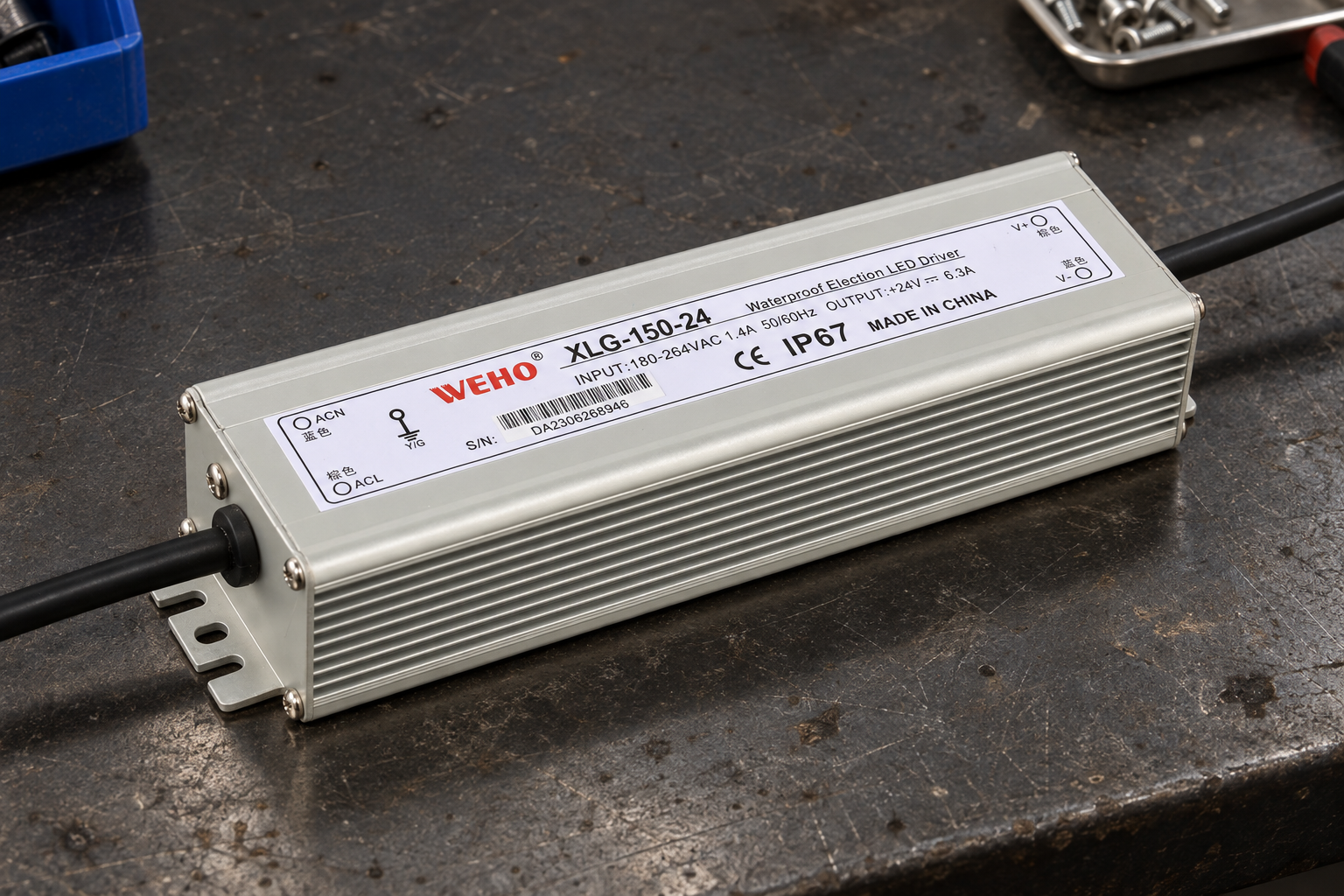
For B2B integrators and procurement teams, the phrase power supply for aquarium identifies the application setting but leaves essential requirements open. This article uses the official WEHO XLG-150 model table to establish the exact driver rating. The current enterprise-drive specification and source photograph establish the product identity and physical arrangement. Confirm the actual ordered revision and fixture part numbers before design release.
Confirm the luminaire interface, not only its nominal voltage
The official XLG-150 page describes a constant-current LED driver and lists a 12-24V constant-current range for XLG-150-24. Do not assume that this means unrestricted compatibility with all 24V constant-voltage lighting. Ask the luminaire supplier and WEHO engineering to confirm the ordered driver’s operating behavior against the fixture’s input voltage/current window, internal electronics and intended load arrangement.
Build a fixture schedule covering input type, continuous demand, startup behavior, connection polarity and any control-interface requirements. This guide assumes that the specific 24V lighting circuit has passed that compatibility review. If it has not, the calculations below remain a screening exercise and do not authorize purchasing or commissioning.
Keep unrelated aquarium equipment out of this review. Pumps, heaters, chillers, filtration drives and critical monitoring loads need their own supported design. The XLG-150-24 is not presented as a universal aquarium power source or as a certified aquatic-life lighting controller. Spectrum, photoperiod and biological requirements belong to the fixture supplier and relevant husbandry specialist.
Use a transparent 120W lighting-only example
Assume six enclosed lighting fixtures draw 20W each at the verified operating condition and operate simultaneously. These values are illustrative, not measurements from a WEHO customer site.
| Lighting-only item | Illustrative value |
|---|---|
| Simultaneously operating compatible fixtures | 6 |
| Demand per fixture | Công suất: 20W |
| Concurrent lighting power | 120W |
| Arithmetic current at 24V | 5A |
| 25% load allowance | Công suất: 30W |
| Sizing screen including allowance | 150W / 6.25A |
The arithmetic is 120W ÷ 24V = 5A. A 25% allowance reaches 150W and 6.25A at 24V. The exact model table lists 6.3A and 151.2W, but this example retains the conservative 150W family power screen instead of treating the extra 1.2W as usable project margin. The calculation does not prove LED regulation compatibility, thermal capacity, startup performance or system approval.
Replace the example with the actual fixture demand and acceptance limits. Do not add unmeasured lights because a nominal margin exists. If the verified load or startup event exceeds the supported envelope, redesign the circuit or choose another verified driver architecture. Increasing a branch fuse is not a remedy for an incompatible load or undersized cable.

Keep the driver and mains connections in protected dry services
The exact source label shows INPUT 180-264VAC, 1.4A, 50/60Hz. The 230VAC worked example lies inside that input range; it is not a universal site assumption. Verify the actual feed, ordered label and supply arrangements before energizing.
The sealed driver has fixed black-jacketed input and output cables. Its current drawing identifies brown AC/L, blue AC/N and green/yellow protective earth on the input side, and brown +V with blue -V on the output side. Qualified personnel must verify the ordered conductors and project connection assignments. No exposed terminal block, auxiliary battery lead, dimming wire or adjustment control is assumed for the pictured unit.
IP67 is a product-housing marking, not approval for the complete aquarium installation. It does not establish indefinite submersion, saltwater or cleaning-chemical compatibility, or protection of external connections. Put the driver and covered mains junctions in a suitable dry zone separated from plumbing joints, overflow and direct washdown. Specify suitable fixtures, connection hardware, enclosure construction and cable routing for the actual exposure.
Design mains isolation, protective-earth bonding and required fault protection for the destination market. The generated aquarium scene is an installation concept showing lighting services outside the glass tank; it is not a customer installation, compliance certificate or commissioning record.
Check the ordered mechanical revision and mounting method
Use 190mm overall length L × 49mm width W × 34mm height H, with a 166mm central body, as the corroborated current mechanical envelope. The official page, current specification’s dimension table and drawing, and the exact enterprise-drive dimension image support that envelope. The current PDF’s small headline callout instead states 170mm length; this conflict must be resolved against the ordered revision before a mounting drawing is released.
The flexible leads extend outside the housing envelope. Allow additional space for their bend radius, covered junctions, tool access and heat dissipation. Exterior dimensions do not establish a finished enclosure clearance. Fasten the source-matched short-end mounting ears to a suitable supporting plate; do not invent a DIN clip, rear connector or hidden mounting structure.
The dry lighting service box beside a public display aquarium and the dry utility service area beside nursery racks are deliberately different arrangements. Public displays prioritize access control and discreet maintenance. A hatchery may prioritize service separation and cleaning procedures. Neither image authorizes exposing electrical services to wet cleaning or placing the driver underwater.

Validate cable drop, startup and installed temperature
Calculate branch voltage drop using the complete outgoing-and-return path and the fixture’s permitted input window. Measure the most remote compatible luminaire at the highest verified simultaneous demand. Specify conductor size, connector rating and branch protection together. This article intentionally does not prescribe a universal wire gauge or fuse value.
The reference unit has a sealed finned aluminum housing and no fan. Verify temperature in the actual enclosure, mounting orientation and duty cycle using the ordered specification and engineering acceptance criteria. An IP marking does not guarantee heat rejection inside every box, and an illustrative power allowance is not a substitute for a thermal test.
Cycle all intended lighting branches through representative startup and supply interruptions. Record branch current, fixture voltage and operation. If an unexpected protection event or unstable light output occurs, investigate load compatibility, cable resistance, startup demand and thermal conditions before handover.
Do not assume dimming, adjustable output or a status interface because another series variant has those features. A controlled-lighting design needs the exact interface confirmed for both driver and fixture. The source-visible base model in this article is not promoted as a dimmable or remotely controlled variant.
Procurement release items for the lighting package
When specifying a power supply for aquarium lighting, put the exact driver model, fixture part numbers, compatibility approval, input label photograph, current sheet and mechanical revision in the purchase record. Confirm XLG-150-24, 24V/6.3A, the nominal 150W design screen, fixed leads, fanless sealed housing and the ordered 190 × 49 × 34mm envelope.
Request the integrator’s protected dry-service arrangement, isolation and earthing design, branch schedule, cable-drop calculation and commissioning acceptance limits. Keep the fixture exposure rating separate from the driver’s housing marking. The exact source label’s printed wording is preserved in the images for identity; it is not an additional functional or environmental claim.

The engineering graphic summarizes the 120W/5A arithmetic screen, nominal 150W design limit, dry-service boundary and corroborated dimensions. It is not a wiring schematic, mounting-hole release or safety certification. Actual protection, cable sizes, fixtures, connectors and enclosure details must be established by the project.
Bài học chính
- Verify the luminaire’s electrical interface; 24V alone does not prove compatibility with a constant-current LED driver.
- The illustrative six-light load is 120W/5A; a 25% allowance reaches a conservative 150W/6.25A screen.
- The exact table states 24V/6.3A and a 12-24V constant-current range; confirm the ordered operating behavior.
- Corroborated dimensions are 190 L × 49 W × 34 H mm, with a 166mm body; resolve the PDF headline-length conflict before release.
- The driver and all mains junctions belong in protected dry services, with separate fixture and connector exposure checks.
- Do not assume pump, heater, submerged or dimming suitability from the lighting example.
Phần kết luận
XLG-150-24 is an evidence-supported candidate for the defined, compatibility-confirmed commercial 24V lighting circuit. Its suitability depends on the actual LED interface, ordered label, verified site feed, dry-service arrangement, thermal behavior, cable drop and startup test. Documenting those boundaries makes procurement and replacement more dependable than selecting an aquarium supply from wattage alone.
Câu hỏi thường gặp
Does a 24V luminaire automatically work with XLG-150-24?
No. The official page identifies a constant-current LED driver and lists a 12-24V constant-current range. Confirm the actual ordered driver behavior against the fixture’s verified input window and electronics before purchasing.
Is the 120W example an actual WEHO installation?
No. It is an explicitly illustrative six-fixture lighting-only load screen. Replace its values with verified fixture demand and project commissioning results.
Why use a 150W design screen when the exact table lists 151.2W?
The series is described as 150W and the exact model table lists 24V, 6.3A and 151.2W. This example deliberately keeps 150W as the conservative power screen, not extra project margin.
Can the driver be submerged or power pumps and heaters?
This article approves none of those uses. Keep the driver and mains junctions in protected dry services. Pumps, heaters, submerged equipment and complete wet-area compliance require their own supported design.
Which housing length should procurement confirm?
The official page, current sheet’s table and drawing, and exact dimension image support 190mm overall length with a 166mm body. The PDF headline instead states 170mm, so confirm the ordered revision before releasing mounting drawings.
Can the pictured base model be dimmed or DIN-clipped?
Neither is assumed. The exact source shows fixed opposing cables and screw mounting ears, without a dimming lead, visible control or DIN clip. Confirm any required interface and mounting feature for the ordered revision.