Xác định điện áp hợp lệ tối thiểu của tải, đo thời gian vượt ngưỡng dưới sự gián đoạn đã được phê duyệt và quyết định xem nguồn cung cấp AC-DC hiện tại có bắc cầu sự kiện hay không khoảng cách liên tục vẫn còn.
Trả lời trực tiếp: xác định điện áp hợp lệ tối thiểu đầu cuối tải, gián đoạn đầu vào được phê duyệt, tải thực tế, môi trường, và mẫu cung cấp điện chính xác trước khi hỏi liệu DC UPS có cần thiết hay không. Sau đó, một phòng thí nghiệm đủ điều kiện có thể tạo ra sự gián đoạn được phê duyệt với thiết bị được điều khiển và đo thời gian từ sự kiện mất đầu vào đến lần vượt đầu tiên dưới ngưỡng điện áp đó. So sánh thời gian đo hợp lệ ngắn nhất với chuyến đi cần thiết-qua thời gian cộng với trợ cấp đo lường đã thỏa thuận.
Không kết quả nào chứng minh hiệu suất phổ quát.“Cầu PSU” chỉ áp dụng cho mô hình và sửa đổi được đặt tên, dân số mẫu, điều kiện đầu vào, trạng thái tải đo được, điều kiện môi trường xung quanh, ngưỡng, hồ sơ gián đoạn, thiết bị đo đạc và quy tắc chấp nhận.“Đánh giá UPS” bắt đầu một nhiệm vụ kỹ thuật khác; nó không được phép đoán dung lượng pin hoặc thời gian chạy dự phòng.

Bắt đầu với một hợp đồng gián đoạn, không phải là một số danh mục
Một số thời gian lưu giữ chỉ có ý nghĩa khi ngưỡng và điều kiện hoạt động của nó đi cùng với nó. Đối với giao thức này, hold-up thời gian là khoảng thời gian từ sự kiện ngắt đầu vào được xác định của phòng thí nghiệm đến lần đầu tiên điện áp tại các cực tải được chỉ định giảm xuống dưới điện áp hợp lệ tối thiểu được phê duyệt của tải, Công ty TNHH Vmin.
Định nghĩa đó là một ranh giới quyết định ứng dụng. Tải không phải là tên tiếp thị cung cấp điện đặt Vmin. Nó có thể đến từ một đặc điểm kỹ thuật thiết bị đã được phê duyệt, một đặc tính khóa điện áp thấp hoặc giới hạn chấp nhận hệ thống. Nếu không có nguồn được kiểm soát nào thiết lập Vmin, thử nghiệm giữ lại không thể đưa ra quyết định vượt qua/thất bại có thể phòng thủ.
Đóng băng các trường sau trước khi ủy quyền kiểm tra:
| Lĩnh vực hợp đồng | Hồ sơ được phê duyệt phải chứa những gì |
|---|---|
| Ranh giới tải trọng | Thiết bị đầu cuối chính xác nơi có hiệu lực điện áp quan trọng; bao gồm cáp sản xuất, đầu nối, bảo vệ và các yếu tố phân phối khi chúng nằm trong ranh giới quyết định |
| Công ty TNHH Vmin | Điện áp đầu cuối tải tối thiểu được phê duyệt, nguồn, sửa đổi và bất kỳ trình độ thời gian nào |
| Sự gián đoạn bắt buộc | Thời gian và hình dạng hoặc hồ sơ nguồn được phê duyệt; đầu vào danh nghĩa một mình là không đủ |
| Input condition | Voltage, frequency where applicable, tolerance and the defined event used as time zero |
| Load state | Measured steady and dynamic current or power during the interruption; identify startup, transmit, actuator or processor states |
| Môi trường | Ambient temperature, airflow, mounting and warm-up condition relevant to the test |
| Specimen | Exact model, output variant, hardware or document revision, serial/sample ID and adjustment setting |
| Measurement rule | Instrument IDs, bandwidth/sample settings selected by the lab, time-reference definition, repeat count, uncertainty or allowance and invalid-run criteria |
Do not replace measured load with the nameplate maximum unless the project has formally chosen that as the acceptance condition. Do not replace a defined interruption with “brief outage.” The purpose of the contract is to make two laboratories interpret the question the same way.
External technical documentation on hold-up behavior provides a useful public example of why conditions matter: it defines hold-up behavior and presents different hold-up values at different load levels. That external example does not establish a WEHO model’s performance, but it supports the discipline of attaching load and input conditions to every hold-up claim.
Giữ ba câu hỏi thời gian riêng biệt
The same AC-removal event can start several clocks, but the buyer tasks are different.
Lời bài hát: Ride-Through
How long the powered load remains at or above Vmin during a temporary approved input interruption. It ends at the first Vmin crossing and supports this article’s two outcomes.
Xả đầu ra xả
How long residual output energy takes to decay after intentional shutdown. It governs shutdown waiting and access controls. This article provides no safe-discharge interval.
Sao lưu UPS sao lưu
How a continuity system transfers, supports load and charging, manages a battery, signals events, recovers and meets a service-runtime objective.
A load staying valid for 20 ms says nothing about when a primary circuit or internal capacitor becomes safe to touch. Likewise, a hold-up test does not calculate battery ampere-hours and does not validate a UPS. This separation prevents an attractive but unsafe shortcut: turning a published “hold-up” cell into a promise of seamless transfer or minutes of battery service.
Chạy một giao thức bằng chứng sáu giai đoạn
Đóng băng mẫu vật và cấu hình
Photograph or otherwise identify the label and record the exact output variant, adjustment, revision and sample ID. Record all elements between the supply output and the load measurement boundary. A bench result taken directly at supply terminals may not represent the voltage at a remote controller after cable and connector drop.
Do not mix samples, revisions or output variants in one summary value. If procurement needs a production claim, engineering must define the number of samples and lot coverage rather than treating one unit as universal evidence.
Phê duyệt ma trận gián đoạn
List the interruption cases the application actually requires. Each row should name the starting input, interruption duration/profile, load state, ambient condition and recovery expectation. Include credible worst cases chosen by the system owner; do not create extra hazardous scenarios simply because the equipment can.
The matrix also defines invalid runs. Examples include an input event outside its tolerance, a load state not reached, an instrument over-range, a trigger failure, or operation of a stop limit. Invalid data stay in the record but do not support the decision.
Thiết lập một đường cơ sở ổn định
Before an interruption is authorized, the lab confirms that the specimen and load are operating in the recorded state and that the load-terminal voltage is above Vmin with the intended margin. Baseline input, output voltage, load current or power, ambient and relevant temperatures belong in the record.
If the baseline itself is unstable or below the acceptance window, stop. Hold-up analysis cannot repair an unsuitable steady-state design.
Nắm bắt bằng chứng sự kiện đồng bộ
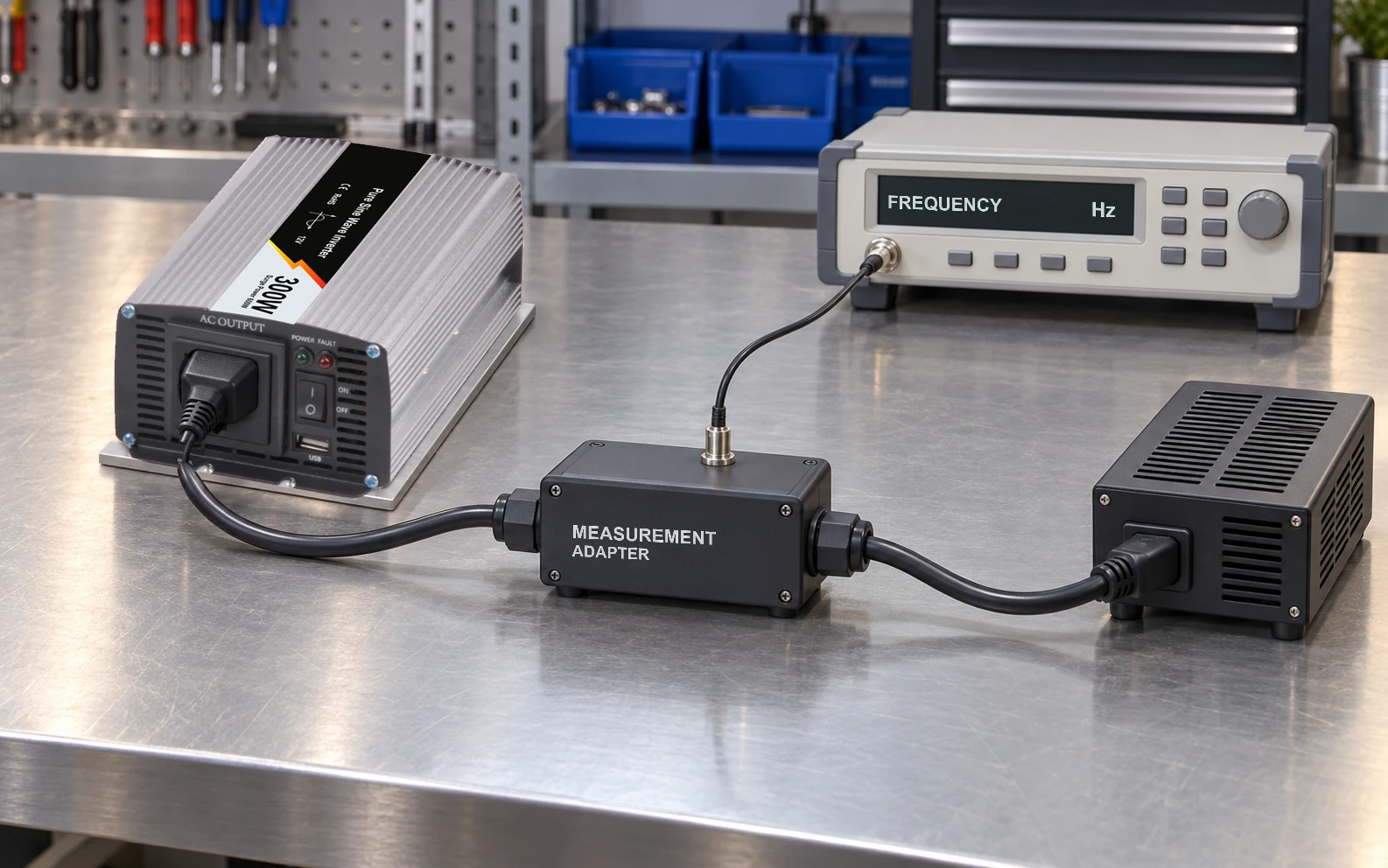
For each approved case, the laboratory records a time reference representing the defined input-interruption event and the voltage at the load boundary. It also records enough load information to prove that the intended load state was present. The qualified lab chooses the measurement architecture, ratings and acquisition settings.
The raw trace remains evidence. Cropped screenshots without scale, channel identity, threshold, record length or instrument setup are not a complete acceptance record. Preserve the unaltered acquisition and a human-readable export tied to the specimen and test-row ID.

Giảm mỗi bản ghi hợp lệ một cách nhất quán
Mark time zero at the approved input-interruption event. Mark the first load-terminal crossing below Vmin. Their difference is the measured hold-up interval for that record, t_measured. “First crossing” prevents a later rebound from hiding an earlier loss of validity.
If the voltage never crosses Vmin inside the captured window, report it as greater than the valid observation window; do not invent an exact time. If noise near Vmin makes crossing ambiguous, apply the approved threshold/hysteresis and uncertainty method or repeat with a corrected acquisition. Never smooth a trace after the fact merely to obtain a pass.
Lặp lại, phục hồi và ký
Repeat each case as required by the approved plan and retain the shortest valid t_measured. Confirm the separately approved recovery behavior after input returns: output restoration, load restart state, alarms and any unacceptable cycling. Recovery observations do not change the hold-up interval, but they can independently block acceptance.
A result is usable only when a named technical owner signs the conditions, reductions, exceptions and decision. Procurement should receive the signed record, not a number copied into an email without context.
Áp dụng một quy tắc quyết định bảo thủ
Let t_required be the longest approved interruption the existing AC-DC supply is expected to bridge; m_measurement be the positive allowance approved for measurement uncertainty, repeatability and decision guard band; and t_measured,min be the shortest valid threshold-crossing interval among the covered records.
The protocol issues Cầu PSU (PSU bridges) only when:
Every other acceptance condition—including the baseline, load state, input event and recovery checks—must also pass. Otherwise, issue gap remains—evaluate UPS hoặc HOLD—evidence incomplete, whichever describes the record.
Ví dụ threshold rõ ràng
Assume an approved 24 V load specification sets Vmin = 21.6 V. Assume the required interruption is 20 ms and the laboratory’s approved measurement allowance is 3 ms. The decision threshold is therefore 23 ms.
Now assume—not measure, predict or attribute to any WEHO product—that a completed laboratory record reports t_measured,min = 26 ms across the covered cases. The arithmetic margin over the 20 ms requirement is 6 ms, and 26 ms exceeds the 23 ms decision threshold. The record may state PSU bridges under the recorded conditions. It may not state “26 ms hold-up for all units,” “UPS not needed in every installation,” or “the product passed” without the complete scope.
This example contains no simulated waveform and no product-performance claim. Changing Vmin, load, input, temperature, sample or interruption definition invalidates the comparison until those conditions are tested.
Đọc các hàng sản phẩm được xuất bản dưới dạng khách hàng tiềm năng, không phải bản án
Three WEHO pages illustrate why a catalog value must be reopened as a controlled test question.
| Published page | What the published page lists | What remains unknown for this decision |
|---|---|---|
| RSP-200 AC to DC Power Supply with PFC | A 200 W summary; 12 V, 24 V, 36 V and 48 V variants; 90–264 VAC / 135–370 VDC input; and a row labeled “setup, rise, hold up time” listing 800 ms, 50 ms, 16 ms / 230 VAC (when fully loaded) | The page does not state the load-terminal Vmin used for 16 ms, tolerance, sample coverage or a customer interruption profile. It does not prove any user’s load will remain valid. |
| RSP-500 AC to DC Power Supply with PFC | A 500 W summary; 12 V, 24 V, 36 V and 48 V variants; 90–264 VAC / 135–370 VDC input; and the same labeled timing row listing 800 ms, 50 ms, 16 ms / 230 VAC (when fully loaded) | Confirm the exact variant and current documentation. The public row does not provide the application Vmin, measurement tolerance, sample coverage or a customer-specific pass result. The family headline must not replace variant-level electrical review. |
| PSC-150 12 V / 24 V AC-DC UPS power supply | PSC-150-12 and PSC-150-24; rated-current rows of 7.5 A + 3 A (charge) Và 4 A + 1.5 A (charge) respectively; and a row labeled “start-up, rise, and hold time” listing 600 ms, 50 ms, 80 ms / 230 VAC Và 1200 ms, 50 ms, 16 ms / 115 VAC | The row does not state load, Vmin, ambient, tolerance or the exact measurement definition. Those times are not asserted here as battery-transfer time, seamless-transfer proof, battery runtime or customer-system performance. Battery compatibility and operating behavior require current model-specific evidence. |
These are statements about what each published page lists, not independent verification. The RSP timing rows provide a candidate condition—230 VAC and fully loaded—but still lack the load’s Vmin and the project’s event definition. The PSC page includes a hold-time row and battery-related functions, yet its published timing tuple cannot be relabeled as UPS transfer or backup duration.
Use the product rows to choose questions for a controlled datasheet review and laboratory plan. Never average their values, apply one model’s condition to another, or claim that a larger wattage guarantees longer hold-up.
Nếu vẫn còn khoảng trống, hãy mở một quyết định mới của UPS
When t_measured,min does not clear the threshold, first verify that the record is valid and that the requirement is real. If both stand, the existing supply has an evidenced ride-through gap for that scoped case. The next action is evaluate a DC UPS or another approved continuity architecture.
That new work needs its own requirements: required service duration, source-transfer behavior, load peaks, simultaneous equipment and charge currents, battery voltage and chemistry, temperature, aging reserve, cutoff, alarm, recovery and safe shutdown. No battery Ah or runtime calculation belongs in this hold-up record.
A UPS candidate must also be tested at the load boundary. A product label or nominal transfer claim cannot erase cable drop, control resets, source interaction or recovery behavior. For background terminology, the WEHO switching-power-supply datasheet glossary explains hold-up at a general level; this protocol supplies the narrower go/no-go decision record.
Phát hành hồ sơ quyết định mà bên mua có thể kiểm toán
The final one-page summary should point to, rather than replace, the raw evidence.
This format protects both engineering and sourcing. It makes a qualified “bridges” result usable without turning it into an unlimited catalog promise, and it makes a gap actionable without prematurely buying and sizing a battery system.