آخر تحديث: 2026-10-05
إجابة سريعة: Enclosed power supply troubleshooting should begin with a safe, traceable fault report—not repeated power cycling or an assumed replacement. Record the exact model, installation history, operating sequence and available input/output evidence. After qualified personnel isolate the equipment and verify it is safe to handle under the site’s procedure, separate supply-related questions from load, distribution and control-system questions. Escalate uncertain or damaged units with their original evidence intact.
Establish the boundary before enclosed power supply troubleshooting
For an OEM service team, “the machine stopped” and “the power supply failed” are different statements. A stopped controller, blank display or intermittent actuator is an observed symptom. Assigning the cause to one component requires evidence. A disciplined intake process helps maintenance, purchasing and the supplier discuss the same event instead of replacing parts against an incomplete description.
This guide concerns external inspection, documentation and engineering review. It is not an instruction to open the supply, probe energized terminals, bypass protection or repair internal parts. Qualified personnel must follow the equipment manufacturer’s and site’s isolation procedures, including relevant stored-energy precautions and verification before handling. Disconnecting one cable or seeing an unlit indicator does not establish that equipment is safe.
If there is visible damage, contamination, a burning smell or uncertain isolation, keep the item out of service and refer it to the responsible qualified team. Do not restart it simply to reproduce a symptom for a photograph.
Build a fault record that another team can use
A useful enclosed power supply troubleshooting record connects the complaint to one identifiable unit. Photograph its full model label and external condition before cleaning, changing connections or moving identification tags. Preserve the machine identifier, supply serial or batch information where available, installation date, return date and person reporting the event. Distinguish information photographed on the unit from information copied out of an older purchasing record.
Then describe the event in operational terms. Did the equipment fail at initial commissioning, after a component change, during a particular machine sequence or after an extended shutdown? Was the complaint continuous, intermittent or reported only once? Note what changed shortly before the event, including software revisions, added loads, maintenance work, relocation or a replacement cable assembly. These are investigation leads, not proven causes.
Record what is unknown. “No input record available” is more useful than an estimated supply voltage presented as a measurement. Keep original logs and test reports, with their dates and methods, alongside the return request. If an engineering team later obtains new evidence under an approved procedure, retain both versions rather than overwriting the initial report.
Use an exact model reference, not a generic enclosure
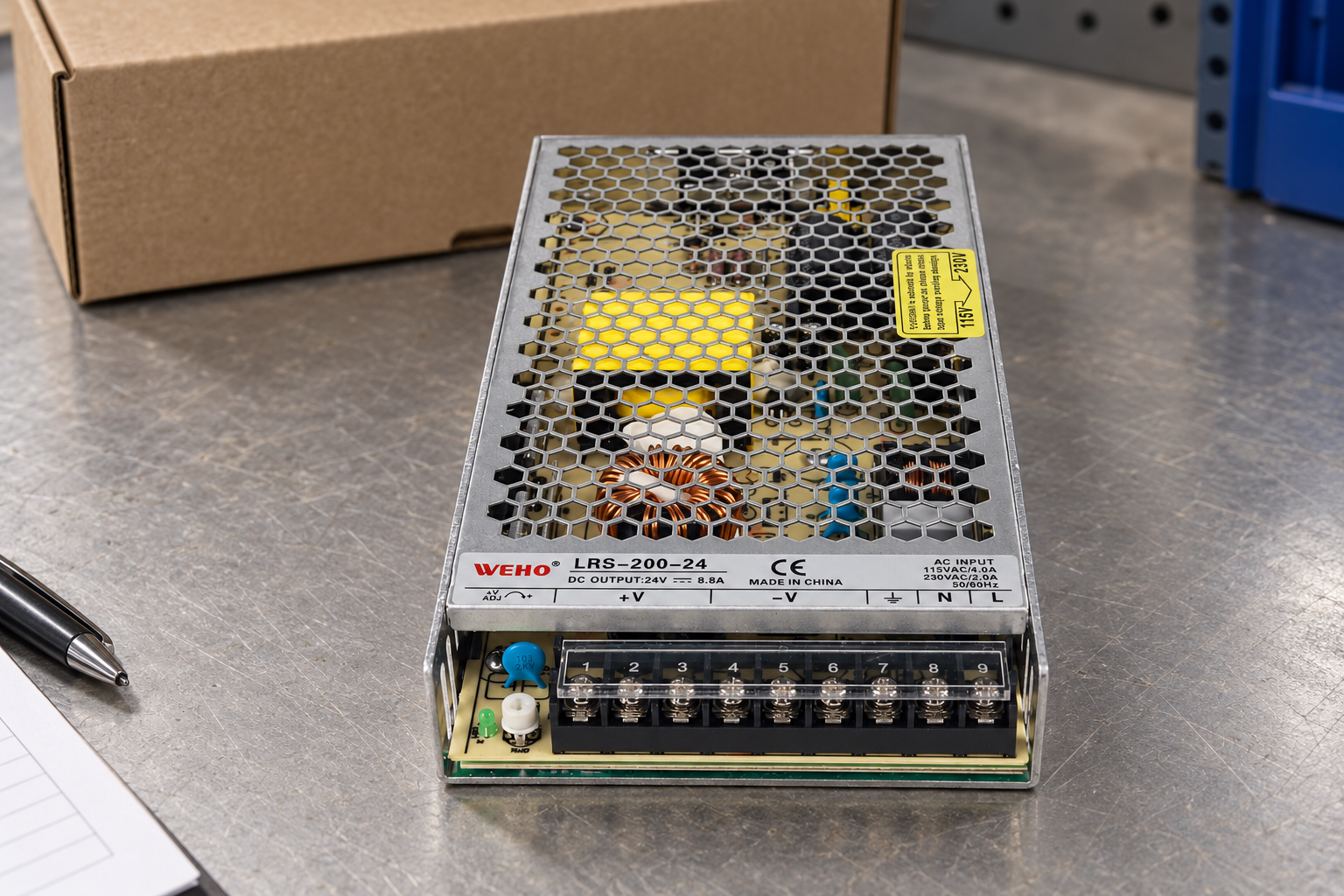
ال WHO LRS-200 صفحة المنتج identifies LRS-200-24 as a 24 V model with a listed output-current range of 0–8.8 A. The series is nominally 200 W, uses switched 90–132/180–264 VAC input ranges and measures 215 × 115 × 30 mm. Its natural-air-convection design has no fan. The approved source photo shows nine screw-terminal positions. These details identify the example; they do not confirm suitability for an unmeasured load. Keep the nominal 200 W designation—do not infer a higher continuous power rating by multiplying two label values.
Before ordering a replacement, compare the actual returned unit with the current, exact-model documentation. Other products in the WEHO enclosed switching power supply category may differ in input selection, cooling, terminal arrangement and installation requirements. Similar-looking housings and matching output voltage are not sufficient interchangeability evidence.
Sort the symptom into an evidence question
The following questions organize the investigation. They do not prescribe live measurements or identify a fault from appearance alone.
| Reported symptom | Evidence to request | What the review must distinguish |
|---|---|---|
| Equipment will not start | Existing commissioning record, exact model, input configuration and machine sequence | An unavailable supply output versus a downstream control or distribution problem |
| Equipment restarts during a sequence | Event timing, load changes and available synchronized records | A supply event versus wiring, load or controller behavior |
| Behavior changes after time in service | Operating duration, cabinet condition and maintenance history | Environmental or installation change versus a component-specific fault |
| Reported unstable output or interference | Original test report with method, instrument and conditions | A verified electrical observation versus an ambiguous symptom description |
No start or no apparent output
Start with documentation consistency. Does the unit installed match the approved bill of materials? Does the installation record identify the input range and, where applicable, selector configuration? Was the replacement procedure completed and signed off? An unknown setting or conflicting record requires qualified review before the equipment returns to operation.
For a safely isolated assembly, authorized personnel can document externally visible damage, displaced conductors and damaged connectors without changing the evidence. Connection work belongs to the approved maintenance procedure; this article supplies no terminal torque, cable size or wiring order. Do not assume that an internal fuse is accessible or user-replaceable. A status light also must not be treated as a documented fault code unless exact-model instructions establish that meaning.
Intermittent resets or a sequence-related shutdown
Ask which event happens first. A controller alarm, a commanded load change and a reported output interruption may be connected, but an unsynchronized recollection cannot establish their order. Request available machine logs and the timing of the complaint. Note any recently added device or changed operating sequence without assuming its current demand.
The engineering review should compare the documented supply capability with the actual load requirements, including relevant operating and start-up conditions. If those requirements are unavailable, procurement should not promise that a larger replacement will solve the problem. Repeated restart attempts can obscure the original state; preserve the report and agree on a controlled investigation with the responsible team.
Temperature-related complaints
Describe the observed condition precisely: location, duration, surrounding equipment state and any recorded temperature data. “Too hot” without a measurement method and applicable limit is not a pass/fail assessment. Photos of the isolated installation can help document obstructed openings, accumulated contamination or changes around the supply, but they cannot establish internal temperature or remaining service life.
Review environmental and installation evidence against the exact specification. Do not recommend a replacement fan for a fanless unit, add an unapproved fan arrangement or infer clearance requirements from exterior dimensions. If the system installation differs from its approved design, resolve that discrepancy with the OEM before attributing the complaint to the supply alone.
Voltage fluctuation, ripple or interference complaints
Keep the original measurement report, if one exists, and record where the observation was made. A result taken at the load is not automatically the same as a result at the supply. Instrument setup, bandwidth, connections, operating conditions and the applicable specification need qualified engineering review before comparisons are meaningful.
An unexplained display error or communication failure is not itself a ripple measurement. Do not add capacitors, filters or other parts as an undocumented workaround. Proposed changes require the relevant engineering approval and verification; otherwise the returned assembly no longer represents the original complaint.
Keep intake scenes separate from operating claims
The application illustrations show a disconnected unit during robot-palletizer OEM returns intake and an indoor parking-payment service-center receiving process. They represent documentation and handling contexts, not energized installations, measured performance or verified compatibility with the surrounding equipment. Their purpose is to show where traceable enclosed power supply troubleshooting begins.

A service photograph should make the unit identifiable while preserving the setting’s meaning. Do not stage a live test, add invented meter results or photograph a substitute model as evidence for the returned item. Separate illustrative images from actual customer records in the case file.

Decide on escalation, replacement or further review
Give the supplier one organized packet: exact model and identification photos, symptom timeline, relevant machine information, recent changes, installation records and original test evidence. State whether the unit remains isolated, whether any modification occurred after the complaint and which questions are still unresolved. Remove confidential customer details that are unnecessary for technical review while retaining traceable case identifiers.
For replacement procurement, request confirmation of the full model, input arrangement, output requirements, installation fit and applicable documentation. Do not approve substitution solely because the mounting footprint looks close. Keep the failed or suspect item segregated according to the site’s process so it cannot be mixed with approved stock.
When contacting WEHO technical support, include the exact model and existing test evidence, and ask which additional information is needed for the case. Distinguish a quotation request from a fault determination. Receiving a replacement or return authorization does not prove the original cause; the case should record the actual conclusion and any approved corrective action separately.

الوجبات السريعة الرئيسية
- Describe the symptom before assigning a component-level cause.
- Make isolation and handling the responsibility of qualified personnel under the approved site procedure.
- Identify the exact model and preserve original photos, logs and test methods.
- Do not infer fault codes, repair instructions or installation limits from a generic supply.
- Require evidence-based replacement review, then document the disposition of the suspect unit.
خاتمة
Enclosed power supply troubleshooting is most useful when it produces an actionable record rather than an unsupported diagnosis. A consistent intake process lets the OEM, maintenance team, buyer and supplier separate confirmed facts from open questions. Preserve the original evidence, use exact-model documentation and obtain the appropriate technical decision before returning equipment to service.
الأسئلة المتداولة
What is the first step in enclosed power supply troubleshooting?
Record the exact model and reported symptom, then ensure qualified personnel isolate the equipment and verify it is safe to handle under the site’s approved procedure. Preserve original photos, machine logs and existing test reports before changing the assembly. Do not start with repeated power cycling or an assumed component-level diagnosis.
Does an unlit indicator prove that the supply has failed?
No. An indicator’s meaning must come from exact-model documentation, and its appearance does not establish safe isolation or identify the cause of a stopped machine. Document the observation and have the responsible qualified team review the relevant input, load, distribution and control-system evidence.
Can the LRS-200-24 replace any supply with a 24 V output?
No. Matching output voltage alone is insufficient. Confirm the exact input arrangement, load requirements, nominal power, installation fit and current documentation. WEHO lists the LRS-200-24 within its nominal 200 W LRS-200 series; do not infer a higher continuous power rating from label arithmetic or assume compatibility with unmeasured loads.
Should maintenance replace an internal fuse or add a filter during initial intake?
Not on the basis of a generic troubleshooting article. This guide does not authorize internal repairs or undocumented modifications. Keep damaged or uncertain units out of service, preserve their original condition and refer the case to the appropriate qualified team and manufacturer support.
What should an OEM send to WEHO for technical review?
Provide the exact model, readable identification and condition photos, a symptom timeline, relevant machine and installation records, recent changes and existing test evidence with its method and conditions. Clearly state what is unknown and ask which additional information is required before a replacement or fault conclusion is agreed.