















| Μοντέλο | T-60A | T-60B | T-60C | T-60D | ||||||||
| CH1 | CH2 | CH3 | CH1 | CH2 | CH3 | CH1 | CH2 | CH3 | CH1 | CH2 | CH3 | |
| Τάση εξόδου DC | 5V | 12V | -5V | 5V | 12V | -12V | 5V | 15V | -15V | 5V | 12V | 24 (unit not printed; verification required) |
| Output voltage tolerance (not separately stated) | Not specified | Not specified | Not specified | Not specified | Not specified | Not specified | Not specified | Not specified | Not specified | Not specified | Not specified | Not specified |
| Rated output current (not separately stated) | Not specified | Not specified | Not specified | Not specified | Not specified | Not specified | Not specified | Not specified | Not specified | Not specified | Not specified | Not specified |
| Output current range (as printed) | 0 ~ 5A | 0 ~ 2.5A | 0 ~ 0.5A | 0 ~ 5A | 0 ~ 2.5A | 0 ~ 0.5A | 0 ~ 5A | 0 ~ 2A | 0 ~ 0.5A | 0.5 ~ 5A | 0.2 ~ 2.5A | 0.2 ~ 0.5A |
| Κύμα και θόρυβος | 50mVp-p | 100mVp-p | 100mVp-p | 100mVp-p | 120mVp-p | 120mVp-p | 100mVp-p | 120mVp-p | 120mVp-p | 80mVp-p | 100mVp-p | 100mVp-p |
| Σταθερότητα καλωδίου εισόδου | ±0,5% | ±1% | ±0,5% | ±0,5% | ±1% | ±0,5% | ±0,5% | ±1% | ±0,5% | ±0,5% | ±1% | ±1% |
| Σταθερότητα φορτίου | ±1% | ±4% | ±1% | ±1% | ±4% | ±4% | ±4% | ±4% | ±1% | ±1% | ±4% | ±1% |
| Series summary power (not per rail) | 60W (series summary; group rating not separately stated) | 60W (series summary; group rating not separately stated) | 60W (series summary; group rating not separately stated) | 60W (series summary; group rating not separately stated) | ||||||||
| Αποδοτικότητα | 72% | 72% | 72% | 72% | ||||||||
| Ρυθμιζόμενο εύρος για τάση DC | CH1: ±10%; CH2: ±5%; CH3: ±5% (independent controls not stated) | CH1: ±10%; CH2: ±5%; CH3: ±5% (independent controls not stated) | CH1: ±10%; CH2: ±5%; CH3: ±5% (independent controls not stated) | CH1: ±10%; CH2: ±5%; CH3: ±5% (independent controls not stated) | ||||||||
| Input voltage / frequency | 85 ~ 264VAC; 120 ~ 370VDC; 47 ~ 63Hz | |||||||||||
| Ρεύμα εισόδου AC | Cold start current 30A/115VAC; 60A/230VAC | |||||||||||
| Ρεύμα διαρροής | Not specified in the bound datasheet. | |||||||||||
| Προστασία υπερφόρτωσης | 105% ~ 150% cut off the output, automatic recovery; reference base, channel coverage and waveform not stated. | |||||||||||
| Προστασία από υπέρταση | CH1: 115 ~ 135%; shut down O/P voltage, re-power on to recover. CH2/CH3 protection not specified. | |||||||||||
| Temperature Coefficient | Not specified in the bound datasheet. | |||||||||||
| Setup, Rise, Hold Up Time | 300ms, 50ms, 80ms/230VAC at full load | |||||||||||
| Δόνηση | Not specified in the bound datasheet. | |||||||||||
| Αντοχή τάσης | I/P-O/P: 1.5kV; I/P-FG: 1.5kV; O/P-FG: 0.5kV; 1 minute. Test waveform not specified; no output-to-output rating stated. | |||||||||||
| Αντίσταση απομόνωσης | I/P-O/P, I/P-FG, O/P-FG: 500VDC/100MΩ. Output-to-output isolation and commoning permissions not specified. | |||||||||||
| Working temperature / humidity | -10℃ ~ +50℃; humidity, derating curve and full-temperature full-load conditions not specified. | |||||||||||
| Συνολική διάσταση | 159 × 98 × 38mm | |||||||||||
| Βάρος | 0.55kg | |||||||||||
| Πρότυπα Ασφαλείας | Certification not specified in the bound datasheet; verification required. | |||||||||||
| EMC Standards | Approval not specified in the bound datasheet; verification required. | |||||||||||
| Συσκευασία | 34 × 32 × 24CM/30PCS/16.5kg | |||||||||||


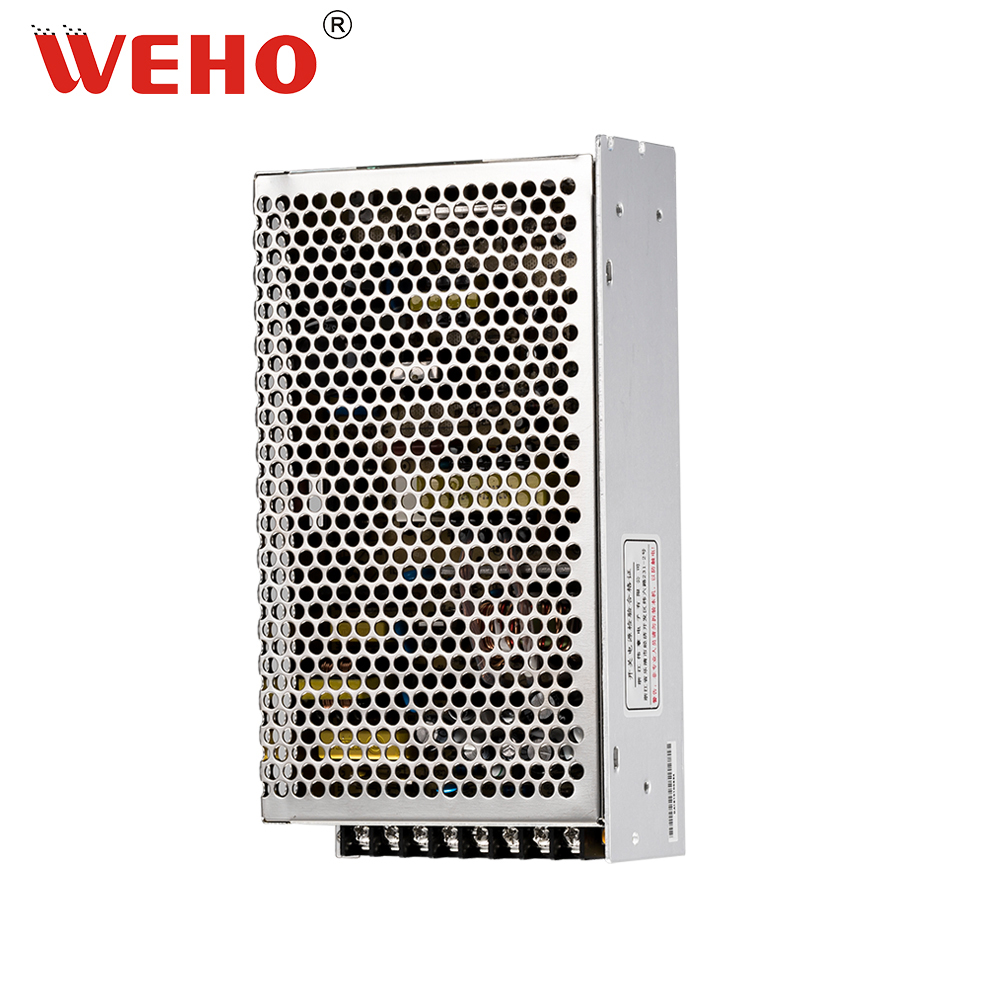
WEHO T-60W triple output power supply — T-60A / T-60B / T-60C / T-60D
T-60 is an AC/DC triple-output supply for compatible OEM bridge measurement, pressure-signal acquisition and bipolar analog receiver electronics. The document describes a 60W series; each ordered version is a three-channel combination, not three separately approved continuous power ratings. The input row lists 85 ~ 264VAC, 120 ~ 370VDC and 47 ~ 63Hz. Choose the exact voltage combination and qualify the complete joint load, terminal mapping and host enclosure before integration. Send the required combination and measured load profile for model review.
Εάν έχετε οποιεσδήποτε ερωτήσεις, μη διστάσετε να επικοινωνήσετε μαζί μας στο E-mail: [email protected]
Στείλτε μας email [email protected]
- Περιγραφή

Why Choose T-60
Choose a documented multi-voltage combination
Examples include T-60B 5V/12V/-12V; T-60C 5V/15V/-15V.
The bipolar alternatives give a host designed for logic and signed analog inputs a clear channel map for its receiver and signal-conditioning boards; actual load and reference compatibility still need qualification.
Build the load review around printed current windows
T-60B lists CH1 0 ~ 5A, CH2 0 ~ 2.5A, CH3 0 ~ 0.5A.
Use the printed windows to review a bridge amplifier or signal receiver as a complete host, with logic and both analog paths identified separately; validate idle and startup demand rather than selecting from the series power name alone.
Match the input specification to the host supply
The input row specifies 85 ~ 264VAC, 120 ~ 370VDC and 47 ~ 63Hz.
Review the receiver host against this model's broad AC row and separate DC row; a switch instruction from a different series is not evidence for this model.
Plan the physical electronics compartment early
The documented envelope is 159 × 98 × 38mm and weight is 0.55kg.
Start the receiver or bridge-instrument compartment around this envelope, then qualify fixing points, service access and ventilation rather than treating outer dimensions as a complete installation drawing.
Features and Benefits
Version-specific triple outputs
The four combinations are T-60A 5V/12V/-5V; T-60B 5V/12V/-12V; T-60C 5V/15V/-15V; T-60D 5V/12V/24. The final T-60D voltage unit is not printed and must be verified.
The complete three-channel table is the selection basis; do not split a single combination into independent output SKUs.
Documented overload and channel-specific overvoltage response
Overload protection is listed as 105% ~ 150% output cut-off with automatic recovery.
CH1 overvoltage protection is 115 ~ 135%, with output recovery after re-powering.
The page does not establish an overload reference base, a hiccup waveform or matching overvoltage thresholds on the other channels.
Timing entries with an explicit test condition
The table lists 300ms setup, 50ms rise and 80ms hold-up at 230VAC and full load.
These values support interruption planning, but do not guarantee host data retention or full-load operation across the complete working-temperature range.
Consistent group efficiency entries
Efficiencies are 72%, 72%, 72%, 72% for T-60A, T-60B, T-60C and T-60D respectively.
The group entries are not per-rail efficiencies, and their load and temperature test conditions are not supplied on the page.
Typical Service Conditions
Assess the complete analog and digital load set
For a host explicitly accepting the specified bipolar analog and logic voltages, assess idle demand and measurement-start transients together.
T-60B is proposed only for CH1 5V (0 ~ 5A) for 5V contact-meter processing-board DC input; CH2 12V (0 ~ 2.5A) for 12V positive analog measurement-board supply input; CH3 -12V (0 ~ 0.5A) for -12V negative analog measurement-board supply input.
Qualify all three channel demands together through idle, startup and transients. Printed current-range lower bounds are not independent minimum-load rules; range endpoints and series-summary power do not establish simultaneous continuous loading.
Variant-specific terminal polarity, return mapping, signal-reference compatibility and protective bonding require separate engineering evidence. Do not assume output commoning, inter-output isolation or permitted strapping; a concealed supply does not waive these prerequisites.
Plan interruption and restart behaviour
Check recovery of the compatible decoding electronics after an input interruption; process-loop excitation and isolation are separately supplied and assessed.
T-60B is proposed only for CH1 5V (0 ~ 5A) for 5V loop-decoder logic-board DC input; CH2 12V (0 ~ 2.5A) for 12V positive analog receiver-board supply input; CH3 -12V (0 ~ 0.5A) for -12V negative analog receiver-board supply input.
Qualify all three channel demands together through idle, startup and transients. Printed current-range lower bounds are not independent minimum-load rules; range endpoints and series-summary power do not establish simultaneous continuous loading.
Variant-specific terminal polarity, return mapping, signal-reference compatibility and protective bonding require separate engineering evidence. Do not assume output commoning, inter-output isolation or permitted strapping; a concealed supply does not waive these prerequisites.
Assess compartment temperature and access
Qualify the mounted receiver compartment with its real joint load, access, ventilation and measured temperature rather than inferring a cooling method from enclosure shape.
T-60B is proposed only for CH1 5V (0 ~ 5A) for 5V waveform-acquisition processing-board DC input; CH2 12V (0 ~ 2.5A) for 12V positive analog receiver-board supply input; CH3 -12V (0 ~ 0.5A) for -12V negative analog receiver-board supply input.
Qualify all three channel demands together through idle, startup and transients. Printed current-range lower bounds are not independent minimum-load rules; range endpoints and series-summary power do not establish simultaneous continuous loading.
Variant-specific terminal polarity, return mapping, signal-reference compatibility and protective bonding require separate engineering evidence. Do not assume output commoning, inter-output isolation or permitted strapping; a concealed supply does not waive these prerequisites.
Confirm returns and signal-reference compatibility
Obtain variant-specific terminal and signal-reference evidence before connecting a compatible bipolar multiplexer front end; source legend labels do not approve return strapping.
T-60B is proposed only for CH1 5V (0 ~ 5A) for 5V sensor-multiplexer controller DC input; CH2 12V (0 ~ 2.5A) for 12V positive analog switching-board supply input; CH3 -12V (0 ~ 0.5A) for -12V negative analog switching-board supply input.
Qualify all three channel demands together through idle, startup and transients. Printed current-range lower bounds are not independent minimum-load rules; range endpoints and series-summary power do not establish simultaneous continuous loading.
Variant-specific terminal polarity, return mapping, signal-reference compatibility and protective bonding require separate engineering evidence. Do not assume output commoning, inter-output isolation or permitted strapping; a concealed supply does not waive these prerequisites.
Application Industries
Weigh-hopper signal processing
Consider only a compatible local weighing-electronics assembly; hopper gates, vibrators, process drives and safety equipment have separate power and qualification.
T-60B is proposed only for CH1 5V (0 ~ 5A) for 5V hopper-weight processing-board DC input; CH2 12V (0 ~ 2.5A) for 12V positive load-cell signal-conditioning board supply input; CH3 -12V (0 ~ 0.5A) for -12V negative load-cell signal-conditioning board supply input.
Jointly qualify controller and bridge-board demand through empty-hopper idle, sampling and restart; the printed ranges are not independent minimum-load or simultaneous continuous-load approval.
Confirm bridge reference, signal returns, terminal mapping and protective bonding for the exact variant before connection; no permission to common outputs or assume inter-output isolation is inferred.
Melt-pressure signal acquisition
Consider compatible local pressure-acquisition electronics only; extrusion heaters, screw drives and machine protection remain separately supplied and qualified.
T-60B is proposed only for CH1 5V (0 ~ 5A) for 5V pressure-acquisition processing-board DC input; CH2 12V (0 ~ 2.5A) for 12V positive pressure-amplifier board supply input; CH3 -12V (0 ~ 0.5A) for -12V negative pressure-amplifier board supply input.
Evaluate pressure-acquisition demand through sensor settling, sample capture and restart as a joint-load problem; endpoint currents are not a separately approved continuous power budget.
Confirm the pressure-amplifier references, returns and variant terminal assignments separately. The generic legend does not approve shared returns or inter-output isolation.
Textile tension-signal conditioning
Consider compatible local tension-measurement electronics, not the web-drive or actuator power; qualify bridge excitation, returns and all channel demands separately.
T-60B is proposed only for CH1 5V (0 ~ 5A) for 5V tension-processing controller DC input; CH2 12V (0 ~ 2.5A) for 12V positive bridge-amplifier board supply input; CH3 -12V (0 ~ 0.5A) for -12V negative bridge-amplifier board supply input.
Assess the complete tension-electronics load during stationary-web idle and signal acquisition; neither range endpoints nor the series description establishes a continuous combined load rating.
Qualify bridge excitation, signal-reference compatibility, return routing and exact terminal assignments for the host; do not infer output commoning or isolation from the signed voltage labels.
Process-analysis detector-signal integration
Consider compatible local detector-signal electronics only; detector bias, heaters, pumps and analytical or hazardous-area approvals are separate requirements.
T-60B is proposed only for CH1 5V (0 ~ 5A) for 5V detector-signal integration-board DC input; CH2 12V (0 ~ 2.5A) for 12V positive detector-amplifier board supply input; CH3 -12V (0 ~ 0.5A) for -12V negative detector-amplifier board supply input.
Review detector-amplifier and processing demand as one host during baseline settling and data capture; the printed ranges are not a metrology-performance or simultaneous-loading approval.
Verify detector-board references, returns, protective bonding and variant-specific wiring before connection. The source does not supply output commoning or inter-output isolation permission.
Technical FAQ
Which voltage combinations belong to T-60?
T-60A 5V/12V/-5V; T-60B 5V/12V/-12V; T-60C 5V/15V/-15V; T-60D 5V/12V/24. The final T-60D voltage unit is not printed and must be verified.
These are complete three-channel model combinations; variant-specific terminal mapping remains a separate engineering prerequisite.
Does the series power description establish an independent rating for every output?
The summary describes 60W for the series.
It does not provide separate continuous per-rail power ratings or simultaneous endpoint-load approval. Voltage-current multiplication must not be used to create those missing ratings.
What current ranges are printed for the exact output combinations?
T-60A: CH1 0 ~ 5A; CH2 0 ~ 2.5A; CH3 0 ~ 0.5A.
T-60B: CH1 0 ~ 5A; CH2 0 ~ 2.5A; CH3 0 ~ 0.5A.
T-60C: CH1 0 ~ 5A; CH2 0 ~ 2A; CH3 0 ~ 0.5A.
T-60D: CH1 0.5 ~ 5A; CH2 0.2 ~ 2.5A; CH3 0.2 ~ 0.5A.
These are literal current ranges, not independent minimum-load or cross-regulation acceptance criteria; qualify all channel demands together.
What input range and selection method are documented?
The input row is 85 ~ 264VAC, 120 ~ 370VDC and 47 ~ 63Hz.
The page does not state an input-selection switch; do not import a switched-band instruction from another model.
Which cold-start current belongs to each input voltage?
Cold-start current is 30A at 115VAC and 60A at 230VAC.
These are voltage-specific inrush entries, not continuous input-current ratings; assess the host input path and protection separately.
How are overload and overvoltage recovery scoped?
Overload protection is 105% ~ 150% output cut-off with automatic recovery.
CH1 overvoltage protection is 115 ~ 135%, with re-powering to recover.
The page does not extend that overvoltage threshold to other channels or define the overload reference base and waveform.
What are the setup, rise and hold-up entries and their condition?
The source lists 300ms setup, 50ms rise and 80ms hold-up at 230VAC and full load.
The explicit full-load timing condition does not establish full-load thermal operation, safe process restart or host data retention.
How do the wave/noise entries vary by model and channel?
T-60A wave/noise: CH1 50mVp-p; CH2 100mVp-p; CH3 100mVp-p.
T-60B wave/noise: CH1 100mVp-p; CH2 120mVp-p; CH3 120mVp-p.
T-60C wave/noise: CH1 100mVp-p; CH2 120mVp-p; CH3 120mVp-p.
T-60D wave/noise: CH1 80mVp-p; CH2 100mVp-p; CH3 100mVp-p.
Probe bandwidth and the complete noise test method are not specified on this page.
Which efficiency, line and load stability entries apply to each version?
T-60A efficiency 72%; line stability ±0.5%/±1%/±0.5% and load stability ±1%/±4%/±1% in CH1/CH2/CH3 order.
T-60B efficiency 72%; line stability ±0.5%/±1%/±0.5% and load stability ±1%/±4%/±4% in CH1/CH2/CH3 order.
T-60C efficiency 72%; line stability ±0.5%/±1%/±0.5% and load stability ±4%/±4%/±1% in CH1/CH2/CH3 order.
T-60D efficiency 72%; line stability ±0.5%/±1%/±1% and load stability ±1%/±4%/±1% in CH1/CH2/CH3 order.
These are group/channel entries, not independent rail efficiency or a complete cross-load regulation method.
How are the printed adjustment ranges and channel labels interpreted?
T-60A printed adjustment cells: CH1: ±10%; CH2: ±5%; CH3: ±5%.
T-60B printed adjustment cells: CH1: ±10%; CH2: ±5%; CH3: ±5%.
T-60C printed adjustment cells: CH1: ±10%; CH2: ±5%; CH3: ±5%.
T-60D printed adjustment cells: CH1: ±10%; CH2: ±5%; CH3: ±5%.
Printed channel adjustment ranges do not establish three independently adjustable controls or simultaneous adjustment behaviour.
What mechanical, thermal and dielectric boundaries are supplied?
Working temperature is -10℃ ~ +50℃; the envelope is 159 × 98 × 38mm and weight is 0.55kg.
Withstand entries are I/P-O/P 1.5kV, I/P-FG 1.5kV and O/P-FG 0.5kV for 1 minute.
The resistance entry names I/P-O/P, I/P-FG and O/P-FG at 500VDC/100MΩ.
Cooling, humidity, derating, full-temperature full-load operation and the withstand AC/DC waveform are not stated. These interface tests do not establish output-to-output isolation or permission to common outputs.
Does the generic terminal legend approve variant-specific wiring?
Pin 5 is printed as DC OUTPUT+V2.
The legend does not establish terminal-to-rail applicability for every signed-output combination, permitted return strapping or inter-output isolation. Obtain the exact variant wiring evidence before connection.
Product information
Our partners can cooperate with us in OEM or ODM.
WeHo’s T-60 Series is an AC/DC multi-output Power supply that standard models offer the most cost-effective option when multiple voltages are required.
T-60 is a reliable switching power supply with high-quality material, durable, and safe to use.
ΣΧΕΤΙΚΑ ΠΡΟΪΟΝΤΑ



Ποια είναι τα καλύτερα προϊόντα Power Supply για την επιχείρησή σας;
Ενισχύστε την επιχείρησή σας με ποιοτικά προϊόντα τροφοδοσίας WEHO.
Ρωτήστε έναν ειδικό