Use a suitable fixed DMM range when logging a known DC rail, or validate the time and behavior of every relevant autorange transition. Save actual timestamps and instrument status: a requested reading schedule is not proof of continuous voltage coverage.
- Range changes can interrupt the valid-reading sequence.
- Keep overflow and invalid results in the original log.
- Plot actual timestamps rather than assumed equal intervals.
- Fixed range still needs adequate headroom and measurement accuracy.
Decide what the rail log must demonstrate
A cabinet voltage log may support steady-state drift assessment, startup observation or a slow interruption investigation. These tasks need different time coverage. Before choosing autorange for convenience, specify the shortest event the log must detect and the quantity each reading represents.
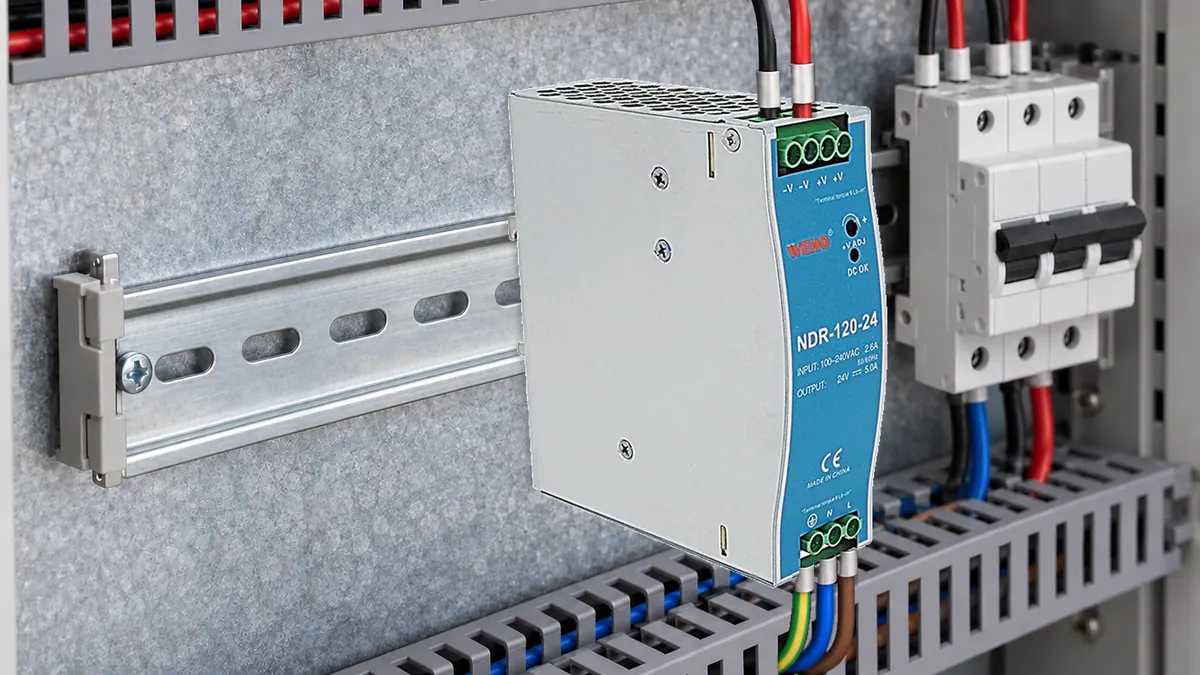
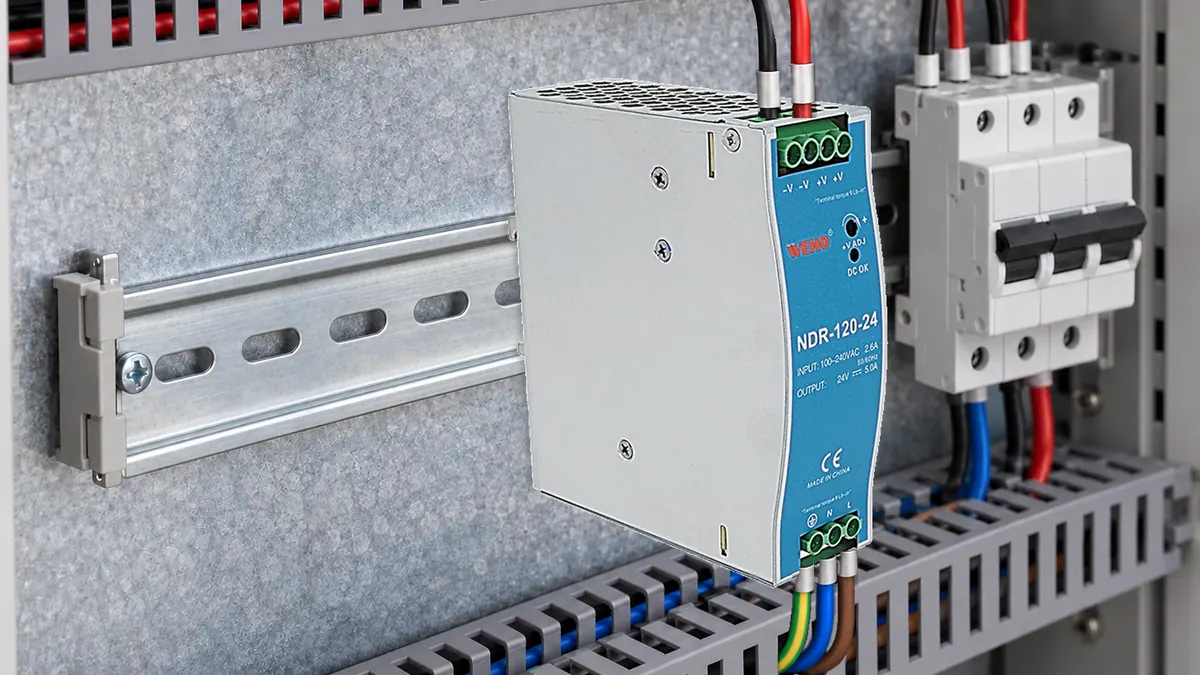
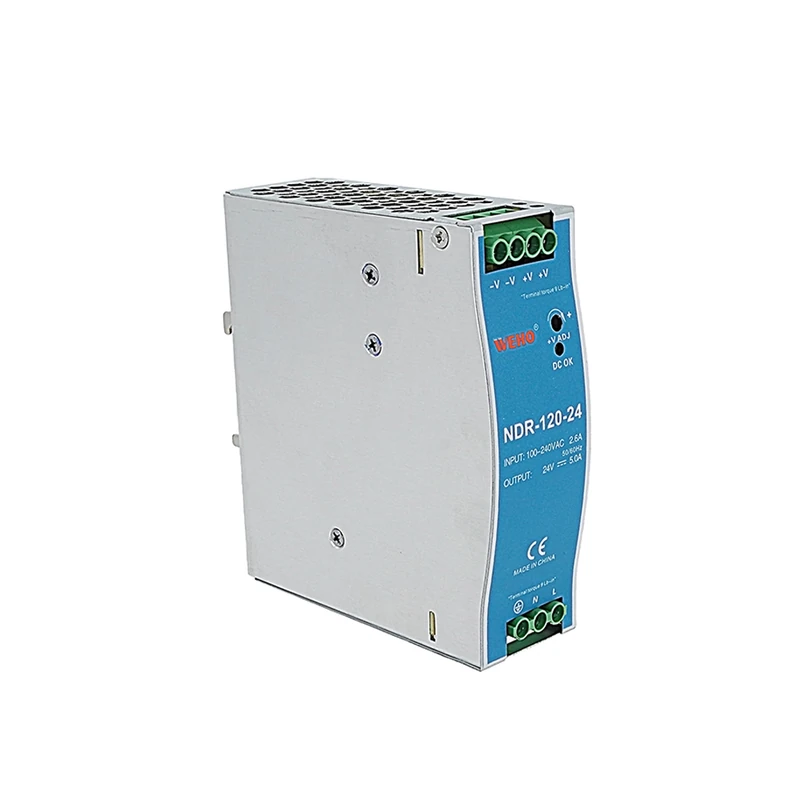
For a cabinet containing the WEHO NDR-120-24 model reference, identify the measured terminals, load state and expected operating range. The supply identity does not establish the DMM's timing. Preserve those two sets of information separately so another engineer can reproduce the record.
An automated script may request readings every 40 ms while the instrument spends additional time selecting a range, settling, integrating, transferring data or processing commands. Communication timestamps may describe the receipt of data rather than the instant or interval of measurement. Determine which clock the logger actually records.
Treat the measurement range as a recorded state
Autoranging adjusts the instrument to accommodate the input while using an appropriate measurement range. The transition can affect the time to the next valid result. Exact behavior depends on function, model, firmware and other settings; a universal range-change delay is not defensible.
El Keysight Truevolt operating guide advises manual ranging to eliminate autoranging delays in its fast-measurement discussion. That is instrument-method evidence, not a timing specification for every DMM. Consult your actual manual and validate the commanded configuration.
Log the range or its equivalent configuration state where the instrument exposes it. Also retain overload, settling, timeout and error indications. A missing measurement is an observation about the test system. Converting it into zero volts invents a rail failure; deleting it can conceal a coverage gap.
Some instruments offer an automatic range chosen once, a continuously changing range, or different policies through their remote interface. Confirm the specific function being used. A front-panel indicator is insufficient if the script changes the configuration immediately afterward.
Reconstruct a hypothetical interrupted sequence
Assume a hypothetical test requests one voltage reading every 40 ms. Five valid readings are returned with measurement timestamps of 0.00, 0.04, 0.08, 0.28 and 0.32 s. A range transition is recorded between the third and fourth valid readings.
The normal interval is 40 ms, but the interval from 0.08 to 0.28 s is 200 ms. A 90 ms event beginning at 0.12 s and ending at 0.21 s could occur entirely within that interval. The five valid numbers alone cannot establish whether that event happened.
If software assigns the five results artificial times of 0.00, 0.04, 0.08, 0.12 and 0.16 s, it compresses the missing period and misstates when the final readings occurred. Drawing a smooth line through that plot adds visual certainty unsupported by the acquired data.
Swipe to view the complete diagram, or open full size.

This example does not claim that all 90 ms events will be detected on a fixed 40 ms schedule. Aperture, trigger timing, event phase and the detection threshold also matter. It demonstrates a narrower point: a range-change gap can be substantially longer than the nominal requested interval and must remain visible.
Include an event's required amplitude and duration in the coverage requirement. A short excursion averaged inside an integration interval can have a different reported amplitude from a sustained change. Range strategy and aperture therefore need separate validation rather than being combined into one advertised readings-per-second number.
Choose fixed or automatic range using the task
A fixed range is often useful when the expected rail and credible excursions fit inside its documented envelope. It removes range selection as a changing state, but it does not make the instrument continuous or eliminate all settling and processing delays.
Swipe table horizontally when needed.
| Test condition | Range approach | Evidence to retain |
|---|---|---|
| Known steady DC window | Fixed range with adequate headroom | Accuracy terms, aperture and timestamps |
| Startup from zero to operating rail | Fixed range or validated transition policy | Overflow behavior and actual coverage |
| Wide unknown diagnostic span | Autorange may aid initial investigation | Every transition and invalid state |
| Short-event acceptance | Use a method qualified for event capture | Detection challenge and achieved response |
El Keysight handheld DMM guide distinguishes automatic selection from manually chosen ranges and describes the performance benefit of avoiding repeated range determination. Apply that distinction to the selected equipment rather than assuming a fixed range always produces a specified speed improvement.
A higher fixed range may reduce resolution or increase a range-dependent uncertainty term. Choosing it solely to prevent overflow can therefore undermine a tight steady-voltage decision. If two tasks need incompatible settings, create separate validated records and state what each can demonstrate.
Challenge the logger before accepting its timeline
- Save the full configuration after initialization. Read back function, range policy, integration, filtering, trigger source and relevant delay settings where supported.
- Apply a controlled voltage sequence within the test equipment's ratings. Include the intended range boundary and identify the reference event timing independently.
- Export original results with instrument timestamps, host timestamps, range states and errors. Compare the clocks rather than assuming they have identical meaning.
- Calculate the intervals between valid measurements. Keep a distribution and maximum observed gap for the actual operating sequence.
- Introduce a known challenge event representing the acceptance requirement. Verify whether the complete system detects and classifies it correctly.
The challenge must remain within an authorized test arrangement. Do not connect a second active source to a powered rail merely to create a disturbance. Use a suitable simulator or approved test configuration, and have qualified personnel manage exposed electrical connections.
Test the export and plotting code as well as the instrument. Check whether an invalid token becomes zero, whether repeated timestamps are discarded, and whether a spreadsheet fills blank rows. Preserve a machine-readable raw file before any cleaning so the evidence can be audited later.
If the DMM cannot provide sufficiently meaningful timing, use the log for the slower question it can answer and obtain an event-capable record separately. The absence of an observed event in sparse data is a statement about that record's coverage, not proof that the supply output stayed inside limits continuously.
A long run can include periodic operations beyond autoranging, such as an automatic zero cycle or a buffer transfer. Record these separately when the instrument exposes them. The purpose is to identify the actual gap mechanism rather than attributing every timing discontinuity to the range policy.
Keep a monotonic sequence number with every requested and returned result. It helps distinguish a delayed result from an omitted result, especially when a communication layer retries a command. Validate whether retries repeat a measurement or repeat only its transfer before interpreting duplicate values or timestamps as independent voltage observations.
Provide the original record with the model dossier
For a review of the WEHO NDR-120-24 cabinet rail, send the original timestamped log, expected voltage window, shortest event of interest, load sequence and DMM configuration. Include the logger challenge result and explain which timestamps represent acquisition versus data receipt.
A useful report states what was observed, the maximum validated gap and the conditions under which the result applies. Keep a range-change timing issue separate from a supply regulation issue until the available evidence connects them. That separation makes the next test specific and prevents unnecessary product rejection.
Engineering FAQ
Is autoranging unsuitable for every rail measurement?
Autoranging can be useful when the voltage span is uncertain and rapid coverage is unnecessary. For event-sensitive logging, validate transitions and preserve their timing. The required observation, instrument behavior and allowed uncertainty determine whether it is suitable.
Does a fixed range guarantee evenly spaced readings?
A fixed range removes range-selection delays but does not guarantee equal intervals. Triggering, integration, autozero, processing and communication can still affect the sequence. Use actual acquisition timestamps and validate the configured method.
Should an overload result be replaced with zero volts?
An overload result should retain its original status and must not automatically become zero volts. It indicates that a valid numerical reading was unavailable in the selected condition. Determine whether the rail, range choice or test system caused it.
Can I use host arrival times as measurement times?
Host arrival times can be useful but may include buffering and communication delays. Confirm their meaning and relationship to the acquisition interval before using them to calculate event timing. Prefer instrument timing when it is available and sufficiently documented.