An RV battery should be charged with equipment whose input, charging controls and installation conditions match the actual vehicle and battery. A generic industrial switching power supply is not automatically an RV charger, and an AC-input unit cannot be connected directly to a DC alternator output.
Key Engineering Takeaways
- Separate shore-power AC charging from alternator-fed DC-DC charging before choosing hardware.
- Use the exact battery manufacturer's charging limits and temperature policy; lead-acid and lithium instructions are not interchangeable.
- Calculate output power at the charging voltage and include simultaneously operating loads.
- Do not infer vehicle qualification, conformal coating or battery charging functions from a generic product description.
Confirm the input and battery first
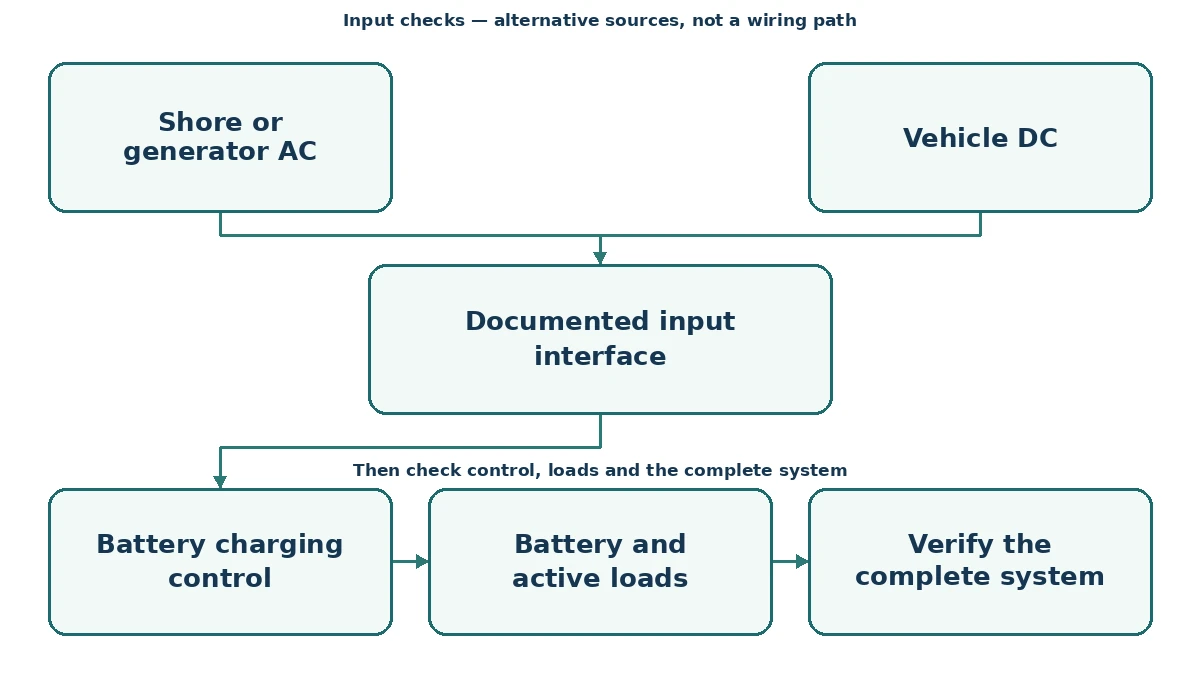
Write down whether the source is shore AC, generator AC or vehicle DC. Verify the actual input range, frequency where applicable, isolation arrangement and required vehicle-interface behavior against the candidate's documentation. A mains-powered industrial supply and a vehicle DC-DC charger solve different input problems.
Next record the battery's exact model, chemistry, capacity and charging instructions. Obtain permitted voltage and current, temperature measurement requirements, termination and recharge conditions. Battery capacity alone does not establish an acceptable C-rate or voltage setting.
A related comparison of power supplies and battery chargers can help frame that distinction, but it does not replace the vehicle and battery documents.
Keep temperature rules chemistry-specific
A lead-acid battery may require a particular compensation method specified by its manufacturer. Do not carry a cold-temperature voltage increase across to a lithium battery merely because both batteries are used in RVs.
For lithium batteries, the permitted charging temperature is a charge-enable condition. If the battery is outside that range, inhibit charging or use a manufacturer-approved heating sequence where provided. A supply's ability to operate in cold air does not mean the battery may be charged there.
A Victron Lithium Battery Smart operation manual, for that named family, states a permitted charging temperature range and says temperature-compensated charging is not required for those batteries. That document is not a general lithium rule and is not a WEHO product setting.
Calculate watts at the charging voltage
Standard Engineering Sizing Example: assume, for arithmetic only, a 100Ah battery whose manufacturer permits 10A charging at a particular operating point of 14.2V. The output power at that point is 14.2V × 10A = 142W, not 12V × 10A = 120W.
For a second hypothetical operating point at 20A, 14.2V × 20A = 284W, not 240W. These are arithmetic examples, not recommended charge settings or proof that the battery permits either current. At another charging voltage, recalculate the output requirement.
| Assumed condition | Calculation | Output demand |
|---|---|---|
| 10A charge only at 14.2V | 14.2 × 10 | 142W |
| 20A charge only at 14.2V | 14.2 × 20 | 284W |
| 10A charge plus 5A simultaneous load at 14.2V | 14.2 × (10 + 5) | 213W |
Check the candidate's available output at the actual enclosure temperature and input condition. Do not add an arbitrary universal margin or assume that the nameplate rating is available at every operating point. Input power also includes losses and is not identical to the DC output figures above.
Verify control behavior, not just a voltage knob
Adjustable voltage, overload protection and a battery-management system do not by themselves form a complete charger. Verify the required current regulation, voltage regulation, temperature permission, charging completion and restart behavior. Confirm how connected RV loads affect any current-based completion decision.
Do not leave lithium batteries on indefinite float simply because the voltage can be held constant. Follow the specific battery manufacturer's standby policy. Treat BMS protective disconnects as protection unless documented charger coordination explicitly defines another interface role.
A related discussion of switching supplies used with lithium batteries is in switching power supply lithium charging.
Installation and acceptance records
Have qualified personnel follow the vehicle, battery and charger instructions for isolation, conductor sizing, overcurrent protection, ventilation, mounting and commissioning. This article does not prescribe a universal connection order, fuse rating, cable size or acceptable voltage drop for all RV systems.
Record input condition, battery temperature, charge voltage and current, active loads, completion response and AC-loss or DC-source-loss behavior during acceptance. Use documented limits, not a hand-temperature check or a fixed observation time, to judge the result.
Separate shore charging from vehicle charging in the specification
For an RV builder or fleet buyer, the input source belongs at the top of the charging specification. Record the source available during the intended operating mode, rather than assuming that every charging unit will see the same electrical input. A shore-power requirement and an alternator-fed requirement should be reviewed separately even when both ultimately charge the same battery.
Describe how the charging equipment is enabled and what happens when the source disappears. Ask whether the battery can backfeed the input or output circuitry, and obtain the manufacturer's permitted connection arrangement. Do not infer the answer from the fact that a product includes overload protection or is advertised for industrial use.
The mechanical specification should identify the intended mounting position, enclosure environment, ventilation and service access. Ask for supporting documents for any required vehicle-specific environmental performance. A coating claim does not, by itself, establish resistance to every combination of vibration, moisture, temperature or electrical transient encountered in a vehicle.
Keep the battery, charger and RV electrical-system instructions together for design review. Where their requirements conflict or leave an interface unspecified, resolve that interface before installation. Do not choose whichever instruction produces the most convenient charging rate or the smallest power supply.
Record what the current measurement includes
In a system that charges the battery while supplying lights, a refrigerator or controls, total charger output current is not necessarily battery charging current. Record which loads were operating when each measurement was made. If charging completion depends on current, the control method must account for the actual arrangement rather than assuming all output current enters the battery.
Use the hypothetical 14.2V example above to keep the arithmetic transparent. The 5A equipment load is separate from the 10A assumed battery current, so the example's total is 15A and its output demand is 213W. This does not select a production charger: the actual battery instructions, load behavior and candidate operating limits still govern.
Do not turn a calculated output figure into an AC input rating. Request the candidate's input-current and efficiency information for the relevant operating conditions. Also check any documented starting or transient behavior of the connected loads. A steady-state wattage calculation does not, by itself, prove successful startup or compliant installation.
Keep an RV commissioning record
The commissioning record should identify the battery and charger models, document revisions, settings, source condition and measurement points. Record the relevant battery temperature and which loads are active, so that later comparisons describe the same conditions rather than unrelated snapshots.
Use the manufacturers' procedures to verify charging enable, normal completion, restart and source-loss behavior. Document the response to conditions that the instructions require the system to detect. Do not deliberately bypass a protective device to create a test condition, or use a protective disconnect as evidence that ordinary charging control is correct.
Retain unresolved items with the configuration, including any vehicle qualification, coating or interface evidence still requested. This avoids turning an industrial product description into an unsupported onboard-charger claim. A documented system decision is more useful to purchasing and service teams than a general promise of several additional years of battery life.
What to ask WEHO
Provide the RV electrical arrangement, battery charging document, input source, simultaneous load and installation environment. Ask for evidence for the exact proposed model, including relevant vehicle transients, vibration, temperature and coating requirements where they apply. This article makes no claim that every industrial WEHO supply is vehicle-qualified or includes a programmable charging curve.
Preguntas frecuentes
Is 120W sufficient for a 12V, 100Ah battery at 10A?
Not at the hypothetical 14.2V charging point used here: the charging output alone is 142W. Add simultaneous loads and check the candidate's documented operating limits. Battery instructions determine whether 10A and 14.2V are appropriate at all.
Does lithium charging always finish with float?
No. Follow the exact battery's completion, standby and restart policy. A lead-acid float sequence must not be applied to lithium batteries as a universal rule.
Can an industrial AC supply run directly from an alternator?
Not unless its documented input explicitly supports that source and arrangement. Vehicle DC and shore AC require different input interfaces.
Does constant-voltage operation prove overcharge protection?
No. Voltage regulation is one function. Battery-specific current limits, temperature conditions, termination and protective coordination still need verification.
Sources
- TI application note SLUAAJ8 (PDF)
- Fuentes de alimentación frente a cargadores de baterías: ¿cuáles son las diferencias?
- Cómo utilizar de forma segura una fuente de alimentación conmutada para cargar baterías de litio
- Contacto WEHO
- Victron Lithium Battery Smart operation manual (named battery family; not a universal charging setting)