Key engineering takeaways
- A sampling plan makes a lot-disposition decision; it does not guarantee every accepted unit.
- Specify sample size, acceptance number, random selection and rejection disposition in advance.
- An OC curve describes acceptance probability at assumed lot quality levels.
- Use finite-lot calculations when sampling without replacement requires them.
An attributes lot-acceptance plan needs an explicit decision rule and a review of the risks that rule creates at relevant quality levels. Sample size alone does not describe the plan. A buyer should agree what counts as a nonconforming unit, how the sample is selected and what happens when the lot is rejected.
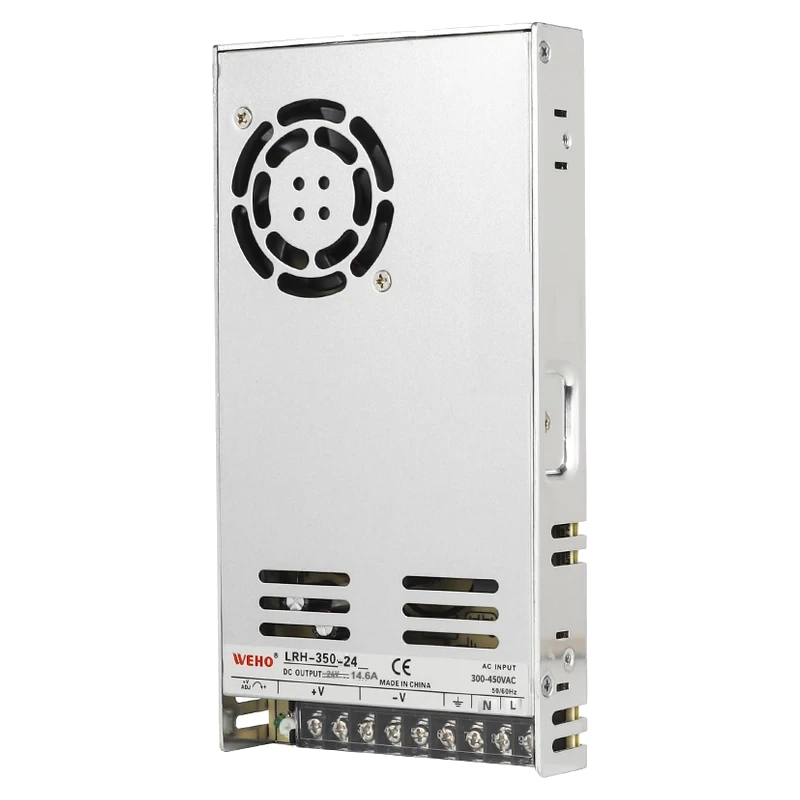
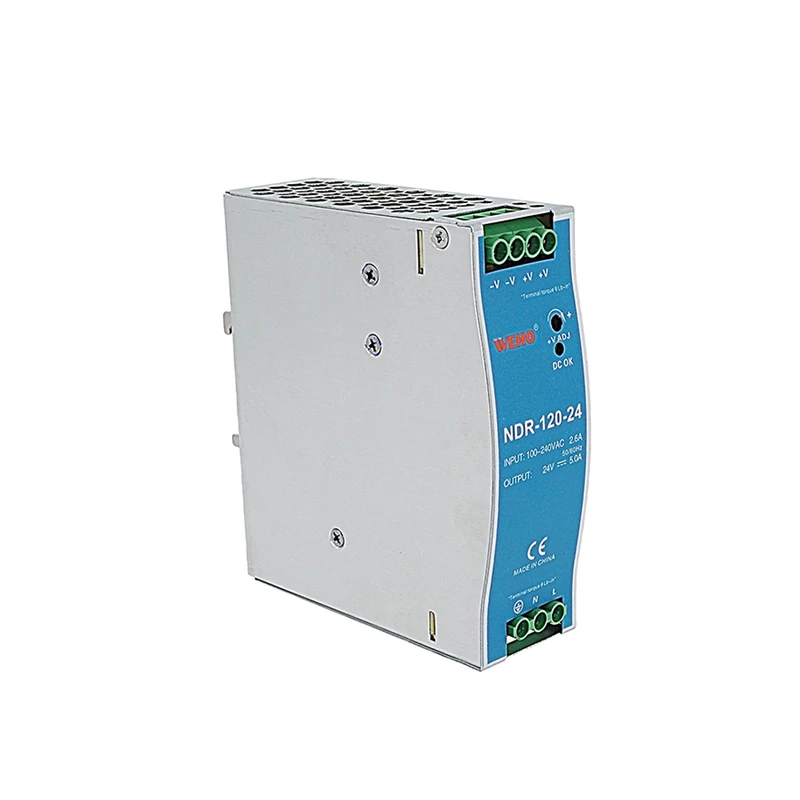
For purchasing the WEHO NDR-120-24, define the actual characteristic and contractual disposition separately from the product identity. The fictional plan below is not a recommended WEHO inspection level, ISO table selection or agreed AQL. Its purpose is to make a proposed decision rule and its limitations visible.

Define the lot and the complete decision rule
A single attributes plan is commonly written as (n, c), where n is the number of sampled units and c is the largest observed nonconforming-unit count that permits lot acceptance. If the observed count exceeds c, the plan rejects the lot. These definitions need an agreed lot boundary and inspection method.
NIST's acceptance-sampling overview distinguishes lot disposition from estimating lot quality. Keep that distinction in the inspection report. Accepting a lot under a plan is not the same statement as proving that the lot's nonconforming fraction is below a particular value.
The sample should represent a defined random selection from the actual lot. Taking only accessible cartons, the first units off a pallet or units a supplier selected informally can undermine the stated probability model. Preserve selection identities and explain any practical restrictions before interpreting calculated risks.
Count nonconforming units consistently with the plan. One unit with multiple discrepancies may still count as one nonconforming unit for that particular attributes rule, while defect-category records remain separately useful. Define severity classes and their applicable rules without silently combining unlike characteristics into one count.
| Plan field | Question to resolve | Required record | Do not infer |
|---|---|---|---|
| Lot and characteristic | Which units and requirement are covered? | Identity, configuration and criterion | Coverage of every other characteristic |
| Sample selection | How are units selected? | Random method and selected identities | Convenience sample has identical risk |
| (n, c) decision | How many observations permit acceptance? | Predetermined sample and count rule | Sample size alone defines protection |
| Rejected-lot handling | What happens after rejection? | Hold, review and authorized disposition | Unlimited resampling until a pass |
Read an OC curve as a conditional decision property
NIST's plan terminology defines the operating-characteristic curve as the probability of accepting a lot versus its assumed nonconforming fraction. The curve compares how the same decision rule behaves under different lot-quality scenarios. It is not a posterior probability that a particular accepted lot is good.
Producer's risk and consumer's risk require designated quality points and agreed meanings. AQL and a limiting quality point are not interchangeable labels for whatever percentage happens to be observed in a sample. Obtain the actual contractual scheme, standard edition and switching rules where those govern the transaction.
A plan with a nonzero acceptance number can accept a sample containing identified nonconforming units. That statistical lot decision does not authorize shipping those known nonconforming sampled units. Their individual disposition and the treatment of the remainder must follow the applicable agreement and requirements.
The cost of rejecting acceptable lots and the consequence of accepting poor lots should influence plan selection. A convenient low sample size may provide weak discrimination. Some characteristics or safety obligations may require a different control strategy; a generic attributes example cannot override those requirements.
Recompute a fictional finite-lot example
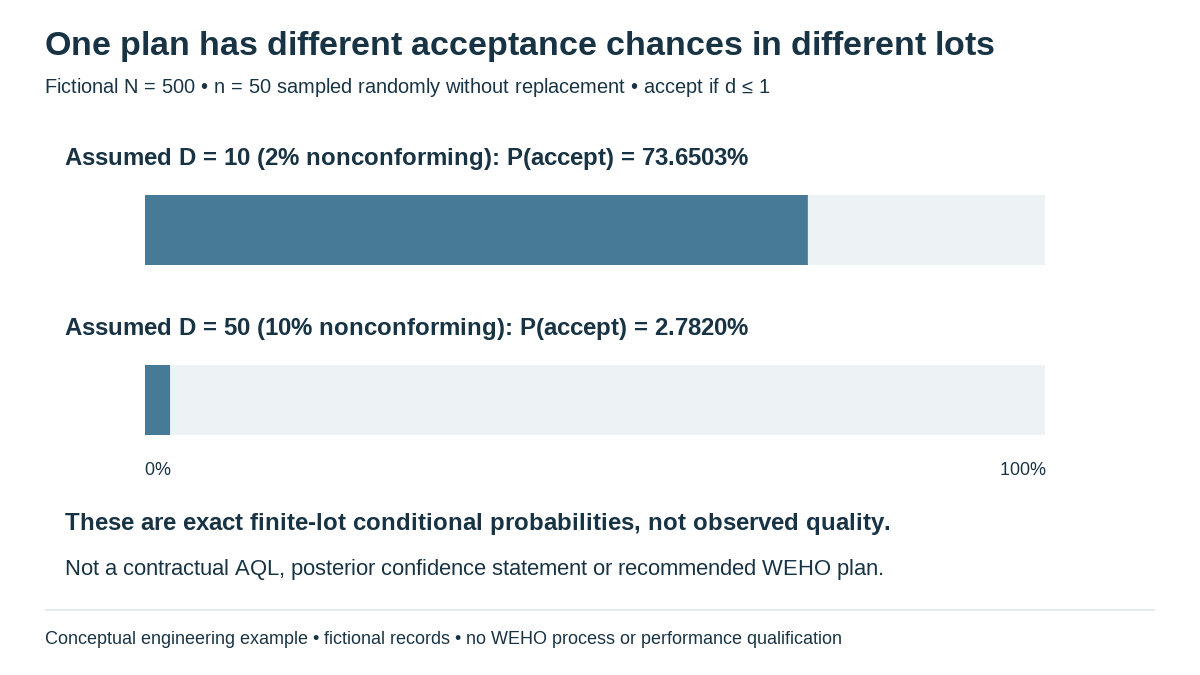
Assume a lot of N = 500 units, a random sample of n = 50 without replacement, and acceptance number c = 1. Assume perfect classification solely to isolate sampling behavior. The rule accepts if zero or one nonconforming unit is observed and rejects if two or more are observed.
Consider two separate hypothetical worlds: the lot contains D = 10 nonconforming units, or D = 50. These are assumed true counts for risk calculation, not estimates obtained from a sample. The corresponding lot fractions are 10 / 500 = 2% and 50 / 500 = 10%.
For the finite lot, the exact acceptance probability is the sum for i = 0 and 1 of C(D, i) × C(500 − D, 50 − i) / C(500, 50). Here C(a, b) means the number of combinations choosing b items from a. Independent recomputation gives the values in the table.
| Assumed lot state | Exact finite-lot acceptance | Binomial calculation | Interpretation |
|---|---|---|---|
| D = 10; 2% of 500 | 73.6503% | 73.5771% | Plan often accepts this assumed state |
| D = 50; 10% of 500 | 2.7820% | 3.3786% | Acceptance remains possible |
| Observed count d ≤ 1 | Apply the stated accept rule | Not an estimate of D | Individual sampled defects still controlled |
| Observed count d ≥ 2 | Apply the stated reject rule | No automatic fresh sample | Use authorized rejected-lot disposition |
The binomial comparison uses (1 − p)^50 + 50p(1 − p)^49 for c = 1. It gives 0.735771 at p = 0.02 and 0.033786 at p = 0.10. The exact finite-lot results are 0.736503 and 0.027820; the difference is relevant to evaluating the proposed rule, not a rounding error to conceal.
Swipe horizontally on a small screen, or open the full-size diagram.
NIST's OC calculation page explains the binomial approximation when the lot is very large relative to the sample. Here the sample is 10% of a specified finite lot, so the exact without-replacement calculation is available and preferable for the example. Never apply an approximation without checking its assumptions and adequacy.
Keep confidence statements and acceptance rules distinct
A confidence bound derived from observed inspection data addresses an inferential question under a specified model. A preselected (n, c) plan addresses what disposition to make when a sample outcome occurs. A zero-failure confidence calculation does not by itself choose the contract's sample size, acceptance number or rejected-lot treatment.
This article intentionally does not reproduce ISO 2859 tables or assign an inspection level. A standards-based scheme may include lot-size categories, quality designations and switching rules that must be applied together. Verify the actual licensed edition and agreed contractual requirements rather than assembling a plan from isolated online examples.
El WEHO first-article approval checklist provides a related product-configuration evidence framework. Lot sampling adds an explicit population decision after an agreed characteristic inspection. First-article approval and sampled-lot acceptance answer different questions, so preserve both when the quality plan requires them.
Agree a usable lot-disposition plan
- Define the population. Identify lot size, configuration, characteristic and unit classification. Record boundaries and severity rules; verify that inspectors can classify the same condition consistently.
- Choose and review the rule. Specify n, c and relevant quality scenarios or the applicable complete standard scheme. Record risk calculations and model assumptions; verify that the proposed protection fits the consequences.
- Control random selection. Select identifiable units using the approved method. Record the selection and any access limitations; verify that convenient substitutions have not changed the sample.
- Inspect and reconcile. Preserve unit results and the observed count against the predetermined rule. Record measurement-invalid outcomes separately; verify that sample defects and lot disposition remain traceable.
- Execute the disposition. Hold and route rejected lots under the agreed procedure. Record approvals and any subsequent authorized inspection; verify that repeated sampling is not being used simply to obtain a passing draw.
Prepare a lot-plan enquiry
Send WEHO the exact NDR-120-24 enquiry identity, proposed lot definition, characteristic and applicable contractual scheme. State the required inspection evidence and rejected-lot process. Ask the responsible parties to agree the plan; the illustrative (50, 1) rule and 2%/10% scenarios are not WEHO recommendations or promised quality levels.
Preguntas frecuentes
Does accepting a sampled lot prove every unit conforms?
No. A plan makes a bounded lot-disposition decision with sampling risk. Known nonconforming sampled units and other requirements still need their applicable individual controls.
Is an OC acceptance probability the chance an accepted lot is good?
No. It is the probability of acceptance conditional on an assumed lot state and plan. A posterior statement about a particular lot requires additional assumptions and analysis.
Can a rejected lot be sampled again until it passes?
No, unless an explicitly authorized scheme defines that process and its consequences. Ad hoc repeated draws change the decision's risk and conceal the original rejection.
Can the binomial model always replace a finite-lot calculation?
No. Check selection and sampling-fraction assumptions and whether the approximation is adequate. For the specified without-replacement example, the exact hypergeometric calculation is available.