













| Especificación | S-200-5 | S-200-12 | S-200-15 | S-200-24 | S-200-36 | S-200-48 |
| Tensión de salida CC, corriente | 5V 0 ~ 40A | 12V 0 ~ 16.5A | 15V 0 ~ 13.3A | 24V 0 ~ 8.5A | 36V 0 ~ 5.5A | 48V 0 ~ 4.2A |
| Ola y ruido | 150mVp-p | 150mVp-p | 180mVp-p | 180mVp-p | 200mVp-p | 200mVp-p |
| Estabilidad del cable de entrada | ±0,5% | ±0,5% | ±0,5% | ±0,5% | ±0,5% | ±0,5% |
| Estabilidad de carga | ±1% | ±0,5% | ±0,5% | ±0,5% | ±0,5% | ±0,5% |
| Eficiencia | 79% | 82% | 83% | 83% | 86% | 86% |
| Rango ajustable para voltaje CC | ±10% | ±10% | ±10% | ±10% | ±10% | ±10% |
| Rango de voltaje de entrada | 90 ~ 132VAC or 180 ~ 264VAC | |||||
| Corriente de impacto | Corriente de arranque en frío 15A/115VAC 30A/230VAC | |||||
| Protección contra sobrecarga | 105% ~ 201% cut off the output, automatic recovery | |||||
| Protección contra sobretensión | 115% ~ 150% shut down O/P voltage, re-power on to recover | |||||
| Configurar, levantarse, mantener el tiempo de actividad | 200ms, 50ms, 20ms/230VAC at full load | |||||
| Voltaje de soporte | I/P-O/P: 1.5kV; I/P-FG: 1.5kV; O/P-FG: 0.5kV; 1 minute | |||||
| Resistencia de aislamiento | I/P-O/P, I/P-FG, O/P-FG: 500 VCC/100 MΩ | |||||
| Temperatura de trabajo | -10°C ~ +50°C | |||||
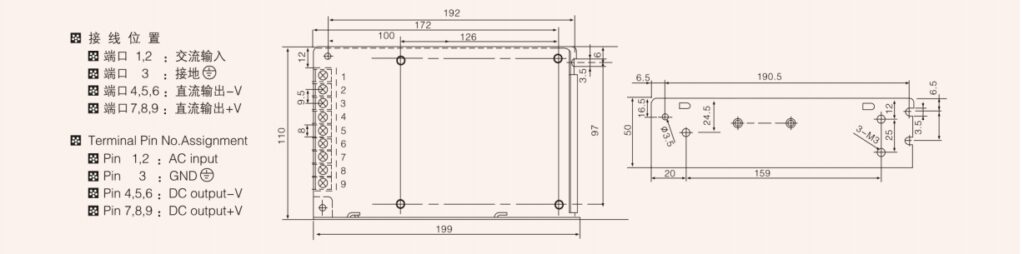
| Dimensión | 199 × 110 × 50mm | |||||
| Peso | 0.9kg | |||||
| Embalaje | 42 × 31.5 × 26CM/20PCS/18kg | |||||

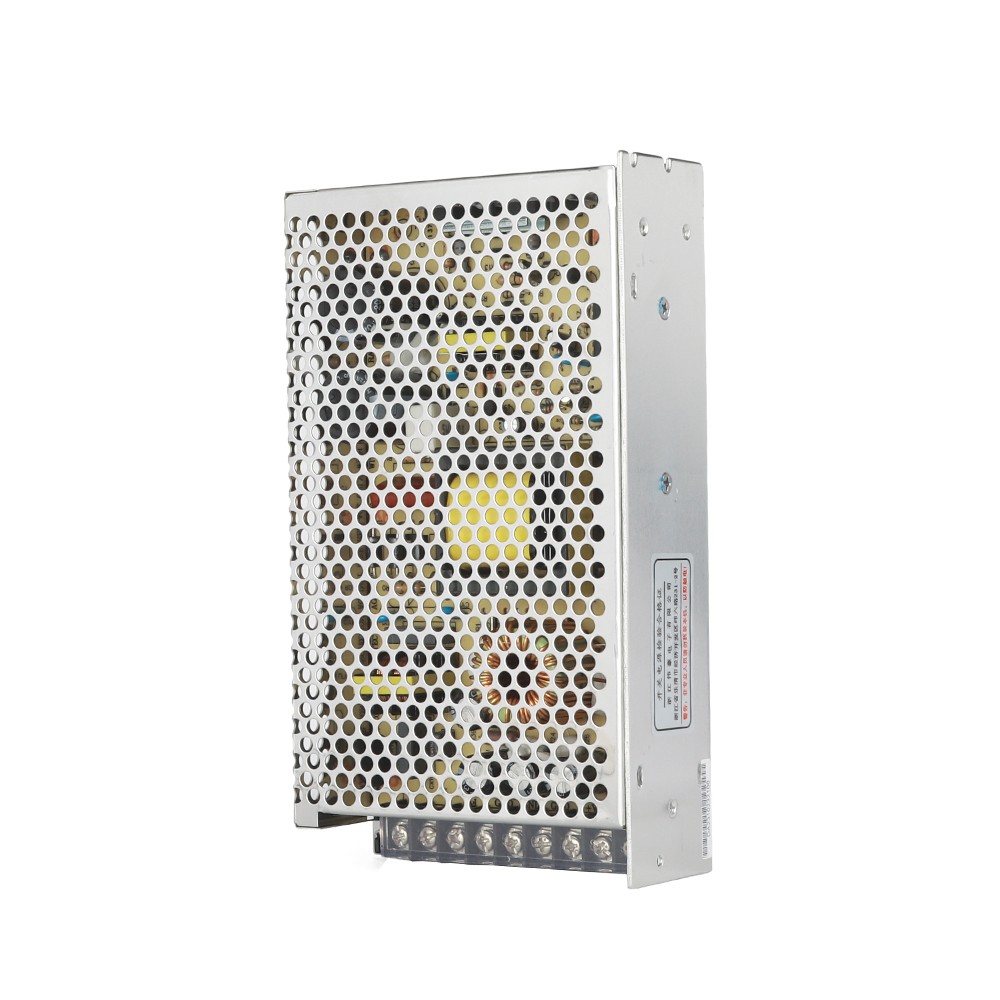
Serie S-200W fuente de alimentación de conmutación simple normal
WEHO S-200 is a 200W-designated single-output family offered in six separate output-voltage versions from 5V to 48V. Its 199×110×50mm outline supports a defined mechanical review, while each suffix has its own printed current, ripple and efficiency entries. AC input is listed as 90~132VAC or 180~264VAC. Evaluate the exact version for compatible local machine electronics. The datasheet does not specify a DC-input range, input frequency or an input-selection method; confirm those conditions with the manufacturer. Confirm real continuous duty, thermal conditions and the nine-pin terminal arrangement before integration. Specify the intended electronic load when discussing an order.
Si tiene alguna pregunta, no dude en contactarnos en Correo electrónico: [email protected]
Envíenos un correo electrónico [email protected]
- Descripción
Why Choose S-200?
Compare the 12V, 15V and 24V columns directly
S-200-12 lists 12V 0~16.5A, S-200-15 lists 15V 0~13.3A and S-200-24 lists 24V 0~8.5A. Match these separate outputs to the board’s required rail and current range. Startup and accepted continuous duty still need load-specific verification.
Plan around the input information actually supplied
The input row states 90~132VAC or 180~264VAC. It does not print a DC-input range, frequency range or selection method. Verify the delivered unit’s instructions and setting for the intended line system instead of treating two separated bands as one automatic universal-input range.
Review noise together with heat-producing losses
The 5V and 12V models list 150mVp-p ripple, while 15V and 24V list 180mVp-p and 36V and 48V list 200mVp-p. Efficiency entries also vary by output. Match noise tolerance to the actual boards and assess heat in the real enclosure; the highest family efficiency is not a substitute for the selected column.
Check the nine-pin service interface
The S-200 legend has AC input on pins 1 and 2, GND on pin 3, DC output-V on pins 4, 5 and 6, and DC output+V on pins 7, 8 and 9. A similar nominal outline does not establish an identical terminal arrangement. Review terminal access and the delivered markings rather than assuming a drop-in replacement.
S-200 Features
Six alternative output versions
S-200-5 lists 5V 0~40A; S-200-12 lists 12V 0~16.5A; S-200-15 lists 15V 0~13.3A; S-200-24 lists 24V 0~8.5A; S-200-36 lists 36V 0~5.5A; S-200-48 lists 48V 0~4.2A. One ordered model supplies one output; these columns do not establish simultaneous rails or a switchable multi-voltage unit.
Adjustment and output-specific load stability
Each output lists ±10% DC-voltage adjustment and ±0.5% line stability. Load stability is ±1% for S-200-5 and ±0.5% for the remaining variants. Check the connected electronics throughout the intended duty; voltage adjustment is not evidence of constant-current control, dimming or charging.
Paired cold-start values and a three-part timing row
Cold-start current is 15A/115VAC and 30A/230VAC. Setup, rise and hold-up are 200ms, 50ms and 20ms at 230VAC and full load. Coordinate startup and board reset behavior at the stated input and test conditions.
Separate fault thresholds from usable load duty
The overload row prints 105%~201% with output cutoff and automatic recovery; the protection-coordination threshold needs manufacturer clarification before it is used in an equipment design. Overvoltage is 115%~150% with shutdown and re-powering to recover. Neither row establishes sustained overload capability.
Typical Service Conditions
Contain debris at a vibration finishing bowl
A vibration finishing bowl may evaluate an S-200 suffix for compatible cycle-interface and indication electronics. Keep abrasive media and conductive residue away from the dry electrical compartment and verify its actual thermal environment. The bowl drive, process fluids and mechanical guarding require independent design.
Keep slurry out of a glass edge-grinding machine
A glass edge-grinding machine needs separation between wet processing and its electrical bay. Consider an exact S-200 output only for compatible local logic and display boards after load and enclosure checks. Grinding motors, coolant pumps and protective bonding of the complete machine need separate qualification.
Manage paper dust at a guillotine cutter
A paper guillotine cutter may assess an S-200 variant for compatible job-interface electronics in a protected, accessible compartment. Verify dust control, board reset behavior and real temperature. The blade drive, clamp actuation and two-hand or other protective control functions are not supplied or validated by this concept.
Segregate drive noise at a robot screwdriving cell
A robot screwdriving cell should route drive and tool power separately from local interface and communication electronics. Evaluate the selected S-200 at the actual electronic load during boot and tool cycles. Robot axes, screwdriver motors and torque verification remain separately powered and qualified.
Potential S-200 Applications
Vacuum membrane press
A vacuum membrane press may evaluate a selected S-200 output for compatible recipe-interface and status boards. Keep the electronic compartment away from process heat and verify load and wiring conditions. Vacuum pumps, press actuation, heaters and protective shutdown require their own qualified power architecture.
Wire braiding loom
A wire braiding loom may consider a qualified S-200 suffix for compatible local program-interface and communication electronics. Assess voltage, noise and boot demand in the actual enclosure. Carrier drives, take-up motors and tension-control performance are not established by the supply choice.
Industrial parts-wash machine
An industrial parts-wash machine may assess an exact S-200 output for compatible cycle-display and local logic boards within a dry protected bay. Confirm chemical exposure controls and thermal conditions. Spray pumps, heaters, fluid-level protection and cleaning performance require separate engineering.
Toroidal-core winding bench
A toroidal-core winding bench may evaluate an accepted S-200 variant for compatible count-programming and operator-interface electronics. Verify the actual board load and interruption response. Shuttle drives, wire-tension mechanisms and winding-quality measurement remain separately qualified functions.
S-200 Technical FAQs
Which exact output models and current ranges are listed?
S-200-5 lists 5V 0~40A; S-200-12 lists 12V 0~16.5A; S-200-15 lists 15V 0~13.3A; S-200-24 lists 24V 0~8.5A; S-200-36 lists 36V 0~5.5A; S-200-48 lists 48V 0~4.2A. These are alternative single-output models, not six simultaneous rails. The printed zero lower bounds do not independently establish no-load regulation.
Does the family designation establish every continuous operating point?
The family is designated 200W. Do not calculate a replacement continuous wattage from voltage multiplied by a printed current-range endpoint. The current ranges do not by themselves establish minimum load, universal no-load operation or full-load output at every input and temperature. Confirm actual continuous and startup demand for the exact electronic load.
Which input bands and selection information are specified?
The input row states 90~132VAC or 180~264VAC. It does not print a DC-input range, frequency range or selection method. Do not assume automatic universal input; confirm the delivered unit’s input instructions, setting and intended line system before energizing.
What does the voltage-adjustment entry establish?
Each of the six models lists ±10% DC-voltage adjustment. Match any setting to the connected board’s voltage limits and the exact model’s verified duty. This entry does not establish constant-current regulation, programmable operation, dimming, battery charging or permission to exceed the equipment’s accepted operating envelope.
Which ripple and line/load stability belong to each output?
S-200-5: 150mVp-p ripple, ±0.5% line stability, ±1% load stability; S-200-12: 150mVp-p ripple, ±0.5% line stability, ±0.5% load stability; S-200-15: 180mVp-p ripple, ±0.5% line stability, ±0.5% load stability; S-200-24: 180mVp-p ripple, ±0.5% line stability, ±0.5% load stability; S-200-36: 200mVp-p ripple, ±0.5% line stability, ±0.5% load stability; S-200-48: 200mVp-p ripple, ±0.5% line stability, ±0.5% load stability. Line stability and load stability are separate parameters. These entries do not specify a ripple-measurement bandwidth or complete load-side wiring method.
Which efficiency and cold-start values belong to this family?
Efficiencies in S-200-5, S-200-12, S-200-15, S-200-24, S-200-36, S-200-48 order are 79%, 82%, 83%, 83%, 86%, 86%. Cold-start current is 15A/115VAC and 30A/230VAC. These inrush entries apply at their respective input voltages. The inrush values are transient entries, not continuous input current or protective-device selections.
What overload range and recovery behavior are printed?
The overload entry prints 105%~201%, cutting off the output with automatic recovery. The unusual 201% upper endpoint needs manufacturer clarification before use in equipment protection coordination. This is not a sustained overload allowance. Check the connected electronics’ response to repeated power loss and recovery and coordinate equipment protection separately.
How does overvoltage shutdown recover?
The overvoltage entry is 115%~150%, shutting down the output voltage and requiring re-powering to recover. This differs from automatic overload recovery. Evaluate downstream protection and a safe equipment restart independently of this supply response.
Which setup, rise and hold-up times and conditions are given?
Setup, rise and hold-up are 200ms, 50ms and 20ms at 230VAC and full load. The stated input and full-load conditions apply to this timing entry. Timing at full load is not permission for full load across the temperature range, nor a guarantee of the same response at every input and load.
What temperature, dimensions and mass are listed?
The listed working temperature is -10°C~+50°C, dimensions are 199×110×50mm and mass is 0.9kg. Check actual local temperature, mounting, terminal access and service clearance. These entries do not provide an ingress rating, humidity specification or complete full-load derating curve.
What withstand and isolation-resistance entries are specified?
The withstand row lists I/P-O/P 1.5kV, I/P-FG 1.5kV and O/P-FG 0.5kV for 1 minute, without an AC/DC qualifier. Isolation resistance is listed as 500VDC/100MΩ for I/P-O/P, I/P-FG and O/P-FG. These are test entries, not an undocumented certification, inter-output-isolation claim or finished-equipment safety approval.
What terminal assignment is shown, and does it establish variant wiring?
The nine-pin legend labels pins 1 and 2 as AC input, pin 3 as GND, pins 4, 5 and 6 as DC output-V, and pins 7, 8 and 9 as DC output+V. Treat this as the printed generic legend, not suffix-specific installation approval or permission to strap terminals. Confirm the delivered markings, conductor sizing, bonding, branch protection and connection instructions. Any proposed DC operation requires separate manufacturer instructions because no DC-input range is specified. Use the delivered S-200 markings and its approved connection instructions.
PRODUCTOS RELACIONADOS


¿Cuáles son los mejores productos de fuentes de alimentación para su empresa?
Impulsa tu negocio con productos de suministro de energía de calidad WEHO.
Pregúntale a un experto