Key Engineering Takeaways
- A multiplexed voltage test must settle after changing channels before applying its limit.
- Scan order, input range and the complete fixture can change the result.
- Four sequential readings do not describe four rails at the same instant.
- Prove channel coverage as well as the final aggregate pass result.
Why can a good multi-output supply fail a fast voltage scan?
A measurement taken before the switched path and meter have settled can report a value that does not represent the selected rail accurately. On a multi-output assembly, a faster test sequence may therefore create false rejects or false acceptance. The task is to validate the measurement sequence before using its result to release production.
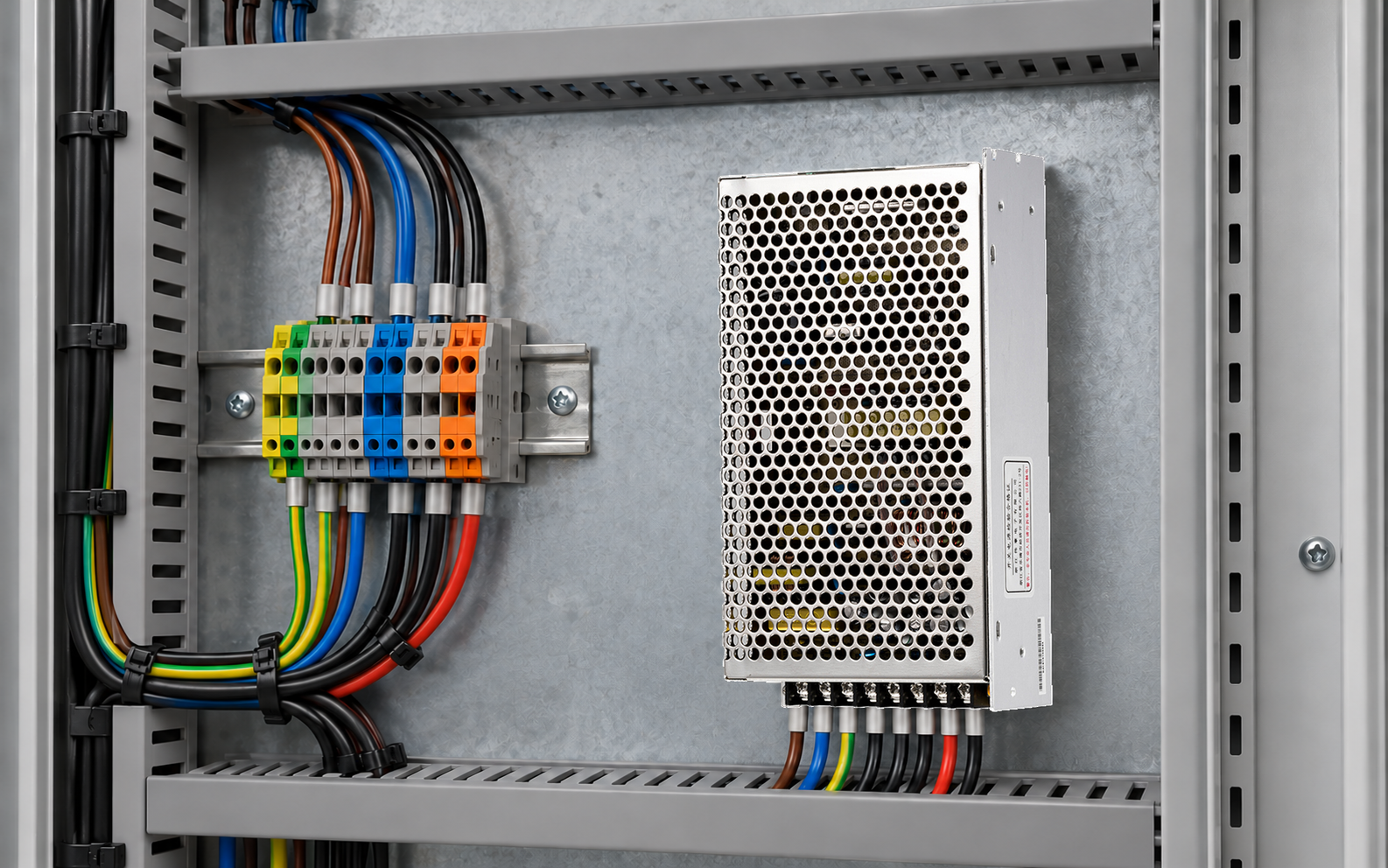
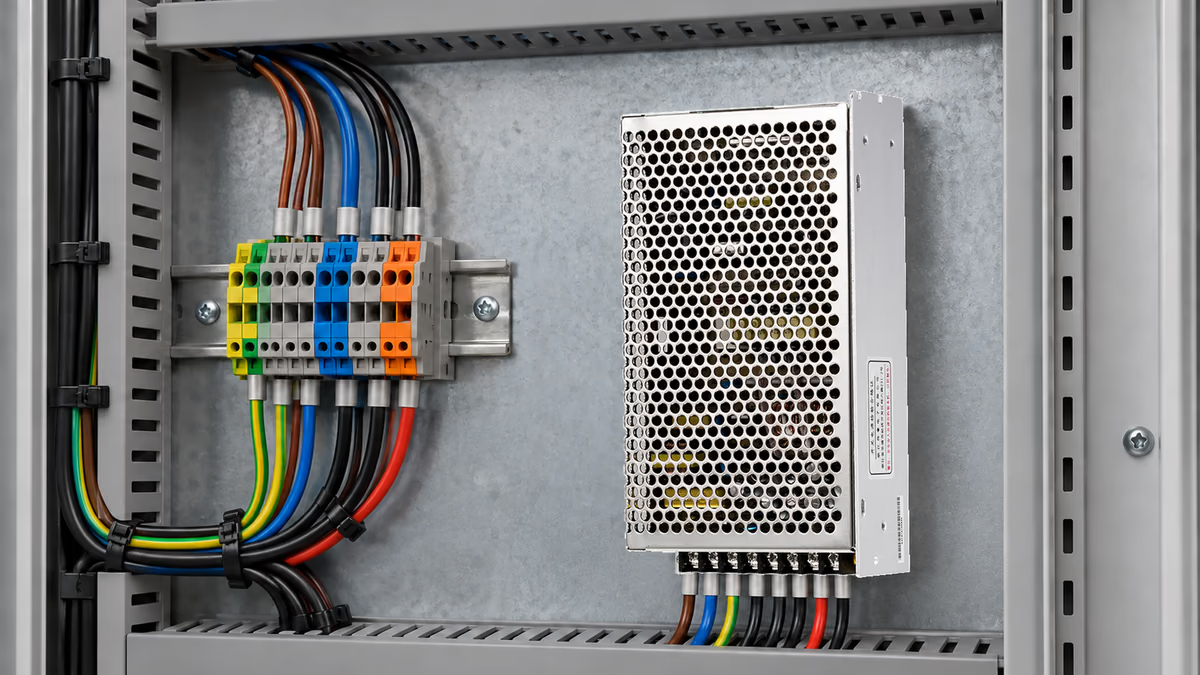
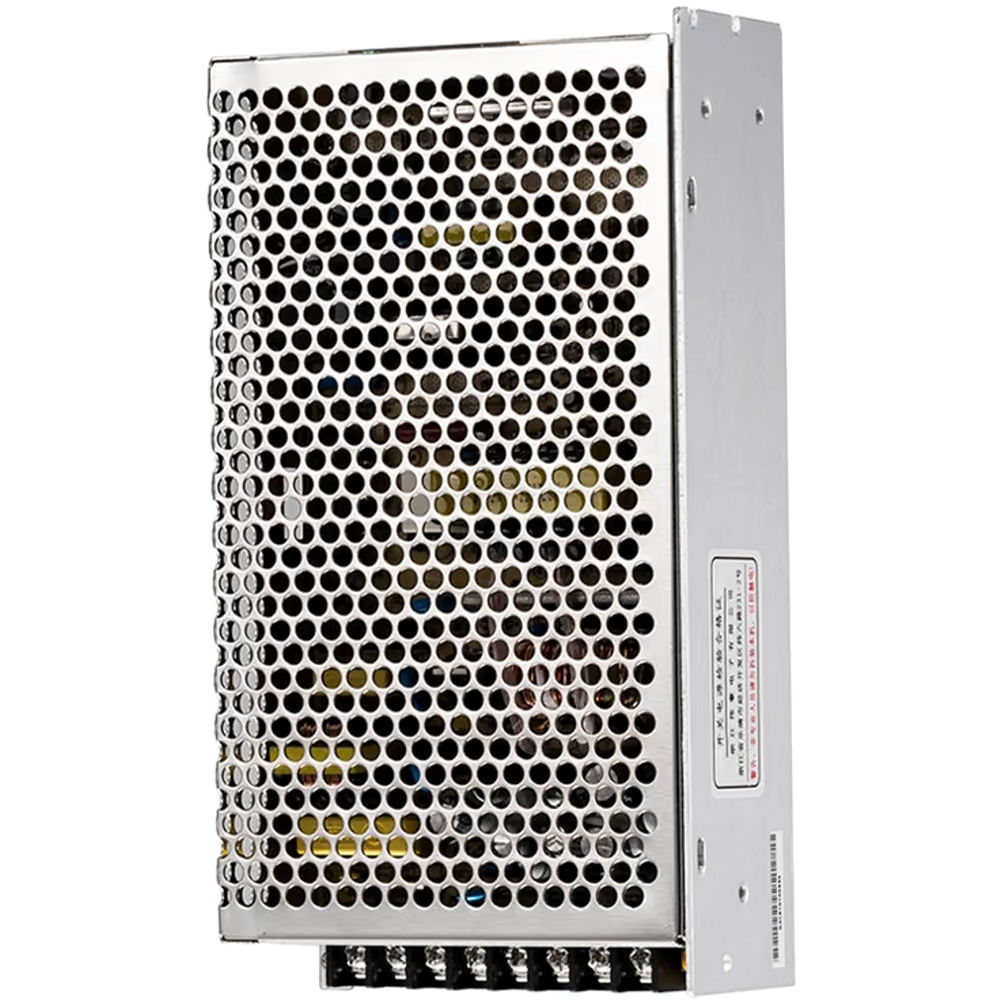
Le Q-120 quad-output product information provides a relevant family reference for a four-channel test. Its variant table describes different output combinations. This article does not assign one combination to the family photograph or replace the required individual rail and total-load checks.
The focus is the tester: how it selects, measures and records each rail. An accurate pin map and acceptable supply regulation are prerequisites, but neither proves that the instrument's switch-and-read timing is valid.
How do you separate switching, settling and measurement time?
Treat the measurement cycle as several distinct intervals. A relay's nominal actuation time is not the entire delay required for the complete signal path to settle. The meter configuration, cable capacitance, source impedance and previous channel can also influence the first accepted reading.
NI's DMM settling-time documentation explains how switching sources and the equivalent source resistance and input capacitance affect measurement settling. This general model does not specify a valid delay for a particular WEHO supply or test fixture.
Hypothetical Production-Test Timing Example
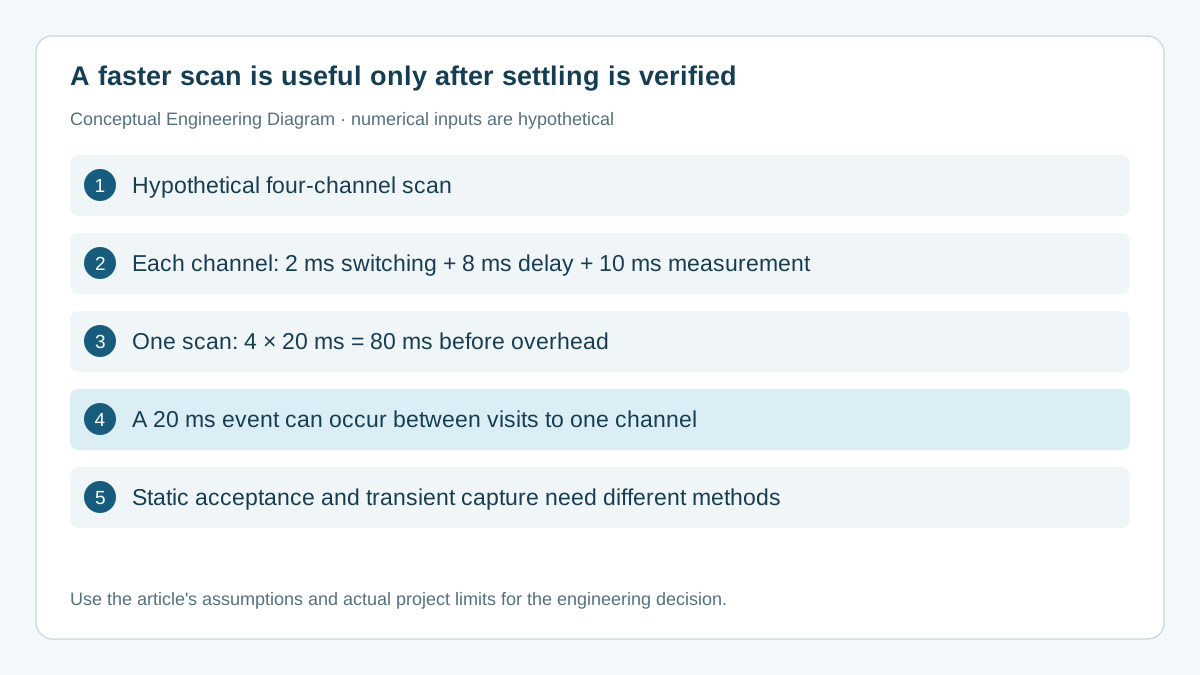
Assume a four-rail static voltage scan allocates 2 ms for switching, 8 ms for an additional settling delay and 10 ms for the measurement on each channel. The assumed per-channel allocation is 20 ms. Four channels therefore require 4 × 20 ms = 80 ms, before communication, processing and other overhead.
If the assumed additional delay is reduced from 8 ms to 1 ms, the arithmetic scan time becomes 4 × (2 + 1 + 10) ms = 52 ms. That 28 ms reduction is only a timing calculation. It does not prove that the shorter sequence retains the required measurement accuracy.
The valid delay must be established using the actual system. Compare readings with an appropriately settled reference method over the required channel transitions and operating conditions. Preserve both the observed differences and the rule used to decide whether they are acceptable.
A higher display update rate also does not prove that the stored measurement is new. Check triggering, buffering and software read behavior. A tester can return an old sample, associate a correct number with the wrong channel or omit a channel while still producing a plausible aggregate result.
Which conditions belong in the scan qualification matrix?
Include the transitions that stress the actual scan sequence, rather than testing each channel only in isolation. Changing from a positive rail to a negative rail may present a different settling condition from reading the same rail twice. An automatic range change can add another variable.
| Condition | What to vary | What to retain | Acceptance basis |
|---|---|---|---|
| Channel transition | Order and preceding rail | First and later readings | Allowed measurement error |
| Meter configuration | Range and integration setting | Actual stored configuration | Qualified test method |
| Fixture condition | Cable, relay path, connection | Fixture revision and reference check | Path-specific validation |
| Coverage | Missing, stale or misassigned result | Per-channel completion evidence | All required checks executed |
The equipment limit and the test-system error allowance must be related through a documented decision rule. A measured result just inside an equipment limit may require different treatment from a result well within the permitted range. Do not conceal uncertainty by adding arbitrary decimal places to the report.
For a negative output, retain its sign and reference. Applying the magnitude limit to a signed measurement incorrectly can turn a failure into a pass. Similarly, a test recipe for one output combination must not be selected solely because the supply shares the same enclosure as another variant.
How should you validate the production sequence?
Validate the full production path, from channel selection through the recorded decision. A bench reading made with the relay card bypassed cannot prove that the production fixture is accurate. Start with a stable and appropriately characterized reference condition, then introduce the intended operating variation.
- Define every required rail, reference, load state and acceptance limit. Link the recipe to the accepted output combination and fixture revision.
- Record the actual switch, delay, range, integration and trigger settings. Distinguish command issue time from the point at which the measurement occurs.
- Compare the first accepted reading after each relevant transition with the qualified reference method. Vary scan order and verify repeatability.
- Demonstrate that absent, stale and misassigned results are detected. Use approved test-system checks that do not damage a product or create an uncontrolled fault.
- Retain per-channel data and the final result together. Requalify affected conditions after a fixture, meter, firmware or recipe change.
Software checks should verify that each required channel appears once in the intended scan record and carries the correct timestamp or sequence identification. An aggregate pass flag alone is weak evidence: it can conceal an omitted rail or a limit loaded from the wrong recipe.
Connection changes and fixture maintenance require the relevant isolation procedure. Energized access and instrument reference connections must follow the approved test setup and instrument instructions. This article does not prescribe opening the supply, probing its primary side or bypassing protective interlocks.
Can the same scan prove transient behavior?
A sequential static scan cannot automatically prove simultaneous transient behavior. In the hypothetical 80 ms scan, one channel may be revisited roughly every 80 ms before overhead. A 20 ms disturbance could occur and disappear between observations of that channel.
Use a measurement system with the required timing and channel relationship when the acceptance question concerns rail overlap, a brief excursion or a simultaneous event. Record its sampling and trigger conditions. A fast-looking report is not a substitute for the bandwidth and time alignment required by the event.
Le Q-120 output-combination documentation remains the supply reference for the selected variant. The tester's qualified scan method is a separate controlled item. Keep both linked to the unit record so a later recipe revision does not detach old results from their measurement conditions.
This distinction also prevents needless supply replacement. If a rejection moves with scan order or disappears after an independently justified settling change, investigate the tester before declaring the product defective. Conversely, a stable reference reading does not excuse a real excursion observed with a suitable method.
What should an OEM send WEHO when discussing a scan failure?
Send the ordered output combination, per-rail loads, raw signed readings, scan order, timing settings and fixture revision when discussing the Q-120 multi-output product reference. Include the comparison method and acceptance rule. Ask for the applicable product documentation while keeping measurement-system qualification in the OEM test record.
Engineering FAQ
Is relay actuation time the correct settling delay?
Not by itself. The entire switched path and meter must reach the required measurement condition. Relay motion, contact behavior, cable effects, range changes and measurement integration can all contribute. Validate the actual configured system.
Can I use one fixed delay for all channels?
Yes, if qualification shows it meets the required accuracy for all relevant transitions and conditions. A single delay can simplify the recipe, but it must cover the applicable worst case rather than an average channel.
Does a four-channel scan measure all rails simultaneously?
No. A sequential scanner measures them at different times. Whether that matters depends on the acceptance question. Static voltage acceptance and time-correlated transient capture may require different measurement arrangements.
Is an omitted channel caught by the final pass flag?
Only if the test software explicitly checks complete coverage and valid new data. Verify that behavior with the approved test-system validation method. A plausible aggregate pass result does not prove that every required rail was measured.
Is the example's 8 ms delay a Q-120 requirement?
No. All timing values in the worked example are hypothetical. The valid delay belongs to the complete fixture and instrument configuration. Determine it from an appropriate comparison and retain that qualification record.