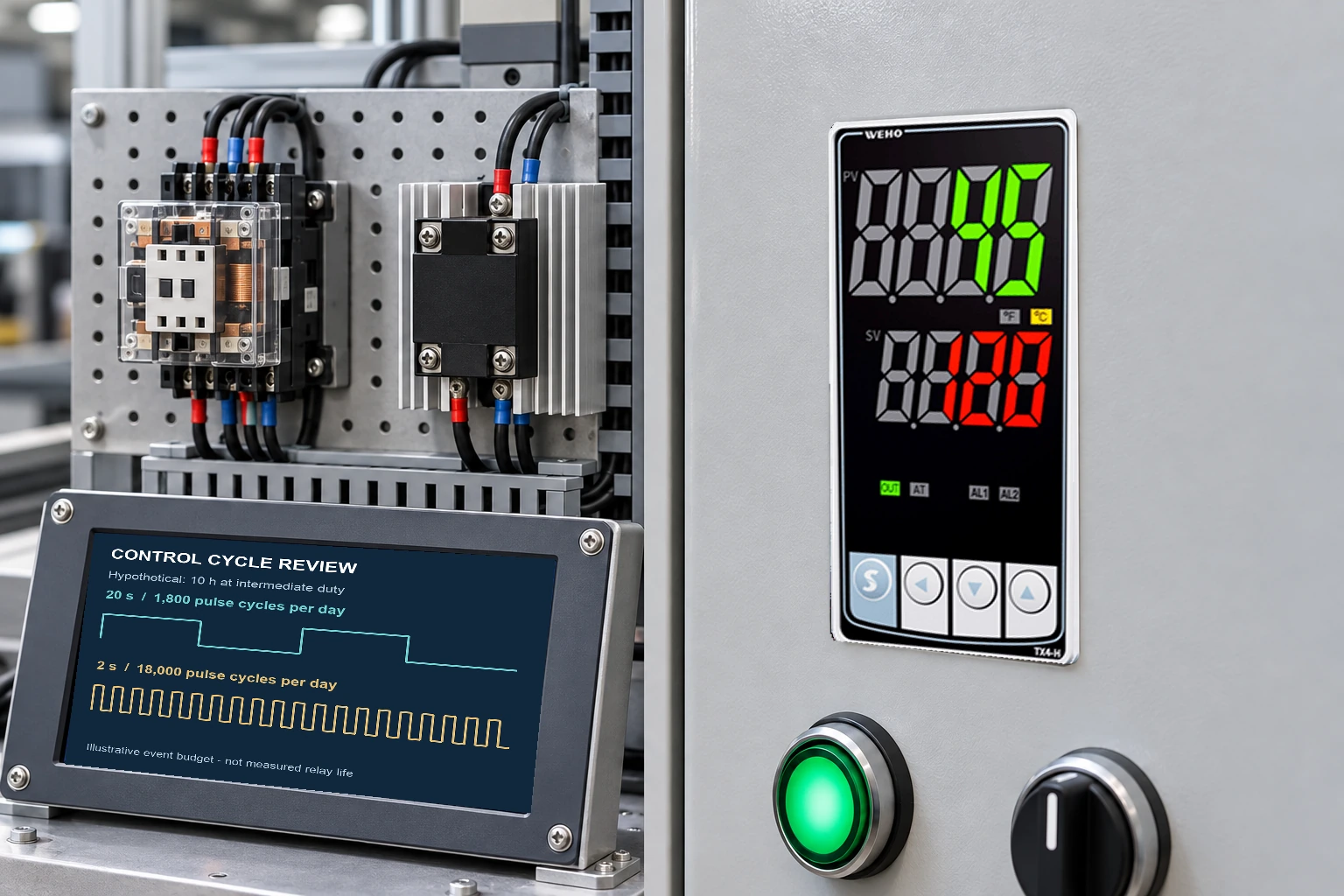
A shorter PID control cycle can greatly increase mechanical relay operations without increasing the controller’s displayed temperature accuracy. Before changing the TX4-H switching period, identify whether the installed output is a relay or an SSR drive and calculate the switching demand for the actual operating schedule.
This guide is for an OEM electrical designer choosing how a local temperature loop commands its power-switching interface. It provides an operations budget and a review method. It does not predict a contact replacement interval or authorize the controller to switch an arbitrary heater directly.
Identify the output before comparing cycle times
그만큼 WEHO TX4-H product page describes relay/SSR output selection. The TX4 instruction manual TX4 230808EN distinguishes the relay output from the 12 VDC±2V,≤20mA SSR drive and suggests 20s for relay control and 2s for SSR control. These are documented configuration references, not proof that every process or external switch should use those periods.
An SSR drive is a low-power control signal for a compatible external device. The relay output has its own voltage/current and load conditions. Confirm the complete ordering code, selected output mode and installed interface; the front TX4-H marking does not identify all of these details.
Count cycles at the duty that actually causes switching
For a simple repeating time-proportioning output at an intermediate duty, estimate one ON pulse and one OFF transition in each control period. If the period isT seconds overh operating hours, pulse cycles are approximately N = h ×3600/T. If recording individual transitions, the total is approximately 2N. State which convention is used.
This model is deliberately limited. At continuous 0% or 100% demand, a repeating pulse may not occur every period. Process changes, startup and alarm transitions can add events. Use an output trace or controller record to determine the real schedule rather than assuming every clock cycle creates a mechanical contact operation.
A tenfold cycle change creates a tenfold event estimate
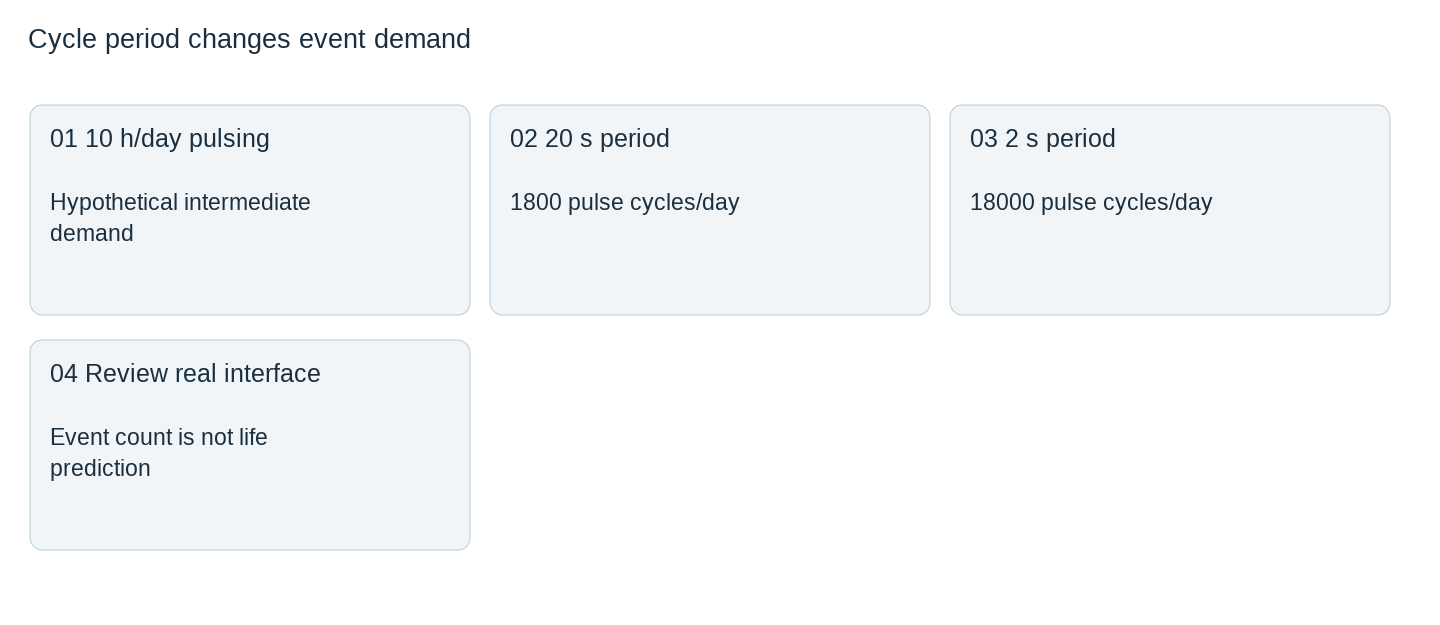

Assume a hypothetical loop runs 16 h/day and spends 10 h/day at an intermediate duty that creates one pulse cycle per period. At 20s, the estimate is 10 ×3600/20=1800 pulse cycles/day. At 2s, it is 18000/day. Over 250 such days, those become 450000 and 4500000 pulse cycles.
These are arithmetic event estimates, not predicted relay life. A mechanical endurance statement and an electrical endurance statement are different. Contact loading, switching conditions and the actual definition of an operation affect interpretation. Do not divide a mechanical life figure by 1800 and promise the customer that many days of electrical service.
Review the switch and the thermal process together
A slow period can produce more visible temperature ripple in some systems, while a fast period can create unacceptable switching demand for a mechanical interface. The useful comparison includes the process’s thermal behavior, required temperature variation, output-device ratings and any minimum ON/OFF timing of the external equipment.
If an external SSR is considered, verify its compatible control-input requirements, power-circuit rating, thermal installation and protection from its own documentation. The presence of an SSR-drive setting does not qualify an unspecified SSR, remove heat-sinking needs or establish the result of a power-device fault.
Use the output trace to explain the temperature result
Compare the candidate period on the actual process under an approved commissioning method. Record set value, measured value, output duty, startup behavior and steady-state variation. Count or estimate actual switching events during representative states. Keep the sensor type, control mode and other tuning parameters unchanged when isolating a period change.
Do not improve the apparent graph by smoothing away real temperature variation or omitting startup. If the process needs a faster period than the approved mechanical interface supports, revise the interface or process design. A different period is an engineering change, not a cosmetic setting.
Retain the full output configuration with the BOM
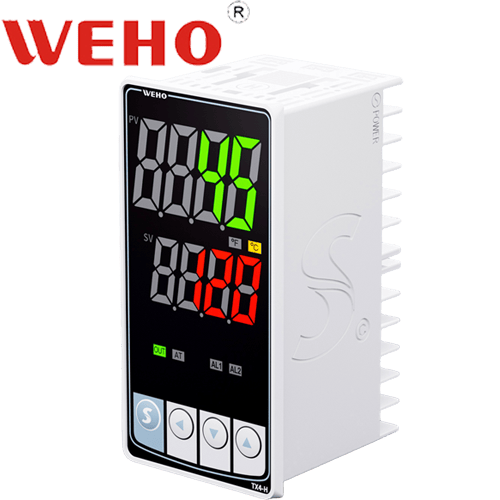
The official TX4-H illustration identifies the tall 48 ×96 mm front form. It does not identify the complete supply/output/alarm order code or prove a power-switching arrangement. Retain the current manual, exact device marking, external-switch information and tested control period together so replacement or setup restoration does not silently alter the event budget.
Send 웨호 the full TX4-H code, sensor type, selected output mode, external-switch model, operating hours and proposed period. Include the temperature and output trace when requesting a configuration review.
Control-cycle and switching demand record
| Representative state | Hours | Pulse cycles | Transitions convention |
|---|---|---|---|
| Period change | Old/new event estimate | Temperature variation | Interface limits |
| Trial | Actual output trace | Temperature trace | Release |
Blank project worksheet. Enter verified project data; example calculations above are not measurements.