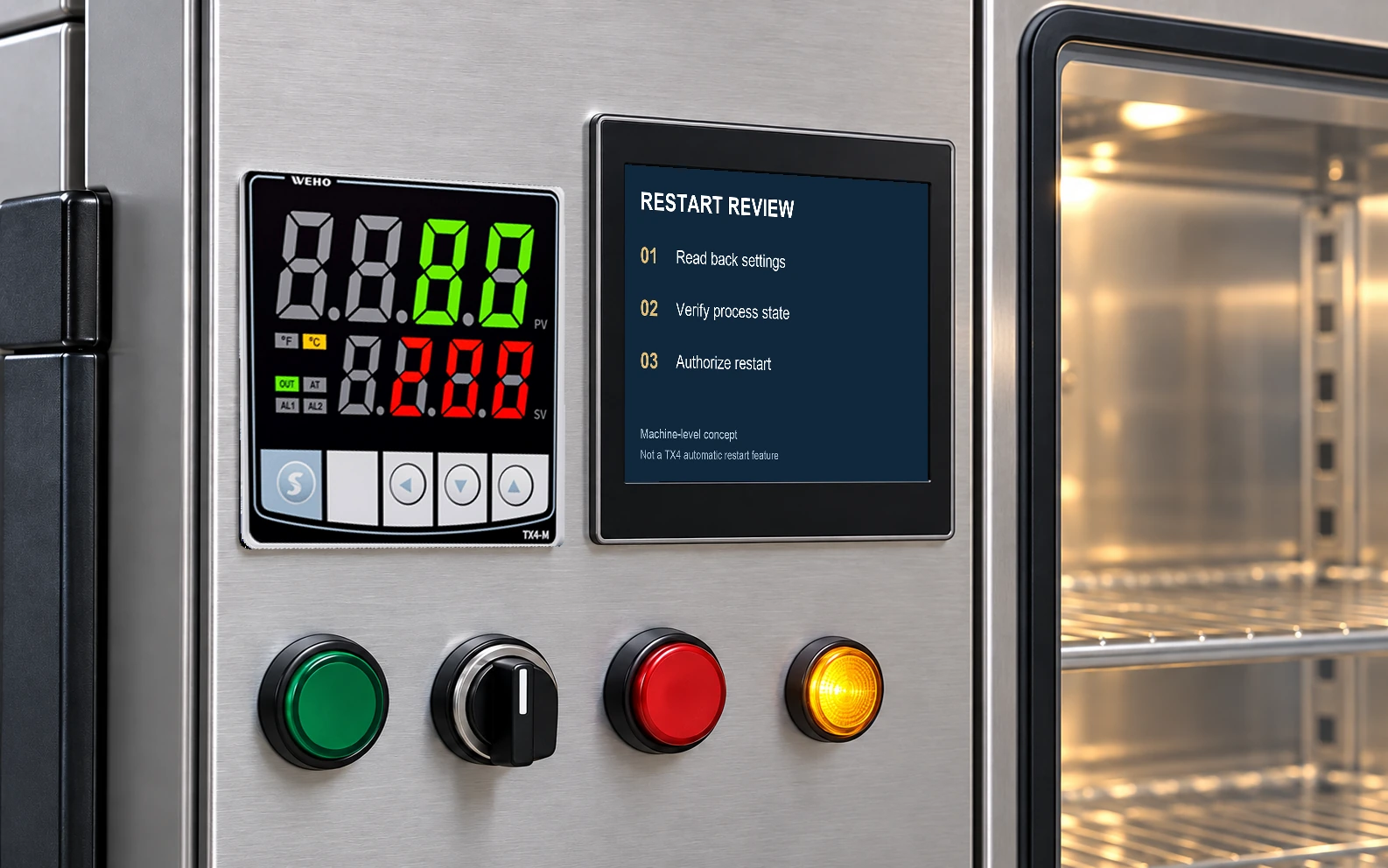
Retained temperature-controller settings do not by themselves authorize a hot process to restart. A TX4-M can be part of a local temperature loop, but the machine must still determine the actual thermal state, sensor validity and permitted output state after power returns.
This guide is for an OEM controls engineer writing a restart acceptance test. The central distinction is between information stored in a controller and the present condition of the equipment. It does not assert a verified TX4-M output state for every power-loss sequence.
List settings separately from physical process state
The WEHO TX4-M product table describes nonvolatile memory retention for the family. The TX4 230808EN manual identifies startup display behavior and configuration items. These are useful starting documents, but a retention-duration statement does not demonstrate the complete output sequence of a specific installed unit after a voltage dip or outage.
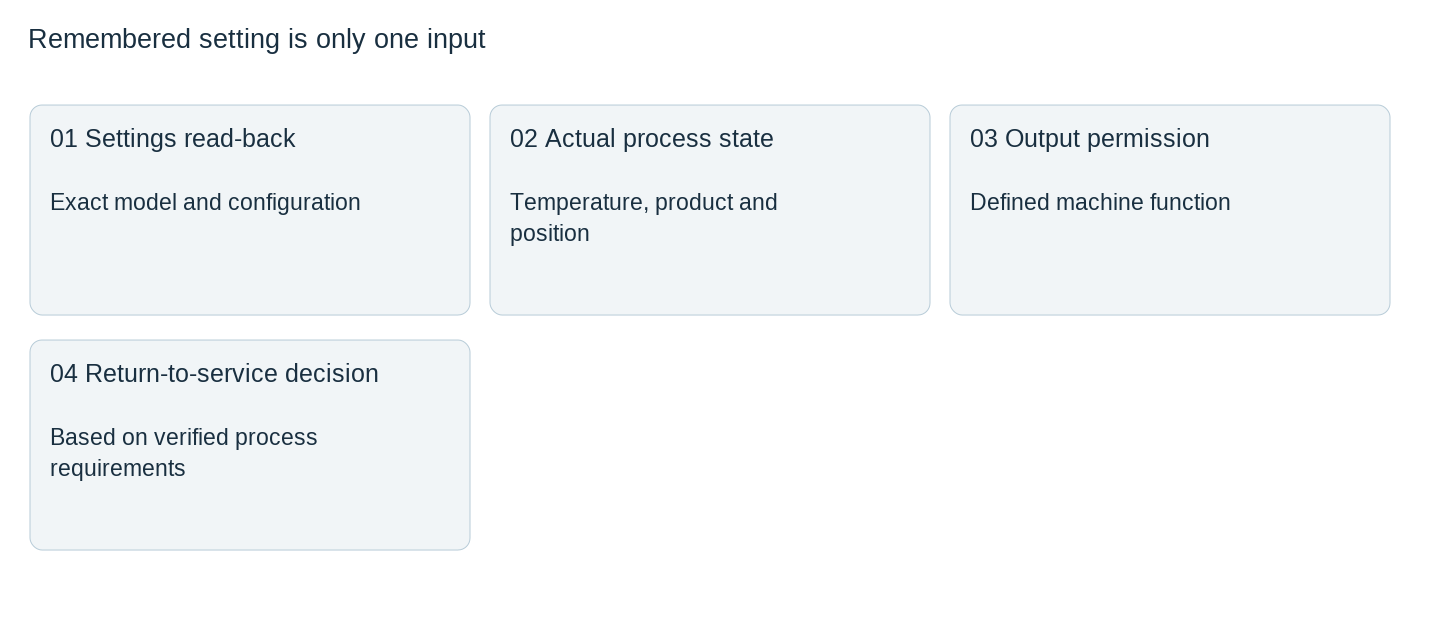
Set value, sensor type, units and control-output selection are configuration. Actual tool temperature, product condition, coolant flow and actuator position are physical states. A restored set value cannot tell the machine whether all of those states are ready for the next production cycle.
Define several restart cases instead of one power cycle

| Case | What can differ after return | Evidence to record |
|---|---|---|
| Cold start | Equipment and product begin near ambient | Configuration, sensor reading, output permission |
| Short interruption | Tool may remain hot while controls reboot | Interruption duration, PV, command state |
| Long interruption | Temperature and product condition may change substantially | Actual condition and restart disposition |
| Interrupted motion/process step | Sequence may no longer match physical position | Machine-state recovery and operator action |
These cases are not a universal timer specification. Choose durations and conditions from the actual process requirements. A dip that does not fully reboot one device may still reset another device in the chain, so the complete system response matters.
Show why the same retained setpoint is insufficient
Consider a hypothetical process whose retained set value is 160 °C. After one interruption the measured process temperature is 154 °C; after another it is 82 °C. The differences from the set value are 6 °C and 78 °C. Both cases can show the same 160 °C set value while requiring different warm-up, product disposition and readiness decisions.
These are illustrative numbers, not measured TX4 temperatures or approved process tolerances. Neither a 6 °C difference nor a 78 °C difference alone determines restart permission. The process owner must define the acceptable thermal history and any other required conditions. Do not infer a soak-complete or product-quality result from a display returning to its set value.
Make the restart permission explicit in the machine design
Identify which device holds the power-switching command inactive until the machine is ready, how readiness is established and what happens if the controller reboots before the rest of the system. Use the documented complete output option and external switching interface. Avoid assuming that a relay or SSR-drive output automatically restarts safely, remains OFF or resumes its previous duty without an actual applicable source and verification.
Separate controller operation from the independent protections required by the machine design. A local process controller, retained recipe and ordinary alarm should not be described as an independently qualified protective system. Any required manual acknowledgement must be a defined machine function, not merely an instruction hidden in the blog.
Observe the complete return-to-service sequence
Use an approved commissioning procedure to record source interruption, controller startup indications, actual measured temperature, selected output mode, external-switch command and the machine’s restart-permission state. Check that configuration read-back matches the controlled record. Include a case where the controller and another relevant subsystem return at different times if that can occur in the equipment.
After restoration, verify the sensor and actual process state before admitting production. Record whether the process is resumed, rewarmed, inspected or rejected according to the process specification. Do not use a successful laboratory reboot as evidence for every voltage dip, firmware revision or installed power-switching arrangement.
Keep the complete M code with the restart test
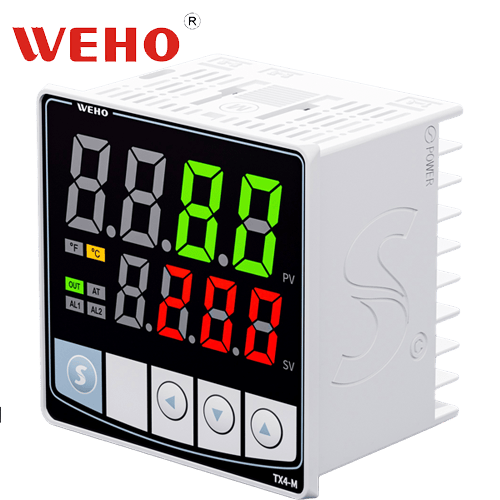
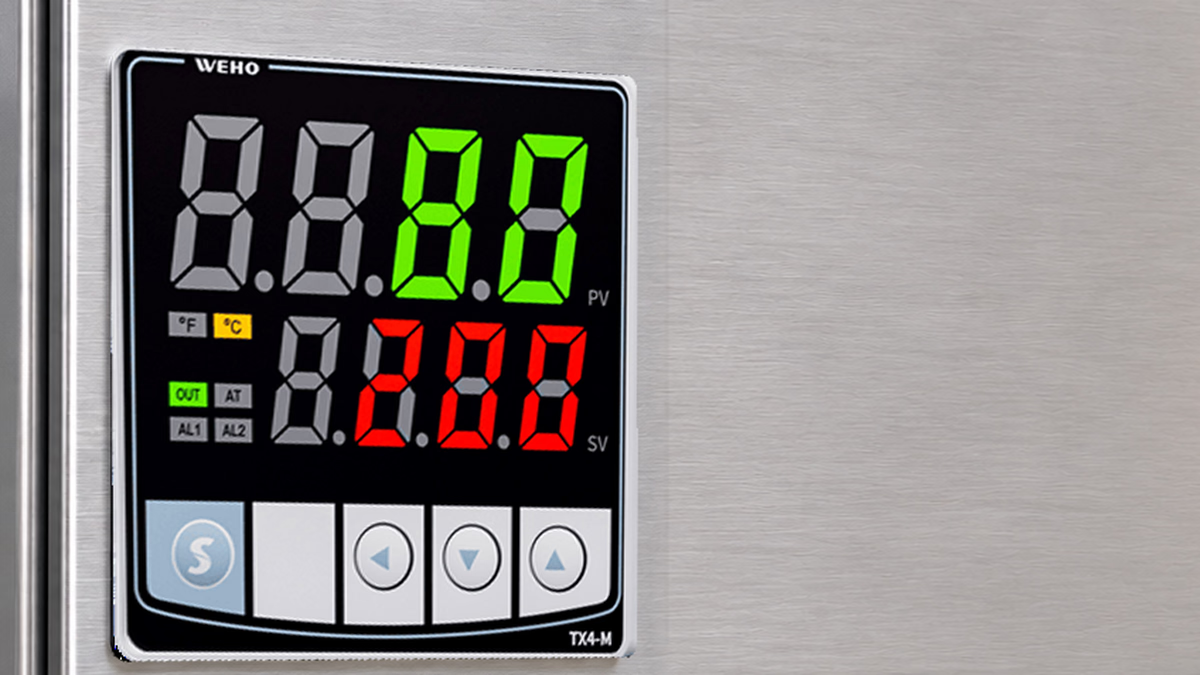
The official TX4-M image identifies a 72 ×72 mm front form, not the full supply/output/alarm option or the exact restart behavior. Retain the device marking, manual revision, parameter record and tested machine logic together. A replacement controller or a restored recipe should trigger the relevant read-back and restart checks rather than inheriting the previous unit’s result automatically.
Send WEHO the complete TX4-M code, manual revision, outage cases, external output interface and restart observations. Ask for clarification of documented controller behavior while keeping machine restart acceptance with the responsible controls and process teams.
Power-interruption restart record
| Case | Interruption/return sequence | Measured temperature | Actual process condition |
|---|---|---|---|
| Read-back | Sensor/unit/output selection | Set value | Różnica |
| Output permission | Before/after return | Machine interlocks | Observed behavior |
| Disposition | Resume/warm/inspect/reject | Evidence | Responsible signoff |
Blank project worksheet. Enter verified project data; example calculations above are not measurements.