400VAC and 480VAC Power Supplies: Match the Actual Input Window
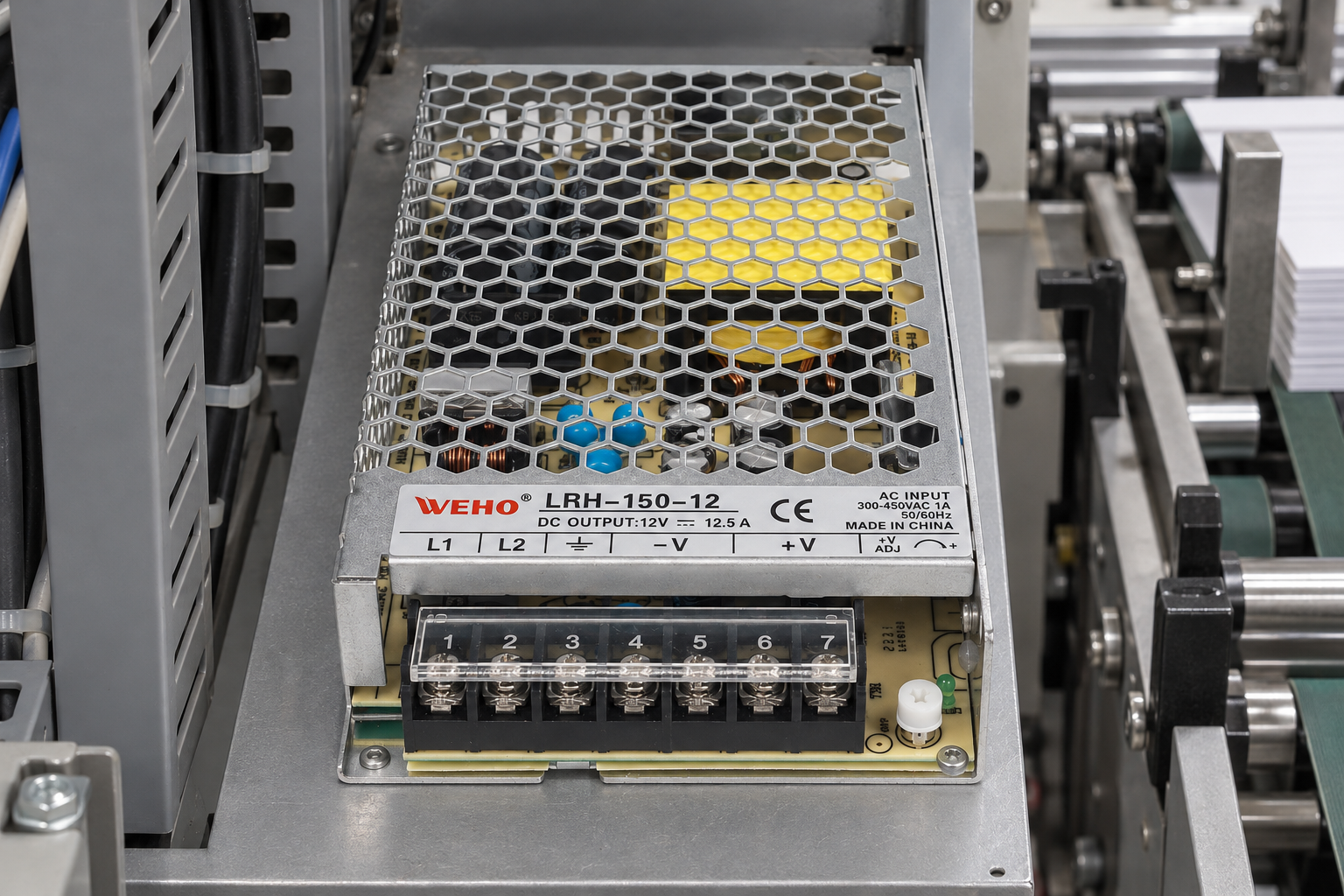
A power supply described as a 380 V or 400 V model is not automatically suitable for a 480 V supply. Compare the actual voltage at the intended input connection, including its specified variation, with the exact unit’s permitted input window. The WEHO LRH-150-12 example in this article is marked 300–450 VAC: a nominal 400 VAC source may fit that window after the full conditions are checked, but 480 VAC is outside it.
For machine builders and distributors, this comparison should happen before choosing the cabinet layout or ordering a regional machine variant. A familiar product-family name is not enough to decide an input-voltage match.
Read the window, not only the nominal voltage
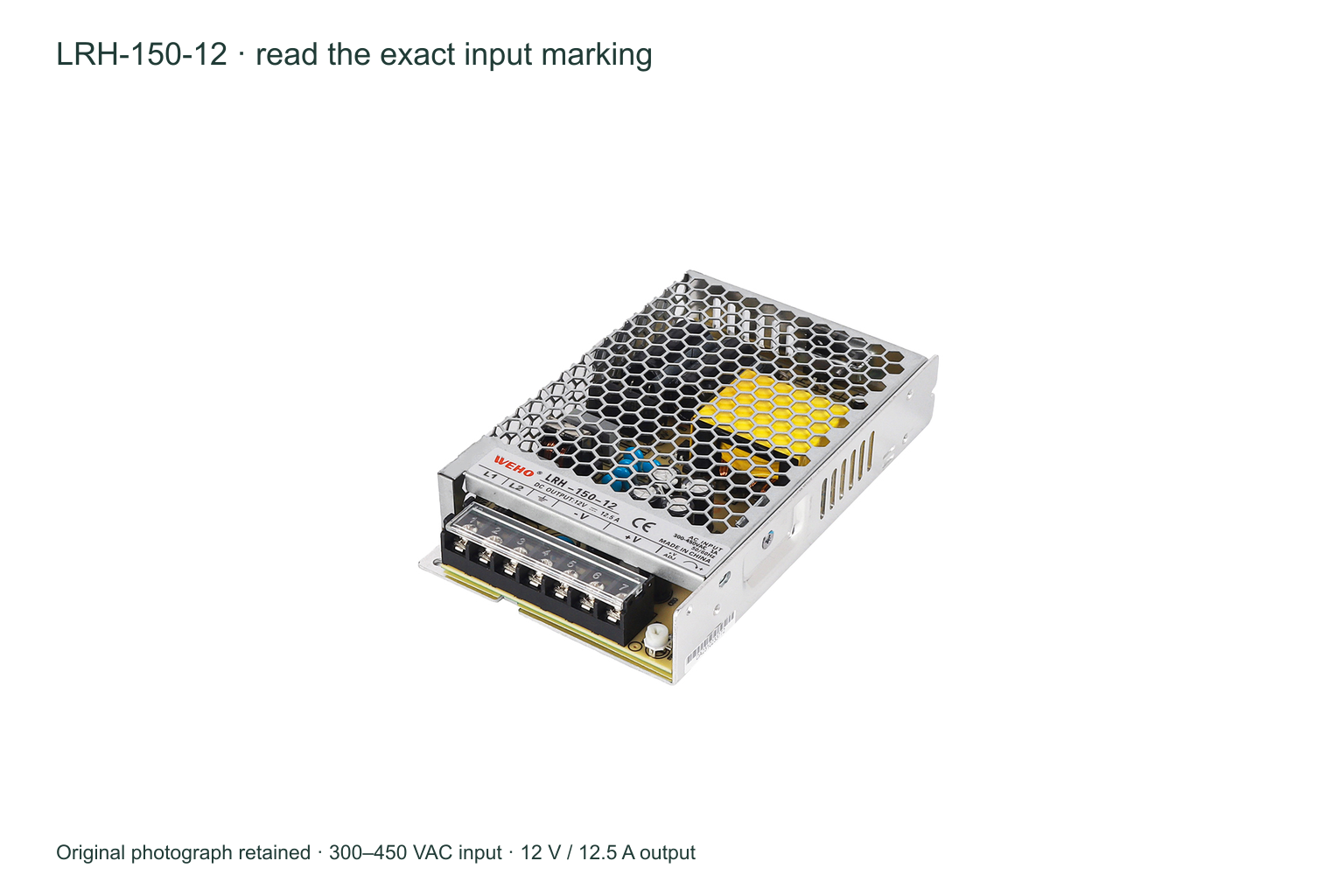
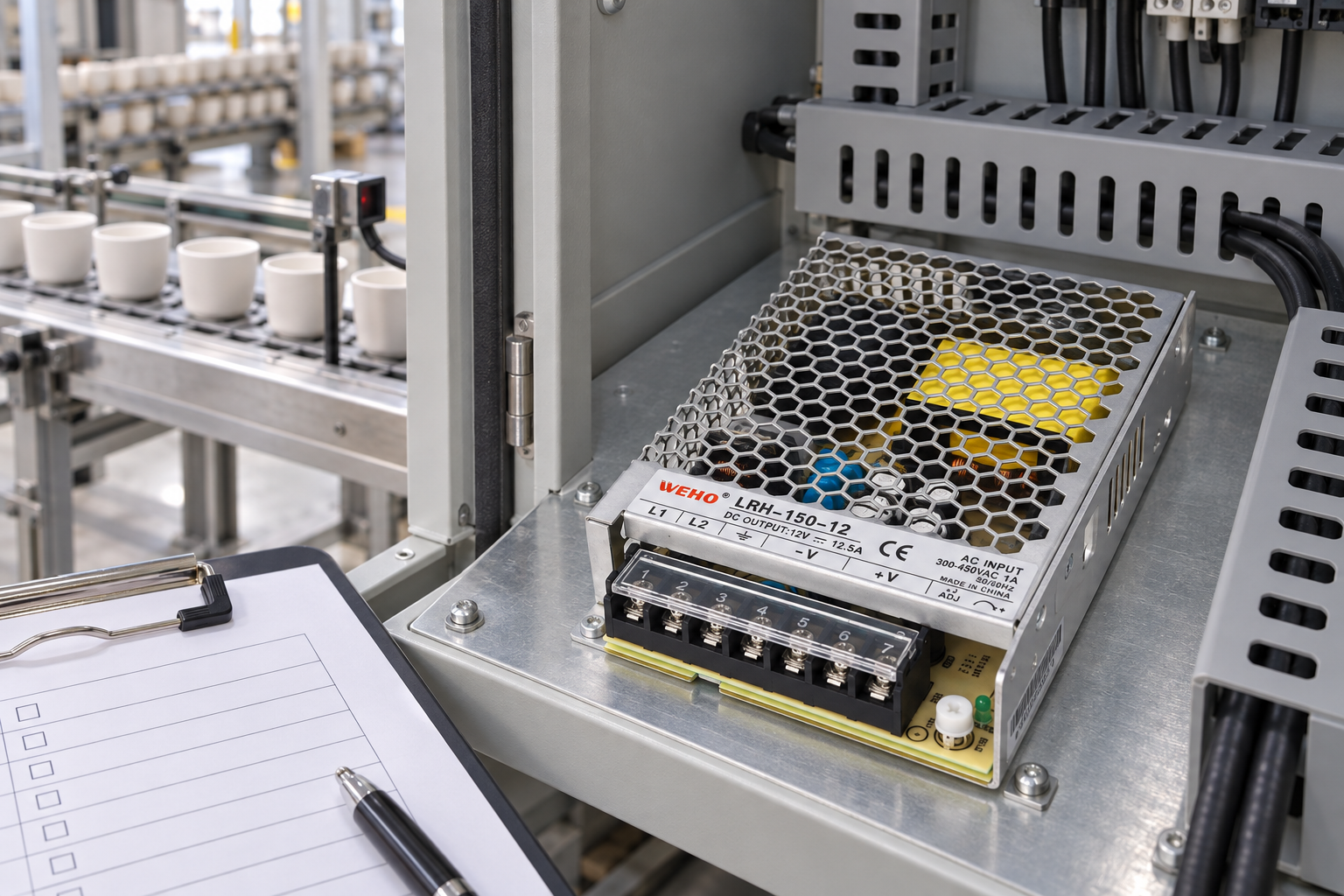
The WEHO LRH-150 product page identifies a high-line AC-to-DC family. The specific LRH-150-12 source label states 300–450 VAC, with a 12 V, 12.5 A output. Its input terminals are marked L1 and L2, followed by protective earth. The DC output terminals are a separate interface; their low output voltage does not reduce the required input-side review.
Record the full suffix and the actual marking on the unit being purchased. Then obtain the matching specification and installation information. If a quotation, product-family description and delivered label disagree, resolve the difference with the supplier before connecting the unit. Do not assume that a tolerance from one model or revision applies to another.
Compare both ends of the source range
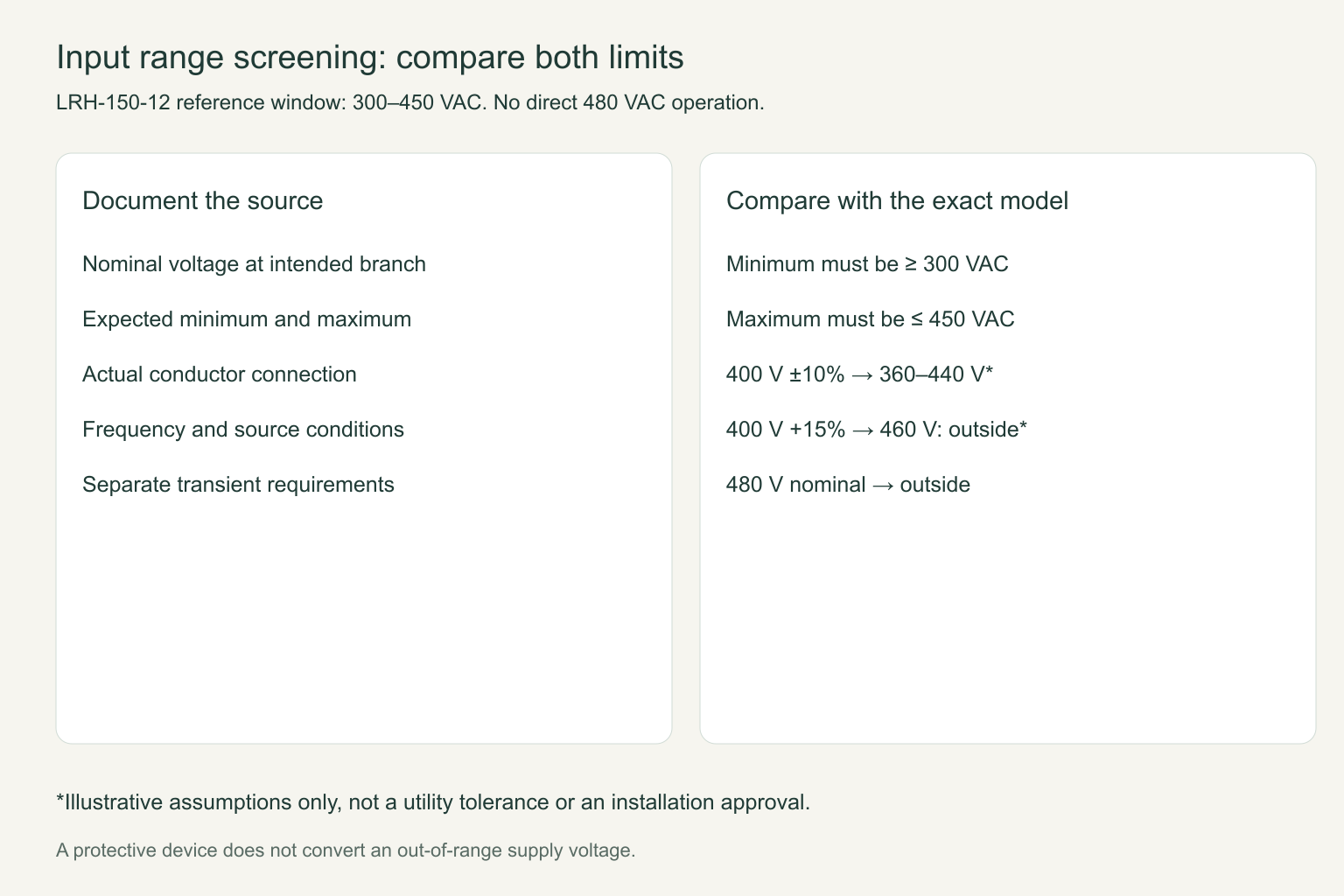
The basic selection check is straightforward: the expected minimum source voltage must not fall below the permitted minimum, and the expected maximum must not exceed the permitted maximum. The nominal value sitting inside the window is necessary but not sufficient. Use the actual project supply specification, including the intended connection point, rather than an assumed national or regional tolerance.
| Illustrative source case | Arithmetic comparison with 300–450 VAC | Procurement conclusion |
|---|---|---|
| 400 VAC nominal, with an assumed ±10% range | 360–440 VAC lies inside the stated window | Input-voltage screening is satisfied under this assumption only; other requirements remain |
| 400 VAC nominal, with an assumed +15% maximum | The upper value is 460 VAC | That maximum exceeds the window; do not accept the nominal value alone |
| 480 VAC nominal | 480 VAC already exceeds 450 VAC | This LRH-150-12 must not be selected for direct operation from that source |
These percentages are hypothetical arithmetic examples, not statements about a particular utility or electrical standard. They do not cover transient events, source disturbances or installation acceptance. Those requirements need separate documentation.
Confirm what voltage reaches the two input terminals
A site voltage description does not necessarily identify the voltage at every branch. Ask the responsible electrical designer to identify the intended supply conductors, grounding arrangement, protective devices and voltage at the power supply connection. A photo of a three-phase cabinet cannot establish those facts.
Do not reinterpret L1 and L2 as a permission to connect any two conductors, and do not infer a three-phase-input power supply from the surrounding equipment. The LRH example presents two AC input positions plus protective earth. The exact branch design and safe verification belong to qualified personnel working to the equipment documentation.
If the machine uses a transformer or another conditioning stage, evaluate the voltage and applicable conditions on that stage’s output. Its presence is not an automatic cure: the intermediate equipment, protection, loading and fault behavior must be specified as part of the system.
Keep steady-state range and transient capability separate
The input window answers a continuous operating-voltage question. It does not, by itself, establish immunity to every switching event, surge or temporary overvoltage at a factory site. Ask for the evidence required by the equipment specification and confirm the exact conditions attached to it.
Likewise, an input fuse or protective device should not be treated as a voltage converter. Do not approve a 480 VAC connection to a 450 VAC maximum unit on the assumption that a protective device will make the mismatch acceptable. Select equipment with a documented input range that covers the source, or have the electrical architecture redesigned and evaluated.
Put the input decision into the purchasing record
A useful review sheet has separate fields for the nominal voltage, expected minimum and maximum, intended conductor connection, frequency and relevant disturbances. Alongside them, record the exact power supply model, specification revision and permitted range. Keep the arithmetic comparison visible rather than reducing the decision to a single tick beside “400 V compatible.”
Only after this screen should the buyer proceed to output load, thermal conditions, mounting and cable-interface checks. The LRH-150-12 drawing specifies a 159 × 97 × 30 mm chassis and bottom M3 mounting provisions; fitting it mechanically does not establish that the selected source is electrically acceptable.
Frequently asked questions
Can this LRH-150-12 operate directly on 480 VAC?
No. Its referenced 300–450 VAC input marking does not cover 480 VAC. Request an appropriately rated model or a separately engineered supply arrangement.
Is a 400 VAC nominal source enough to approve the selection?
No. Confirm the source’s minimum and maximum at the intended connection, then check the remaining electrical, environmental and installation conditions.
Does the 12 V output make input selection less important?
No. Input and output are distinct interfaces. The required output voltage cannot compensate for an input-voltage mismatch.
Request a model against the actual site supply
Send the documented input range and connection arrangement, desired output voltage and current, cabinet conditions and applicable equipment requirements to WEHO. Ask for a full-model recommendation and the matching current specification. State 480 VAC explicitly where that is the source; do not let a broad “high-voltage input” description conceal the limit.