Last Updated: October 10, 2026
Quick answer: A power supply fan filter maintenance record should identify the cabinet’s external filter and fan separately from the installed power supply. For the WEHO DRP-240-24 example, document the host enclosure’s dust route, filter condition and controlled maintenance requirement without inventing an internal supply fan, cleaning method or replacement interval.
Separate the filter assembly from the power unit
An OEM service sheet may use one convenient line for “power supply cooling.” That line can hide several different objects: a cabinet inlet filter, a host enclosure fan, a duct, the power unit’s ventilation openings and the surrounding equipment. A maintenance action on one object does not automatically establish the condition of the others.
Start with an assembly map. Give the external filter housing and cabinet fan their own equipment references. Link the installed power supply to its full model and revision. Then identify which controlled instruction governs each component. This makes a service observation more useful than an undifferentiated note saying that the power supply was cleaned.
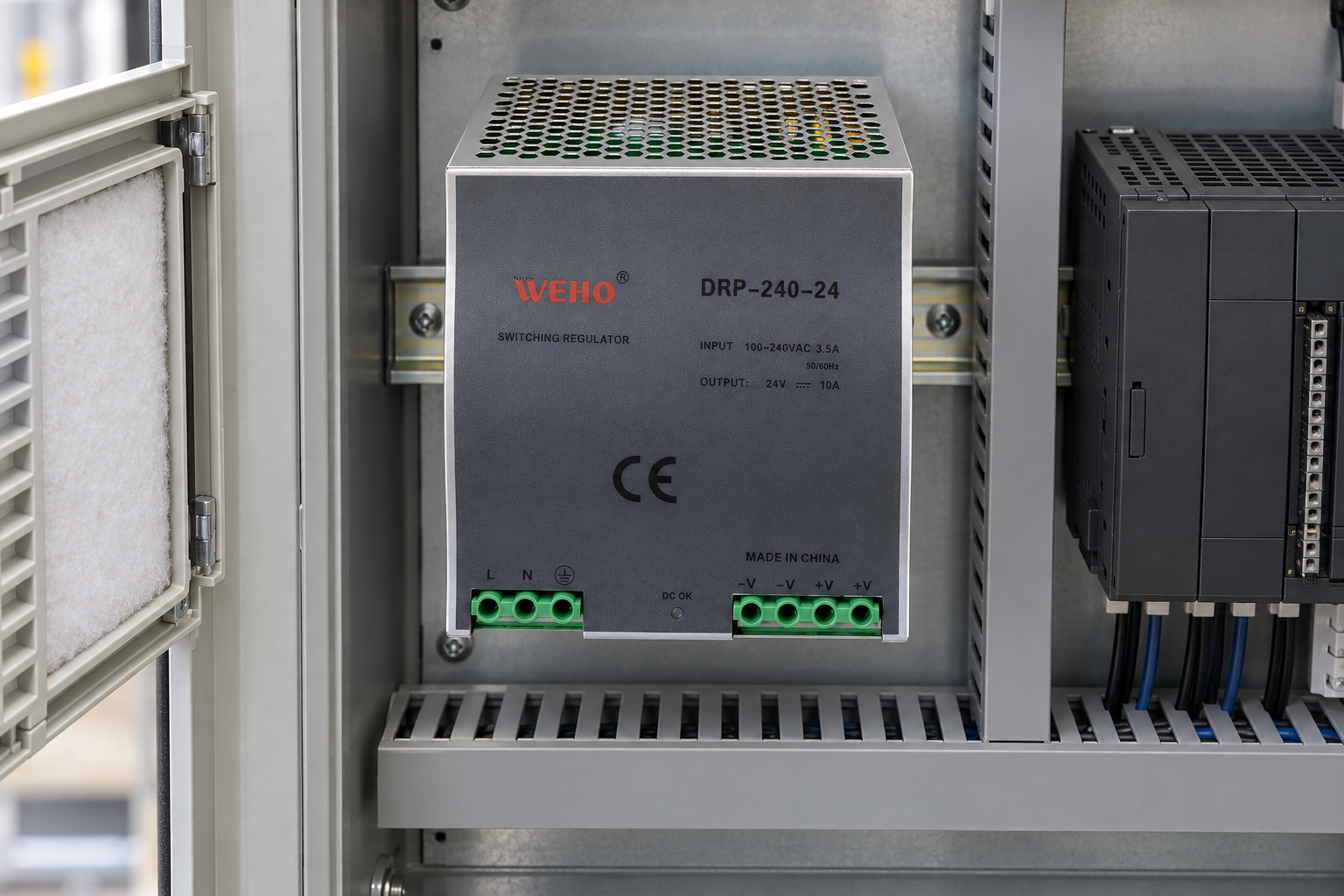
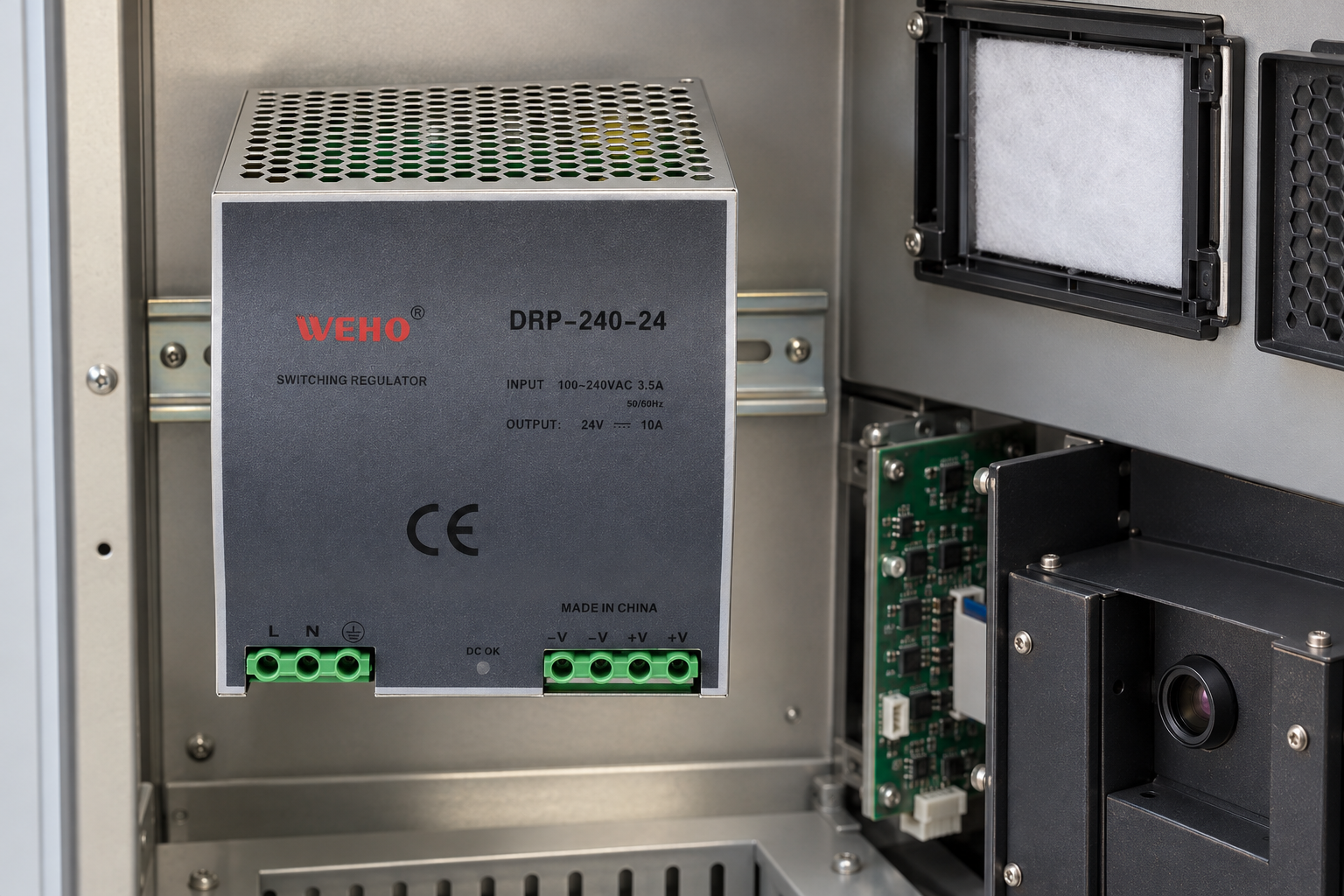
The selected DRP-240-24 source set shows a ventilated metal enclosure but no visible internal fan. This article therefore treats the external filter and fan as host-cabinet components, not accessories supplied with that power unit. Their illustrated positions are scene context, not a WEHO airflow specification.
Identify the installed unit without expanding its claims
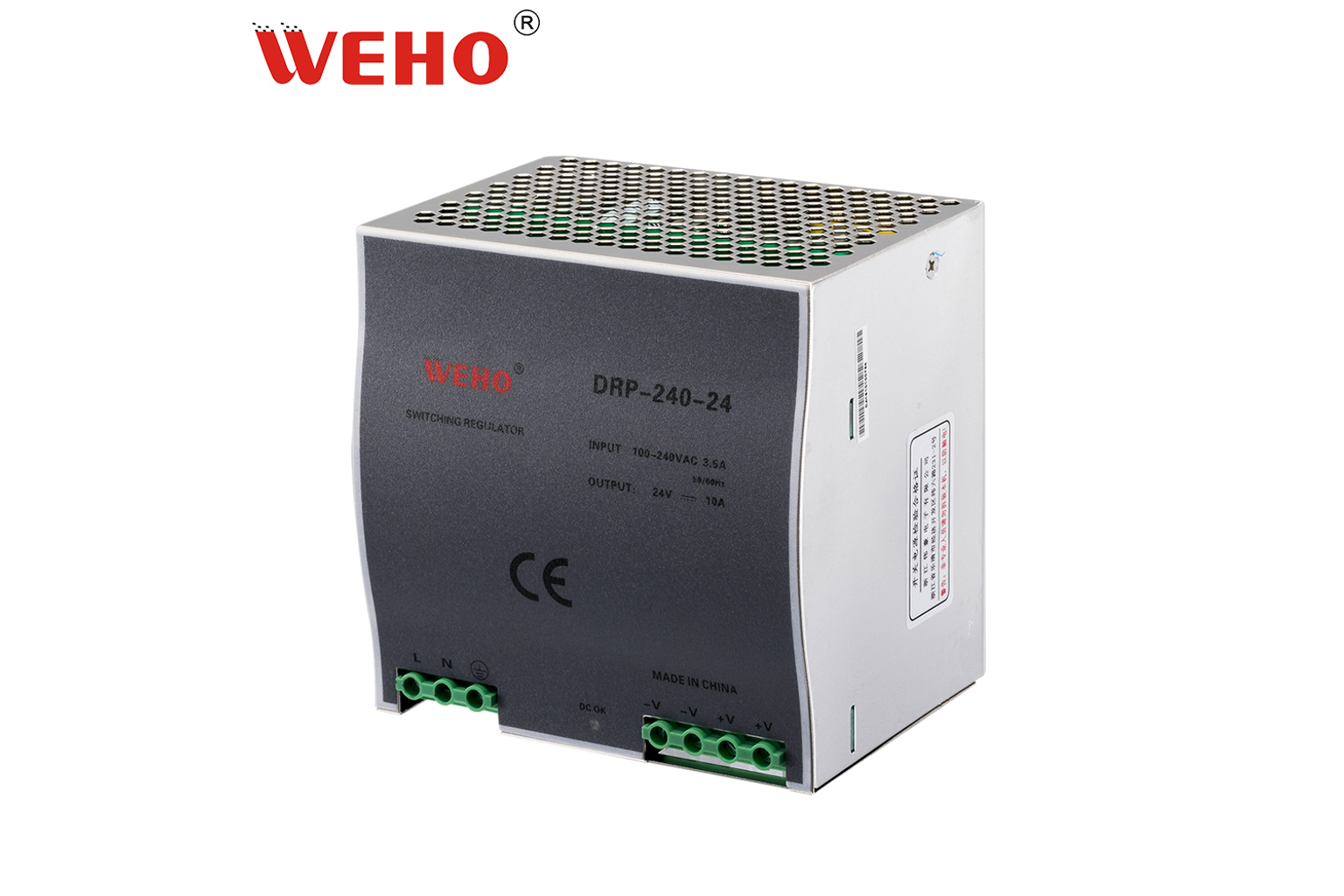
The original front photograph identifies DRP-240-24 and nominal markings INPUT 100–240VAC 3.5A, 50/60Hz and OUTPUT 24V DC 10A. Its two lower green groups contain three input positions and four output positions. Those observations identify the sample; they do not set an external filter interval or prove a cabinet’s thermal performance.
The retained complete drawing records a 125.5mm front width, 125.5mm height and 100mm front-to-rear depth. The source rear photograph documents the steel rail-engagement assembly and white release part. The public dimensional entry differs in height, so the retained sample and current ordered revision must not be treated as automatically interchangeable. Obtain the applicable controlled drawing for an actual assembly. WEHO DRP-240 product information.
Do not turn the visible ventilation pattern into a claim about airflow direction, a required clearance, an internal fan or a cleaning opening. A cabinet filter belongs to the cabinet design. The supply’s exterior photograph cannot replace the equipment builder’s installation and service instructions.
Record filter condition, not an invented calendar
An inspection schedule needs an applicable equipment requirement and a way to record what was observed. Do not copy a monthly replacement interval from an unrelated cabinet or another power-supply family. An interval also needs a revision history: who defined it, what exposure it assumes and when the equipment configuration changed.
Useful observations can include the external filter’s identity, its recorded condition, the location of visible deposits and whether an enclosure change affects the documented ventilation route. Keep the observation and disposition separate. “Filter changed” records an action; it does not establish why the cabinet previously became warm or whether every affected condition was corrected.
Where the equipment procedure uses measurements, preserve the point, instrument reference, machine state and acceptance basis. A room-temperature reading is not a power-component temperature. A different reading after service does not, by itself, prove that the filter caused an earlier fault.
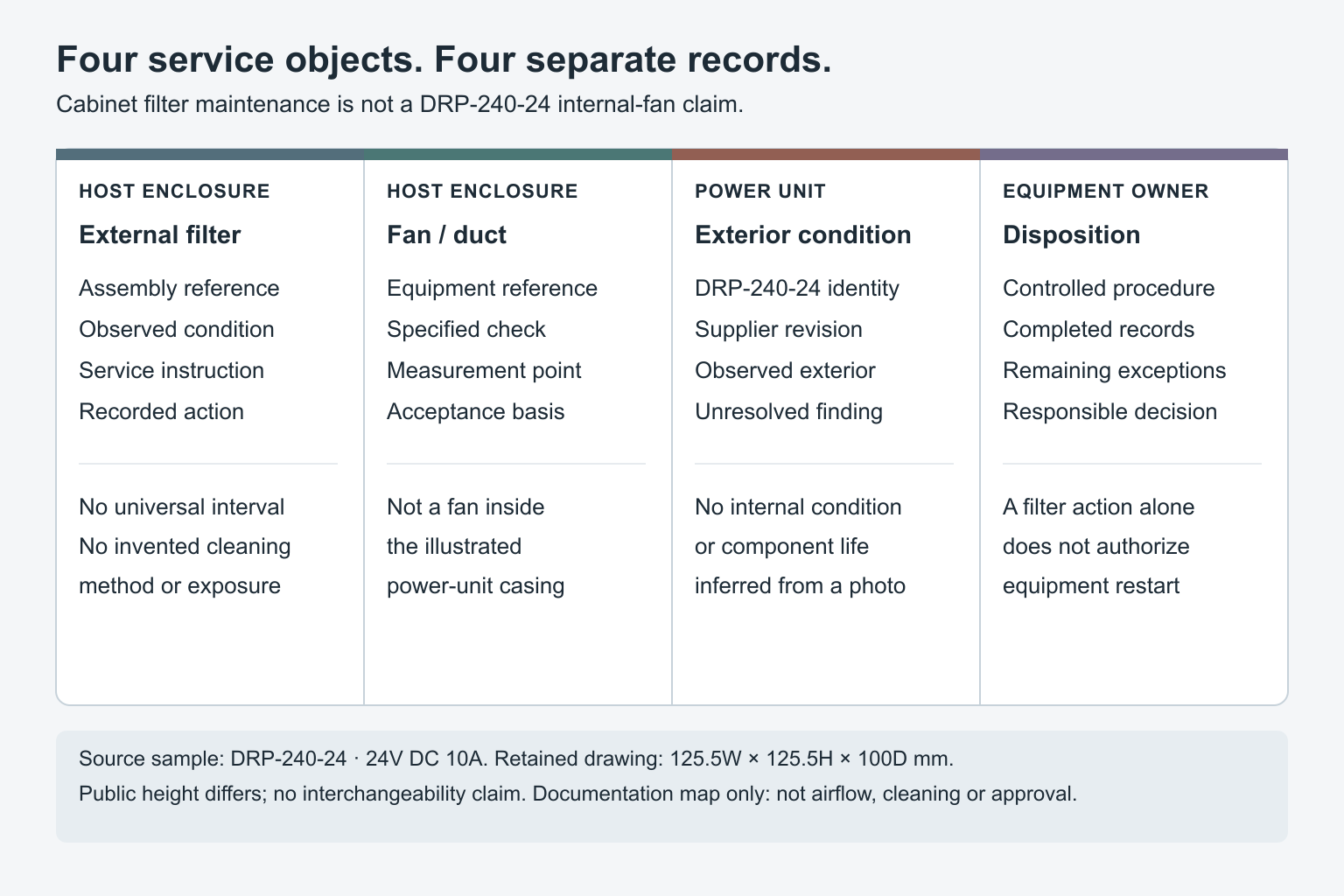
Use one short record for each service object
| Object | Evidence to retain | Decision boundary |
|---|---|---|
| External cabinet filter | Assembly reference, observed condition and applicable service instruction | No universal interval or cleaning method inferred |
| Host fan or duct | Exact equipment reference and specified check or measurement | Not a fan inside the DRP-240-24 |
| Power-unit exterior | Full model, visible condition and matching supplier reference | No inferred internal contamination or component life |
| Equipment return to service | Completed procedure, remaining exceptions and responsible disposition | A filter action alone is not restart authorization |
This is a proposed documentation structure, not a performed inspection. The equipment owner defines energy-control arrangements, access permissions, approved cleaning or replacement methods and return-to-service requirements through its controlled procedures. This article supplies none of those machine-specific instructions.
Keep an unresolved symptom open until evidence resolves it
If a service event involves lost DC power, abnormal cabinet temperature or equipment stoppage, retain the symptom, filter observation and subsequent finding as separate fields. A dirty-looking filter is not a confirmed supply failure. Replacing the supply is not proof that the removed unit was defective.
Record what changed during the visit. A filter replacement, enclosure modification, load change and exchanged power unit create different comparison conditions. Preserve the earlier configuration instead of overwriting it with the latest photograph. If the cause remains uncertain, use an explicit unresolved disposition.
For supplier clarification, name the exact power model, reference revision and observed exterior condition. For filter or fan questions, name the host assembly and equipment instruction. Routing the question to the correct object avoids asking the power-supply supplier to approve a cabinet maintenance method it did not define.
Konklusyon
Power supply fan filter maintenance is clearer when the external enclosure components and power unit have distinct identities, observations and controlled requirements. Use the DRP-240-24’s actual markings and mounting evidence to identify the illustrated sample, then obtain the equipment-specific maintenance basis. Leave an interval, cause or restart decision open when its required evidence is missing.