Last Updated: October 3, 2026
Quick Answer: For a fanless cabinet candidate, power supply cooling acceptance should begin with a controlled test plan, not a general claim that removing a fan makes the enclosure suitable. Record the exact model and revision, load profile, local air conditions, mounting and cabinet configuration; agree the applicable limits before measuring. Retain the resulting evidence and review changes to layout, load, ventilation or maintenance. The WEHO DR-120-24 illustrated here is a source-verified 24 V, 5 A DIN-rail example, not a documented sealed-cabinet thermal qualification or a measured test result.
An OEM buyer investigating power supply cooling needs an answer to a specific release question: will the ordered unit remain within its documented operating conditions in this particular cabinet and duty cycle? A catalogue comparison between fanless and fan-cooled designs does not answer that question.
This guide is a thermal-acceptance planning checklist for auxiliary control electronics. It does not rank cooling technologies, promise service life or supply a derating curve. The illustrations show disconnected mechanical preparation; none depicts an energised thermal trial or proves compatibility with the surrounding machinery.
Freeze the sample and configuration before the trial
Give the evaluation a configuration record. Identify the full model, revision and sample; record the input condition, output setting, normal and demanding load states, mounting orientation and relevant neighbouring components. Link the current specification and installation instructions rather than relying on a remembered family rating.
Record the enclosure as it will be assessed: door state, installed covers, cable ducts, openings, any filters or cabinet ventilation, and heat-producing neighbours. An open-bench result is evidence for that bench setup, not automatic evidence for a closed production panel. If service-door operation is a permitted machine state, assess it as a separately recorded condition rather than mixing configurations in one result.
Document uncertainty in the load data. A heater, moulding drive or baggage-conveyor motor is not assumed to belong to a 24 V controller supply. Verify the actual auxiliary electronics and overlapping demand from their specifications or safe measurements. If the worst state is unknown, do not substitute a convenient percentage of nameplate power and call it the acceptance load.
Keep room temperature separate from local air and case temperature
Define measurement locations before collecting data. Room air, air close to the supply, enclosure air and an external case point describe different conditions. A comfortable room can coexist with a hotter pocket near neighbouring equipment. Equally, a case reading does not establish the internal temperature of every component.
Use the measurement method and locations required by the controlled documents or agreed engineering plan. Record sensor identity, location, attachment where appropriate, uncertainty and whether the measurement itself changes access or airflow. Qualified personnel must manage electrical access and instrumentation safely; this guide does not instruct anyone to place a probe on exposed energised parts.
Agree how thermal stabilisation will be recognised and documented. Do not apply an arbitrary fixed waiting time to every panel. A useful record preserves the time history, load and environmental conditions used for the decision, along with the responsible reviewer’s criterion. Without an agreed criterion, a single temperature photograph is not a defensible steady-condition acceptance result.
Use the exact model as an evidence anchor
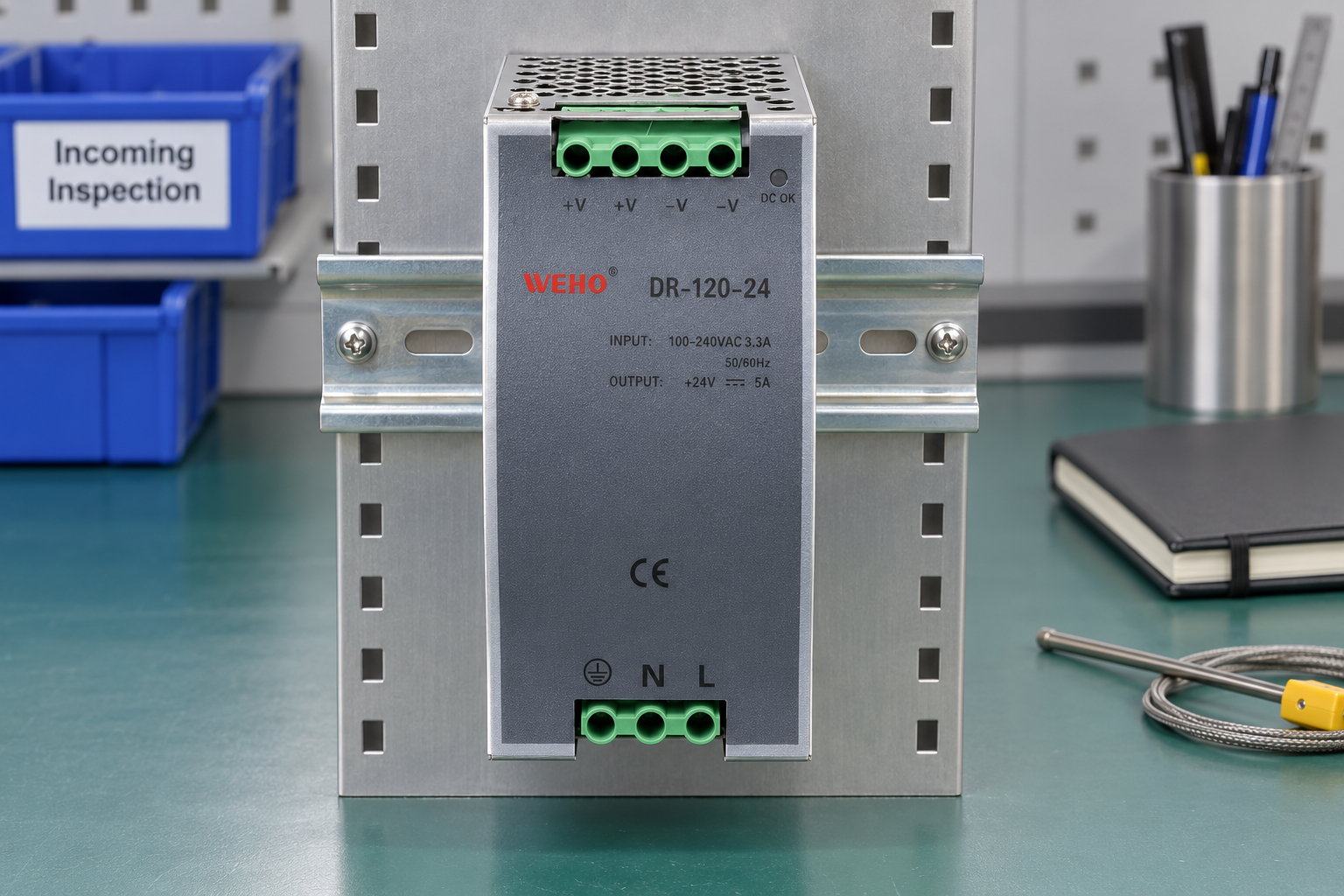
The WEHO DR-120 product page identifies DR-120-24 at 24 V, 5 A and 120 W. The current mechanical specification records 65.5 mm width × 125.2 mm height × 100 mm depth, with rear DIN mounting. This envelope excludes the additional ventilation, wiring and service space required by the ordered installation instructions.
The approved source photograph shows a ventilated metal casing and no visible fan. It does not establish a dustproof enclosure, sealed-box rating, zero electrical noise or a particular thermal limit. Confirm the ordered unit’s documented cooling and installation conditions. Do not infer an allowable current-versus-temperature curve from the absence of a fan or from another model’s specification.
Keep the source label’s nominal input “100-240VAC 3.3A” and “50/60Hz” separate from the current specification’s operating 85–264 VAC and 47–63 Hz table. Resolve the ordered revision before electrical release. This article does not adopt conflicting public-page input wording or convert a mechanical source image into proof of a thermal operating point.

The first application scene concerns an injection-moulding equipment builder’s auxiliary-control cabinet. The nearby machine establishes the field, but the disconnected supply does not power mould heaters or the hydraulic drive. Actual cabinet heating, duty cycle and control-load demand require their own evaluation; an assembly illustration supplies none of those measurements.
Write limits first, then compare the evidence
The acceptance plan should identify the controlled output limits and relevant environmental and installation restrictions for the ordered revision. Request missing manufacturer information before setting a release gate. A generic operating-temperature range without its load, mounting and cooling conditions is not enough to justify every enclosed installation.
State what will be observed: agreed temperature points, output at the demanding control loads, relevant operating status and any abnormal behaviour under the defined test condition. Specify how interruptions or configuration changes are recorded. A passing average voltage alone does not close a thermal question, and an indicator window is not an independent temperature measurement.
Do not invent a thermal pass limit, derating percentage or shutdown temperature where the documents provide none. Record the missing basis as an open supplier or engineering action. If the sample unexpectedly cycles, resets loads or exhibits abnormal behaviour, retain that evidence and investigate safely rather than assuming the cause or changing the criterion after seeing the result.

The second scene is a protected dry baggage-handling equipment workshop. It shows an auxiliary-controller fitting station beside a stopped luggage conveyor, not a powered airport installation. The candidate’s use does not establish aviation approval, equipment safety or motor-drive capacity. Service conditions and the responsible system requirements must be verified independently.
Review dust exposure, maintenance and later changes
Fanless does not mean vent-free or maintenance-free. For a vented metal candidate, evaluate the actual cabinet’s contamination exposure, enclosure protection and documented maintenance arrangement. Do not claim that an internal supply photograph establishes an ingress-protection rating for the finished cabinet. Keep openings and access consistent with the installation instructions; cleaning procedures must follow the equipment’s safe service requirements.
Make the configuration record useful after initial qualification. Increasing control demand, changing a neighbouring drive, rerouting ducting, relocating the supply or modifying cabinet ventilation can change the evaluated thermal conditions. Have the responsible reviewer decide whether the existing evidence remains applicable or further assessment is required. A changed filter or maintenance interval also deserves a documented impact review where it affects the evaluated configuration.

For procurement, request a traceable file containing the ordered-model documents, agreed test plan, sample identity, configuration record, actual results, deviations and release decision. Keep missing information visible. No lifespan prediction, sealed-cabinet approval or guaranteed thermal performance is established by this guide or its AI-generated images.
Key Takeaways
- Define the ordered unit and cabinet configuration before collecting thermal data.
- Distinguish room air, local air and case points; record measurement uncertainty.
- Agree documented limits and stabilisation criteria before reviewing results.
- Do not infer dustproofing, sealed-box capability or a derating curve from fan absence.
- Review layout, load and service changes against the retained evidence.
Konklusyon
Effective power supply cooling acceptance is a controlled evidence process, not a cooling-method label. DR-120-24 supplies a specific 24 V, 5 A mechanical identity for discussion, while the ordered cooling conditions and actual cabinet performance remain engineering checks. Ask WEHO for the applicable controlled information, retain real sample data and resolve open questions before releasing the auxiliary-control panel.
Frequently Asked Questions
Is this another fanless-versus-fan-cooled comparison?
No. It concerns a controlled thermal-acceptance plan and configuration evidence for an auxiliary-control cabinet, rather than ranking cooling technologies.
Does the DR-120-24 image prove a sealed-cabinet rating?
No. The approved photo shows a ventilated metal unit and no visible fan. Ordered cooling and installation conditions still require controlled documentation; the image proves neither sealed-box performance nor dustproofing.
Can room temperature be used as the supply’s local air temperature?
Not without an agreed measurement basis. Room air, local air, enclosure air and external case points are different conditions and should be identified separately in the test plan.
How long should every thermal trial run?
This guide provides no universal duration. Agree a stabilisation and recording criterion suitable for the documented unit, enclosure and duty cycle before collecting the data.
What DR-120-24 derating curve is supplied here?
None. No allowable current-versus-temperature curve or thermal pass value is inferred. Obtain applicable ordered-revision information and leave an unresolved limit open rather than inventing one.
Do the moulding and baggage images show measured performance?
No. Both are isolated mechanical-preparation scenes with empty supply terminals and dark equipment. They do not establish actual loads, thermal results, aviation approval or machine compatibility.
When does a cabinet change need reassessment?
The responsible reviewer should assess changes to load, layout, neighbouring heat sources, ventilation and relevant service arrangements against the retained configuration evidence and decide whether further evaluation is required.