Power Supply for Mining Equipment and Harsh Sites: Define the Installation Boundary
For mining equipment and harsh sites, first determine whether the installation is in a classified hazardous area or an ordinary industrial location exposed to difficult conditions. These are different selection problems. A metal enclosure, a high wattage or the word “industrial” does not establish explosion protection, dust resistance or mine acceptance.
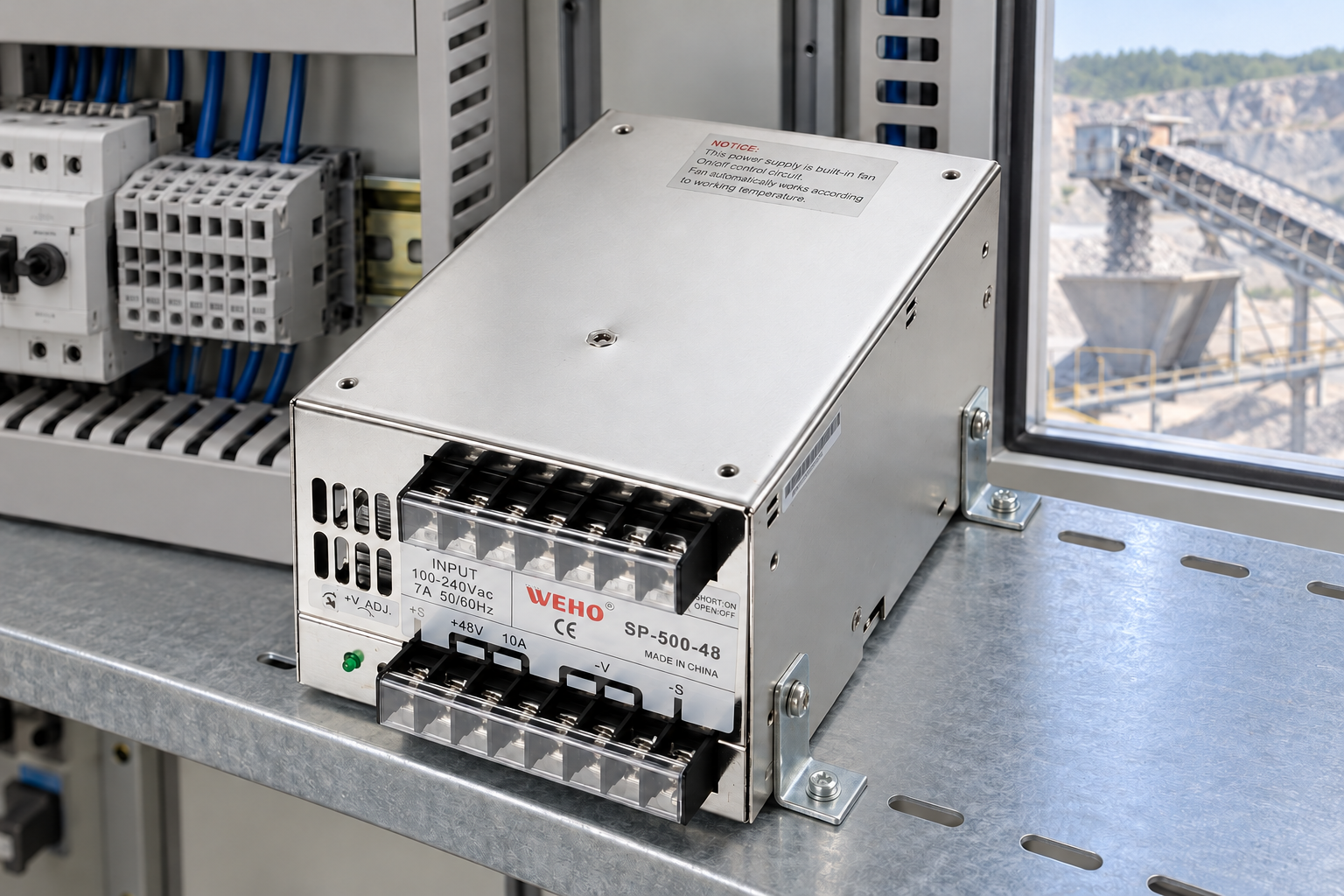
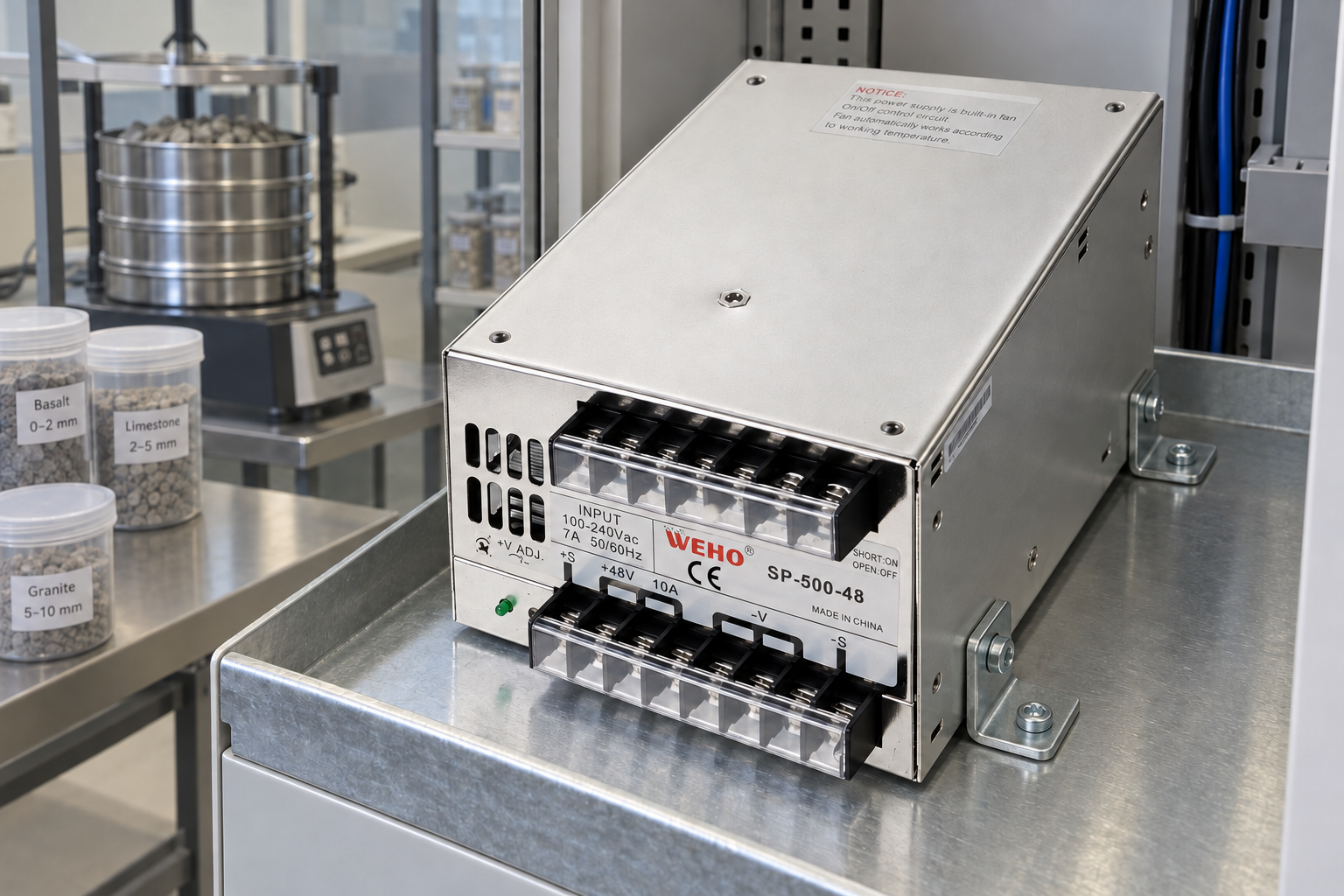
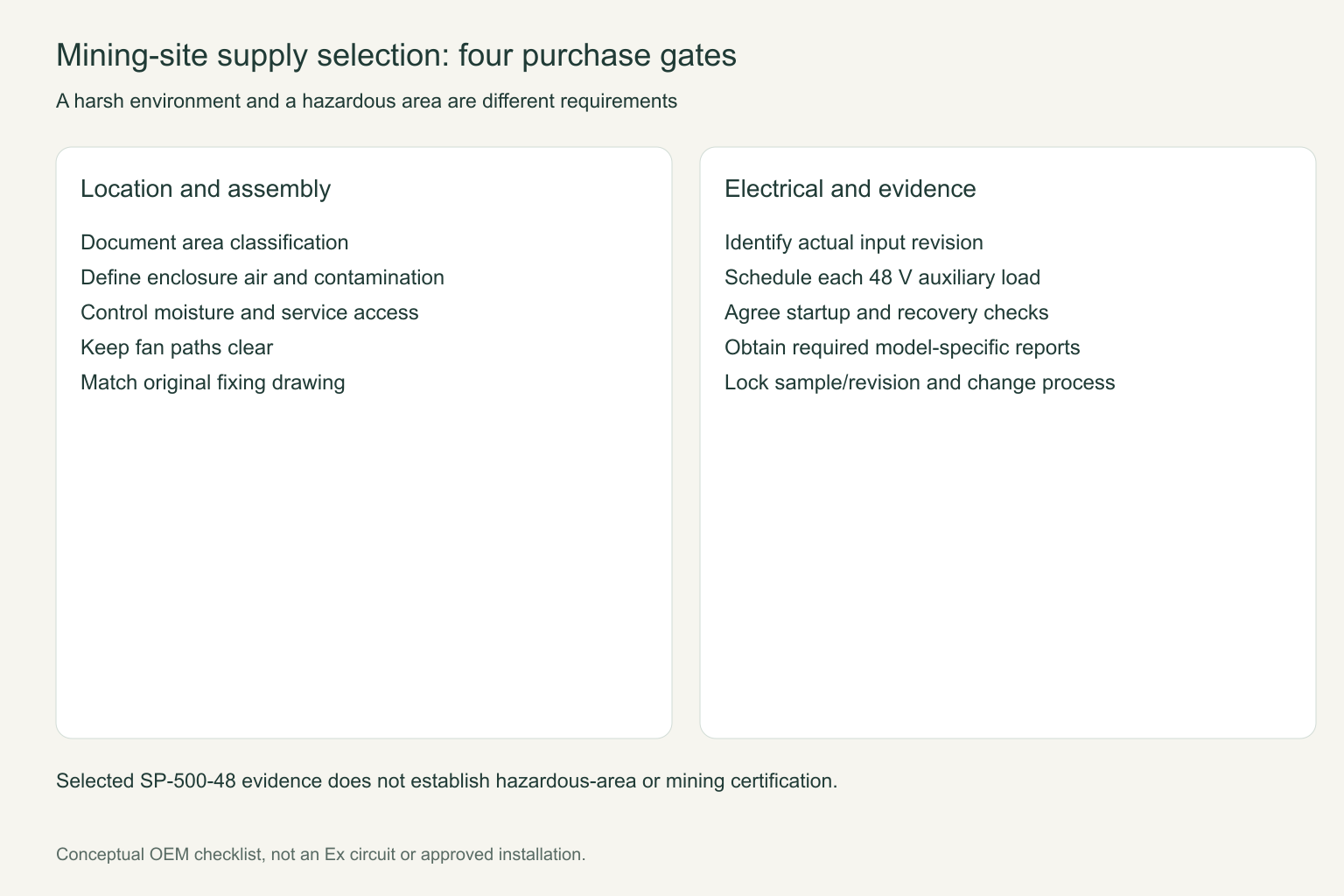
The SP-500-48 is used here as a documented example for a conditional 48 V auxiliary branch inside a protected, non-classified equipment room. Its original label states 48 V and 10 A. The selected evidence does not establish hazardous-area or mining approval for this exact unit. Do not transfer these illustrations to an underground or explosive-atmosphere installation.
Make location classification a purchase input
Ask the site’s responsible engineer to identify the area classification, applicable local rules, required equipment protection and environmental conditions before requesting a supply quotation. A surface control room, a dusty process enclosure and a potentially explosive location cannot be treated as interchangeable merely because they belong to one mine.
The IECEx Certified Equipment Scheme uses independent assessment for equipment intended for explosive atmospheres and distinguishes complete-equipment certificates from component certificates. A buyer should verify a claimed certificate’s exact identity, status, scope and conditions against the offered equipment. The scheme’s official rules listing is a current reference point; it is not a certificate for the SP sample. Agree the jurisdiction and acceptance route with the project authority.
Specify the environment inside the cabinet
For a non-classified installation, define the air temperature at the supply, contamination, moisture, vibration and maintenance regime. Outdoor weather data alone cannot describe a cabinet beside heat-producing equipment. Dust loading and blocked filters can change cooling conditions during service.
The matching SP sheet gives a −10 to +50 °C working-temperature row. The original top label describes temperature-dependent fan operation. Neither supplies a complete cabinet derating curve nor proves tolerance to abrasive dust, condensation or pressure washing. Keep ventilation paths clear and agree how the enclosing equipment will prevent contaminants reaching the supply without creating unacceptable heat rise.
If the project requires an ingress rating, corrosion testing or vibration qualification, request evidence for the relevant component or complete assembly, with its test conditions and acceptance limits. An enclosure rating should not be inferred from a photograph of the internal power supply.
Keep the auxiliary load separate from the main machine
Build a branch schedule for the actual 48 V receivers: control electronics, communication devices, lamps or other documented auxiliary loads. Record steady demand, startup, duty cycle and permitted voltage range. Do not describe this unit as the supply for a crusher motor, conveyor drive or an entire processing line simply because it appears in the same cabinet.
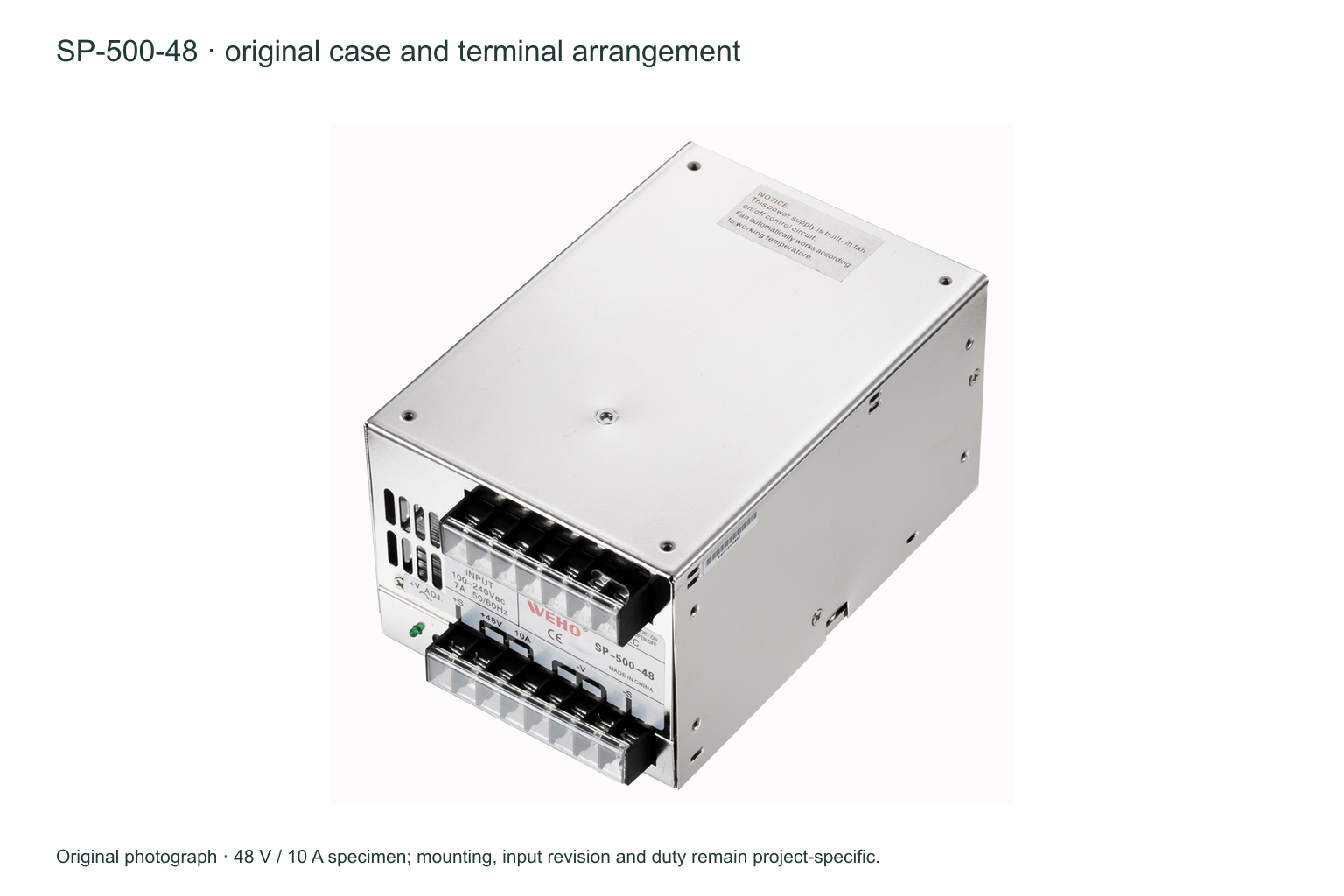
The source label’s 48 V × 10 A corresponds to 480 W nominal arithmetic. The family name SP-500 does not create an extra 20 W of usable capacity. Confirm allowable output under the specified input, temperature and duty with the offered revision, and leave any engineering margin tied to the real load and thermal analysis.
Resolve input and interface revisions before substitution
The photographed unit is marked 100–240 VAC. The selected complete sheet lists 85–264 VAC, while the current SP product page contains switched input-range wording. These records must not be combined into an invented input capability. Obtain the delivered label, current sheet and input instructions before approving a replacement.
The original two terminal rows also include control and remote-sense positions. They are not fifteen interchangeable power outputs. Use the exact terminal map and configuration instructions, including the distinction between +S/−S and the shared positive/negative output groups. A remote-control marking is not evidence of a safety-rated shutdown function.
Design for mounting and maintainable replacement
The matching mechanical evidence gives 185 × 120 × 93 mm and original M3 fixing locations with a 4 mm maximum screw engagement. Confirm the delivered drawing before drilling a production tray. Secure the original fixing points with appropriate hardware; do not add unsupported product feet or treat casing screws as arbitrary mounting points.
Reserve access for terminal guards, ventilation and removal. A recurring-order specification should identify the mounting drawing, connector layout, label revision and permissible supplier changes. A physically similar enclosure is not enough for drop-in replacement if input arrangements, sensing terminals or cooling behaviour differ.
Agree a sample and service evidence package
Define acceptance checks for identity, mechanical fit, startup with the intended loads, output recovery after a permitted interruption and thermal behaviour in the representative enclosure. Add only the environmental and EMC tests that the project actually requires, with a stated method and pass criterion. Record test conditions and the sample revision so later batches can be compared meaningfully.
For an RFQ, provide the installation classification, destination market, actual input envelope, 48 V load schedule, enclosure arrangement, service conditions, required report scope and planned quantities. Ask WEHO for a revision-specific auxiliary-supply proposal and confirm sample arrangements, commercial terms and any project documents in writing. No production quantity or delivery promise follows from the example.
Buyer questions
Does a metal-cased supply qualify for a hazardous mine location?
No. The location and applicable protection requirements must be assessed, and the offered equipment must have the required matching evidence. The selected SP sources do not establish that approval.
Can a sealed outer cabinet solve every environmental issue?
No. It may address particular exposure paths but can also change cooling. Evaluate the complete assembly against the specified environment and duty.
Is SP-500-48 a 500 W supply for any mine load?
The shown unit is marked 48 V, 10 A, or 480 W nominal arithmetic. Actual duty, startup, input and temperature limits must be confirmed for the auxiliary load, not inferred from the family name.