TX4-H Furnace Control: Separate PID Regulation from B2B Soak Acceptance
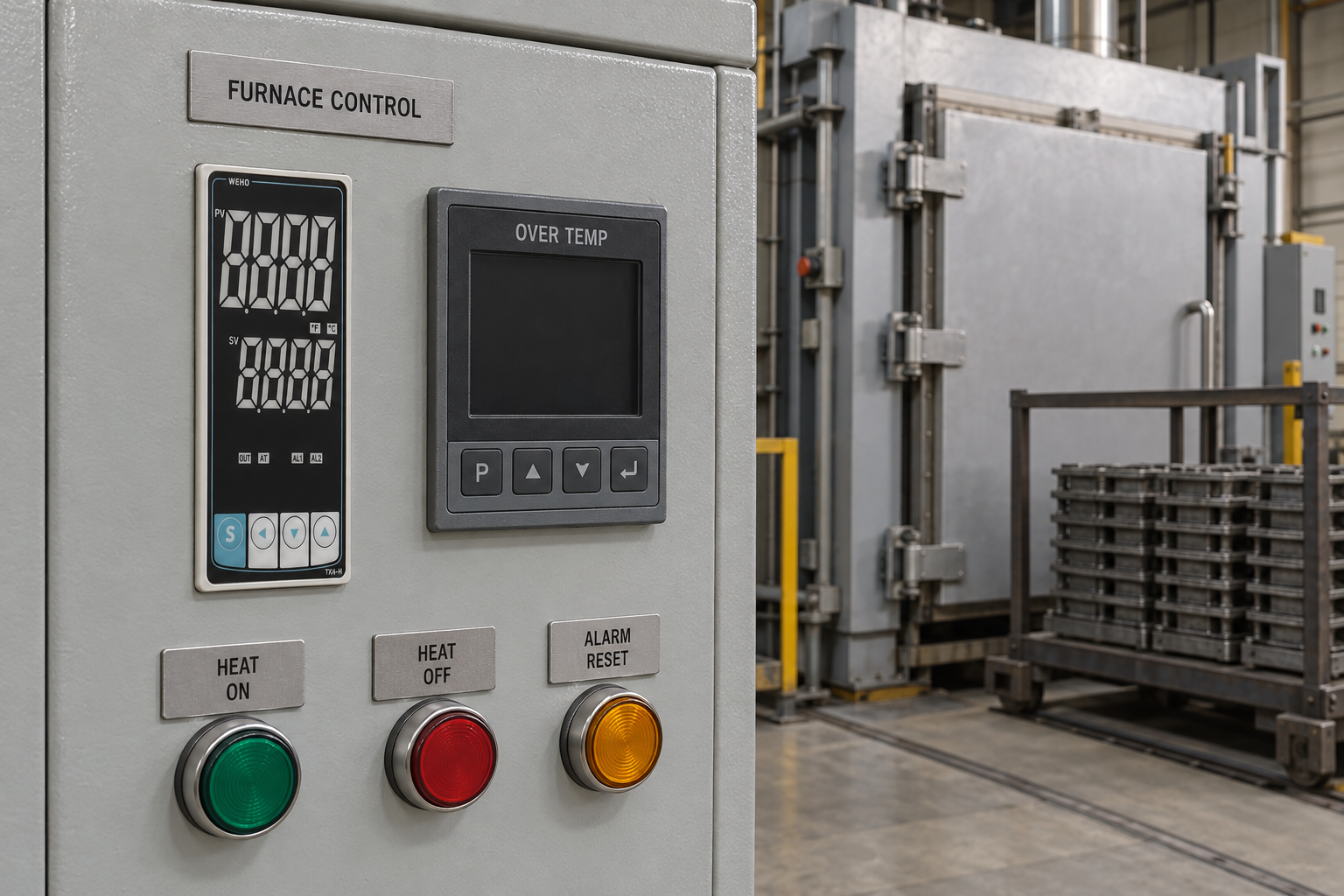
For a heat-treatment furnace project, use the temperature controller to regulate its measured process point, and define furnace/workpiece acceptance separately. A stable set value and a matching process display do not prove that every part has reached the required temperature or completed the required soak.
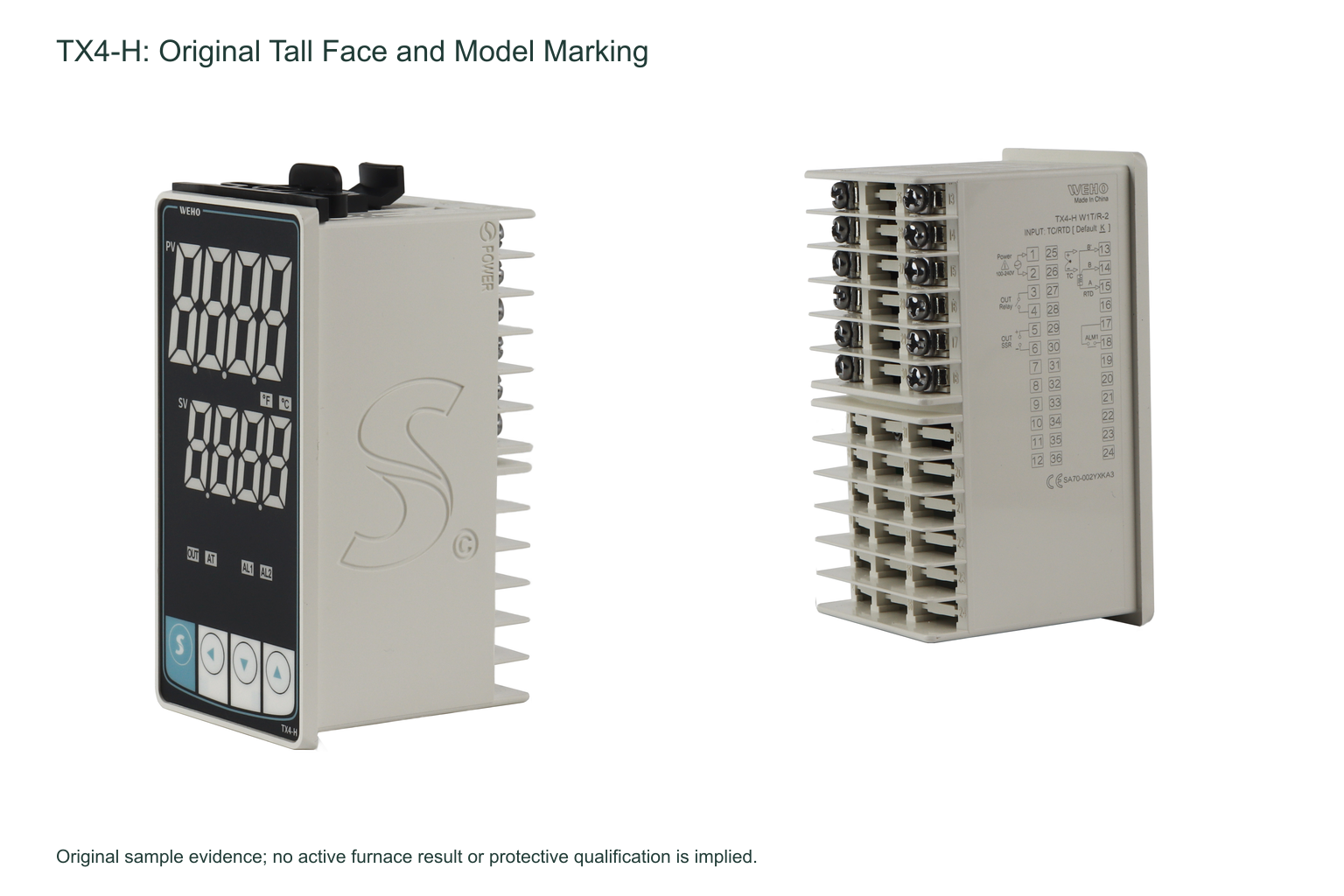
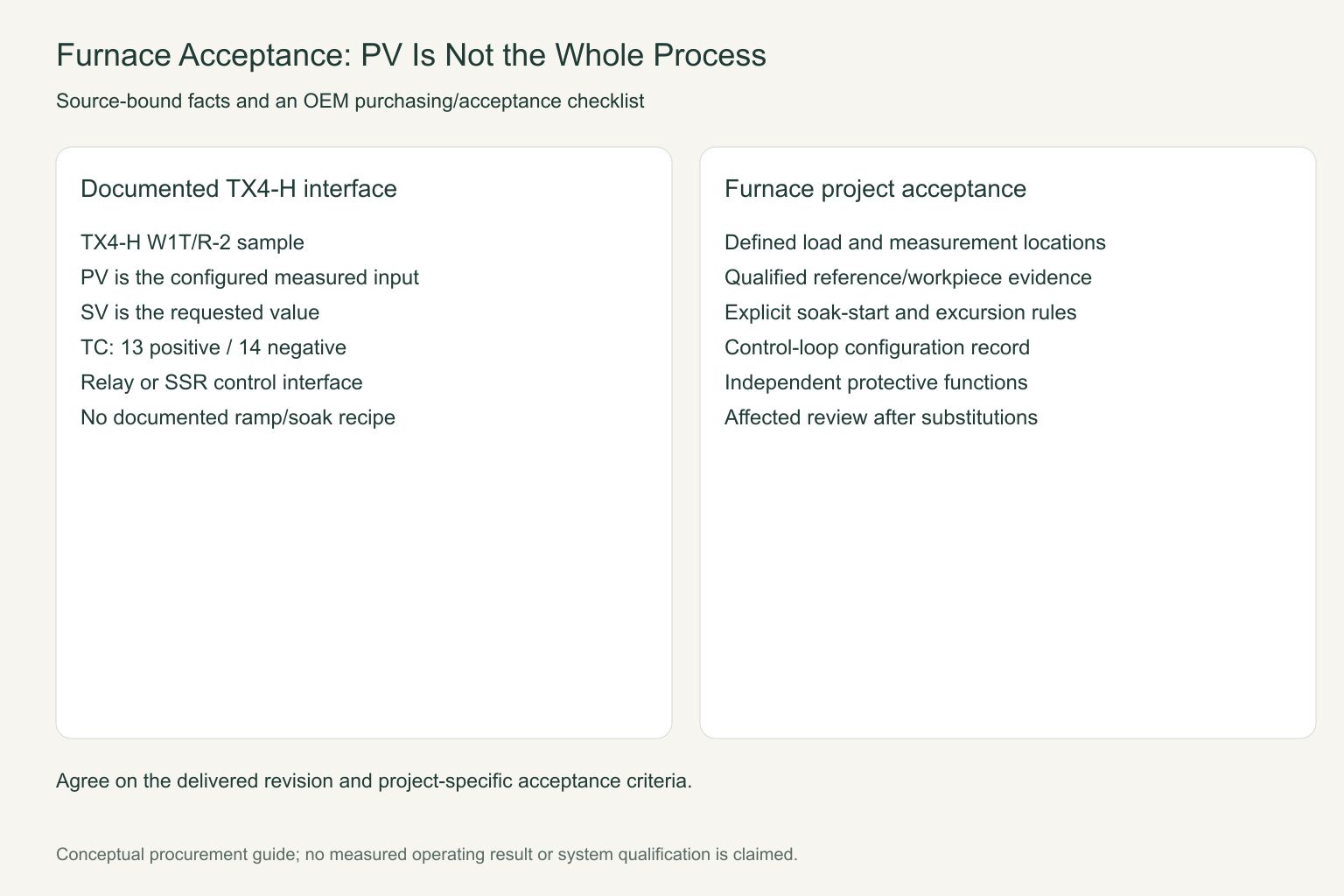
The TX4-H W1T/R-2 sample is a tall panel-mounted controller with the input and output functions described in the matched TX4 manual. That manual does not establish a programmable ramp/soak recipe, workpiece-temperature logging system or independent safety-controller function. Specify those project requirements explicitly instead of assuming them from the term PID.
Start the RFQ with the heat-treatment requirement
Define the process temperature, permissible variation, load type, loading pattern, required atmosphere and the meaning of the hold period. State whether acceptance follows the control sensor, a separate workpiece measurement or an agreed qualified furnace procedure. The controller supplier needs the control-loop requirements; the furnace integrator remains responsible for the completed thermal process and protection design.
For an OEM purchasing several furnaces, document the worst relevant load configuration as well as the empty-chamber behavior. A setup that stabilizes an unloaded chamber may not demonstrate the same workpiece heating delay or spatial distribution with a full batch.
Distinguish three temperatures and a timer
| Quantity | What it establishes | What it does not establish alone |
|---|---|---|
| Set value, SV | The controller’s requested value | The chamber or part has reached it |
| Process value, PV | The configured input’s measured temperature | Every workpiece has the same temperature |
| Qualified workpiece/reference temperature | Evidence at its agreed measurement location | All loads and future loading patterns are identical |
| Soak duration | Elapsed time from an agreed start condition | Automatic compliance if the temperature leaves the allowed band |
Specify the controller and switching interface
The matched H drawing uses thermocouple input at 13 positive/14 negative, or the specified three-wire RTD arrangement at 13/14/15. Confirm the sensor type and configured range against the actual furnace measurement requirement. Probe construction, placement and extension wiring belong in the furnace measurement design.
The controller’s relay rating is 250 VAC, 3 A; its SSR drive is 12 VDC ±2 V at no more than 20 mA. These are interface ratings, not the furnace heater capacity. Specify the external switching device, load circuit, duty and protection independently. The photographed W1 configuration has one evidenced alarm output, not a demonstrated dual-alarm safety system.
Agree on a process-specific commissioning record
Record sensor configuration, control-output selection, set value, tuning parameters, alarm settings, reference measurements and load arrangement. The manual’s PID auto-tuning function characterizes the controlled response; successful tuning does not itself qualify furnace uniformity or a heat-treatment recipe.
The soak-start rule must be explicit. For example, a project may require a qualified reference location to enter and remain within an agreed temperature band before timing begins. This is a specification example, not a capability claimed for the TX4-H or a universal heat-treatment rule. Define what happens to the hold record after a temperature excursion, power interruption or changed load.
Keep protective functions independently defined
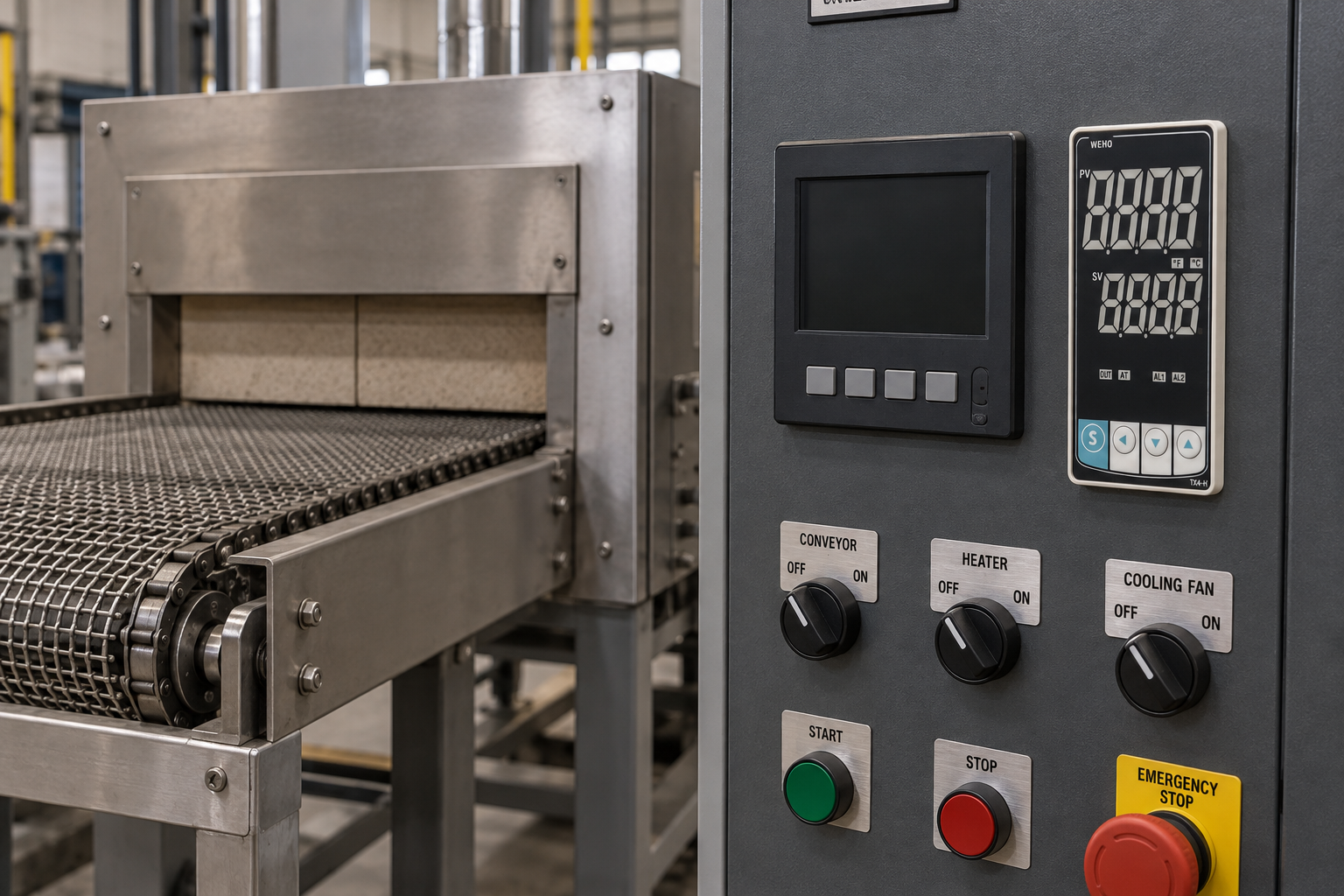
The TX4 manual requires fail-safe protection where failure can cause serious hazards. The furnace design should identify the independent overtemperature protection, isolation and other required interlocks, including their test procedures. Do not use the ordinary PID display or its normal control alarm as proof that the required protective architecture exists.
Controller changes, probe substitutions and changes to the power-switching interface should trigger review of the affected loop and the furnace acceptance record. Preserve the approved configuration through repeat purchases rather than treating a family-compatible front panel as an interchangeable replacement.
Information for a furnace-control quotation
Send the target process range, sensor/extension arrangement, heater-control interface, desired alarm and logging functions, panel space, ambient conditions, load profile, acceptance method and production demand. Compare temperature-controller families in the WEHO product catalogue and request an exact TX4-H configuration review. Ask separately for any required ramp/soak, recorder or protective-system functionality.
Buyer questions
Can soak time start whenever PV equals SV?
Only if that is the project’s justified and approved start condition. Equality at one sensor does not by itself establish workpiece temperature or furnace uniformity.
Does the supplied manual prove a programmable heat-treatment recipe?
No. The documented normal PID functions are not sufficient evidence of a programmable ramp/soak recipe or traceable batch record.