Last Updated: 2026-09-09
power supply efficiency tells you how much input power becomes usable DC output instead of heat. A higher-efficiency supply can reduce enclosure temperature, input current, and wasted energy, but it still must be compared at the real load, input voltage, ambient temperature, mounting position, and duty cycle.
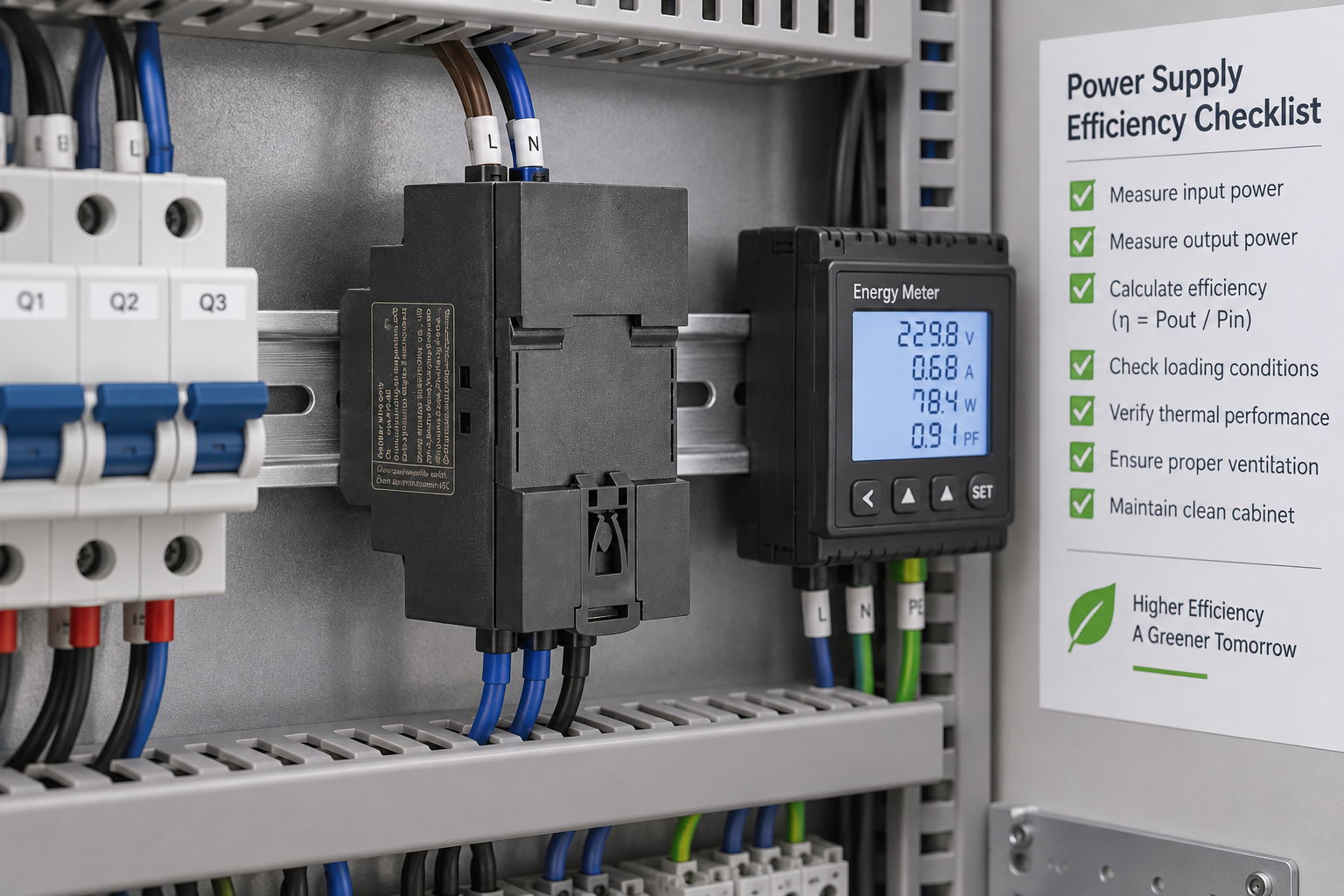
power supply efficiency basics

<strong>Power Supply Verimliliği</strong> Girişten alınan güç ile yüke teslim edilen kullanılabilir DC gücü arasındaki ilişkidir. Bir besleme sensörlere, rölelere veya bir denetleyiciye 48W verir ve AC tarafından 56W çekerse, eksik güç besleme ve çevre muhafazada ısı haline gelir.
This is why efficiency is not just an energy-saving number. In a control cabinet, LED cabinet, access control box, or compact machine panel, heat often becomes the real limit. A small difference in loss can change enclosure temperature, service margin, and how much ventilation is needed.
How to compare efficiency without guessing

Start from output power. Multiply output voltage by output current, then compare it with the expected input power at the same load condition. Efficiency curves are normally highest near a useful middle-to-high load range, not at every point. A 60W supply running a 10W load may behave differently from the same model running 45W continuously.
Also check the input voltage. A model can show different efficiency at 115VAC and 230VAC. For export equipment, site voltage, frequency, and operating range should be part of the comparison before the final model is selected.
Why heat follows power supply efficiency

Daha düşük <strong>Power Supply Verimliliği</strong> Bir DIN ray kabininde, bu kayıp PLC ısısına, röle ısısına, sürücü ısısına ve kablo kanallarından gelen sıcaklık artışına katkıda bulunur. Çıkış yükü doğru olsa bile, zayıf havalandırma raydan çıkmaya zorlayabilir veya pratik hizmet ömrünü kısaltabilir.
For slim DIN rail applications, the WEHO HDR-60 DIN rail power supply is a useful product-family reference when cabinet space is narrow and heat management matters. The real selection should still use the exact voltage, load current, and installation temperature.
Look at real load, not only the label
The label wattage is the maximum output rating under defined conditions. It does not mean every cabinet should run that rating continuously without checking airflow. If the cabinet is sealed, mounted near a heat source, or installed in a hot workshop, plan a margin and review the datasheet derating information.
For example, a 24V system drawing 1.6A needs about 38.4W. Choosing a 60W supply gives room for startup current and future small loads, but the actual thermal result still depends on efficiency, ambient temperature, wire routing, and mounting clearance.
Efficiency and power factor are different checks
Efficiency describes conversion loss. Power factor describes how the AC input current behaves. A supply can be efficient but still require input-current planning when many units share one circuit. For cabinet work, check both when the project has many power modules or sensitive upstream breakers.
Do not compare two models only by one headline value. Compare output rating, real load point, input range, protection, mounting, derating, and service access together. If one model runs cooler at your load, it may be easier to maintain even if its nameplate wattage looks similar.
Practical comparison checklist

Record the output voltage, continuous current, peak current, input voltage, enclosure temperature, mounting orientation, available airflow, and service margin. Then compare the efficiency data at the nearest real load point. If the system is important, test one sample inside the actual enclosure before building the full batch.
SSS
Power Supply Verimliliği Ne Anlama Gelir?
Güç kaynağı verimliliği, kullanılabilir DC çıkış gücü haline gelen giriş gücünün yüzdesidir. Kalan güç esas olarak besleme içindeki ısı olarak kaybolur.
Bir kontrol kabininde verimlilik neden önemlidir?
Verimlilik önemlidir, çünkü düşük verimlilik daha fazla ısı yaratır. Kompakt bir kabinde bu ısı, deating, havalandırma, bileşen aralığı ve uzun vadeli güvenilirliği etkileyebilir.
Her seferinde en yüksek verimlilik kaynağını mı seçmeliyim?
Her zaman değil. Güç kaynağı verimliliğini voltaj, akım, koruma, boyut, montaj tarzı, yük aralığı, ortam sıcaklığı ve kullanılabilirlik ile karşılaştırın.
Is efficiency the same as power factor?
No. Efficiency compares input power with DC output power. Power factor describes how the AC input current behaves. Cabinet planning may need both checks.
How much wattage margin should I leave?
Many applications leave practical margin for startup current, heat, and future small loads, but the correct margin depends on the datasheet, duty cycle, and cabinet temperature.
What details should I send WEHO for efficiency comparison?
Send input voltage, output voltage, continuous current, peak current, cabinet size, ambient temperature, mounting position, quantity, and whether the load runs continuously.
Key Takeaways
- Power supply efficiency compares usable DC output with total input power.
- Lower efficiency becomes extra heat inside the supply and cabinet.
- Compare efficiency at the real load point, not only by headline rating.
- Input voltage, ambient temperature, airflow, and derating can change the result.
- Use the product datasheet and a sample test before scaling a cabinet design.
Çözüm
İyi <strong>Power Supply Verimliliği</strong> Seçim gerçek yük ile başlar ve termal kontrol ile biter. Sadece watt ile seçim yapmayın. Dönüşüm kaybı, kabin ısısı, giriş koşulları, montaj alanı, koruma ve servis marjını karşılaştırın. Model eşleştirme için WEHO ürün sayfasını, e-posta adresini inceleyin. <a href="/tr/”mailto:[email protected]”/">[email protected]</a>, Ya da kullan WEHO contact page with your voltage, current, enclosure, and ambient-temperature details.
Review the relevant WEHO product category, email [email protected], or contact WEHO with the input voltage, output load, ambient temperature, and installation details.